The story continues from Part 2

Canadian National Defense & War Planning
The Canadian federal government and military were fully aware of these “Secret” US plans to invade Canada. In the 1920s, Lieutenant James “Buster” Sutherland Brown had been appointed Director of Military Operations and Intelligence in Ottawa to address the issue of Canada’s national security.
His tasks consisted in developing contingency war plans in the case of a US attack against Canada. Under the helm of Brown (subsequently promoted to Brigadier), Canada’s response to US threats was formulated under , a “Defense Scheme No 1 “counterattack contingency plan, in the case of a US invasion. This land was abandoned in 1931 by Canada’s chief of the general staff (following the adoption of “War Plan Red” in 1930) , on the grounds that “the Americans would inevitably win such a war” and there was no use in acting upon a contingency plan. While American war planners were considering Red-Orange(British-Japanese) scenarios, and the Harding Administration was negotiating away future American naval strength, a Canadian colonel by the name of James Sutherland “Buster” Brown, was writing “Defense Scheme No. 1” for the defense of Canada against the United States. The plan calls for a rapid preemptive offensive against the United States, which was obviously impossible to execute, without the reinforcement of the then nearly non-existent Canadian army by imperial forces. At that time , the renewal of the Anglo-Japanese Alliance had yet to be decided, but Brown wrote that, “there is not much doubt, in case of war between the British empire and the United States, that Japan would take immediate military action against the American Republic, in which case it would make matters much more favorable to us, especially at beginning of the campaign, if we would find that Japan would carry out her traditional policy of delivering their Declaration of War and an Operation at the same time….”
But the Americans don’t give up easily; in late 2013 and early 2014 the entire process was repeating itself with yet another flood of media debate about a US takeover of Canada, with Quebec separatism conveniently again raising its head with such perfect timing. In October of 2013, American-born columnist Diane Francis proposed a final takeover of Canada by the US. According to her, “If Canada is going to be the target of a creeping takeover from a big player, we may as well manage the process”. The ideas originated with the Rockefeller entities – Council on Foreign Relations and the Tri-Lateral Commission. Still, the American ambition is there, and the Rockefeller Empire are unlikely to abandon their dreams anytime soon. And, distressingly, almost no Canadians will take note of the recurring odd coincidence of Quebec separatism fueling the push for a continental merger, and make the mental effort to connect the dots. Canada is a unique case. Both the Rothschild branches have states in Canada. The French branch controls Quebec, and its capital – Ottawa. While the British branch controls the balance of Canada. Today, the US still harbors the same plans to annex Canada, beginning with the creation of US Northern Command military division which President Bush’s Defense Secretary Donald Rumsfeld referred to as a plan of “Binational integration” of military command structures. The Americans intend to set an agenda for this “integration” that would exert enormous influence and control over legal, political, economic and military affairs of Canada. Canada has also been bullied into participating in America’s continental missile-defense program as part of this military integration scheme. The enactment of these plans would amount to a de facto annexation where Canada would cease to function as a sovereign nation and would become a kind of US protectorate. So far as Washington is concerned, this plan for “Securing the North American Security Perimeter” is their way of “bringing Canada into Fortress America”, a fortress from which Canada will never escape.
The US, particularly the entire Western portion, has been so profligate with its water supplies that much of the nation will likely soon become an arid desert, unable to support any kind of agriculture, primarily California which produces much of the nation’s food products. The US already has its eyes on Canada’s ample supplies of fresh water and has already bullied Canada into the creation of a canal to divert much of Canada’s water to the US South-West. It needs to be pointed out here that from political and “defense” machinations or from a greed for Canada’s natural resources, it is very likely that the US will one day invade Canada. The writing has been on the wall for 300 years and Canadians would have to be blind to not see it. Given this, one needn’t much of an imagination to see the CIA deeply involved in the Quebec separatist movement, since it was the US that had by far the most to gain from such an event. An independent Quebec would have been rather useless as a political entity and would most likely have been forced to rejoin at some point, either the new US-Canada federation or become part of the French Republic. A great many people, including many academics, were convinced the CIA had conducted these operations in a deliberate attempt to split Canada for the eventual purpose of what would have been a forced takeover of the country.
Today, most observers agree that the CIA was responsible for the activities of separatist groups in Quebec in the 1960s, as well as having been the source of the persistent Canada-US merger proposals. .
Canada’s vaunted RCMP were little more than messenger boys for the CIA who entered the country, committed terrorist acts including murder, then quietly slipped out again . And this wasn’t the only time the CIA was active in terrorism in Canada; there were many others, some intended to encourage the separation of Quebec and the breakup of Canada. Even more, the Americans had always nourished a dream of integrating Canada into the US, by military means if necessary, and at the last cabinet meeting prior to Kennedy’s assassination, one topic was precisely this integration, which was one reason the US was so desperate to absolutely crush any sign of what it termed “Canadian nationalism”. The objective was essentially to destroy Canadians’ identification with their own nation, then swallow them. But most Canadians are totally unaware that under the clauses of US Northern Command as the right to invade both Canada and Mexico. The map below reveals the territory of USNORTHCOM, which allows the US military to deploy from the Mexico and part of Caribbean up to the North West territories and the Canadian Arctic. The map indicates why the Trump government is intent upon acquiring Greenland.
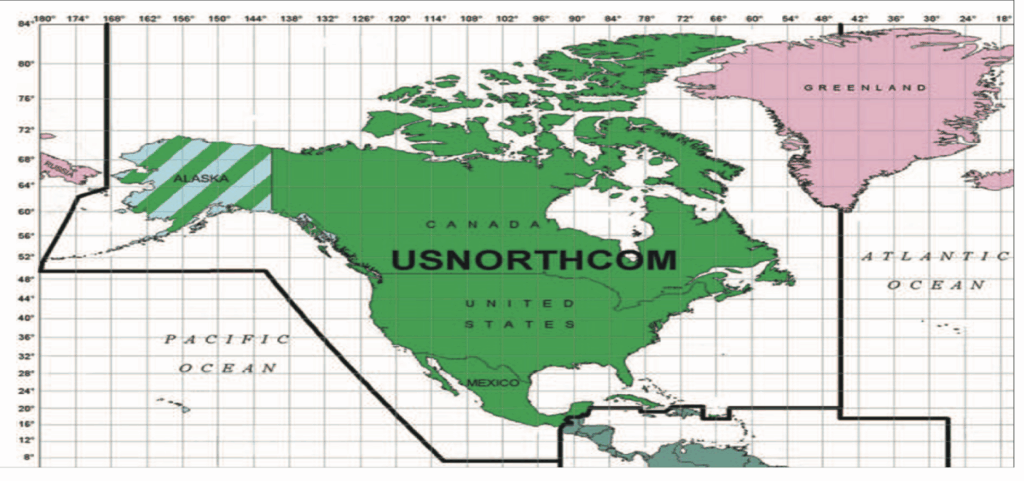
Canada is contiguous to “the center of the empire”. Territorial control over Canada is part of the US geopolitical and military agenda. It is worth recalling in this regard, that throughout history, the “conquering nation” has expanded on its immediate borders, acquiring control over contiguous territories. Military integration is intimately related to the ongoing process of integration in the spheres of trade, finance and investment. Needless to say, a large part of the Canadian economy is already in the hands of US corporate interests. In turn, the interests of big business in Canada tend to coincide with those of the US. Canada is already a de facto economic protectorate of the USA. The US-Canada FTA and NAFTA have not only opened up new avenues for US corporate expansion, it has laid the groundwork under the existing North American umbrella for the post 9/11 integration of military command structures, public security, intelligence and law enforcement. No doubt, Canada’s entry into US Northern Command will be presented to public opinion as part of Canada-US “cooperation”, as something which is “in the national interest”, which “will create jobs for Canadians”, and “will make Canada more secure”.
By 2017, when Klaus Schwab, head of the World Economic Forum’s globalist ambitions, openly boasted about how he had influenced the Canadian government, Trudeau and half his cabinet had become followers of the WEF’s Young Global Leaders program.
For years, Trudeau’s reign had been the perfect model for the governance the WEF advocates: open borders, relentless carbon taxation, unwavering alignment with NATO’s proxy wars, and deference to corporate oligarchs at the expense of ordinary Canadians. The result is a fragmented country, a gutted energy sector, skyrocketing home prices, and the nation’s sovereignty systematically eroded by policies dictated by the boardrooms in Davos, not Ottawa. A borderless, debt-ridden, obedient nation: that was Canada. Justin Trudeau made Canada a disgrace worldwide on an ethical and legal level, especially for his Ukro-nazi sympathies, for his Zionism, for his too many concessions to pedophilia, for having killed freedom of speech, for having imposed a ferocious discrimination against the unvaccinated, going as far as to block the bank accounts of truck drivers who protested against the measures adopted during the pandemic. And other filth of the sort, such as for example the 15-minute concentration camp cities.
On January 7th, Trudeau announced his resignation, effective upon the choosing of a new leader: It is another of the big dominoes to fall as the long-awaited collapse of the Western order finally accelerates.
Now Trump wants Canada to become the 51st state, to give life to a North American Union. But is it convenient for Canada to merge with a state that is up to its neck in debt? Perhaps it is not a matter of free choice and calculation of convenience but the acknowledgement of a strategic balance of power.
After all, it is the acknowledgement of the very late of the end of the British Empire after the Indian Independence Act 1947, that of Rhodesia in 1965 and that of Hong Kong in 1997. Then King Charles was shocked at the level of hostility against him and the British at a recent reception in Australia. This raises the possibility that the attachment of Britain’s colonies to the “Dominions and Motherland “has largely evaporated, and soon Britain will be the “uninvited guest” in many parts of the world.
Asked about his idea that Canada should be a U.S. state, Trump said: “You get rid of that artificially drawn line, and you take a look at what that looks like, and it would also be much better for national security. Don’t forget, we basically protect Canada. They’re great, but we’re spending hundreds of billions a year to protect it. We’re spending hundreds of billions a year to take care of Canada. We lose in trade deficits. What is certain is that if they take Canada, Greenland, Panama, after having taken Sweden and Finland, the USA will regain world power. The entire EU and the UK, not to mention Mexico, the Philippines, the southern continent, are clearly subjects of the star-spangled empire.After all after what Israel did to Gaza, Lebanon, the Golan and Syria make everything in the World possible and plausible in International Politics.
3 The 3 Puppets Beg Trump
From 1860 till now, a total of 165 years have passed. Then, we had a civil war in America, brought up by the Rothschild’s. The family used French troops to attack from the south, and British troops to attack from the north. The Rothschild’s lost, due to Russian intervention on the side of Lincoln and the north.
Today, the US is withdrawing from the Ukraine conflict. And, who does the Rothschild family send to Washington to beg the US to stay on? Yes, the French were sent first, followed by the British, and finally by Zelensky. All were turned down. How ironic. Then, Russia saved the US from a defeat imposed by the Rothschild’s. Today, the Rothschild’s are begging the US to help them defeat Russia. Even worse from the Rothschild view, is that the US and Russia are teaming up to take on the Rothschild control over, Africa and the Middle East. More on this in our next article.
4 Greenland
Greenland, the world’s largest island, was granted home rule by Denmark in 1979. Its territory is rich in oil and minerals. Greenland is also home to the US Pituffik military base and NATO infrastructure.
In 2009, Greenland was granted the right to declare independence through a referendum. The island’s pro-independence Prime Minister, Egede, has also rejected Trump’s acquisition proposal. “We fully recognize that Greenland has its own ambitions. If they materialize, Greenland will become independent, though hardly with an ambition to become a federal state in the United States,” Danish Foreign Minister Rasmussen said. Danish officials have rejected the possibility of selling the island. “Greenland is not for sale and will not be in the future either,” Prime Minister Frederickson said on Tuesday.
US annexation of Greenland would pose ‘military threat to Russia, and could provide a springboard for a future war. Trump has insisted that “ownership and control of Greenland is an absolute necessity” for American national security. The Distant Early Warning Line runs north of the Arctic Circle from Alaska in the west to Baffin Island in the east, then continues across Greenland. It was built by the United States, with the cooperation of Canada, at the height of the Cold War in the 1950s as a defense against the Soviet Union. The Trump administration has made it clear that it finds Canada’s defense to be unacceptable. The complaint is legitimate. The fact is that the world is very different from what it looked like in the 1950s and 60s. At that time, the Soviet Union was the major threat to the West, while communist China was desperately poor and weak. China looked then more like North Korea than the economic and military behemoth it has become today. Now, both China, and Russia are formidable foes. They are also very interested in the north. The fact that shipping on a large scale through the Northwest Passage might be a possibility in the not-so-distant future is one of the reasons why. The passage can cut shipping distances drastically, so huge amounts of money and fuel can be saved. Future passage from Asia to Europe via the Northeast Passage (also called the Northern Sea Route) would be incredibly valuable—strategically, militarily and commercially—for both Russia and China. Russia is far ahead of Canada on northern strategy and development. It has at least 40 ships capable of breaking through ice, including eight nuclear-powered icebreakers. Canada has no icebreakers that are nuclear powered. The Americans are acutely aware of Russia’s northern superiority. Northern security goes some way to explaining Donald Trump’s very public offer to buy Greenland. Whether he is serious about buying it, or just wants better access guarantees, is something known only to Trump and his closest advisers.
The prospect of Greenland falling under the control of its adversaries (and possible future enemies) must alarm the Pentagon. Is such a prospect remote? Consider the fact that there are only 56,000 Greenlanders. After all, Denmark has assured the Greenlanders that they can become independent with a simple vote. Trump aims to prevent China or Russia (separately or as a combined force) from gaining control of Greenland. But a glance at the map shows how close Greenland is to Canada. Trump probably has many of the same concerns about the vast, largely undefended Canadian Arctic that he has about Greenland.
We have seen how important the issue of Chinese control of the Panama Canal is to the Americans. The possibility of China/Russia control of the Northwest Passage could well be equally important to them.
5 The Panama Canal
The Panama Canal was completed in 1914, an engineering marvel of locks that raise ships 85 feet above sea level as they sail from the Caribbean Sea to the Pacific Ocean. But from the start, there was dissatisfaction within Panama and across Latin America with the U.S. government controlling such an economically valuable resource. The idea of digging a shortcut across the Isthmus of Panama was first proposed in the 16th century, and the route became a well-worn path for river and overland shipments long before the Americans built their canal. According to the 1903 treaty that created the 51-mile-long, 10-mile-wide Canal Zone, the United States retained “all the rights, power and authority within the zone” for perpetuity. The United States didn’t “own” the Canal Zone, but it had the authority to govern, operate and protect the zone as if it were “sovereign” territory within Panama. To create the Canal Zone, the United States removed an estimated 62,000 Panamanians living in more than 40 towns and villages in the region. After the canal was built, the Canal Zone became a government-run “company town” with housing, schools and businesses exclusively for American citizens. The Canal Zone was racially segregated until 1954, with Black and white workers given separate “gold” and “silver” jobs. Their families attended segregated schools and used separate bathrooms and recreation facilities.
“The Canal Zone was not a normal place,” says Maurer. “It was essentially run like a giant military base, but also like a socialist enterprise. Everything was operated by the U.S. government, even franchises like McDonald’s.” “The basic conflict was that Panama was really angry that first we built a canal and we created the Canal Zone, but then we did everything we could to ensure that Panama got absolutely no economic benefit from the canal whatsoever,” says Maurer. But the unifying symbol of all of Panama’s dissatisfaction with American control of the canal became the flag—specifically the exclusive display of the American flag in the Canal Zone.
In 1959, there were anti-American riots in Panama City over America’s refusal to fly the Panamanian flag in the Canal Zone. On January 9, 1964, a contingent of Panamanian students marched to the border of the Canal Zone carrying a Panamanian flag. They demanded that Balboa High School raise it alongside the American flag, but the Zonians trampled and tore the flag instead. A skirmish ensued, but no one was seriously hurt. Hours later, news spread about the flag incident and the real trouble began. Panamanians threw rocks at the American Embassy. American office buildings and stores were looted and burned. The U.S. military was dispatched to quell the riot. During three days of clashes, 22 Panamanians were killed and hundreds more were injured. Roberto Chiari, Panama’s president, responded by severing diplomatic ties with the United States, the first and only time a Latin American country has taken that measure.
After World War II, it was clear that the economic benefits of the canal were drying up, at least for the United States. For Americans, the Panama Canal paid its biggest economic dividends in the 1920s and 1930s, when it was used to transport oil and lumber from the West Coast to refineries and factories on the East Coast. But by the 1940s, railroads had switched to diesel engines, and it was cheaper and faster to transport by rail than by sea. The political situation changed after the 1964 riots. When Jimmy Carter took office in 1977, negotiations with Panama had been ongoing for nearly a decade. But with Republican opposition softening, Carter and his advisors saw a path to a treaty. By this point, there was little to gain from the United States holding onto the canal, either politically or economically, says Maurer. The Soviets cited U.S. control of the canal as an example of American “imperialism.” Also, the country benefiting the most from the canal in the 1970s was Japan, which used it to ship inexpensive cars and electronics that undercut U.S. companies. In 1977, Carter signed two treaties with Panama that created a framework for handing over the canal. First, the Neutrality Treaty gave the U.S. military the right to defend the Panama Canal if there is ever a threat to its “neutrality.” Second, the Panama Canal Treaty stated that the Canal Zone would officially be dissolved on October 1, 1979, and that the canal itself would be turned over to Panama on December 31, 1999.
“It was an enormous time of celebration in Panama,” says Lasso. “Not only the signing, which was very important, but also in 1979 when Panamanians could finally enter the Canal Zone freely. It was also a big moment for all of Latin America because it was seen as the end of the last colony in Latin America.”
From 1979 to 1999, both American and Panamanian flags flew at all civilian and military outposts while the two countries worked together to assure a smooth transition. “When the administration of the canal switched from American to Panamanian, it wasn’t a sudden change,” says Lasso. “It was designed to be a very slow, careful process. That ensured that the Panama Canal would continue to function without any problems like it has for the past 25 years.” Now, fast-forward to the present day – – –
The idea behind the US takeover of the Panama Canal is to deny its use to China, when a naval blockade is placed on China, sometime in the future. The second reason is Fortress America. New York does not prefer any outside power to be present in Central and Latin America. The removal of sanctions on Cuba is part of that change. China leverages commercial port operations throughout the Western Hemisphere, including the Panama Canal, to project power, enable surveillance, facilitate trafficking, and pre-position for conflict. Trump wrote on X: “The United States has a vested interest in the secure, efficient, and reliable operation of the Panama Canal, and that was always understood. We would and will NEVER let it fall into the wrong hands! It was not given for the benefit of others, but merely as a token of cooperation with us and Panama. If the principles, both moral and legal, of this magnanimous gesture of giving are not followed, then we will demand that the Panama Canal be returned to us, in full, and without question. To the Officials of Panama, please be guided accordingly! The Panama Canal is considered a VITAL National Asset for the United States, due to its critical role to America’s Economy and National Security. A secure Panama Canal is crucial for U.S. Commerce, and rapid deployment of the Navy, from the Atlantic to the Pacific, and drastically cuts shipping times to U.S. ports. The United States is the Number One user of the Canal, with over 70 percent of all transits heading to, or from, U.S. ports. Considered one of the Wonders of the Modern World, the Panama Canal opened for business 110 years ago, and was built at HUGE cost to the United States in lives and treasure – 38,000 American men died from infected mosquitos in the jungles during construction. Teddy Roosevelt was President of the United States at the time of its building, and understood the strength of Naval Power and Trade. When President Jimmy Carter foolishly gave it away, for One Dollar, during his term in Office, it was solely for Panama to manage, not China, or anyone else. It was likewise not given for Panama to charge the United States, its Navy, and corporations, doing business within our Country, exorbitant prices and rates of passage. Our Navy and Commerce have been treated in a very unfair and injudicious way. The fees being charged by Panama are ridiculous, especially knowing the extraordinary generosity that has been bestowed to Panama by the U.S. This complete “rip-off” of our Country will immediately stop….
Look, the Panama Canal is vital to our country. It’s being operated by China, and we gave the Panama Canal to Panama. We didn’t give it to China, and they’ve abused it. They’ve abused that gift. It should have never been made.”
The name Blackrock derives from Rock for Rockefeller. The Black comes from the Black Eagle Trust- designed by Rockefeller Prime Minister John J McCloy at the end of World War 2. After defeating Germany, the US intelligence service – known as the OSS (formed from intelligence units embedded within many companies in the Empire – such as oil companies, banks, etc. The OSS was the brainchild of Nelson Rockefeller. It became the CIA after the war) found a lot of gold that Germany herself looted from European nations. Figures range from 25,000 to 100,000 plus tons. John and Nelson decided that this gold will be “off-the-books”, and would be housed in various banks across the world. The entity that would be in charge of this was called the Black Eagle Trust. The family made John J McCloy the US Pro-Consul of Germany at war’s end, with the principal aim of managing this recently put together enterprise. Later, the family was so impressed with his service that David made him the Prime Minister of the Empire. Now, we know how the name Blackrock came about. Blackrock is an investment fund that is one of several that are in the Rockefeller (New York) orbit. We now know that the Family “selected” Trump for his second term as POTUS. Going forward, any foreign and domestic policy decision/change, etc. will be in line with what the family wants. The best example of this is the Rockefeller takeover of the Canal, through its Blackrock firm. And, it was done very quietly. Blackrock Inc. has secured control over key ports near the Panama Canal, stripping away Chinese-linked influence over one of the world’s most crucial shipping routes. The $23 billion deal, which includes $5 billion in debt, will effectively place the strategic ports under American control—a move long advocated by Trump and national security hawks (working for the Rockefeller Empire) concerned about China’s grip on global infrastructure. The transaction, announced on the 4th of March, involves Hong Kong-based CK Hutchison Holdings selling its controlling stake in Hutchison Port Holdings and Hutchison Port Group Holdings to a U.S.-led consortium spearheaded by Blackrock. This historic acquisition grants control over 43 ports in 23 countries, including major sites in Mexico, the Netherlands, Egypt, Australia, Pakistan, and Panama’s critical ports of Balboa and Cristobal—the two primary gateways to the Panama Canal. The $22.8 billion deal with CK Hutchison’s subsidiary Hutchison Port Holdings, which will see the firm acquire the Panama ports of Cristobal and Balboa, which are located at the Atlantic and Pacific ends of the canal, respectively. It will also acquire Hutchison’s controlling interest in 43 ports in 23 other countries. The world’s largest asset manager will partner with Terminal Investment Limited (TiL) to operate the ports in concert with the Blackrock subsidiary Global Infrastructure Partners (GIP). China is getting kicked out of Panama and America is winning. Our next article is titled “The 5 Major Power Centers of the World”.