

The American Republic vs. the British /Rothschild Empire
Certain of the post-World War I planning documents and lectures betray an American officer corps that was disillusioned by its experience with the British in France. These officers understood the real, unbridgeable differences between the American Republic and the British Empire, even when they had to fight alongside the troops of that Empire. They understood that the goals and methods of the British Empire were incompatible with those of the U.S.A. It is from this standpoint that the significance of the between-the-wars war-planning must be understood. American participation in the war in France, 1917-18, crystalized the view among U.S. Army officers, in particular, that the alliance with Britain (and France) was an unnatural one, that could quickly dissolve into confrontation, because of the way it changed the relative relationship between the U.S. and Britain.
The Anglo-American Alliance in World War I
While planning documents in preparation for a possible war with Great Britain can be found in the Navy’s archives, dating back to 1890, and the U.S. Army War College conducted a number of exercises in 1913-1914 for the same eventuality. That alliance was fraught with difficulties, because of the differing war aims of the two sides. Britain, as was shown after the Sykes-Picot Treaty came to light at the end of the war, was seeking to expand its already considerable empire, and the U.S. was looking to end the war as decisively as possible, in the shortest time possible, so that it would have leverage in the peace that was to follow. Many American officers understood that British and French imperial aims in the war were at odds with American national interests.
American Expeditionary Force Commander Gen. John J. Pershing had to fight off British and French efforts to feed American soldiers into combat as piecemeal replacements for losses in British and French divisions, even as the British, in particular, were conducting operations in secondary theaters, such as Palestine and Mesopotamia, Pershing and Gen. Bliss had to fight for the American army to fight as a national army with its own section of the frontlines, so that the American commitment to end the war decisively could be carried through. Pershing saw the Western Front as the decisive front and he therefore resisted efforts to siphon off American troops to other theaters, such as Italy, Palestine and Iraq. General Bliss noted these difficulties in a May 22, 1929 lecture at the Army War College. Bliss, reported that, of the three principal allies, two of them, Britain and France, went into the war “with the primary purpose of securing, each for itself, certain widely separated territories; the third [the United States] with the initial purpose of warding off future danger by preventing the enemy from securing territory that would make her a constant menace. . . .” Each of the three allies could have had three different military plans, “each handicapped by a political plan.”
Such an alliance was “likely to be an unnatural union,” Bliss concluded. “They may even be the direct cause of such a war. It is evident that no nation, which bases its prosperity on trade, can exist with an adverse trade balance of four billions annually, a figure which the British estimate will increase in the near future, rather than decrease. The United States is the direct cause of this adverse trade balance. If it develops that we can successfully compete with England on the seas, this adverse balance will be maintained. A nation doomed to commercial defeat will usually demand a military decision before this commercial defeat is complete. Therefore, there is always the possibility that the British, however friendly they may wish to be, may be forced into a war to maintain their commercial supremacy of the seas, which is essential to the existence of the British Empire.”
In Washington, sentiment supported that the U.S. Army and Navy ought to be prepared to defend the United States in such an eventuality, and not depend on allies in doing so. In the opening phases, Britain would launch a land campaign from Canada, and attack the U.S. Atlantic seaboard, the Panama Canal Zone, and U.S. possessions in the Caribbean. The U.S. plan of attack should be to take control of the entrance to the St. Lawrence Seaway, capture British possessions in the Western Atlantic and the Caribbean, and with that accomplished, attack British commerce throughout the world, and invade and capture Canada.
We need to explain a few points here on the Middle East, to clarify the main story- – –
Britain and France were on the verge of losing the war. They had purchased war materials from the US, paying for it via loans issued by a Rothschild firm on Wall Street – JP Morgan. The amount was more than $2 billion. London used this “potential financial loss” to induce America to enter the war, which it did by April 2017.
While US troops were pouring into the war fronts in France, the British moved 1 million troops to the Eastern Mediterranean. This upset the Americans to no end. The British troops were replaced by American troops in the killing fields. The Americans never forgot nor forgave the British for this. The 1 million British troops were for 2 reasons. The first reason was to capture Jerusalem. Just around this time, London issued the Balfour Declaration in November 1917. The Ottomans were on the retreat in the Middle East. British General Allenby entered Jerusalem on December 11, 1917. Only days earlier, the city was still under the administration of the Ottoman Empire, a 400-year long occupation. Accompanying Allenby during this time, acting as an “advisor”, was none other than Jimmy Rothschild of the French house! Nothing strange, as at the oddest of moments in geopolitical history, we find a Rothschild on the scene at the most opportune time. The Battle of Jerusalem occurred during the “Jerusalem Operations” when fighting for the city developed from 17 November, continuing after the surrender until 30 December 1917
The second reason had to do with oil. By the end of 1800’s the importance of petroleum had become apparent. It was the driving force behind industrialization. Besides, the military – strategic implications of petroleum for future control of the world seas was understood. Thereupon, western states and the companies turned their faces to the Middle East which for long was known to include rich oil reservoirs. First a group of leading German industrialists and bankers around Deutsche Bank stepped in the region. With the Berlin – Baghdad railway project, Germans had secured subsurface mineral rights, including oil along the path of the railway. Deutsche Bank became a shareholder of the TPC, with a 24.5 % stake. With the inclusion of other powers a fierce competition ensued between the old rivals Standard Oil and British Petroleum.
With the defeat and dismemberment of the Ottoman Empire, the German stake in TPC was taken over by the British, as “war booty”. Partitioning of the Middle Eastern oil, which could not be set apart from the partition of Ottoman lands, took place within and around the Turkish Petroleum Company (TPC) in the following years. The history of the TPC begins in 1914, and ends in 1929. When London assumed control of the TPC, London changed its name to the Iraqi Petroleum Company, or the IPC, with BP as its biggest shareholder, along with the other, newly-formed French Rothschild company, Total. But the bitter rivalry and struggle over the partitioning of Middle Eastern oil using TPC as an instrument made its peak between the years of 1918 and 1925. The US was upset at the Turks since the US had not declared war on the Ottomans. In the end, the Rockefellers lost out to the British.
Oil was first discovered by the British in Iran in 1908. Looking around the region, they then found oil in Kirkuk, Iraq. In July 1927 oil was discovered near Kirkuk making it the first commercial oil find in Iraq. British Petroleum (BP) started drilling the first oil well at Baba Gurgur north of Kirkuk. BP was shareholder in the ‘Iraqi Petroleum Company‘. The Kirkuk oil fields have reserves of around 12 billion. American oil companies never stood a chance regarding Kirkuk’s oil. The Rockefellers have not forgotten this. In 2023, Iraq produced over 30 million cubic meters and 4 million bpd of crude oil and NGLs. The country’s proved reserves stood at 3,714 bcm for gas and 150 billion barrels for oil in 2023. It was these 2 key issues that made the Americans realize that the British could never be trusted. Strangely enough, BP has just recently struck a deal to work these oil fields. BP has reached an agreement with the Iraqi Government to invest in the rehabilitation and redevelopment of several large-scale oil fields in Kirkuk, northern Iraq. The agreement encompasses oil, gas, and power and water development, with potential for future exploration investment. The deal covers four main fields in Iraq all currently operated by Iraq’s North Oil Company (NOC). The agreement follows a Memorandum of Understanding signed in July 2024, with technical terms agreed in December 2024 and commercial terms finalized in January 2025. It also builds upon BP’s previous work on the Kirkuk fields from 2013 to 2019.
– – now, back to the main story
Washington Naval Treaty
The Washington Naval Treaty of 1921, rather than being a disarmament treaty that reduced the danger of war, actually helped propel the U.S. towards war with Japan. American strategic thinkers such as Arthur MacArthur viewed acquisition of the Philippines as a bulwark against the European colonial empires in Asia, on America’s extreme western flank. That flank came under threat when the Treaty of Versailles awarded the island chains of the Marshalls, Marianas, and Carolines, which had been acquired by Germany late in the 19th Century, as mandates to Japan, a British ally since 1860. Those island chains lay directly across the U.S. lines of communication from Hawaii to the Philippines and Guam. From the American standpoint, the Washington Treaty did two things: It cancelled the revived 1916 naval construction program, which would have brought the U.S. fleet close to parity with the Royal Navy, but with more modern ships, and it denied the U.S. the right to build fortified bases in the Philippines and Guam. The treaty left the U.S. weaker in capital ships and cruisers than “the next strongest power,”- “it also “took from us every possibility of an outlying base in the Pacific except one [Hawaii]. We gave up our new capital ships and our right to build bases for a better international feeling, but no one gave us anything.” The treaty also caused a full-scale shift in naval war planning. Whereas war planning prior to 1921 was focused on and Red-Orange (British-Japanese) scenarios, after 1921, war planning naval war planning shifted almost entirely to Japan. A military-intelligence specialist- Schofield – became the director of the Plans Division in the Office of Naval Operations in 1927. Schofield had concluded that the Anglo-American impasse at the Geneva Naval Conference of that year was the result of Britain’s determination not to surrender supremacy on the seas, nor to accept naval parity with the U.S. He also observed “understandings and relations” between the British and Japanese delegations not shared by the other delegations to the conference. Schofield argued that Japan would never attack the United States except in alliance with a European power. Therefore, Schofield, in his estimates for 1928, called for Canada, Britain, and British-Japanese plans to be available. However, despite his recommendations, the Navy gave very little attention to the War Plan Red effort, focusing instead on Orange (Japan), and leaving Red (Britain) to the Army.
The Great Pacific War
The British did give in to a key U.S. demand at the Washington naval conference: the end of the Anglo Japanese alliance. But the British did not give up their goal of bogging the U.S. down in a long Pacific war. They merely shifted strategy. In The Great Pacific War (1925), Hector Bywater, an English naval analyst, envisioned a surprise Japanese strike against the U.S. fleet based at Manila, followed by assaults on Guam and the Philippines. The initial American response is to deploy the Atlantic fleet through the Panama Canal on a long drive across the Pacific, which ultimately fails because of its logistical over-extension into Japanese controlled waters. The Americans then turn around and launch a Pacific island-hopping campaign, ending in a climactic battle at the island of Yap in the Carolines, approximately two years after the Japanese sneak attack that started the war. Bywater’s scenario bore a surprising resemblance to the drafts of War Plan Orange that had been circulating among Navy planners. In any event, the book caused a sensation among Navy planners, who then set about revising their war plan, away from the thrust across the Pacific that had dominated their thinking before 1925, to something closer to the island-hopping campaign that was actually carried out in 1942-45.In the immediate wake of World War I, Washington’s intent was to undermine, destabilize and destroy the British Empire, an objective which was largely completed in the wake of World War II. What has been omitted from our history books in schools, colleges and universities is that America had plans to wage war on Canada. The U.S. War Department had drafted in the early 1920s a plan to invade Canada.The Red War Plan to Attack Canada was casually presented as a peacemaking endeavor to rightfully defend the U.S. against the British: First approved in 1930, Joint Army and Navy Basic War Plan – Red was drawn up to defend the United States in the event of war with Britain. It was one of a series of such contingency plans produced in the late 1920s. Canada would be invaded to prevent the Britons from using it as a staging ground to attack the United States.
“War Plan Red” Against Canada under the Helm of General D. MacArthur
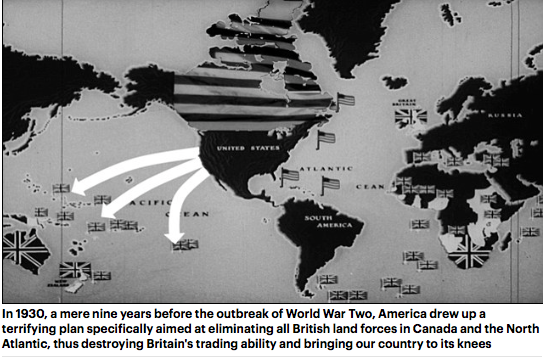
The final version of War Plan Red, which was approved in May of 1930, started from the conception that a war would be of long duration, involving a maximum effort by America, directed initially at separating Canada from Britain, the defeat of British forces in the Western Hemisphere, and eventually, the economic exhaustion of the United Kingdom (Figure 2). The Army’s mission was to destroy British armed forces in North America and occupy the territory of Canadian and British possessions in the Western Hemisphere “as may be necessary.” The Navy’s mission was to gain control of the oceans adjacent to both coasts of Canada, and ultimately to extend such control to “areas necessary to effect the economic exhaustion of Britain.” The Army was to prepare for operations to include a joint overseas expedition against Halifax, overland operations to take the Montreal-Quebec area, and an operation to cut rail connections in the Winnipeg area. The Navy was to concentrate sufficient forces to destroy the Royal Navy fleet in the North Atlantic and cut communications between Britain and Canada. The Navy was also to blockade Canada’s Pacific coast.
Secondary operations were to include the taking of Britain’s Caribbean territories, and operations in the Great Lakes region to secure U.S. access and deny British/Canadian access to the locks and waterways. The Panama Canal was to be held “inviolate,” and the defense of Hawaii, the Philippines, and Alaska was to be carried out with the forces available. The Estimate of the Situation that accompanies the war plan reflects, very well, the concerns of the Empire cited by Holloway Frost in his 1919 lecture, and the concerns of the Rothschild group, with respect to growing U.S. economic and naval power after World War I. It describes British foreign policy as “designed to protect and advance the commercial, financial and economic interests of the British Empire,” and particularly of the United Kingdom and its seaborne trade. British policy is “actively exerted in favor of acquirement of, or unrestricted access to, the world’s supply of raw materials and to expansion of British commerce.” The estimate warns that while Britain had no known military allies at that time, it was unlikely to enter into a war against the US without them. Japan was considered the most likely such ally, but Britain was also expected to seek agreements with such other powers as needed to secure the interests of the British Empire (and the Rothschild’s that controlled this ) around the world during a war with US. The estimate identified “the constantly increasing American economic penetration and commercial expansion into regions formerly dominated by British trade, to such extent as eventually to menace British standards of living and to threaten economic ruin” as the most probable cause of a British-American war.
Therefore, Britain’s war aims would be the “definite elimination of America as an important economic and commercial rival in international trade.” The estimate goes on to develop and assess the political and economic strengths and weaknesses of both Britain and America, and to assign likely missions to the military forces of both sides. Perhaps the most important political quality of America, however, is that it possesses “an anti-British tradition and it is believed that the American government would have little difficulty in mobilizing public sentiment in favor of a vigorous prosecution of the war, once hostilities began.”
An Estimate of the British Empire In late 1925, the U.S. Army War Plans Division produced a “Strategic Estimate Britain” in which they stated, “if America becomes involved in a war with Britain it will be because of the expansion of American foreign trade as to be a dominant factor in menace to the British favorable trade balance which Britain has so long maintained and which is essential to Britain existence.” The planners estimated that British goals would be the destruction of the American Navy and Merchant Marine, the destruction of American trade, the acquisition of the Panama Canal, and the capture of American possessions in the West Indies. The planners also thought that Canada would go for part, or even all of Alaska, that Australia would have its eyes on the Philippines, and New Zealand might be interested in acquiring American Samoa. “The main consideration involved,” wrote the planners, “in the determination of the probable British course of action, is the first objective. British war aims require the destruction of the American fleet, but Britain’s purpose is to force America to sue for peace on terms dictated by London, and for this purpose, Britain must bring such military and economic pressure to bear on America as to make it impossible for America to continue the war. This will require Red to invade and occupy US territory, and specifically, the industrial region in the vicinity of Pittsburgh in order to deprive America of the power to wage war”. The planners envisaged that Britain would move its fleet to Halifax and from there secure control of the Western Atlantic so that an expeditionary force could be moved via Halifax and Quebec for an advance on Pittsburgh, Pennsylvania. The remainder of the estimate is a description of the political, economic, and military situations in the British Empire. The description of the economy is notable for the fact that it identifies to what degree Britain is dependent on imports of food and raw materials from the colonies and from continental Europe. The planners estimated that if control of the seas is conceded to Red, then Red can supply all of its war needs, including replacing those materials that it imports from America, such as copper. As of the mid-1930s, the war plans against Canada consisted in the bombing of Montreal, Quebec City, Halifax and Vancouver. The use of “poison gas” was part of that project.
In that year, the US War Department obtained $57 million in funds to build three air bases on the Canadian border for the sole purpose of pre-emptive invasion attacks on Canada. The bases were to be camouflaged as civilian airports, but powerful enough in military terms “to dominate the industrial heart of Canada”. The US military held massive ‘war games’ involving some 50,000 troops on Canada’s border, containing practice maneuvers for the eventual invasion. Even in those days the Americans were already involved in chemical and biological warfare; one of Roosevelt’s 1935 amendments was the authorization to the US military for “the immediate first use of poison gas against the Canadians”, and recommended bombing to total destruction any cities that could not be captured. The US maintained this plan on the books during World War II, with the intention of pursuing it after completing victories in Europe and Japan. The plan was presented to a Committee of the US Congress in secret testimony but was discovered when it was published by mistake.
In a published article, the Washington Post admitted this was not only “a bold plan”, but “a step-by-step plan to invade, seize and annex our neighbor to the north. First, we send a joint Army-Navy overseas force to capture the port city of Halifax, cutting the Canadians off from their British allies. Then we seize Canadian power plants near Niagara Falls, so they freeze in the dark. Then the US Army invades on three fronts – marching from Vermont to take Montreal and Quebec, charging out of North Dakota to grab the railroad center at Winnipeg, and storming out of the Midwest to capture the strategic nickel mines of Ontario. Meanwhile, the US Navy seizes the Great Lakes and blockades Canada’s Atlantic and Pacific ports.”
“The U.S. Army’s mission was “ULTIMATELY, TO GAIN COMPLETE CONTROL OF CRIMSON [Canada].” The war plan directed against Canada initially formulated in 1924 was entitled “Joint Army and Navy Basic War Plan — Red”. Though ostensibly for war against Britain, the Plan was focused on the conquest of Canada, which was color – coded CRIMSON. The 1924 draft declared that U.S. “intentions are to hold in perpetuity all CRIMSON and RED territory gained… The Dominion government [of Canada] will be abolished.” War Plan Red was officially approved by the US War Department in May 1930. The 1928 draft stated Canada that in a war she would suffer grievously”.
The 1930 draft stated that “large parts of CRIMSON territory will become theaters of military operations with consequent suffering to the population and widespread destruction and devastation of the country. In February 1935, the US War Department arranged a Congressional appropriation of $57 million dollars to build three border air bases for the purposes of pre-emptive surprise attacks on Canadian air fields. The base in the Great Lakes region was to be camouflaged as a civilian airport and was to “be capable of dominating the industrial heart of Canada, the Ontario Peninsula”
In August 1935, the US held its largest peacetime military maneuvers in history, with 36,000 troops converging at the Canadian border south of Ottawa, and another 15,000 held in reserve in Pennsylvania. The war game scenario was a US motorized invasion of Canada, with the defending forces initially repulsing the invading Blue forces, but eventually to lose “outnumbered and outgunned” when Blue reinforcements arrive.
It is worth noting that in the course of World War II, a decision was taken by the War Department to retain the invasion plan on the books. But, it was later shelved. War Plan Red was declassified 35 years later in 1974. “A bold plan, a bodacious plan, a step-by-step plan invade, seize to and annex our neighbor to the north. …First, we send a joint Army-Navy overseas force to capture the port city of Halifax, cutting the Canadians off from their British allies. Then we seize Canadian power plants near Niagara Falls, so they freeze in the dark. Then the U.S. Army invades on three fronts — marching from Vermont to take Montreal and Quebec, charging out of North Dakota to grab the railroad center at Winnipeg, and storming out of the Midwest to capture the strategic nickel mines of Ontario.
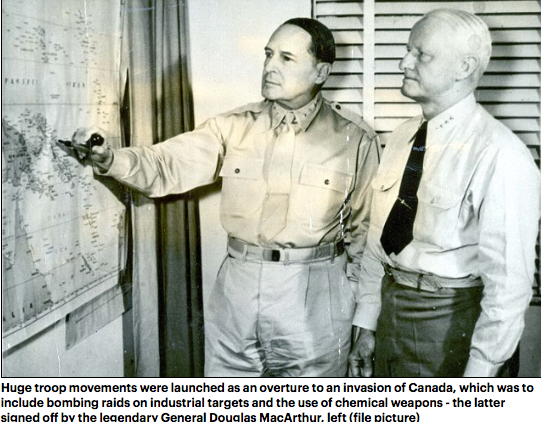
Meanwhile, the U.S. Navy seizes the Great Lakes and blockades Atlantic and Pacific ports. The strategic bombing of Halifax, Montreal and Quebec City was envisaged under Plan RED In March 1935; General Douglas MacArthur proposed an amendment making Vancouver a priority [bombing] target comparable to Halifax and Montreal. General Douglas MacArthur was actively involved in the planning of the invasion of Canada from 1930to 1937. The war plan was explicitly geared towards the conquest of Canada 1937. War Plan Red was declared obsolete in 1936, and directives were issued that no further planning was to be undertaken under Red. Even so, it was not withdrawn from active files until 1939, nor was Britain necessarily considered a friendly ally with the same objectives as the United States, by this time.
Chief of Naval Operations Adm. Harold Stark, in his famous “Plan Dog Memorandum,” of Nov. 12, 1940, implied that if the U.S. were to allow Great Britain to be defeated by Germany, Britain could end up joining Germany, France, and Japan, in war against the United States. Indeed, the British continued to act with imperial arrogance during U.S.-British staff conversations that took place in early 1941 at Stark’s recommendation, demanding that the U.S. protect British imperial interests such as Singapore. The American officers involved in those conversations rejected that demand, fearing that were the U.S. fleet to be deployed to Singapore, it would be at great risk of being destroyed by the Japanese. Even after the U.S. entered the war in alliance with Britain, the strategic threat presented by the British Empire remained, as was recognized even during World War II by President Franklin Roosevelt, with his intention to dismantle the European colonial empires once the war was over. The story continues in part 3.


One thought on “When America & Britain (nearly) went to War Part 2 (of a 3 Part Series)”