

Quantitative Madness
Here is where it began to go really bad. The largest Wall Street banks such as JP Morgan Chase, Wells Fargo, Citigroup or in London HSBC or Barclays, lent billions to their major corporate clients. The borrowers in turn used the liquidity, not to invest in new manufacturing or mining technology, but rather to inflate the value of their company stocks, so-called stock buy-backs, termed “maximizing shareholder value.” BlackRock, Fidelity, banks and other investors loved the free ride. From the onset of Fed easing in 2008 to July 2020, some $5 trillion had been invested in such stock buybacks, creating the greatest stock market rally in history. Everything became financialized in the process. Corporations paid out trillions in dividends. Companies like Tesla which had never earned a profit, became more valuable than Ford and GM combined. Cryptocurrencies such as Bitcoin reached market cap valuation over $1 trillion by late 2021. With Fed money flowing freely, banks and investment funds invested in high-risk, high profit areas like junk bonds or emerging market debt in places like Turkey, Indonesia or, yes, China.
The post-2008 era of Quantitative Easing and zero Fed interest rates led to absurd US Government debt expansion. Since January 2020 the Fed, Bank of England, European Central Bank and Bank of Japan have injected a combined $10 trillion in near zero rate credit into the world banking system. Since a Fed policy change in September 2019, (the Wall Street Repo Crisis) it enabled Washington to increase public debt by a staggering $10 trillion in less than 3 years. US Federal debt went from a manageable 35% of GDP in 1980 to more than 140 % of GDP today. Only the Fed Quantitative Easing, buying of trillions of US government and mortgage debt and the near zero rates made that possible. Now the Fed has begun to unwind that and withdraw liquidity from the economy with QT or tightening, plus rate hikes. This is deliberate. It is not about a stumbling Fed mis-judging inflation.
Energy Drives the Collapse
Sadly, the Fed and other central bankers lie. Raising interest rates is not to cure inflation. It is to force a global reset in control over the world’s assets, its wealth, whether real estate, farmland, commodity production, industry, even water. The Fed knows very well that Inflation is only beginning to rip across the global economy. What is unique is that now the Iran-Hormuz crisis is turbo-charging inflation across the globe. The global shortages of fertilizers, soaring prices of natural gas, and grain supply losses from global draught or exploding costs of fertilizers and fuel or the war in Iran and Ukraine, guarantee that, at latest this September-October harvest time, we will undergo a global additional food and energy price explosion. Those shortages all are a result of deliberate policies. Far worse inflation is certain. Similarly, the European Union has decided to phase out Russian oil and gas with no viable substitute as its leading economy, Germany, moves to shut its last nuclear reactor and close more coal plants. Germany and other EU economies as a result will see power blackouts this winter and natural gas prices will continue to soar. In the second week of June in Germany gas prices rose another 60% alone. Both the German government and the EU Commission continue to push unreliable and costly wind and solar at the expense of far cheaper and reliable hydrocarbons, insuring an unprecedented energy-led inflation.
Fed has pulled the Plug
With new rate hikes and promise of more to come, the US central bank has now guaranteed a collapse of not merely the US debt bubble, but also much of the post-2008 global debt of $303 trillion. Rising interest rates after almost 15 years mean collapsing bond values. Bonds, not stocks, are the heart of the global financial system. US corporations took on record debt owing to the years of ultra-low rates. Some 70% of that debt is rated just above “junk” status. That corporate non-financial debt today exceeds $18 trillion. Now a large number of those marginal companies will not be able to rollover the old debt with new, and bankruptcies will follow in coming months. The highly-speculative, unregulated Crypto market, led by Bitcoin, is collapsing as investors realize there is no bailout there. Last November the Crypto world had a $3 trillion valuation. Today it is less than half, and with more collapse underway. Even before the latest Fed rate hike the stock value of the US megabanks had lost some $300 billion. Now with stock market further panic selling guaranteed as a global economic collapse grows, those banks are pre-programmed for a new severe bank crisis over the coming months. The Federal Government will now find its interest cost of carrying a record $40 trillion in Federal debt far more costly. Unlike the 1930s Great Depression when Federal debt was near nothing, today the Government, especially since the Biden budget measures, is at the limits. The US is becoming a Third World economy. If the Fed no longer buys trillions of US debt, who will? China? Japan? Not likely.
Deleveraging the Bubble
The heart of the world financial system, contrary to popular belief, is not stock markets. It is bond markets—government, corporate and agency bonds. This bond market has been losing value as inflation has soared and interest rates have risen since 2021 in the USA and EU. Globally this comprises some $250 trillion in asset value a sum that, with every fed interest rise, loses more value. The last time we had such a major reverse in bond values was forty years ago in the Paul Volcker era with 20% interest rates to “squeeze out inflation.” As bond prices fall, the value of bank capital falls. The most exposed to such a loss of value are major French banks along with Deutsche Bank in the EU, along with the largest Japanese banks. US banks like JP MorganChase are believed to be only slightly less exposed to a major bond crash. Much of their risk is hidden in off-balance sheet derivatives and such. However, unlike in 2008, today central banks can’t rerun another decade of zero interest rates and QE. This time, as insiders like ex-Bank of England head Mark Carney noted three years ago, the crisis will be used to force the world to accept a new Central Bank Digital Currency, a world where all money will be centrally issued and controlled. This is also what the Globalist people mean by their Great Reset. It will not be good. A Global Planned Financial Tsunami Has Just Begun.
Postponing the World’s Financial Winter – for how long?
Announcing that “A whole civilization will die tonight,” Donald Trump threatened on April 7, 2026 to destroy “every bridge in Iran” and “every power plant … burning, exploding, and never to be used again.” His intention to continue committing war crimes is driving the world toward a Financial Winter as devastating as the Great Depression. Iran’s April 8 response called his bluff, laying down the terms for ending the conflict and opening the Strait of Hormuz. Oil-importing countries will need to compel U.S. and Israeli compliance with these terms in order to avoid economic crisis. We are seeing the economic version of what the 1960s called Mutually Assured Destruction (MAD). The term referred to the military standoff that avoided the global Nuclear Winter that would have occurred if the world’s leading powers had used atomic weapons against each other. Today’s world is threatened with a more economic kind of global collapse. Iran is defending itself against the prospect of U.S. and Israeli military attack by threatening to destroy OPEC’s oil and gas trade if its survival as a sovereign country is endangered. But today’s economic version of MAD has no such restraint on America’s floundering attempts to reverse the loss of its economic power that has left it with few major levers to exert control over other countries.This is not the first time that U.S. strategists have broken the rules of international relations that America itself had put in place in 1945 to shape the post-World War II economic order. Controlling 75% of the world’s monetary gold, it dictated creditor-oriented rules of international finance, and also rules of free trade as a means of breaking up Britain’s imperial preference trade restrictions. These rules prevented other countries from following protectionist policies to protect their agriculture and industry as the U.S. itself was doing. The United States also created a global military presence, promising to protect the world against the specter of Soviet military attack and to prevent countries enacting strong government controls or socialist policies that would pose an alternative to the U.S.-backed system of international finance, trade and private investments.
But now that the United States has de-industrialized and become debt-ridden, it has abandoned and indeed reversed these rules that served it eighty years ago. What U.S. officials call national security strategy is how to recover and maintain America’s control over other countries by weaponizing the dollar-centered financial system and its foreign trade. And instead of protecting other countries and their economic sovereignty, its attempt to enforce its dominance disruptively and militarily has become a threat to the entire world’s security. And unlike the balance of power that Mutually Assured Destruction had established, most other countries have not mounted any symmetrical check to U.S. bullying by isolating themselves from America’s weaponization of its trade and financial relations. Japan has promised $650 billion in free loans to the United States as the price for maintaining its access to U.S. markets. And Korea’s parliament last week approved the $350 billion extorted by Trump for its own access. There seems little ability for these sums to be paid if Japanese and Korean production of electronics and autos is disrupted by ending OPEC energy imports, yet neither country has objected to remaining a U.S. military and economic satellite. There are 3 fuses, already lit, waiting to blow up the global financial system, with the economy following closely behind. The financial system is now wired with three interdependent fuses. Any one of them can trigger a cascade that eventually reaches the AI bubble.
The Financial Fuse: $2 trillion of private credit, which is opaque, illiquid, already cracking, and mostly ignored by the media. Recent data show elevated redemption requests at several large funds: Carlyle: 15.7% of investors tried to flee; only 5% were let out. Blue Owl: 41% redemption requests. 69% of private credit is rated B – or lower. A quarter is already in CCC territory.
Let’s not forget that the five major hyperscalers—Amazon, Microsoft, Google, Meta, and Oracle—issued $121 billion in US corporate bonds in 2025 alone, more than four times their typical annual issuance. This figure will have grown considerably by the end of 2026. Amazon’s $54 billion global bond deal in March was the largest in the company’s history. Essentially, this is the bond market being drafted to fund what equity alone cannot—and in a context of rapidly rising bond yields. Now, PPI is at 6%. The 30-year Treasury coupon is above 5% for the first time since August 2007. The Fed cannot cut rates without reigniting inflation. So, the Fed is again in need of an excuse—a “shock to the system” that makes the extraordinary not only possible but legitimate. The Iran war provided that excuse and is still very much on course to continue providing it. A “viral outbreak” could provide another, just like an “unexpected” private credit collapse, or a “malevolent” cyberattack. Or, for that matter, a Japanese bond blow-up. Take your pick. These stories are all waiting in the wings, and they’re all systemically useful. The vulnerabilities have been there for years, decades even, and today’s symptoms are all public: redemption filings, earnings reports, bond auction results, labor dispute settlements, and the admissions buried in footnotes. The real economy, meanwhile, has long been flashing warning signs of its own.In all likelihood, the next crash won’t announce itself with a headline. It will start in a place that no one is watching. By the time you see it, the fuse will have already burned through. How long can the system continue to absorb shocks before one of them doesn’t bounce? Read the boring stuff because the answers are often there.Watch the bond market—that’s the clock. The emergencies are just the alarm that has been set.
Oil as a Geopolitical Factor
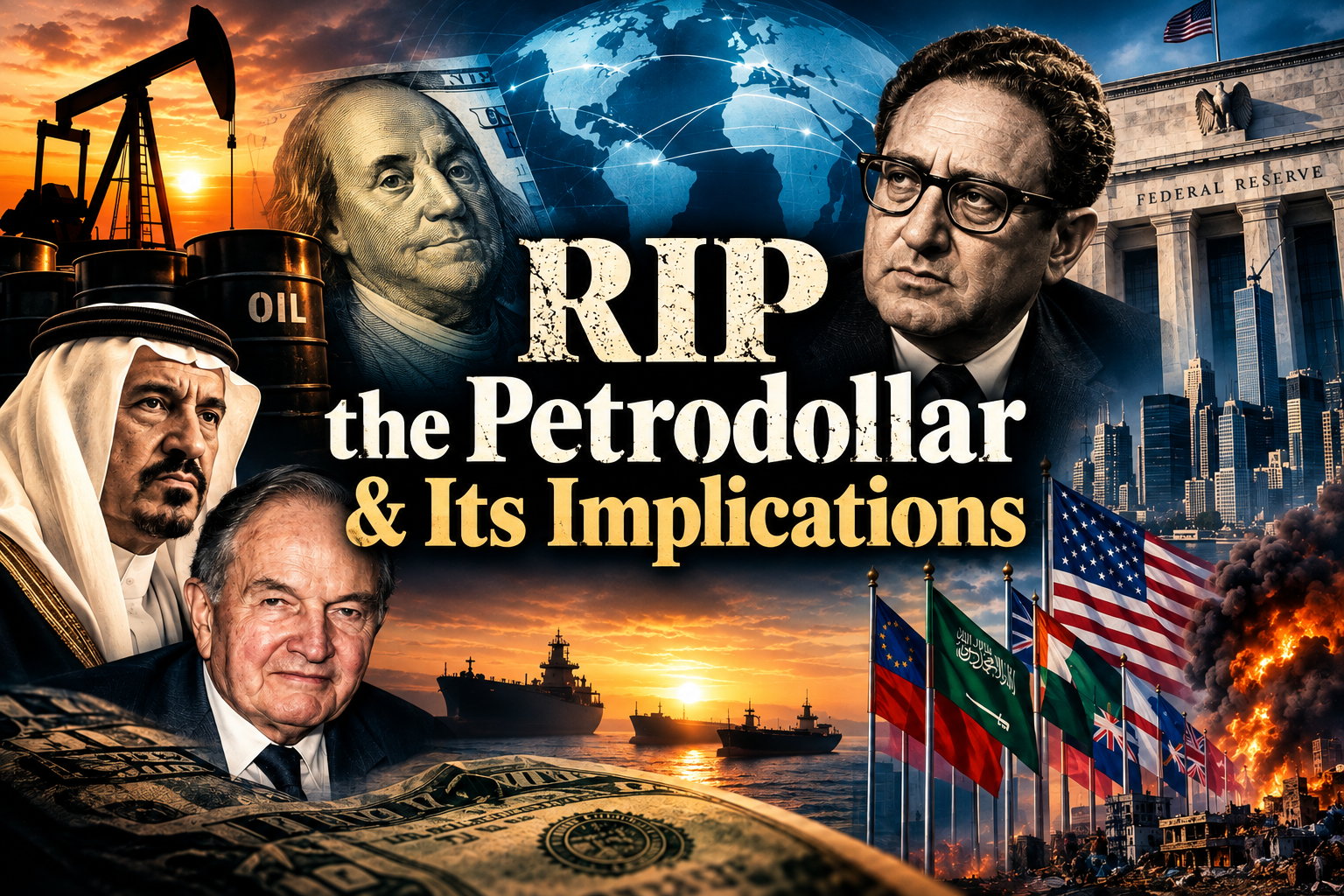
“Who controls the flow of oil – – – controls the destinies of nations “Henry Kissinger (1970s).
Control of strategic raw materials, primarily oil, and the markets for their sale have always been in the spotlight for the world’s leading powers. Since the beginning of the twentieth century, when oil began playing a key role in industry, world history has been full of conflicts related to control over its extraction and sale. Oil has consistently acted as a powerful geopolitical factor, generating, sustaining, and fueling conflicts wherever the irreconcilable interests of key players collide. The considerable distance between oil fields and consumer markets makes transit communications critically important. Whoever controls these connecting links gains the ability to dictate the terms of trade and to make both producers and consumers dependent on them. The advantageous geographical position of the Middle East, at the crossroads of three continents – Asia, Africa and Europe – turns the region into a strategic center of world affairs. The military bases of leading powers are located here, with the most important transit routes passing through its territory and maritime areas. On top of that come the richest oil reserves concentrated in the Gulf countries. Control over the routes of hydrocarbon supplies to the world markets inevitably increases the economic and political significance of the territories and countries located along these routes. The Middle East retains its undeniable strategic role not only as the cradle of civilizations and spiritual centers but also as a key crossroads of global trade and transit routes.
2 Europe’s Position
Europe has removed itself from the group of powerful nations. It has become irrelevant. Due to a reduction of its geopolitical weight, it has become a vassal of the US. This has weakened the Rothschild power overall.
Preparing for a Future War Between the US And Europe Unavoidable
The economies of the European Union’s 27 member nations (450 million people) and other countries of Europe (an additional population of 294 million) are undergoing a “controlled disintegration,” perpetrated by Western financial networks, centered in Wall Street through EU “climate change” laws and regulations. In particular, the EU Green Deal, implemented in earnest during 2021-23, has imposed a phasing out of fossil fuels, and a ban on internal combustion engines (ICE), a policy now being reviewed, but probably too late. Europe is out of the race. It has become irrelevant. For those who might have been out of the loop over the past few months, there is a war going on between the US and Europe. Largely, it’s western European governments that are the problem. Without exception, all the heads of EU governments are mere puppets of the Rothschild family. It’s clear that the European elites have a distaste for US policy. From anti-woke reforms and immigration restrictions to geopolitical interactions, when Americans voted en masse to remove the far-left Biden regime, Europe became an overnight enemy. Since 2014, European globalists have been pursuing a multicultural blitzkrieg of their own respective populations. Open borders and mass immigration from largely Islamic countries became the political standard. The Rothschild familywant the establishment of a “new world order” in which national borders are erased and green authoritarian socialism is enforced under a globally centralized bureaucracy. There are many ways to go about achieving this agenda. Europe has been overwhelmed by a third world incursion. Between 50 million and 60 million migrants now reside in the region, making up around 20% of Western Europe’s total population. The decline is present all across the EU; economic growth is stagnating. Een worse is the state of European finances. Practically, every country is beyond broke. How much longer can they continue to hold the dam back?
This brings us to what appears to be the US strategy in preparation for the schism, and it’s not hard to see, it involves oil. The move on Iran is clearly the catalyst for a US program of energy dominance. Consider for a moment the insane geopolitical changes and energy market mutations that have happened in just the past few months. Venezuela is now under new leadership and shipping oil to the US, while China has mostly been cut out. Trump has been engaging with Panama to dramatically reduce Chinese influence over canal operations, again, cutting the CCP out of the western hemisphere. Canada under globalist Mark Carney refuses to negotiate a tariff deal with the US and is trying to form bilateral trade agreements with Europe and China (to Canada’s detriment). This could lead to direct hostilities between the US and Canada if Carney tries to use oil agreements as leverage against Trump, or if he tries to give China access to Canadian soil. NATO is now likely to break apart. Trump is puling equipment, planes and troops from Europe and may shut down military bases entirely. Tariff salvos are going to increase. European governments are cracking down on their own citizens for expressing conservative and nationalist views. The lines are forming. After endless abuse by the Rothschild establishment, if there was a war, millions of Europeans would likely welcome the US with open arms. The move marks an accelerated shift away from the security guarantees Washington has provided to Europe for eight decades. The decision, will limit NATO’s ability to carry out long-range strikes and conduct surveillance. This move has greatly alarmed the overlords of Europe-the Rothschild family.
Under the proposed drawdown: The number of F-16 and F-15E fighter jets assigned to NATO operations would drop from approximately 150 to 100; Maritime reconnaissance aircraft would be cut from 26 to 15; All eight aerial refueling tanker jets previously available in Europe would be withdrawn; A missile-launching submarine and an aircraft carrier, along with several warships and scores of carrier-based jets, would be reallocated; One of two bomber groups previously assigned to Europe’s defense would also be redeployed. The Rockefeller Empire is retreating into Fortress America.
The Rothschild Positions
The Rothschild Empire is involved in several geopolitical contests that will decide its future as a world power- the most important of all these contests are two- Ukraine and Israel. And, of these two, the Israel Project is the most important. Just as the American people foolishly believed in the “American Dream”, which has now turned into a nightmare, the settler-thieves in Israel believed in the Zionist dream. This has now turned into a Zionist nightmare. Over a period of time, the Zionist Project will be re-tweaked by its masters-the Rothschild family. They will not give up their mandate. As we know from religious prophecies, the region will experience much turmoil and chaos in the coming years, and this carnage will end only with the return of Jesus.
Zionist influence in the US
After spending tens of billions on pushing the Islamophobia narrative, Israel lost it all over the last few years. Now, they are doubling down, and more, in trying to rebuild their image. It’s like spitting in the wind. Furthermore, AIPAC is also losing its influence. If the Americans liked the Zionists so much, then why bribe them? Not only that, AIPAC and the Zionist lobby is spending more money on electing those who tilt their way. It’s not working. Today, being a pro-Israeli candidate is proving to be a liability. In fact, those candidates who stand on an “America First” program are winning.
Zionist influence with the Arabs – no more
All those Gulf Arab states and others such as Morocco are re-thinking their ties with Israel. For various reasons, these Arab rulers forged economic and military ties with the US and Israel. Iran has showed them that this reliance is not sustainable. Both the Abrahamic Accords and the IMEC trade route deal is over.
Expansion of Israel- no more
Israel has proved to be weaker than a spider’s web. Its Greater Israel project will not live to see its fruition. Israel has been weakened to such an extent that it barely has the strength to survive, let alone expand. The new-found confidence of the regional powers- especially Iran, will come together and contain Israel.
3 Russia ‘s Position
Both the families have been waging war on Russia for the past 4 plus years. With no success. Washington has now passed the management and operations of weakening Russia to the Rothschilds. Britain, France and Germany are now in the lead for this. But, Europe refuses to surrender, and is increasing provocations against Russia. Now, the Russian elite, its people and the Kremlin is fed up. Putin made an announcement that negotiations are over. The ultimate result will be obtained on the battlefield. With this decision, Russia is increasing its war of attrition against Ukraine and its backers. As Putin stated last year: “The vampire’s ball is ending “!
4 Iran’ position
Financial & Military Costs to Date
It is now four months since the Feb. 28 closure of the Strait of Hormuz, a predictable—some would argue intended—result of the unprovoked U.S.-Israeli war of aggression against Iran. If this war continues for another few months, it is likely that the world economy will enter into a spiral of collapse leading into a full-scale global depression, including skyrocketing poverty, hunger, industrial collapse, and population dislocation and forced migration—as well as a guaranteed hyperinflationary blowout of the entire $2.5quadrillion global financial bubble. It will make the Great Depression of the 1930s pale in comparison. The closest parallel will be with the New Dark Age of the 14th century, with its notorious Black Death that wiped out up to half of the population of Europe. This is because of the massive dislocation of the physical means of survival of billions of people that is well underway, triggered by the closure of the Strait of Hormuz. This is already having devastating, non-linear effects. The real financial cost of the war is also staggering—probably upwards of $4 trillion. This includes the costs borne by the US, Israel and the Gulf Arabs in munitions, etc. There is also in the range of $1 trillion in physical damage across Iran and the Gulf states. The IMF’s April Regional Economic Outlook further estimates that as much as 2% of global GDP will also be wiped out by the war—implying $1.5-$2 trillion in lost global output for 2026 alone. So, $4 trillion is probably on the low side of the real monetary cost of the war to date. How many productive jobs could be provided if those funds were invested in infrastructure, agriculture and industry? How many bridges, ports and high-speed rail lines could be built? How many lives could be saved by increased investment in hospitals, schools, and essential pharmaceuticals?
Over a longer time period: The war kills hundreds of thousands directly and through cascading food and energy shocks; pushes hundreds of millions into hunger over the next two to three years; and—through the destruction of productive capital and the diversion of $4 trillion from development to destruction and the rebuilding of what once was—could reduce the planet’s mid-century potential population by something on the order of a half-billion to a billion. The US fired over 1,000 Tomahawk missiles at Iran, while fewer than 200 Tomahawks are currently produced each year. Replacing them could take up to five years as a result. Washington used some 290 Terminal High Altitude Area Defense (THAAD) interceptors to shoot down incoming Iranian drones and missiles, while only 96 are currently manufactured yearly. Washington has devoted significant funding to the military to increase weapons production. However, the problem today isn’t money; it’s time. It takes time to expand production capacity and to build these complex systems. As a result, the US military will be vulnerable for several years until inventories return to their previous levels and another several years before they get to the levels that war planners desire. Mark Cancian, a retired Marine colonel and stated that the shortages are due in part to assumptions the Pentagon made after the fall of the Soviet Union. US military leaders no longer believed that fighting a long, protracted war would be necessary. They therefore reduced orders for missiles and munitions, causing defense firms to slash production. However, “Russia’s war with Ukraine showed that wars could be protracted and require deep inventories of advanced weapons,” Cancian said. China’s military has grown much larger and more powerful in recent years, prompting US military strategists to plan for the possibility of a protracted war in Asia. China is deeply aware that it has no recent combat experience and that it performed poorly in its last war – against Vietnam in 1979, that difference in experience may preserve deterrence until munitions inventories are restored. The Ukraine and Middle East conflicts are one war, waged on different fronts. These wars have combined to de-militarize the West- about 80-90% less stocks on hand than what was in store in January 2022. Replacing this much will take years-time the west does not have.
The Two Reasons why Iran needs to control the Strait of Hormuz
The least violent way for Iran to control the oil and gas trade of its neighboring sheikdoms and monarchies is to control the Strait of Hormuz, throwing off the centuries of foreign control. Iranian control of the Strait, and hence its regional oil trade, is the most direct way to shut down much of the world’s energy supply. Iran hopes that the threat of doing this will lead other countries to deter U.S. forces from renewing their attempt to seize Iranian oil by force and destroy its economy. This is Iran’s MAD defense strategy discussed above. Iran also is using its control of the Strait to charge toll fees for ships using the waterway. It has made an alliance with Oman on the other side of the Strait to split the toll fees. Iran is following the path of least resistance to obtain reparations from the collective West for the damages on its country. The toll fees will be a further cost for the failure of oil importers to stop the attacks, adding to the costs of the economic disruption caused by the shutdown of energy and other exports from the Persian Gulf. We have explained many times in past articles that the Rockefeller Empire wants to blow up the Middle East as a way to blow up Eurasia. The way for the family to achieve this is by doing what it is trying very hard to do: close Hormuz. Trump’s proposal was to invite European and Asian countries that depend on oil shipped through the Hormuz Strait to “grab it.” In other words, let European and Asian armies fight to the last man in what the U.S. military has shied away from doing. Hardly by surprise, no European or Asian country accepted this invitation for their armies to be sitting ducks in a vain attempt to gain military control of the Strait in the face of Iran’s elaborate defenses.
When the charade broke down on April 12, Iran’s government summarized the resulting stalemate: “The American enemy, which is vile, wicked and dishonest — attempted to achieve on the negotiating table what it could not achieve through war. Iran has decided to reject these terms and continue the sacred defense of its fatherland by any means necessary, military or diplomatic.”
Beyond the problem of America’s military bases is the fact that the entire region has become economically and politically linked to the U.S. economy. It is an investment outlet for Saudi Arabia, the UAE and other Arab sheikdoms (and their wealthy elites) to hold dollarized savings. These states also have become hosts for U.S. information technology companies to use their low-priced local energy to power the AI installations of Amazon, Microsoft, Meta, Google and other major companies, in which OPEC investors themselves hold large financial stakes. These interconnections have tied the fortunes of the Sunni monarchies to U.S. investment and financial markets, leading them to side with the United States in its war against Iran. Iran has insisted that in order for U.S. political, financial and military influence over OPEC countries and other oil exporters to end, the economic linkages such as investment of OPEC foreign reserves and national sovereign wealth funds in U.S. bonds and other financial securities must be wound down, along with OPEC hosting of U.S. information technology companies and other investments and U.S. military bases in their countries.
The Opposition between U.S. and the Rest of the World
Looking only to its own interests, the United States views economic success by the most rapidly growing and successful economies, above all those of China and its neighboring Asian countries, as a threat to its own security. More broadly, U.S. policy has sought to maintain world dominance by destroying whatever assets it cannot control and monopolize for itself, from oil and food crops to information technology and alternatives to the dollarized international monetary system. The war against Iran has shown the Arab OPEC countries that instead of protecting them against attack, the United States is seeking to consolidate its control of their oil, just as it has done with Venezuela’s oil. The Rockefeller plan is to defeat Iran and consolidate its control over the region’s oil trade, having already seized the oil of Iraq, Syria and Libya. And it hopes that mounting an attack to end Iran’s control of traffic through the Strait of Hormuz will prevent Iran from gaining the power to block the Gulf oil trade and the related U.S. economic and financial symbiosis with the region’s Arab OPEC monarchies. Iran’s government recognizes that its struggle to free itself means freeing its region from the U.S. drive for control. That will be a long-term project, and one that is beyond the ability of Iran to resolve by itself. Iran’s strategy to resist a civilizational threat to its existence is to show the world that it will not permit itself to be isolated and defeated while other countries stand by passively and permit its destruction. Iran has forced the world’s oil-consuming nations to choose between “Prosperity for All or Prosperity for None.” The choice is between “Security for All or Security for None” if its’ and the rest of OPEC’s oil export capacity is blocked or destroyed. We’re seeing the ending of an era, not a decline, but an abrupt change. Every move taken to escape US ‘decline’ has become the mechanism that delivers it. The US went to war to reassert dominance – and proved it could no longer dominate. The Rockefeller Empire clearly wants to consolidate global energy control in order for the US to determine who may have access to energy. The world has reached a turning point that is ending the U.S.-centered world order created in 1945 You, the reader, also know well that the MOU just agreed on between the US and Israel won’t last long. This MOU was signed by Trump on Wednesday 17th June. In reality, the US has run out of options. This “deal “is actually a pause between hostilities. The key players- Russia, China, Iran, Saudi Arabia and North Korea know full well that both the US and Israel are not to be trusted. As Putin called the 2 families – “An Empire of Lies “, and Lavrov stated that America is: “agreement incapable”.
We shall return to the subject of Iran and discuss how Iran brought the US kicking and screaming to defeat.
The most dangerous mistake in international affairs is to confuse military destruction with strategic success. That mistake now risks obscuring one of the most consequential geopolitical shifts in the modern Middle East. For decades, the United States and its allies defined victory through familiar metrics: air superiority, precision strikes, technological dominance, sanctions pressure, and the ability to shape the diplomatic endgame. Yet the outcome of the 2025—26 Iran conflict suggests a different reality. Despite absorbing devastating attacks, suffering immense economic damage, and confronting the combined weight of American and Israeli military power, Iran emerged with something far more valuable than winning on the battlefield: it emerged with leverage. And in contemporary geopolitics, leverage is power. Throughout modern history, weaker powers have repeatedly defeated stronger ones without winning conventional wars. Vietnam did not conquer America. The Taliban did not invade Washington. Hezbollah did not destroy Israel in 2006. Yet each succeeded in preventing its adversary from achieving political objectives. Iran appears to have mastered this same logic. It learned how to endure without capitulating and how to fight without seeking decisive battle. The most striking feature of the reported memorandum is not what Iran conceded. It is what Iran appears to have gained. The inclusion of Lebanon within a broader ceasefire framework effectively transforms disparate fronts into a single strategic theatre defined by Tehran’s interests. For decades, Washington attempted to isolate conflicts across Lebanon, Syria, Iraq, Yemen, and the Gulf. Iran spent the same decades knitting them together through networks of militias, political movements, and proxy forces. If hostilities in Lebanon now become inseparable from wider negotiations with Tehran, then the “Axis of Resistance” has moved from a slogan to an organizing principle of regional security. This represents more than a tactical success. If passage through Hormuz increasingly depends upon Iranian acquiescence, then geography has succeeded where missiles alone could not. This is the economics of strategic exhaustion. The stronger power must sustain expensive commitments indefinitely. The weaker power merely needs to endure.
The most important outcome of the 2025—26 conflict may not be what Iran destroyed. It may be what Iran proved. It proved that in the twenty-first century, endurance can defeat superiority. It proved that networks can compete with states. It proved that strategic patience can overcome overwhelming force. And it proved that an exhausted hegemon, however powerful, is not the same thing as a victorious one. The Middle East has not simply witnessed another war. It may have witnessed the birth of a new geopolitical era. A multipolar Middle East is emerging, shaped simultaneously by Iranian resilience, Chinese economic influence, Rusan opportunism, and the growing autonomy of regional powers. Now, both families are beyond arrogant. Their humiliation is profound, and they won’t take this lying down. Trump bought his masters some time – time to build up stocks and equipment, time to think of more diabolical schemes, and so on, in order to get back the global power they have lost. The coming months and years will see an escalation of wars, chaos, economic and financial dislocations that are unprecedented. Failure to achieve their global aims, the Rothschilds- will use religion as a means of achieving the long-term goals. This will also turn out to be a failure.
We have planned three articles around this. This article that you have just completed analyses the financial state of the west and globe. The next article discusses the economic state- and is titled “AI & Physical economy- which is better for mankind?”. The 3rd article is titled “The RIC Triangle”, which will discuss the military state of the key players – Russia, China, Iran and the US.
Glad you will be including AI, Technocracy in your next articles.
It is fascinating to live through these times. Yet “these times” have existed for centuries from the time of Napoleon Bonaparte to today, at lest when discussing the Rothschild influence and later the Rockefellers. Without a doubt the Global East must crush the Global West, and it is well on its way to being ready and willing to do just that. The Global East (strangely called the Global South) with BRICS evolving into a military cooperation alliance as well as a trading block against the Global West, will succeed. It is slow to anger but it’s a monster when awakened. The weak and pathetic societies of the Global West are no match for the Global East who have fought and died and lost billions of their own citizens over millennia. They will not allow themselves to be defeated by the West. It is all over for the West, thank God, or more specifically China, Russia, Iran and all other nations who have had it up to here with being bent over by the Wedt for 500 years. Time for a major change.