

1 New York
2 London
3 Moscow
4 Beijing
5 Riyadh
Into this “new world”, that has begun this month (remember, we said in September last year that in “six months from now, the world will be a different place”; well, we are here now).
Global Power Centers
There are five global power centers; meaning that the important decisions affecting international politics, economics and finance usually emanate from one of these five. They are as follows, and it includes the leading/controlling entity within each power center:-
New York – the Rockefeller family
London – the Rothschild family
Moscow – the nationalist faction headed by Putin
Beijing – the nationalist faction headed by Xi Jinping
Riyadh – the Al Saud family headed by MBS
Now, we find that New York has managed to neutralize and cripple London.
What’s left are Moscow, Beijing and Riyadh.
Individually, these four power centers stand no chance against the US. Combined – – – now, that’s another story. Below is a diagram that says it all.

The 2 Western Power Centers – New York & London

In the world of today, there are five major powers where decisions taken have global impact. They each have distinct advantages. These five centers are New York, London, Moscow, Beijing and Riyadh.
We shall discuss each one.
1 New York
New York is the base of the Rockefeller family. This family, through their oil business, eventually became the dominant economic and financial power in the US. It gained control of the White House in 1933, and the in 9 decades since, the US government has become a division/subsidiary of the family. The family established the current post-war global system- the Bretton Woods system, including the UN, World Bank and the IMF. It controls the economic, financial and political life in the US. In short, the family is America’s royalty. All the so-called “elite” work for the family. Under this elite come the “workers” placed in high positions- within the government and other places- this is called “the deep state”. The current head of the family is David Rockefeller jnr. He is the informal king of America. Like it or leave it- it is what it is. To clarify the family’s control structure, below is a diagram which somewhat resembles its control over the US and the World.
The American/Rockefeller Deep State
Now, the Deep State is composed of many people serving the Rockefeller family institutions, in a variety of ways. They are found within the media, think-tanks, NGO’s, Wall Street, banks, companies, the political elite and various multi-lateral institutions. Most are known to the public. Those that are not known to the public are the powerful ones. Some of the names tied to the family are Bill Gates, Warren Buffet, DuPont, Mellons, Ford, Koch and many others. The family institutions are the Rockefeller foundations, Chicago University, along with all the other top universities, JP Morgan Chase, Citibank, The Federal Reserve Banks , American Express, Exxon, Chevron, IBM, Microsoft, etc. Then, there are think-tanks – the CFR, Rand, Brookings, etc. It is such people that make up the Deep State. Within this system, some are selected to head the country. Just as the Rockefeller family owns/control the American Deep State, so does the Rothschild family in Europe has its own version of the Deep State. So, we have a US/Rockefeller Deep State, AND, a European/Rothschild Deep State. This latter also has a branch within the US. We see recently, the Rothschild Deep State in the US has turned against the Trump team for trying to end the Ukraine War.
The End of the American Liberal Empire

For the past 100 years, the US has functioned as a global empire. Unlike traditional empires built on territorial expansion, the American empire extended its reach through financial dominance, military alliances, and ideological influence. This model, however, has become increasingly unsustainable. Since the late 1990s, the costs of maintaining global hegemony have exceeded the benefits, fueling discontent both at home and abroad.
Donald Trump’s return to the White House is shaping up to be nothing short of a political revolution. The new administration is rapidly dismantling the old order, purging the ruling elite, reshaping both domestic and foreign policy, and cementing changes that will be difficult to reverse – even if his opponents regain power in future elections. For Trump, as for all revolutionaries, the priority is to break the existing system and consolidate radical transformations. Many of the principles that guided US policy for decades – sometimes for over a century – are being deliberately discarded. Washington’s global strategy, long built on expansive military, diplomatic, and financial influence, is being rewritten to ensure the survival of the Rockefeller Empire and its base-the US.
Trump and his allies seek to end this ‘liberal empire’ and return America to a more self-reliant, mercantilist model – one reminiscent of the late 19th and early 20th centuries. Trump has openly praised this era, viewing it as the golden age of US prosperity, before the country took on the burdens of global leadership. Under this vision, America will reduce unproductive foreign expenditures and refocus on its natural advantages: Vast resources, an advanced industrial base, and the world’s most valuable consumer market. Rather than policing the world, Washington will wield its economic power more aggressively to secure trade advantages. However, the transition to this model carries significant risks, particularly in a highly globalized economy.
A major part of re-industrializing America is through the tariff regime that Trump has imposed on all the countries exporting to the US. These range from a minimum of 10 % to 34 % in China’s case. How much effect this will have on the program remains to be seen. The Rockefeller plan to bring about Fortress America is fraught with known and hidden time-bombs. The US financial system, economy, society and military are broken. Its military industrial base is hollowed out. It should have started this process back in 1990, when the Soviet Union collapsed. Now, it is highly doubtful whether it can succeed- although it will try, only time will tell, followed by much death and destruction.
A Shift in Global Strategy
Trump’s policies are driven by domestic concerns but will have major implications abroad. His administration is systematically dismantling key institutions of the old order, including those that irritated Moscow. For instance, USAID – a major vehicle for American influence in the post-Soviet space – has been gutted. Ironically, Trump had more motivation to destroy USAID than even Russian President Vladimir Putin, given that its resources had been repurposed for domestic political use by Trump’s rivals.
If the US abandons its liberal empire model, many sources of tension with Russia will disappear. Historically, Moscow and Washington had relatively stable relations throughout the 19th century. If Trump’s America reverts to a more isolationist approach, Russia will no longer be a primary target of US interference. The main friction point will likely be the Arctic, where both nations have strategic interests.
China, however, remains the Rockefeller’s top adversary. Beijing’s state-led economic expansion is fundamentally at odds with Trump’s mercantilist vision. Unlike Biden, who sought to counter China through alliances, Trump is willing to go it alone – potentially weakening Western unity in the process. His administration is expected to escalate economic and technological warfare against Beijing, even if it means alienating European allies.
Europe’s Strategic Uncertainty
One of Trump’s most disruptive moves has been his open hostility toward the EU. His vice president, J.D. Vance, recently delivered a speech in Munich that amounted to direct interference in European politics, signaling support for right-wing nationalist movements that challenge the EU’s authority.
This shift is forcing Europe into an uncomfortable position. For years, China has viewed Western Europe as an ‘alternative West’ with which it could engage economically without the same level of confrontation it faces with the US. Trump’s approach could accelerate EU-Chinese ties, especially if Western European leaders feel abandoned by Washington.
Russia and China: A Changing Relationship
For years, Washington fantasized about splitting Russia and China apart. But Trump’s new approach is unlikely to achieve this goal. The Russia-China partnership is built on strong fundamentals: A massive shared border, complementary economies, and a shared interest in countering Western dominance.
If anything, the shifting geopolitical landscape could push Russia into a position similar to that of China in the early 2000s – focusing on economic development while maintaining strategic flexibility. Moscow may reduce its efforts to actively undermine the US and instead concentrate on strengthening its economic and security ties with Beijing. China, meanwhile, will bear the brunt of Trump’s new American empire. The US will no longer rely on alliances to contain Beijing but will use direct economic and military pressure. While this may make life more difficult for China, it does not necessarily mean the US will succeed. China has been preparing for economic decoupling for years, and Beijing may find opportunities in a more divided Western world.
The Road Ahead
Trump’s return marks a fundamental shift in global power dynamics. The US is moving away from being a liberal empire and toward a more transactional, power-based foreign policy. For Russia, this means fewer ideological conflicts with Washington but continued competition in key areas like the Arctic.
For Western Europe, the picture is bleak. The EU is losing its privileged status as America’s primary partner and is being forced to fend for itself. Whether it can navigate this new reality remains to be seen. The American Century started in 1945- as an expression of the Rockefeller family’s new American Empire. Instead of using brute force like the European colonial powers, the US “conned” the world with “nice words”, such as freedom, liberty, democracy and human rights. This became known as the liberal democracy system. And, the world fell for it, little realizing that the American method of Empire was much more dangerous than the European methods. The American method relied heavily on soft power, using the various components of “Empires of the mind” to achieve their goals. The current Gaza conflict helped destroy that 108 year-long liberal democracy paradigm. Now, all that soft power is gone. With it has gone lies, sneaky behavior, misleading ideological narratives and covert operations. From now one, New York is going to use raw power and brute force. One thing is certain: The world is entering a period of profound transformation, and the old rules no longer apply. Trump’s America is rewriting the playbook, and the rest of the world will have to adjust accordingly.
US Economy Country Driven to the Wall: The World’s Richest
It sounds simplistic, but there is actually one party ultimately responsible for all the incidents described: The US. It is – rightly – afraid of losing its role as hegemon after 80 years.
The US’s problem is multifaceted. Firstly, the world’s most indebted country is economically in the doldrums. The published economic figures are lies. Secondly, society in the US is more divided than ever before. Thirdly, the strategy of destroying any economic rivals implemented after the fall of the Soviet has created more problems than solving them. With the rise of BRICS, this dominance will disappear. For this reason, the US is fighting BRICS with all means at its disposal, be it by exerting pressure on new or potential members (e.g. Saudi Arabia) or through military intervention (e.g. Russia and Iran).
For the US, winning these wars by conventional means has to be a distant prospect; the war against Russia in Ukraine has failed. Fourthly, over the last 45 years, the US has lost its dominance in the Middle East. The last bastion is Israel, which is being led to its doom by the Rothschild’s under the expert leadership of the US. Fifthly, the biggest problem for the US is the rise of BRICS, as the American empire cannot exist without the supremacy of the US dollar. The US took over as hegemon after the Second World War with 22,000 tons of gold, an economy that produced 70% of the world’s industrial goods and a monetary system (Bretton Woods) that was imposed on over forty members and made the US dollar the world currency. In addition, the US was practically spared from the Second World War – as it had been from the First World War. The country and the civilian population suffered no damage whatsoever and compared to the losses suffered by many other warring parties – first and foremost the Soviet Union, China, Japan and Europe– the American losses in both world wars can be described as homeopathic.
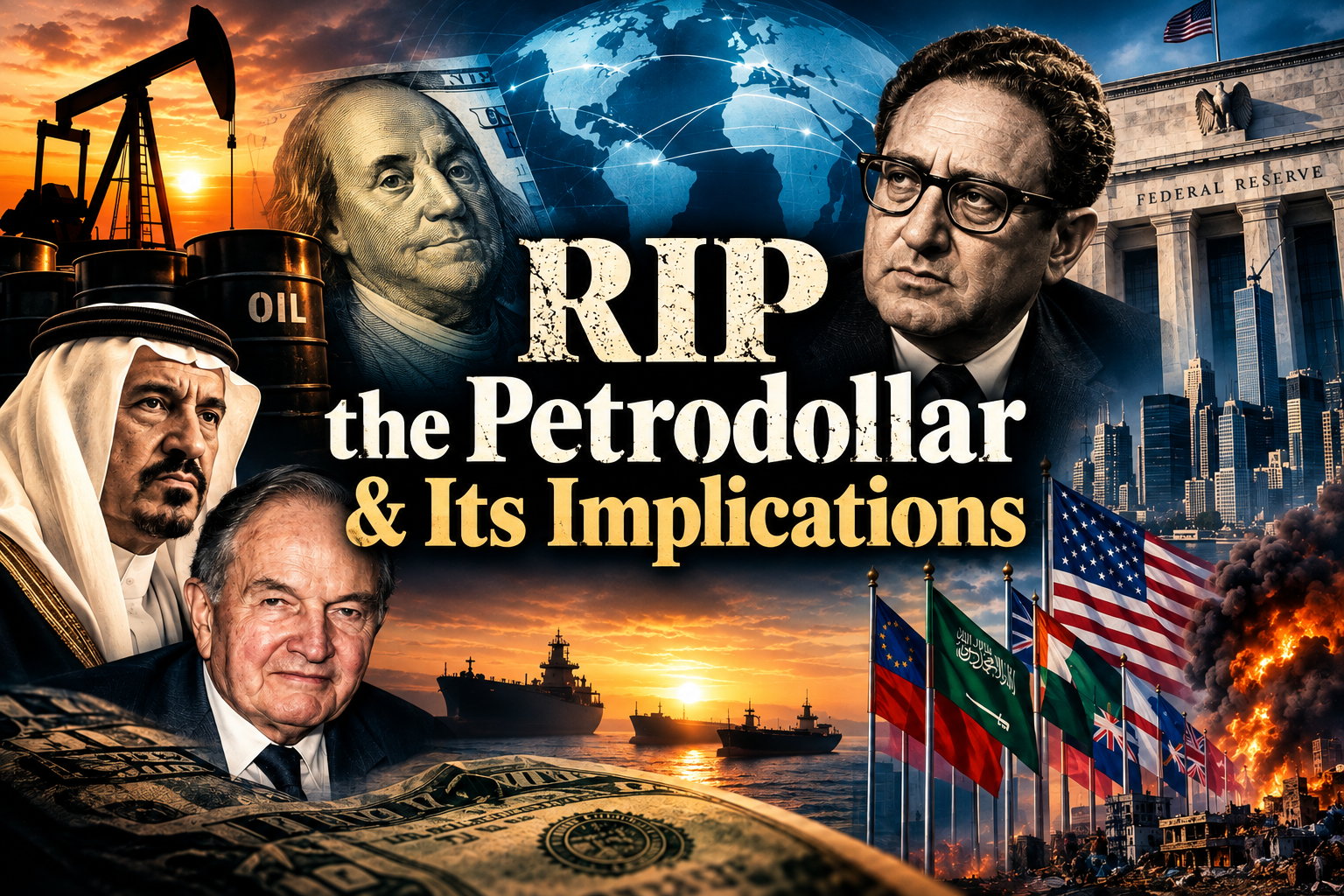
Despite this “starting capital”, the US as hegemon did not succeed in maintaining this strength over time. The list of coups, military conflicts and major wars launched by the US in the last 80 years is almost endless and has led to millions of civilian deaths, destroyed countries and bankrupted the US. The biggest problem for the United States is the fact that it has always lived beyond its means and spent more money than it earned. This led to the collapse of the Bretton Woods system after just 26 years, when President Nixon was forced to close the gold window, which led to them ripping off their partners in the Bretton Woods system. Then David Rockefeller’s sidekick- Henry Kissinger invented the Petrodollar, which turned the US dollar into the “King Dollar” and gave the US an instrument for unlimited debt, which the Americans also used as a weapon. Anyone who tried to break away and sell raw materials in currencies other than the US dollar was destroyed (Iraq, Libya). The turning point came with the freezing of Russian central bank funds, an infringement of assets that was primarily started by the vassals in the EU in 2022, with even “neutral” Switzerland (a Rothschild colony)participating in this – until then – unthinkable breach of the law.
This action will go down in the history books as one of the greatest blunders, as it not only heralds the end of the Petrodollar, but also greatly accelerates the coming together of the Global South, which is characterized by the fact that the Chinese and Russians no longer conduct 60%, but only 15% of their transactions in US dollars and the BRICS countries – whenever possible – conduct their trade activities outside the US dollar. This trend is accelerating with each passing year and will sooner or later lead to the collapse of the US budget, as it is dependent on the world holding US dollars, or else the US will collapse.
The stock markets in the West are still close to their highs, but are a miserable measure of the economic health of the Collective West. Most of the countries in this group are effectively bankrupt and are keeping themselves alive by printing money and cutting interest rates; interest rate cuts that are based on the lie that inflation has been defeated. Every European or American who has to watch their budget has tears in their eyes – from laughter or weeping – when they look at the official inflation figures.
The official figures have nothing in common with reality. It is the West’s last gasp before collapse. It is only a matter of time before this house of cards collapses. Whether the catastrophe starts in Europe, the US or Japan is of secondary importance, as this will lead to a domino effect.
Priority number 1 for the US: Prevent BRICS!
Whether the US can maintain its hegemony ultimately depends not on military successes, but on economic might. Every hegemon that has ever lost its status has lost it because it went broke. Nevertheless, the US’s approach makes perfect sense from its perspective. The weakness of the US can no longer be hidden. They are now trying to weaken their opponents – at least to create a balance on a relative level – by causing wars that are waged by third parties who weaken each other in the process.
This is intended to prevent the “rest of the world” from realigning itself collectively. BRICS stands for precisely this realignment: realignment through the creation of a multipolar world. If BRICS is successful, the US will disappear as a hegemon and will then be one of many players at the table, with defunct empires regularly acting as if they were playing a major role for centuries to come. The West’s cast-iron silence on BRICS should therefore by no means be interpreted as a lack of interest. The really important geopolitical developments are known to take place in the background. The Russians and Chinese are aware of this and are reacting with the discretion and restraint typical of both countries. There have been 200 events on BRICS in Russia last year and not a lot has been heard. It is a huge challenge for BRICS to develop in a well-structured way in this geopolitical turmoil. Some members are already at war with the Collective West (Russia, Iran), Saudi Arabia may not make up its mind as it is obviously under enormous pressure due to its huge investments in the UK and US. The formal signature for accession is still pending.
To date, US efforts to bring down BRICS by weakening Russia and China have failed. Nevertheless, the geopolitical turmoil that the US has caused in recent years is certainly influencing the development of BRICS – both negatively and positively. Negatively, as potential members are being bullied, such as Saudi Arabia. Attempts are also being made to influence full BRICS members by luring and threatening them (India, Brazil). Other countries that would like to join BRICS are put under pressure, even if the general public is not aware of this, as this happens in the background or the pressure is exerted for other reasons (e.g. Venezuela). The Indian Foreign Minister, Jaishankar, stated that India is now embarking on closer economic and industrial ties with China. The US pinned its hope on India to act as its attack dog on China. That is now crumbling. The positive effect of the US’s behavior is that many countries are becoming acutely aware of what could befall them if they are treated in the same way as Russia and China, although many countries in the Global South are mere microcosms compared to these two giants and therefore lack the resilience of Russia and China. Since BRICS sells multi-polarity credibly and actually behaves in a spirit of partnership and not domination and debt slavery, the prospect of living under the umbrella of this community is extremely attractive. This is evident from the long list of countries that would like to formally join or have expressed a strong interest.
Looking into the crystal ball – what can be considered certain: BRICS has evolved from an economic association to a geopolitical entity. In times of conflict, such an economic community must secure itself geopolitically. It is very possible that the SCO, a security policy organization, will move closer to BRICS or even merge with it. From an economic perspective, the biggest challenge for BRICS is to create an efficient payment or settlement system independent of the US dollar. At present, most trade activities within BRICS are settled in local currencies, but no solution has yet been found for settling trade deficits among the members. A lot is being written and rumored, but the Russians and Chinese are keeping their cards close to their chests on this matter. Being able to develop in an orderly and free manner in such an adverse environment is a huge challenge for an organization like BRICS. This organization, which was launched as a purely economic association, was originally designed to assert itself in free competition. Today, hatred, sanctions and wars are being used as a means to put an end to this organization. A loose economic alliance is becoming a geopolitical alliance and, in the event of further escalation, has every chance of becoming a military alliance
Why the Chessboard Needs to be Rejigged
It’s the greatest show on earth – unleashing a Manifest Destiny on crack. We are the greatest. We will rock you – in every sense. We will crush you. We will take whatever we want because we can.
And if you wanna walk away from the U.S. dollar, we will destroy you. BRICS, we’re coming to get ya.
Under Trump 2.0, global tech infrastructure must run on U.S. software, not just on the profit front but also on the spy front. AI data chips must be American only. AI data centers must be controlled by America only. “Free trade” and “globalization”? That’s for losers. Welcome to neo-imperial, techno-feudal mercantilism – powered by U.S. tech supremacy.
Trump’s National Security Advisor Mike Waltz has named a few of the targets ahead: Greenland; Canada; assorted cartels; the Arctic; the Gulf of “America”; oil and gas; rare earth minerals – all in the name of strengthening “national security”. A key plank: total control of the “Western Hemisphere”. Monroe Doctrine 2.0 – America First, Last and Always.The Empire faces a debt monster that may only be – partially – repaid by selected export surpluses. That would imply re-industrialization – a long, costly affair – and securing smooth military supply chains. Where the resource base will be for this task? Washington simply cannot rely on Chinese exports and rare earths. The chessboard needs to be rejigged – with trade and tech unified under U.S. unilateral, monopoly control.
Plan A, so far, was to simultaneously confront Russia and China: the two top BRICS, and key vectors of Eurasia integration. China’s strategy, since the start of the millennium, has been to trade resources for infrastructure, developing Global South markets as China itself keeps developing. Russia’s strategy has been to help nations recover their sovereignty; actually helping nations to help themselves on the sustainable development front. Plan A against the concerted geo-economic and geostrategic strategies of the Russia-China strategic partnership miserably failed. What has been attempted by the US has generated serial, massive blowbacks. So it’s time for Plan B: Looting the allies. They are already dominated their vassals anyway. The – exploitation – show must go on. And there are plenty of vassals available to be exploited.
Freak out in the EU
On the wider European front, activity is frantic. Assorted Rothschild -linked elites, from Europe to Canada, are in the process of being replaced by new, Trump affiliated elites. That ties into the “Looting the Allies “strategy- the further destruction of the vassal EU economy to strengthen the heart of the Empire. Germany needs to restart importing raw materials and cheap natural gas – let’s reopen Nord Stream – from Russia. That opens the tantalizing possibility that Trump fully realize that Germany is worthless to the U.S. as a de-industrialized backwater. Of course Trump will extract a hefty price for Germans to get a revitalized nation back. Trump at least holds the merit of a relatively realistic reading of the chessboard; Russia, India, China – the Primakov triangle – as well as Iran have become too powerful to be looted. So the next best option is plunder the Allies.
The Future of NATO in the Great America Project is now up for Grabs
The facts on the ground already spell out the “rules-based international order” being replaced in a flash by a no-rules international disorder. After all, international law has already been abolished by the Rockefeller Empire itself – when it comes to illegal, unilateral sanctions, theft of financial assets or legitimization of genocide and head-chopping “moderate rebels” as its proxy forces. All of this incendiary chain of events is on a roll essentially because of one single reason: the Empire lost the proxy war in Ukraine. What remains to be discussed is the modality of the surrender. It simply cannot be swept under the rug any longer: the Western order is literally in crisis. The people have had enough, and the avalanche is picking up inertia because the process is a self-reinforcing feedback loop: the more wanton elites fall, the more those citizens are energized to rise up against their own. And when that happens, the elites are forced to clamp and double down on their lies, hypocrisy, and repressions in a futile attempt to stem the flow; this leads to even more ill-will, resentment, and revolt against their destructive policies. Especially now that Trump has won, and the culture war against ‘Wokeness’- a Rothschild initiative – has taken a 180 turn, we see more and more reversals of this sort on a daily basis. The mask is falling; the pressure is slowly letting off. One can hardly believe it anymore. The West has dropped all pretense of their sacred cow of ‘democracy’, used for generations as an instrument of moral superiority with which to browbeat the rest of the world. As the West finally unravels, we are witness to a veritable string of shocking perversions of the so-called ‘democratic’ process.
The truth is that ordinary people got tired of the lies, hatred, hostility and the wars, as well as the intellectual and cultural junk food that’s become the pervasive staple among Western nations.
For all his faults, we must admit what Elon Musk has been doing on social media of late is a brilliant sally against the Rothschild Deep State forces in this vein. For those in the dark, Musk has been on an absolute tear on his X platform against all the Rothschild puppets of Europe—namely Starmer, Scholz and Macron. What Musk has done is simply shown that if you call them out loudly, they begin to wither and wilt, not to say panic—which is what they’re currently doing: It’s a difficult concept to grasp at first: that the elites’ entire paradigm of control over us is in actuality a fragile mental prison, and that we’re cowed into submission merely through their regime of fear-propaganda. But once the first loud voice bellows his defiance to the warders, the rest of the slaves quickly begin to see that there’s not as much to fear as they thought, that these ‘people’ in charge are more vulnerable than they put on. It breaks a kind of unseen barrier, a mental bondage which irreversibly opens up the flood gates against the establishment. In short: he’s making it “okay” to resist, and that’s a powerful device.
It’s all generating intense discussion throughout Europe which is opening the wounds that the elites have wanted to keep buttoned up. You can feel the global changes on the wind, the unexpected fresh energy that Trump has brought has stirred things up, thrown the establishment on the back foot.
Rockefeller’s Great Reset & Trump has the Mandate
David Rockefeller Jnr-the current head of the family has given Trump a mandate to work towards dividing the world in a “3-bloc” order.
This will leave Russia to dominate Eastern Europe, southern and Central Asia.
This will leave China as the dominant power in eastern Eurasia.
This will leave the United States as the dominant force in both North and South America.
Regarding the Middle East, the aim is to leave Israel as the “attack dog” of the US, in order to keep the Arabs and the oil-rich region under its control. Israel will act as America’s proxy in the region. The key to making this work is Saudi Arabia. Hence, the first foreign trip of Trump is to Saudi Arabia. Europe has no role in this Great Reset. That leaves the Rothschild family and its EU vassals in a fix. That’s the reason for all the hysterical hot air coming out from its key puppets- Macron and Starmer. This is especially true in regards to the US exit from Ukraine. The Great Global Reset could lead to a complete overhaul of the global order. We know that the Kremlin and many other powers including China, India and Iran are keenly interested in redrawing the Eurasian continent’s security architecture and also improving global economic, financial and trade relations. Since the post-World War II period, these relations have heavily favored the Western world in general, but especially the United States. As a result, the West will resist any real changes. However, judging by the statements of Trump’s Secretary of State during his confirmation hearing last month, the current administration may have adopted a different approach.
Not just obsolete…
Secretary of State (a post reserved ONLY for Rockefeller men since the 1920s) Marc Rubio stated that, “The postwar global order is not just obsolete – it is now a weapon being used against us. And all of this has led to a moment in which we must now confront the single greatest risk of geopolitical instability and of generational global crisis…” At the same time, one of Russia’s leading intellectuals and an advisor to the Kremlin, Sergei Karaganov may have revealed the Russian thinking in stating that Russia’s task was to help the United States transition to the new global order as peacefully and with the least disruption as possible. But what could that global order be, and how could Russia help America’s transition to it? Why would the US want to transition? The Trump administration may have clear domestic and foreign policy agendas, but they also have a major weakness in an unbalanced US economy and its overhang of unpayable debts. The three-block architecture has long been an obsession of the British Empire and probably is coherent with the world’s geopolitical realities. The same basic idea also shaped US postwar foreign policy. It is the reason why the Trilateral Commission, formed by Zbigniew Brzezinski and Henry Kissinger (the 2 international geopolitical gangsters in the service of David Rockefeller) has the word “trilateral” in its name.
Towards a New & Improved 3+ Block World


A future, multipolar 3+ block world might envision China as the hegemon in East Asia, Russia in Central and Eastern Europe and the United States in the Americas. Regional powers like India, Iran, Turkey, Brazil, Egypt and South Africa could hold their spheres of influence and become guarantors of peace there. An overhaul of a new global order along these lines could be radical enough that it might warrant significant redrawing of borders, not only in Eastern Europe and the Middle East but also in the Americas, which might explain Trump’s ambitions to acquire control of Panama, Greenland and Canada.
It’s a time of great sweeping change, a crossroads of world history where upheaval usually finds its most fertile ground.
Conclusion
What the death throes of a hegemon look like is currently being demonstrated to the global public in all its gruesome detail. An unbelievable number of people are dying, genocide is once again considered acceptable in the West, and the media are becoming drivers of hatred, concealing objectively important developments and lying through their teeth. Vassals are sent into the fire for ‘the good cause’. Their own population is lied to and economically ruined. It is becoming increasingly difficult for the hard-hit empire to credibly convey the noble slogans of “freedom”, “democracy” and “prosperity” to its people.
The more the post-modern West loses control of the world with its mode of nihilistic reasoning, and the more diverse Asia remains, the less chance of the Rockefeller Empire succeeding.In this context, what is likely to prevent the triumph of the Empire is the collapse of technical civilization” – as such that it is.
Many across the globe have noted how hundreds of millions of Europeans voted in the June EU parliamentary elections. Yet the clear signal from the ballot box has had absolutely no impact on how Brussels is governed. The same leadership simply was re-instated. The façade of active popular participation in policymaking has slipped. There is the feeling of everything being ‘on hold’. The notion of truth — on which we relied are vanishing.
Into this toxic geopolitical cocktail, David Rockefeller Jnr and his family have ordered a brand new paradigm moving forward. They will now retreat from the world, consolidate, re-arm and re-industrialize, as well as bring its neighbors “to heel”. As explained in previous article, they aim to format a “3-bloc” world. While negotiations are going on with Russia over Ukraine, New York is still set on blowing up the Middle East. This will add pressure on Russia, China and Saudi Arabia. So, instead of trying to take down three countries, the US will focus on destroying Iran. With Iran badly damaged, it leaves both China and Russia vulnerable. How possible would that be? Only time will tell. The story continues in Part 2.
One thought on “The 5 Major Power Centers Globally Part 1 (of a 3 Part Series)”