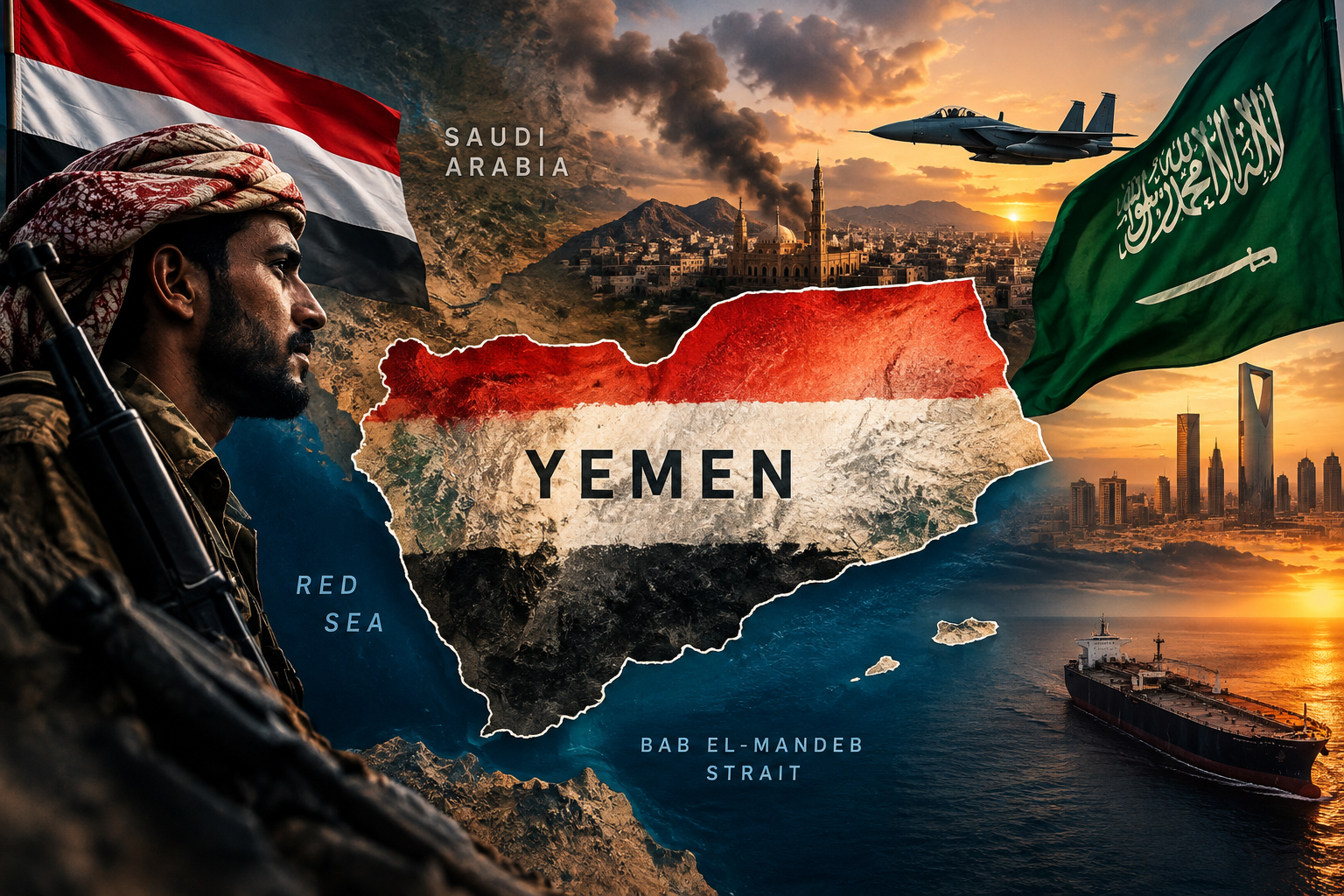
Once viewed as a convenient Saudi punching bag, Sanaa is today reshaping the dynamics in the region and creating new challenges for both regional and international actors.
The Yemenis have shown the ability to launch – and get away with – nonstop military operations at sea against ships linked to Israel, the US, and the UK, missile operations and drones targeting the Israeli depth, and even US aircraft carriers and destroyers stationed in the Red Sea, Arabian Sea, and northern Indian Ocean.These US naval forces conduct regular air operations against the war-torn Gulf state, attempting to intercept Houthi’s efforts and influence its strategic decision to support Palestine and Lebanon. The boldness of these operations demonstrates Yemen’s unyielding commitment to supporting the Resistance Axis and becoming the first Axis member to confront global powers directly.
Both the American-British aggression warplanes continue to launch attacks on Yemen, every few days, but these are empty attacks as no military losses were recorded. Very few strategic sites have been struck, other than the airport, ports, fuel dumps, power stations, etc.
Under Secretary of Defense for Acquisition and Sustainment Bill LaPlante spoke at an event hosted by Axios on Wednesday, where he said that Houthis are displaying and deploying advanced weaponry, especially missiles that “can do things that are just amazing – Yemeni missiles can do things that are just amazing,” expressing that Sanaa’s operations “are getting scary – – I’m an engineer and a physicist, and I’ve been around missiles my whole career. What I’ve seen of what the Houthis have done in the last six months is something that – I’m just shocked”. The Houthis “are getting scary” in terms of their capability on display for more than a year in the Red Sea, where they’ve gone to war against Israeli and international ship. The Houthis possess surprisingly advanced capabilities include anti-ship ballistic missiles. The Houthis have also routinely scored direct hits on commercial shipping vessels with both aerial and drone boats. The past year has seen a number of videos showing destruction of large tankers off Yemen’s coast. They has also scored hits on US, UK, and other allied warships; however, the US has kept a tight lid on the extent of this, or actual damage, to avoid being publicly humiliated and to avoid giving the Houthis a psychological win.
The enduring conflict in the Red Sea has been widely acknowledged as the biggest naval battle that US forces have been engaged in since World War II. Several US and Israeli airstrikes have hit Houthi positions hard over the last months, but this appears to have done little to erode Houthi capabilities.
In response to the ongoing US and British aggression against Yemen and in the Yemeni Armed Forces (YAF) announced Tuesday, November 11th , two major military operations targeting US naval assets in the region.
Houthi attacks & US/UK/Israeli Counterattacks
Nov 10
US and British military formations, including swarms and combat units, were launched toward Yemen on Monday 10th November, but were successfully repelled by the Yemeni Army. The advancing forces were forced to retreat following a decisive response from the Yemeni military.
The US and British forces had been preparing for a large-scale offensive against Yemen, but the operation was thwarted by a precise and strategic military action carried out by the Yemeni Army. The operation, which was described as “highly accurate,” had effectively disrupted the enemy’s plans.
The military operation was not only a defensive maneuver but also an intelligence-driven, highly targeted strike. The Yemeni forces had meticulously analyzed the battlefield allowing them to anticipate the movements of the enemy and preemptively strike with precision. The Houthis launched five anti-ship ballistic missiles and three anti-ship cruise missiles at an aircraft carrier USS Abraham Lincoln, the USS Spruance and USS Stockdale. All three ships were struck multiple times, and the aircraft carrier was badly damaged. But as usual, the Pentagon hides such news. This is nothing new from the Empire of Lies. This operation was conducted over an eight-hour period.
“The Nicholson was towed towards the Pacific Ocean after being attacked … Its repositioning will not prevent it from being targeted again if it is used to carry out hostile acts against Yemen”. The USS Abraham Lincoln is not the first aircraft carrier to be targeted by Yemen as in the summer; it struck the USS Eisenhower twice in 24 hours. The first operation targeted the US aircraft carrier USS Abraham Lincoln in the Arabian Sea. Using a combination of cruise missiles and drones, Yemeni forces struck the vessel while it was reportedly preparing for operations against Yemen. The statement said the operation thwarted an impending American aerial assault, achieving its objectives without interruption. The second operation targeted two destroyers with ballistic missiles and drones, again claiming successful strikes against the vessels. In light of these events, the Yemeni Armed Forces held the US and the United Kingdom accountable for turning the Red Sea region into a zone of military tension, warning of the consequences for maritime navigation in the area. Two days later, Abdul-Malik al-Houthi revealed that the aircraft carrier was forced to retreat “hundreds of miles” away from the Yemeni coast as a result of the retaliatory attacks. “In some instances, the [US] aircraft carrier navigates close to certain African coastlines out of fear of being targeted,” the Yemeni resistance leader.
Pentagon officials on 19 November stated that the USS Abraham Lincoln left the Red Sea “over the weekend,” and leaving the region without a US carrier strike group for just the second time in over a year.
Strategic Capabilities of Yemeni Forces
The complexity and coordination of these missile and drone strikes signify the strategic planning capabilities of Yemeni forces. Conducting an eight-hour operation against such formidable targets required extensive intelligence, meticulous coordination, and advanced technology – a testament to the growing capabilities of Yemeni forces in both conventional and asymmetrical warfare. The Yemeni armed forces have previously directed strikes against US destroyers, as well as the US aircraft carrier which was targeted twice in the northern Red Sea region.
This discrepancy in reports points to the ongoing information warfare between these two adversaries, with each trying to control the narrative and maintain morale. Sanaa’s confidence in openly challenging the US version of events highlights its newfound regional communication impact and its intent to shape the international perception of the conflict.
Sanaa’s Strategy of Gradual Escalation
Yemeni military expert Brigadier General Shamsan emphasizes that the unexpected strike sent multiple messages to Washington. One key message was that the era of US attempts to assert influence without facing repercussions is over: “Sanaa’s capabilities are no longer just defensive but extend to taking the fight to the enemy – especially at sea.”
“Whoever can conduct an eight-hour sea operation has the capability to execute broader offensives,” Shamsan warns, cautioning against any new American “adventure” against the Yemeni armed forces. He notes that Sanaa is not using all its resources at once but is gradually escalating its tactics, suggesting that hypersonic missiles could be deployed in future operations to cause severe damage – – rather than merely issuing warnings.
This gradual escalation signals a meticulously thought-out strategy that keeps the enemy guessing, maintaining an element of unpredictability: “Sanaa does not throw its cards at once, but rather launches gradually, and what drones and winged missiles have reached can be reached by hypersonic missiles with a different effect that goes beyond warning and aborting enemy operations to direct and serious injuries to the aircraft carrier. The US understood that message well, and accordingly worked to withdraw its aircraft carrier miles away.”
A Week Later
At the same time, the Yemeni Armed Forces also carried out a strike on Tel Aviv region using a hypersonic missile of the Palestine 2 type, confirming its success strike. Early Thursday, sirens blared in Tel Aviv following the launch of a Yemeni surface-to-surface ballistic missile. The attack forced large numbers of settlers to seek refuge in shelters. An Israeli media platform reported that “the missile launched from Yemen directly hit a building in central Israel.” Simultaneously, Israeli media outlets reported multiple explosions in Jerusalem as air raid sirens sounded in Tel Aviv. Israeli air defenses failed to intercept a Yemeni hypersonic missile, adding that nearly a million settlers rushed to shelters after the missile struck Gush Dan.
“The last operation had a devastating impact on the Israeli enemy, and they should read it carefully, being in a state of shock and awe from the results of the Yemeni military action,” a Houthi source said.
Israeli strikes targeted the central Dahban power station in northern Sanaa. Later, he indicated that civil defense teams successfully extinguished the fire at the Dahban station, while efforts continued to put out a blaze at another facility. Local Yemeni sources confirmed that three airstrikes targeted the power station in the Hezyaz area south of Sanaa. The sources added that the strikes caused widespread power outages across several areas due to the Israeli assault on the Hezyaz power station.
Mohammed Al-Houthi added that the ongoing attacks on Yemen will not deter Sanaa from carrying out its supportive duty for Gaza, vowing that military operations will continue no matter what.
A Few Days Later
In response the Yemeni Armed Forces executed several military operations. The operation targeted three US ships shortly after their departure from Djibouti’s port, as the ships had previously engaged in the aggression against Yemen. Additionally, the Yemeni Armed Forces targeted two American destroyers accompanying the supply ships in the Gulf of Aden. The coordinated attack employed advanced missiles and unmanned aerial vehicles (UAVs), successfully achieving its objectives in the second attack on such vessels within 10 days. The YAF announced on Sunday the targeting of one US destroyer and three US supply ships in the The Stena Impeccable, Maersk Saratoga, and Liberty Grace ships, belonging to the US Army, as well as an American destroyer, were targeted in a top-tier military operation carried out by the YAF’s missile and drone forces – 16 ballistic missiles, one cruise missile, and one drone were used to carry out the multifaceted operation, achieving precise hits, in both the Arabian Sea and the Gulf of Aden. And, then, Israel attacked Yemen.
Dec 19

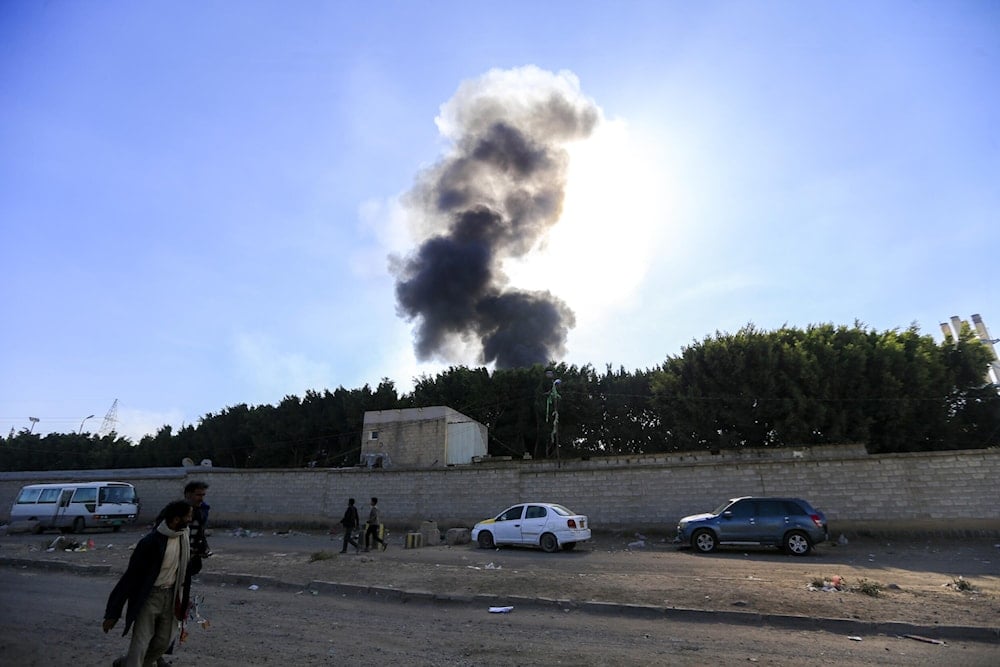
Smoke was seen coming from oil tanks at a power station that was hit by an Israeli airstrike in the capital Sanaa on December 19, 2024. Israeli media disclosed the details of “Israel’s” aggression on Yemen that took place at dawn Thursday. It quoted an Israeli reserve major, one of the pilots who participated in the air strike on Yemen, as saying that the mission “was very complex.” The Israeli officer explained that “the strikes covered a distance of approximately two thousand kilometers, with over sixty bombs dropped during the night. The precision of the raids was crucial,” adding that “the pilots remained in the aircraft for six hours, from takeoff to landing.” Meanwhile, the Ynet news website reported that preparations for the operation lasted two weeks.
Yemen Attacks Tel Aviv
In a related development, the Yemeni Air Force carried out two attacks on military targets in the occupied Palestinian areas of Tel Aviv and Ashkelon the next morning. A drone made a direct impact and detonated in a ten-story building in the city. Footage circulated on social media showed smoke billowing from one of the top levels of the building. Early on Saturday morning, a Yemeni missile made in Tel Aviv, evading Israel’s air defense systems and injuring over a dozen. Yemeni forces also carried out a ballistic missile on Tel Aviv early on 19 December, coinciding with violent Israeli airstrikes on Yemen.
On 21 December, the Yemeni Armed Forces (YAF) announced that an F-18 fighter jet was downed during a US attack on Yemen. The operation, which utilized eight cruise missiles and 17 drones, successfully thwarted an air strike on Yemen.
The F-18 came down as the US was confronting Yemeni drones and missiles. Most of the US jets withdrew from Yemeni airspace to international waters in the Red Sea. The USS Harry S. Truman ship withdrew to the northern Red Sea after being repeatedly targeted.

26 Dec
“Israel” launches a large-scale attack on Yemen, targeting civilian facilities including Sanaa International Airport and Hodeida Port with US-UK assistance. The attack targeted three central sites: Sanaa Airport, a power plant in Sana’a, and the Hodeida port, noting that “this is not an ordinary attack, but the opening of a battle that could be prolonged.”
The Israeli airstrikes hit Sanaa International Airport in the northern part of the capital, as well as two airstrikes on the Hiziz Central Power Plant south of Sanaa. Outages in parts of Hodeida Province due to the Israeli attack on the Ras Kathib Central Power Plant in the northern part of the coastal city on the Red Sea in western Yemen. Israeli aircraft disabled Sanaa International Airport by destroying the control towers and also disrupted the Hodeida seaport.
Image showing a fire breakout after the Israeli aggression on Hodeida port, Yemen, on December 26, 2024. The Israeli occupation launched this attack while the leader of the Houthi movement, Abdul Malik al-Houthi, was delivering his speech. A Houthi source also said that targeting civilian facilities is evidence of the occupation’s failure to have a clear target list within the country, stressing that this “will not change the course of the war and will be met with a similar response.” The Israeli occupation’s aggression targeted a gathering of travelers, including patients, at the Sanaa International Airport terminal, and also targeted airport control towers. The Israeli aggression on Sanaa International Airport took place during the in the airport: the WHO’s Director and the UN’s resident coordinator. The UN airplane’s co-captain had been injured and was transported to a hospital after the Israeli aggression on the airport, adding that two other airport employees were also killed as a result of the attack. The source emphasized that the Israeli entity should “not lie in wait for a response from Sanaa because its military operations will continue.”
According to Israeli Channel Kan, this was “Israel’s” fourth attack on targets in Yemen, adding that the United States had been informed of the operation. Earlier on Thursday, the 26th Dec, airstrikes hit the Hodeida port and the Ras Issa oil facility in western Yemen, resulting in the killing of nine people and injuries to several others among the facility’s staff. Then, further strikes took place on Monday and Tuesday -the 30th and 31st, and involved American ships and aircraft. The targets included a Houthi command and control facility, weapons production plants, and ammunition dumps. Additional strikes targeted a coastal radar site and seven Houthi cruise missiles over the Red Sea. The Houthis fired another ballistic missile at Tel Aviv last week, targeting Ben Gurion airport, and a power station. One of the hypersonic missiles struck the most heavily-defended base in the world-the Nevatim air base- the same one that was struck twice by Iranian missiles.
Following the first attack on Tel Aviv, Israeli Prime Minister Benjamin Netanyahu said that he had instructed the IDF to “destroy the infrastructure of the Houthis” with “full force.” Despite the IDF launching multiple attacks on Yemen, a spokesman from the group said last week that they would “escalate our military targeting of Israel…until the genocide crimes and the siege on Gaza stop.”
YAF spokesperson Brigadier General Yahya Saree: The operation was conducted using a Palestine-2 hypersonic ballistic missile and successfully achieved its objective
Dec 31
The YAFcarried out two ‘top-tier’ operations, targeted USS Truman. The first operation targeted Ben Gurion Airport in Tel Aviv in occupied Palestine, while the second operation targeted a power station in southern occupied al-Quds. The Yemeni missile force carried out two top-tier military operations against Israeli targets. The first targeted Ben Gurion Airport Tel Aviv using a hypersonic ballistic missile of the Palestine-2 type, adding that the second operation targeted a power station in southern occupied al-Quds with a Zulfiqar-type ballistic missile both missiles successfully hit their targets.
The two operations coincided with a joint operation conducted by the YAF’s naval, missile, and UAV forces, targeting the US aircraft carrier USS Harry S. Truman with a large number of drones and cruise missiles, while US forces were preparing to launch a major aerial attack against Yemen. He confirmed that the operation successfully achieved its objectives, thwarting the planned American aerial assault on Yemen.
Jan 1
The leader of Yemen, Abdul Malek al-Houthi, highlighted the numerous operations conducted by the Yemeni Armed Forces this week, including “missile strikes on Tel Aviv, Ben Gurion Airport, the Nevatim Airbase, and a power station south of al-Quds.” He stated, “This week, we carried out a significant and powerful operation, targeting the US aircraft carrier USS Harry S.Truman for the second time with 11 cruise missiles and a drone.” He explained that the operation coincided with “preparations for launching a large-scale aggressive operation against our country, targeting several provinces.” As a result, “the U.S. plan to attack our country was thwarted, leading to the retreat of the carrier and its accompanying naval vessels to the far north of the Red Sea.” He added, “This week’s operations included the downing of two MQ-9 drones in Al-Bayda and Ma’rib. These expensive drones are crucial for US reconnaissance and aggression.” This makes it 14 such drones since the past 14 months.
Abdel Malek noted, “The occupation describes Yemen as an extremely complex adversary, which is highly positive for us. It signifies that Yemen, both officially and popularly, is a resilient, strong, steadfast, and cohesive nation.” He further mentioned that “the Israelis were surprised by the intensified supportive operations for the Palestinian people from Yemen, which have had significant impact and effectiveness.” He also revealed that during a year of U.S.-British aggression, 106 Yemenis were killed and 314 were injured, with 931 airstrikes and naval offensives recorded.
On Thursday Yemen launched two hypersonic ballistic missiles on Wednesday: the first was fired after dusk, while the second was launched as Israeli warplanes carried their aggression on Yemen. In his weekly televised speech, al-Houthi announced that one of the missiles was aimed at the Israeli Ministry of Security, timed with the Israeli airstrike on Yemen, causing significant confusion for the occupation forces and disrupting their mission.
In total, the Yemeni Armed Forces had launched 1,147 ballistic missiles, cruise missiles, and drones, in addition to targeting 211 enemy-linked ships. They also succeeded in blocking Israeli maritime traffic in the Red Sea, Bab al-Mandab, and the Arabian Sea.

4 Jan
On Saturday, Yemen struck Israel again. We are losing count of how many attacks are hitting Israel from Yemen. It’s becoming almost a daily routine. The operation targeted the Israeli Orot Rabin power plant in the southern region of occupied Haifa. The operation was conducted using a Palestine-2 hypersonic ballistic missile and successfully achieved its objective.
In response, US-British aggression targets Yemen’s eastern Saada with 3 airstrikes targeted the September 21st Park, located in the northwestern part of Sanaa, which previously housed the First Armored Division. The aggression targeted, with eight airstrikes, a complex that includes the Ministry of Defense and military administrative offices in the Bab al-Yemen area in central Sanaa, as well as the May 22nd Military Industrial Complex in the al-Nahda neighborhood, northwest of Sanaa.
Yemen Establishes ‘Eye for Eye’ Equation Against Enemies
The technological and multifaceted advancement does not solely entail strategic weaponry, but also Yemen’s intelligence and plans to thwart the enemy’s plots, noting that the armed forces’ latest naval operations and attacks targeting deep occupied territories were achieved using several military tactics.
Regarding missile operations, the Yemeni source stressed that several missiles are capable of reaching occupied Tel Aviv without being intercepted, including the hypersonic ballistic missile, the Zulfiqar ballistic missile, as well as other weapons from the country’s arsenal. He then emphasized that the Yemeni army is preparing “surprises”, demanding the end of the aggression on Gaza given that Yemen’s support for the territory will not cease. “Yemen possesses a myriad of military choices, and the American and British enemies failed in deciphering Yemen’s technical codes,” the source noted, adding that the armed forces own advanced and precise weapons designed to defeat and penetrate all air defenses.
Given the aggression on both Gaza and Yemen, the Yemeni army has decided to establish a new military equation: Power grid for power grid and airport for airport. On this point made by Houthi, Israel has far more targets for Yemen to strike, while Israel has limited targets to strike in Yemen. In addition, while Israel and its backers have to fly 2,000kms to strike Yemen- costly and risky. While all Yemen has to do are fire hypersonic missiles at strategic targets in Israel. Yemen can do this month after month. Will the Israeli/US/UK combo be able to sustain these attacks on Yemen for a year? Very doubtful.
Sanaa was strictly monitoring all suspicious movements, warned against complying with the enemy’s plots. Yemen’s intelligence is busy to thwart the enemy’s plots, noting that stressed that the aggression on Hodeida and Sanaa did not impact the battle nor alter Yemen’s position. ,
Jan 6
In a significant joint operation, the missile and UAV forces of the Yemeni Armed Forces targeted the American aircraft carrier USS Harry S. Truman in the northern Red Sea. The UAV forces conducted multiple strikes this afternoon and evening, targeting Israeli occupation sites.
– First operation: Two drones targeted a military site in the occupied area of Haifa.
– Second operation: A vital target in occupied Askalan was struck with a drone.
– Third operation: A military site in the occupied area of Haifa was again targeted later in the evening also with drones. The missile force of the (YAF carried out a military operation targeting the Israeli Orot Rabin power plant in the southern region of occupied Haifa on Sunday. The operation was conducted using a Palestine – missile and successfully achieved its objective, Saree confirmed in a statement, “2 hypersonic ballistic missiles were used.”
Jan 9 Ongoing Confrontations against US
This week witnessed the third direct confrontation with the US aircraft carrier Harry S. Truman, marking the sixth overall clash with American carriers. The latest encounter coincided with US preparations for large-scale aggressive operations against Yemen, which were thwarted with divine assistance.
The confrontation resulted in a notable tactical achievement as Truman rapidly retreated, altering its course and fleeing to the far northern Red Sea. All accompanying warplanes, initially launched for hostile missions, were recalled immediately.
10 Jan
The Yemeni capital of Sanaa came under heavy attack as the while Yemen’s Sabeen Square was filling up to initiate the weekly million-man marches in solidarity with Gaza. According to the Ministry of Internal Affairs, the aggression targeted the vicinity of Sabeen Square in Sanaa, just as popular crowds were filling the area to showcase their support for the Palestinian people and Gaza Strip, against the Israeli occupation. Moreover, the US-UK aggression launched 12 airstrikes targeting the Harf Sufyan District, in Amran Governorate. The attacks did not result in any human casualties or military damages. The port of Hodeidah was also targeted with six airstrikes.
The US/UK/Israel combo launched raids on Thursday at dawn, targeting the capital Sanaa, Hodeidah, and Amran governorates, with three raids. Also, a raid targeted al-Luhayyah governorate, northwest of the coastal Hodeidah Governorate in western Yemen. The main power station in Haziz, south of Sanaa, was struck as well. More than 20 fighter jets took part in the attack, and this was the first joint US–British–Israeli attack against Yemen. The attacks coincided with a drone and missile attacks on the USS Harry Truman Aircraft carrier and other US warships near the Red Sea. It also announced targeting the Tel Aviv area with three drones, which Israel said were shot down on Thursday night.
Israeli news outlet Channel 12 said the strikes against Yemen on Friday were not a response to the drone attacks but rather “a large-scale attack that was planned in advance, as part of a change in Israel’s policy towards Yemen.” It added that preparations have begun for a Yemeni response against Israel.
Israeli officials have made threats against Yemeni leadership recently. The Houthis made a similar pledge, in a “tit-for-tat” reprise, saying “like-for-like”- – – “If you target our leadership, then we will target your leaders as well “. That gave the thieves in Tel Aviv a cardiac event. Sanaa’s security forces announced this week that they foiled a UK–Saudi aimed at gathering intelligence on military targets and state leaders in the country.
Meanwhile, Sanaa has repeatedly asserted that it will not cease its operations until the war in Gaza is brought to an end. Abdul Malik al-Houthi, leader of the Ansarallah movement, said on 9 January in a speech that “the circle of panic, fear, extreme terror, anxiety and great turmoil is expanding in Israel” as a result of Yemeni operations. Sirens went off in multiple areas across central occupied Palestine, early on Tuesday, due to a Yemeni ballistic strike. This includes the occupied cities and city settlements of Tel Aviv, among other areas. At least 11 Israeli settlers were injured while rushing into bomb shelters, according to Israeli media outlets.On the other hand, Saree announced on Tuesday morning the details of this latest strike. He explained that the YAF fired a Palestine-2 hypersonic ballistic missile aimed at the Israeli Security Ministry in Tel Aviv. Saree said that the missile surpassed enemy defenses and reached its target. Additionally, the YAF’s Unmanned Air Force conducted a top-tier military operation targeting vital Israeli sites in Tel Aviv with four one-way attack drones, Saree added, confirming that the two operations successfully achieved their objectives.
Jan 14th YAF targeted Israeli sites, power station in Tel Aviv, Eilat
The Yemeni Armed Forces’ UAV unit carried out a top-tier military operation targeting Israeli positions in the occupied area of Tel Aviv using several drones, its spokesperson announced Tuesday evening.
The YAF’s missile force conducted another military operation targeting the Israeli power station in the area of Eilat in southern occupied Palestine with a cruise missile. Both operations successfully achieved their objectives, the Yemeni spokesperson confirmed. Saree underlined that the YAF will carry out additional military operations against “Israel” and are capable of targeting more Israeli military positions in the coming period in support of the Palestinian Resistance. Elsewhere, he reiterated that these operations will not cease until the aggression on Gaza ends and the siege imposed on the Palestinian enclave is lifted. At least 11 Israeli settlers were injured while rushing into bomb shelters, according to Israeli media outlets. Meanwhile, the Israeli military command said that several interception attempts were made to down a ballistic missile launched from Yemen, but all failed. There is no air defense system in the world that can bring down a hypersonic missile. Later, Saree confirmed that the YAF fired a Palestine-2 hypersonic ballistic missile in Tel Aviv, pointing out that the missile surpassed enemy defenses and reached its target.
Yemen foils the CIA/Mossad/MI6 Spy Ops


The Yemeni security apparatus revealed that they have foiled intelligence activities by the CIA and the Mossad. In a statement issued on Wednesday, the Yemeni security forces stressed that “the enemy’s intelligence seeks, through espionage activities, to hinder the Yemeni people’s stance in support of Gaza by targeting its military forces and leadership.”
The statement affirmed that they would spare no effort in fulfilling their responsibility to secure the internal front and protect it from attempts of penetration by their adversaries, further warning of the danger of collaborating with noting that the penalty for such actions could reach the death sentence.
In this context, the security forces revealed that several collaborators and spies, recruited by Hamid Hussein Fayed Mujalli, a wanted fugitive, were arrested over the past few days. According to the statement, they were assigned intelligence missions, including monitoring and identifying locations of missile forces, drones, naval forces, and other military sites. Tracking and gathering information on experts, laboratories, platforms, and vehicles used for launching missiles and drones were also among the as well as monitoring locations and positions of naval forces, camps, and weapons depots belonging to the armed forces. Moreover, the collaborators attempted to locate and gather information on the whereabouts of the leader of the Yemen, Abdul-Malik al-Houthi.
In June, the Yemeni Security Forces uncovered a large espionage network operated by American and Israeli intelligence agencies. Officials revealed that the network had been active within various institutions in Yemen since 2015.
Strategic Capabilities of Yemeni Forces
The Houthis possess surprisingly advanced capabilities include anti-ship ballistic missiles.
The Houthis have also routinely scored direct hits on commercial shipping vessels with both aerial and drone boats. The past year has seen a number of videos showing destruction of large tankers off Yemen’s coast. They has also scored hits on US, UK, and other allied warships; however, the US has kept a tight lid on the extent of this, or actual damage, to avoid being publicly humiliated and to avoid giving the Houthis a psychological win. The enduring conflict in the Red Sea has been widely acknowledged as the biggest naval battle that US forces have been engaged in since World War II. Several US and Israeli airstrikes have hit Houthi positions hard over the last months, but this appears to have done little to erode Houthi capabilities. The boldness of these operations demonstrates Yemen’s unyielding commitment to supporting the Resistance Axis and becoming the first Axis member to confront global powers directly. The complexity and coordination of these missile and drone strikes signify the strategic planning capabilities of Yemeni forces. Conducting an eight-hour operation against such formidable targets required extensive intelligence, meticulous coordination, and advanced technology – a testament to the growing capabilities of Yemeni forces in both conventional and asymmetrical warfare.
This discrepancy in reports points to the ongoing information warfare between the two adversaries, with each trying to control the narrative and maintain morale. Sanaa’s confidence in openly challenging the US version of events highlights its newfound regional communication impact and its intent to shape the international perception of the conflict.
According to the commander of Washington’s USS Carney and other crewmembers of the warship, the Yemeni army has been posing a threat unseen by the US since World War II. Efforts to deter Sanaa have also failed. The commander of the EU military mission in the Red Sea said in May that he did not have enough ships to confront the Yemeni Armed Forces’ maritime operations.
Sanaa’s Strategy of Gradual Escalation
Yemeni forces are steadily improving their and capabilities, challenging US dominance in the region. This consistent enhancement of ballistic missile technology, drone capabilities, and real-time surveillance is what continues to reshape the military balance in the region. American and British forces have been launching sporadic strikes on Houthi targets since last October, when the Yemeni militants began attacking Israel-linked shipping in the Red Sea in response to West Jerusalem’s war on Hamas in Gaza. These strikes have increased in scale and frequency since the group hit Tel Aviv with a ballistic missile earlier this month.
Houthi identified two key factors delaying the occupation’s broader expansion: Resistance and the demographic challenges faced by the occupation. “The Israeli enemy lacks the necessary numbers to expand across the vast geographic areas it aims to dominate and continues to seek more Jewish settlers.” Israeli hostility knows no bounds. “Everyone in Lebanon, Syria, Jordan, and Palestine must understand that the Israeli enemy harbors aggressive and expansionist ambitions to dominate and plunder all these countries,” Houthi said, criticizing the policies of Jordan and Syria, arguing that they would not deter the occupation from its expansionist objectives
Regarding Syria, Houthi explained that the Israeli occupation seeks to solidify its control over recently occupied areas, emphasizing that this occupation is not temporary. He pointed to Israeli military reinforcements, the establishment of fortifications, and the construction of barracks, including at the al-
Mantra Dam, the largest in southern Syria. He noted that the US is taking advantage of the situation in eastern Syria to strengthen its presence by establishing new military bases and expanding its control. Houthi warned that both the US and Israel aim to infiltrate Syria internally by recruiting spies and sabotage cells, targeting the Syrian people’s security and seeking to divide the society.He criticized policies that negatively impact minorities in Syria, stating that the US and the Israeli occupation exploit such policies to present themselves as protectors of minorities. He highlighted the psychological and operational impact of these strikes on the occupation, noting widespread panic and alarm among settlers reconsider their operations. According to Houthi, these disruptions, combined with the high costs and inefficiencies of the Israeli occupation’s missile defense systems, are further straining the economy. Houthi emphasized the failure of the occupation’s interception systems, citing instances where missiles reached their targets despite claims of successful interception. The Yemeni operations have also disrupted activities at Ben Gurion Airport, forcing the suspension of flights and prompting several. Airlines to cancel Tel Aviv from its routes, adding further costs to Israeli economy. More than half of Israeli settlers reportedly sought refuge in shelters as sirens blared across over 234 cities and settlements. The economic repercussions of Yemen’s operations continue to weigh heavily on the Israeli occupation, he stressed. Rising costs have forced significant price hikes, he said, citing Israeli media describing the crisis as a “tsunami” impacting various goods and public services, affecting every settler household. Reverse migration is increasing.
Moreover, he underlined a significant security achievement that took place earlier in the week: The dismantling of a British espionage network, which he underlined reflected the strength of Yemen’s counter-intelligence capabilities. Yemen has consistently foiled enemy attempts across military, economic, political, and security fronts, underscoring the resilience and determination of its people, the leader continued.
Houthi commended the significant achievements in military and social mobilization across Yemen. He revealed that over 800,000 individuals have undergone intensive training, with total numbers surpassing a million when including the regular armed forces. This, he stated, reflects Yemen’s robust state of readiness and its capacity to face external challenges.
Our next article is “15 months On- Gaza “