We last visited Gaza in early November. It’s time for an update of events over the past 10 weeks, and the current ceasefire being implemented.
After the Israeli military expanded the slaughter to the West Bank, Israel turned its attention to Lebanon. Genocide and terror are “legal” for the US and the entire West. Israel is losing on both the Gaza and Lebanese fronts. Israel is entering the next phase of its war on Palestine by completing its takeover of the Gaza Strip – from the northern border to the Netzarim corridor. It is likely that they intend for this area to then gradually be made available for Jewish settlement and annexation to Israel.
Was the takeover to proceed, “Palestinian residents who remain in northern Gaza will be expelled, under threat of starvation and under cover of “protecting their lives”? Netanyahu and his supporters will see this move, as a lifetime achievement: Expanding Israel’s territory for the first time, after 50 years of Israeli withdrawals. This will be the Israeli Right’s ‘Zionist response’ to 7 October.
This extraordinary shift was actuated – not just through military operations – but by the stroke of a pen: the appointment of Col. Elad Goren as head of the humanitarian-civil effort in Gaza, which effectively, makes him ‘for years to come.
Israel, fortified by bombs and funding from the Biden administration, is escalating the forced evacuation of hundreds of thousands from the north of Gaza to the south, amid fierce bombing and the deprivation of food and water for those who stay behind. This is continuing amid marches and other demonstrations sponsored by the religious right in Israel whose leadership also is calling for north Gaza to be turned over to Israeli settlers. What was a worrisome rumor in Gaza more and more seems like a reality.
In the process, the resistance in Gaza has broken the back of the Israeli army. Every day, equipment and manpower losses mount for the IOF, with no reprieve in sight. Out of frustration and anger, more massacres are conducted by the genocidal force.
Control over all of Gaza and the West Bank is the core demand of the religious right in Israel that now dominates the government. Arab communities in the West Bank have been under increasingly violent pressure from Israeli police and armed settler attacks have become a sad staple of life. That’s the funny part. They plan, their dream, they boast, but in the end, it all comes to nothing- like so many of their plans in recent years.
1 The General’s Plan for North Gaza
Instructions from New York and London have forced the Israeli military to come up with a plan to complete the “emptying” of North Gaza. This would then pave the way for the Rockefeller’s “gas consolidation “of the eastern Mediterranean gas fields. This plan is called “The General’s Plan “.
Israel’s military is inching closer towards the full implementation of the controversial Generals’ Plan in northern Gaza, and will work to prevent the return of displaced Palestinians to the area even after the extermination and siege campaign in the strip comes to an end, Hebrew media on 17 December.
“The ‘Generals’ Plan’ is on its way to implementation, and the northern third of the Gaza Strip is expected to remain sparsely populated. The Israeli army, which is “subject to the political echelon – is expected to leave the upper, northernmost third of the Gaza Strip as a dismembered and depopulated area,” the report went to say, added that “all of this, of course, could change if a hostage deal is signed that changes the current reality in Gaza.”
The Israeli army’s Southern Command is preparing “to prevent Gazans from returning to their homes in Jabaliya, Beit Hanoun, and Beit Lahia, which overlook Israeli settlements.” At least 100,000 people have been forcibly displaced, and thousands killed in the north alone According to Dr. Nasir, 400,000 Palestinians remain confined in northern Gaza, enduring serious food insecurity as Israeli authorities continue to reject aid delivery. A resident of North Gaza, Ibrahim Assalia spoke concerning the usage of unknown chemical agents, detailing how his father died after breathing in an Israeli chemical. Another local, Qureshi revealed how chronic ailments are killing the people of Gaza, but their statistics are not included in the total death toll. Having spoken with his relatives, he was informed that “they are dying of hunger” and that people are “feeding on grass and trees.”
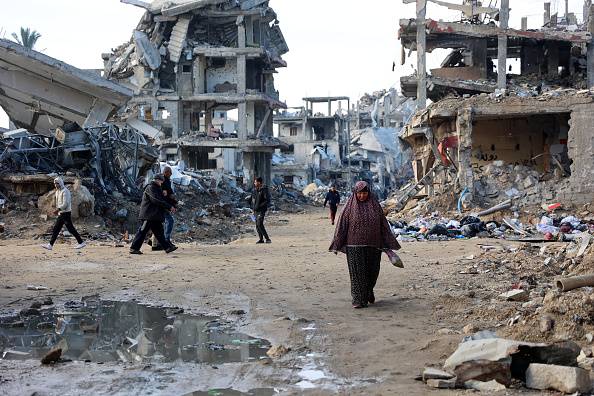
Palestinians walks amid the destruction in the Shujaiya neighborhood of Gaza City, in the northern Gaza Strip on January 4, 2025, as the war between Israel and Hamas militants continues.
A thorough analysis released by the BPC demonstrated how Britain’s military infrastructure actively helps Israeli attacks. Khem Rogaly stated that Britain’s military cooperation “goes far beyond licensing exports,” detailing how British parts of F35 fighters are critical to the frequent bombing campaign.
Hospitals Under Attack
The aid group Relief International on 10 January that Al-Awda Hospital in Jabaliya, the last barely functioning hospital in the north, came under direct attack by Israeli occupation forces. The hospital received immediate evacuation orders at the beginning of January, and Relief International said that since then, the hospital has been awaiting clearance for the safe evacuation of patients to Gaza City. The clearance, however, had not been granted. An Al Jazeera correspondent on 15 January that Israeli vehicles were beginning to bulldoze the western side of the Indonesian Hospital, which was completely rendered out of service last month.
The United Nations that its health partners are “warning of severe fuel shortages that are putting essential services at risk. According to the partners, all hospitals [that are] still partially functioning have exhausted their fuel reserves. They are now relying on piecemeal deliveries of fuel each day to try and sustain the most critical services.”
We continue our reporting on Israel’s abduction and subsequent disappearance of Dr. Hussam Abu Safiya, the director of the Kamal Adwan Hospital in Beit Lahiya, in the north of Gaza. The hospital was surrounded and destroyed by Israeli forces on 27 December, after more than 80 days of relentless attacks because doctors refused to abandon their patients and staff. Al Mezan, a human rights group, announced on Wednesday that it had confirmed that Israel had transferred Abu Safiya to Ofer military prison on 9 January. Israeli authorities continue to bar Abu Safiya from meeting Al Mezan’s lawyer until 22 January. A female resident stated that what she saw in the South could not be compared to the tragedy unfolding in the North. Healthcare staff reported doing surgeries without anesthesia, while physicians staring helplessly as patients perished from curable diseases owing to a shortage of essential medical supplies. The toll on medical workers has been both physical and mental, with many forced to deal with their own anguish while treating an unending stream of casualties. She described how Gaza’s famine is methodically produced. Purchasing veggies in northern Gaza now costs hundreds of dollars, she noted. “It’s not a famine,” she insisted. “It’s manufactured starvation by Israel.”
The strip is facing a severe lack of humanitarian aid as border crossings remain shuttered. “The occupation is perpetuating a policy of starvation against the residents of the strip, especially in the north, by closing the crossings,” the Government Media Office statement said on Tuesday, adding that “the occupation forces have closed all crossings of the Gaza Strip for more than 200 days.” The UN and other international agencies have also recently said that Israel’s siege is preventing the entry of aid.
The statement added that Israeli troops have “executed more than 1,000 doctors and nurses throughout the strip.” Israeli troops have repeatedly stormed hospitals in northern Gaza and detained scores of, most recently in the besieged and nearly dysfunctional. As part of this plan, Israel is also waging a war against medical facilities in northern Gaza, including Beit Lahia’s besieged Kamal Adwan Hospital.
Starting around early December, Israel began hammering North Gaza with increased: “Last night was one of the hardest nights for Kamal Adwan Hospital and the surrounding area. About 10 robots were blown up, most of them near the hospital. All the doors, interior partitions, and windows were destroyed, and some walls were also demolished. The debris scattered everywhere created a painful scene and instilled fear in the hearts of people in the hospital,” said Kamal Adwan Hospital director Hussam Abu Safia.
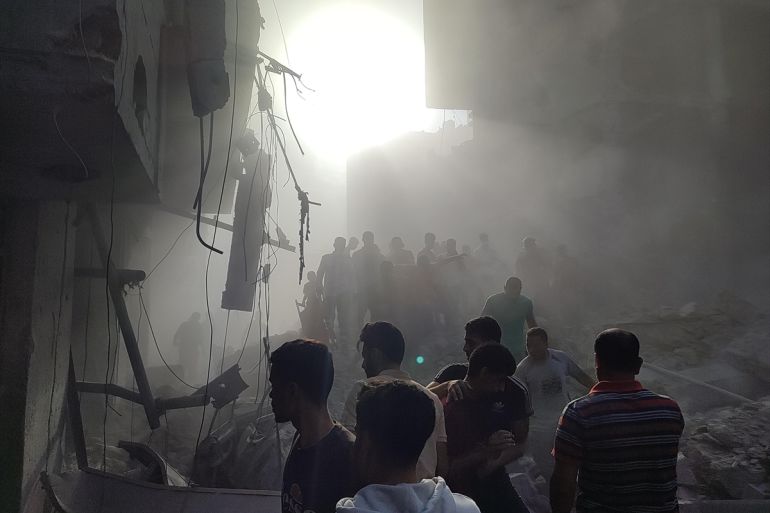
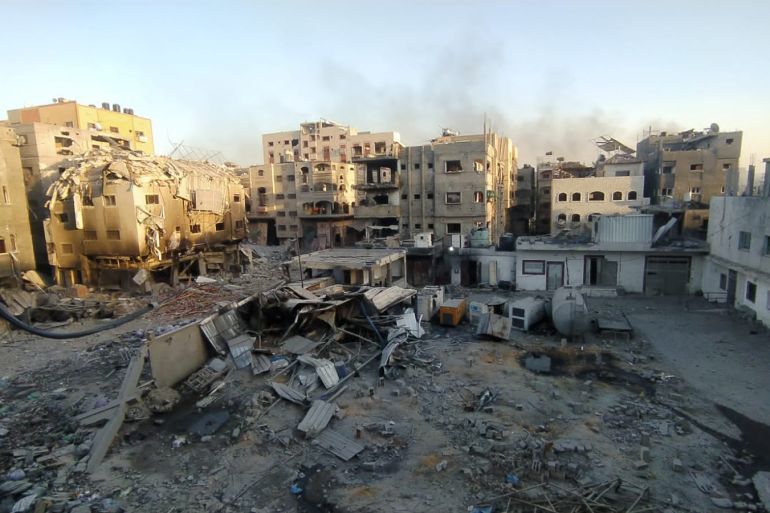
Early on 25th December, Israeli warplanes bombed homes in the vicinity of the hospital. The medical facility has been under near-daily attacks for several months. Israeli forces detonated explosive-laden robotic vehicles, wounding at least 20 patients and medical staff at Kamal Adwan Hospital on 24 December while simultaneously stepping up attacks and shelling on Beit Lahia’s Indonesian Hospital and the Al-Awda Hospital in Jabalia. There are many cases conduct of Israeli army forces, including executions and sexual assault, during their recent storming of Kamal Adwan Hospital in the northern Gaza Strip’s Beit Lahia. According to testimonies collected by the human rights monitor, Israel’s latest storming of the north Gaza hospital included deliberate killings and field executions, and sexual and physical assaults on women, including medical staff members and displaced civilians. A new report by the Euro-Med Human Rights Monitor has the shocking statement.
“These included detonating booby-trapped robots near several inhabited homes, causing their collapse and killing civilians inside. The crimes also involved Israeli soldiers executing civilians on the spot, some of whom were wounded, while others carried white flags,” according to the eyewitness accounts cited in the report. Dozens of women and girls were detained and subjected to “severe abuse,” it adds. “This included beating them and forcing them to remove their hijabs and clothing.” Those in and around the hospital were forced to flee outside northern Gaza at gunpoint. Dozens of people were abducted by Israeli forces during the raid, including Kamal Adwan Hospital director Hussam Abu Safia.
“I am a volunteer paramedic. I was staying in a house near Kamal Adwan Hospital with 11 civilians. Around 12:30 a.m. on Friday, we heard a vehicle at the door. I told those with me it seemed like the army was placing explosive robots. Looking out the window, I saw several robots in front of homes in the area,” an eyewitness told the Euro-Med monitor. The witness said the detonations began 30 minutes later as the group fled the house to find safety. The last photograph taken of hospital director Safia before his abduction by troops circulated on social media on 28th December, showing him walking through a heap of destruction with Israeli tanks in front of him.
Israeli forces again attacked Kamal Adwan Hospital in northern Gaza on 27th December, evacuating people at gunpoint and setting the facility ablaze after brutal attacks on the hospital’s vicinity – which killed at least 50 in under24 hours. This comes as part of the unofficial implementation of the Generals’ Plan, which seeks to make northern Gaza uninhabitable through mass destruction, killing, and expulsion. Israel’s goal is to completely empty out north Gaza and transform the area into an isolated military zone.
The Indonesian Hospital in northern Gaza has been destroyed for the most part and recently surrounded by Israeli troops. Officials say the hospital may not ever open again. The Israeli army continued to launch attacks against hospitals in Gaza on 29th December, bombing the Al-Ahli (Baptist) Hospital and the top floor of Al-Wafaa Hospital in Gaza City. At least eight were killed in the strike at Al-Wafaa Hospital, according to Palestine Today’s correspondent.
In the northern city of Jabalia, which has been ethnically cleansed of over 100,000 of its residents, “hundreds of bodies are scattered in the streets,” the media office said. Israel is unofficially implementing what is known as the General’s Plan, which aims to expel or exterminate all remaining residents of the North. The strategy was devised by former Israeli general Giora Eiland.
2 Shin Bet Cripples Aid into Gaza
The Shin Bet is Israel’s internal agency-akin to the FBI. Its focus is on eliminating current and future threats to Israel, and one of the ways is to use the British Intelligence model of “gang-counter gang “ methodology. This uses elements of the local population to act as a criminal gang which acts in the interests of the occupier by oppressing its fellow citizens. Gaza aid deliveries are suffering “systematic, tactical, armed, crime-syndicate looting” by organized groups, said Georgios Petropoulos, a senior UN official based in the southern city of Rafah, on 23 December. “This is just larceny writ large.”
“There is continued tolerance by the Israel Defense Forces of unacceptable amounts of looting of areas that are ostensibly and de facto under their military control,” Petropoulos said.
Based on interviews with Israeli military officials, aid workers, and Palestinians in Gaza, the NYT concluded that the looting is taking place due to the vacuum left by the Israeli military in the besieged enclave by its targeting of Hamas, including its civilian police force. The NYT reported the testimony of Hazem Isleem, a Palestinian truck driver whose aid convoy was ambushed by armed looters. The armed men stole thousands of pounds of flour from about 100 UN trucks, an amount large enough to feed tens of thousands of people. “It was terrifying,” said Isleem, 47, whom the looters held for 13 hours while they pillaged the flour. “But the worst part was we weren’t able to deliver the food to the people.”
The NYT notes that “Though Hamas has been routed in much of the territory; Israel has not put an alternative government in place. In parts of southern Gaza, armed gangs have filled the resulting power vacuum, leaving aid groups unwilling to risk delivering supplies.” The looting has caused the UN agency for Palestinian refugees, UNRWA, to end aid deliveries through the Kerem Shalom crossing, which is now the main entry point for aid since the closing of the Rafah crossing from Egypt in May. “Hundreds of truckloads of relief are piling up at the crossing in part because aid groups fear they will be looted,” the NYT added. The armed groups are stealing flour, oil, and other commodities to resell to desperate Palestinians in Gaza for massively inflated prices. In southern Gaza, the price of a 55-pound (around 25 kilograms) sack of flour, normally costing $10, has risen to as much as $220. Israel has helped cause the security vacuum by repeatedly killing members of the Gaza police force in previous months as they accompanied aid trucks to their destinations.
“Today, the ordinary Gazan’s dream, his aspiration, is to obtain a piece of bread,” said Abdel Halim Awad, a bakery owner in the city of Deir al-Balah, in central Gaza. “I can’t say anything sadder than that.”
On 29th February, the Israeli army killed 100 Palestinians seeking to receive aid from a humanitarian convoy. Testimonies gathered from Palestinians who survived the “flour massacre” describe Israeli forces opening fire indiscriminately on the crowd, causing those gathered to flee and trucks to drive away. Doctors at Gaza hospitals report that the majority of those injured had gunshot wounds, suggesting most of the dead were killed by Israeli gunfire. The ongoing Israeli aggression has also fostered a new generation of recruits for Hamas and left Gaza littered with unexploded ordnance, which the group’s fighters can repurpose into improvised bombs. The recruitment drive and ongoing fighting under Sinwar present a new challenge for the Israeli occupation. While the Israeli military has inflicted damage on the group in Gaza, it has repeatedly had to return to areas once cleared of Resistance fighters to confront them again in fresh battles. This cycle highlights that the IOF is only exhausting its troops and continuing to jeopardize the captives still held in Gaza.Israel has completely decimated the strip’s infrastructure and has killed over 46,000 people, according to official records. However, a new study published by The Lancet medical journal on 9 January reveals that the death toll from Israel’s war in Gaza was undercounted by 41 percent for almost a year into the war and could be much higher.
The campaign has laid waste to much of the enclave, including homes, mosques, schools, hospitals, universities, agricultural land, and water infrastructure, making Gaza essentially unlivable. A tight siege continues to restrict the entry of desperately needed humanitarian aid.
3 The Netzarim Corridor
Since December 2024, the Israeli occupation forces (IOF) have expanded the Netzarim Axis in Gaza to a width of seven kilometers, destroying and wiping off at least 40 square kilometers of a study by Palestine maps revealed. The Netzarim expansion extended to 2025, stretching to new areas, particularly the al-Zaytoun and Tal al-Hawa neighborhoods, as well as the Nuseirat and Bureij refugee camps. In order to achieve that, the IOF obliterated the agricultural and developed areas between al-Zaytoun and Wadi Gaza, including the towns of Juhr al-Deek, al-Mushraqa, Sheikh Ajleen, and al-Zahraa City. These also include Gaza’s industrial park, power plant, main landfill, and wastewater treatment plant. The Netzarim Axis currently takes up 11% of Gaza’s land, which has been made possible by the erasure of tens of thousands of acres of agricultural land, including ancient citrus and olive grove. 16% of Gaza land to be taken by ‘Israel’ for buffer zone.
In March, an analysis by Adi Ben-Nun, a Hebrew University geography professor, said “Israel” plans to lay its hands on 16% of Gaza’s territory to populate it with Zionist thieves. Construction of the zone has already begun, per the professor, which naturally will involve the demolishing of Palestinian homes and agriculture to make space for the 1-kilometer (0.6 miles) wide zone. Israeli officials previously refused to comment on how wide the buffer would be, but the former head of Israeli military intelligence, Amos Yadlin, said he expected “Israel” would enforce a “perimeter” of 500 meters to 1km inside Gaza. Moreover, “Israel” had bombed factories, warehouses, and civilian infrastructure within the potential buffer zone. Some of the buildings had been deliberately mined by Combat Engineering units, in preparation to demolish the residential bloc. The surface seems to be for a buffer zone, but the as many ministers of the occupation have called for building more settlements.The deadly Generals’ Plan, which has destroyed northern Gaza’s hospitals and displaced hundreds of thousands, in part aims to isolate and starve out the resistance.
4 The Resistance Roars Back & the “Shadow”
After the assassination of Yahya Sinwar, Hamas re-grouped, added thousands of new members, strategized new tactics and Hamas, a revived Qassam Brigades continues to step up attacks and sophisticated operations against Tel Aviv’s forces and is adapting to the harsh battles against Israeli troops in all areas of Gaza, but especially in the north-Jabaliya and surrounds.
“Mohammed Sinwar is managing everything.” Who is the ‘shadow’?
Mohammed Sinwar is a key figure in Hamas’ efforts to strengthen the group. Mohammad Sinwar, believed to be about 50 years old, has long been close to his older brother, who was more than 10 years his senior. Unlike his brother, who spent over two decades in an Israeli prison, Mohammed has not spent much time in Israeli detainment and remains less understood by “Israel’s” intelligence. Operating mostly behind the scenes, he has earned the nickname “Shadow”, according to Arab officials.
“We are working hard to find him,” said a senior Israeli official from the Southern Command, which runs the battle in Gaza. The Israeli military reported that Hamas has recruited hundreds of people in recent months, with recruitment taking place throughout Gaza, particularly in the north. According to Israeli reports, the number could be in the thousands. Meanwhile, Hamas’ armed wing announced several operations against Israeli troops in northern Gaza – which has been besieged for over two months in a bid to starve out the resistance and ethnically cleanse the area of Palestinian civilians.
“In a complex security operation, a number of our Mujahideen managed to stab and kill three Zionist soldiers who were on a mission to protect a building where a Zionist force was fortified,” the Qassam Brigades said.
“They then stormed the house and killed all members of the Zionist force at point-blank range, seized their weapons, and took out a number of citizens who were detained by the occupation inside the house in the Beit Lahia project in the northern Gaza Strip,” the statement added. The Qassam Brigades announced several other operations against the Israeli army in Gaza on 23 December, including explosive attacks against tanks and vehicles, and mortar attacks on troops taking refuge in buildings in northern Gaza. The resistance fighters also shot down an Israeli quad copter in the new camp area north of central Gaza’s Nuseirat.
The Palestinian Islamic Jihad (PIJ) movement’s Quds Brigades, the Al-Aqsa Martyrs’ Brigades, and other resistance factions also continue to carry out operations against Israeli forces. Israel has killed an average of 100 Gazans every day since the beginning of November till yesterday. That’s about 9,000 civilians murdered, with about double the number of injured.
Concurrently, IOF also intensified their bombardment across central Gaza. Artillery fire struck the northern Nuseirat refugee camp, while warships shelled its coastline. Meanwhile, Israeli helicopters launched aerial attacks on the southwestern region of Deir al-Balah.
In Gaza City, Israeli warplanes carried out airstrikes, while invading units targeted the Safatawi area in the northwest and the Jabalia refugee camp in the northern Gaza Strip.
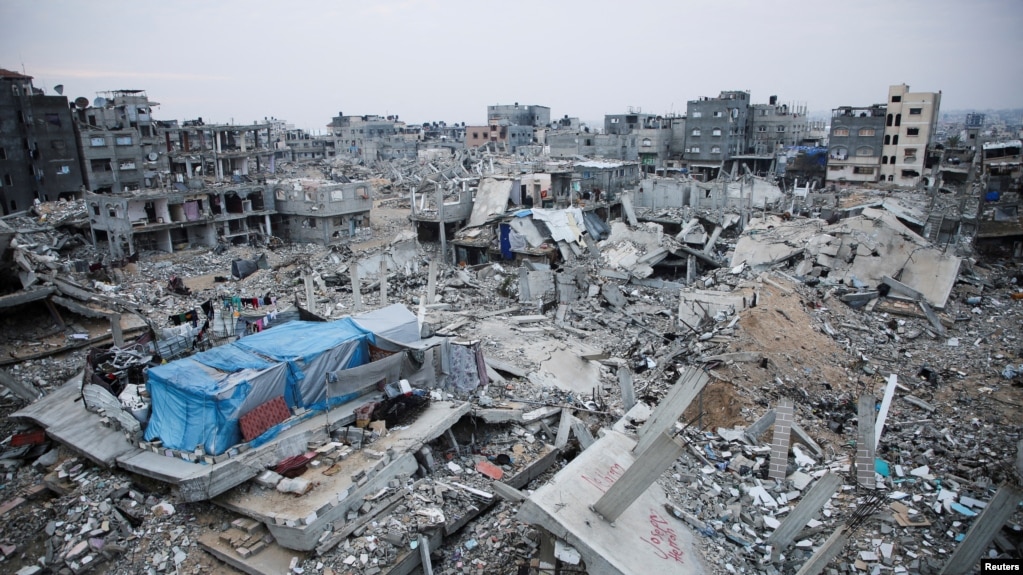
The escalation has further exacerbated the dire humanitarian crisis in Gaza, with civilian casualties continuing to rise amid relentless attacks and suffocating Israeli blockade. On the other hand, Israeli media reported that Israeli soldiers in the northern Gaza Strip are reportedly forcing Palestinian residents to abandon their belongings, including their clothing, despite humanitarian organizations warning of a severe shortage of protective garments in the region. The Israeli army is forcing the residents of the northern Gaza Strip to evacuate towards the South. Still, it is preventing them from taking their personal belongings with them. He added that the occupation soldiers are forcing the displaced to leave their belongings and even their clothes behind, even though humanitarian organizations indicate that there is a shortage of warm clothing among the residents of the Strip.
Despite the heavy setbacks the Resistance groups faced against Israeli occupation forces, who continue to face significant losses during their raids into the Strip, the future trend are such that Israel cannot afford to sustain manpower losses. Equipment gets replaced by its western supporters.
5 Israel Defeated in Every Encounter
Israeli Channel 12’s reporting testimonies of Israeli soldiers from Beit Hanoun, northern Gaza:
— “We are fighting in an environment monitored by cameras by the militants. They have planted explosive devices in every alley and are activating them from inside the tunnels; their underground network is fully operational.”
— “We cannot see them with the naked eye. For a week and a half, there has been no direct identification of the militants. They have completely rigged Beit Hanoun with a huge amount of explosive devices and remnants of the [Israeli] air force’s bombs.
“Every alley, every intersection is filled with state-of-the-art cameras, 360 degree thermal cameras.”
— “They choose targets carefully, and monitor movement through cameras: if there is a drone, they do not activate the bombs, but if there is a military force, they activate them.”
— “They activate the explosive devices, and as soon as the rescue teams are deployed, they go out to shoot at them.”
The Israeli army has been forced to “change methods” in its battles with the Palestinian resistance in northern Gaza as a result of the heavy losses it is taking in the city of Beit Hanoun, Hebrew newspaper reported on 12 January. As a result of the high level of preparedness by Hamas’ Qassam Brigades, particularly after a recent ambush that killed four Nahal Brigade soldiers and injured six in Beit Hanoun, the newspaper reports that the army’s Gaza Division has conducted “a rapid investigation and change methods of work and movement of the forces in the combat zone.” The deadly ambush that killed four soldiers in Beit Hanoun on Saturday took place in an area that was considered to have been fully cleared and under control.
“Following the difficult incident, the Gaza Division decided to take a number of steps, including more firepower before each movement of the maneuvering forces. Opening roads will be carried out using drones and not just bulldozers. The goal is to locate charges from the air, including with thermal systems, and to locate the cameras that the terrorists use to prepare their ambushes,” the report said.
The army also aims to shift its movement routine constantly and carry out operations at night more often due to the advantage.
Israeli troops reentered Beit Hanoun around two weeks ago as part of a brutal operation and siege of northern Gaza, which has just entered its 100th day. According to the Maariv report, Israel is now working to defeat “the last Hamas battalion” in the north. The Israeli military has been unable to destroy Hamas after a year of genocide and mass destruction, despite the war’s stated goals. Additionally, Hamas has fired several rockets at the occupied territories over the past two weeks. The group continues to regularly announce operations and publish footage of its attacks against Israeli troops via its media page, as do other organizations, including the Palestinian Islamic Jihad (PIJ) movement’s Quds Brigades. There are daily battles in Gaza, too numerous to mention. Overall, since the beginning of November till this weekend, the IOF has suffered around 7,000 to 10,000 casualties ONLY in Gaza. Of these take around 30 % as KIA. Equipment losses are around 100 – 200 tanks, APCs, bulldozers and other equipment.
Obviously, as explained many times before, the IOF hides its true casualty numbers. Whatever the official figures of KIA, multiply that by 30-, at least. The Zionists learnt from the Americans- who recorded ONLY 10% of their losses in Afghanistan and Iraq.
In late December, Israeli general Yitzhak Brik said that “the Israeli army cannot eliminate Hamas because there is no surplus of forces and no Israeli soldiers remain in the areas that it has occupied for a long time, and this is the reason why they are unable to eliminate Hamas rule.” “Today, Hamas controls the Gaza Strip, and thousands of its fighters are underground in tunnels extending for hundreds of kilometers,” he added, stressing that Hamas still “runs” Gaza after a year of war. He also said that defeating Hamas militarily is not realistic.
The Resistance Raids an IDF Base
The Israeli occupation forces’ Galei Zahal radio reported the arrest of two Palestinians out of a group of eight who infiltrated the central command military base in occupied al-Quds. Investigations into the incident are ongoing. Soldiers stationed at the base, located in the heart of the occupied territories, chose to hide inside the base instead of confronting the infiltrators. “Central Command leader Avi Blot must explain why most soldiers at the base hid in rooms instead of acting as expected from military personnel and engaging directly.”
“Why was Border Police (MAGAV) forces summoned to handle the situation instead of the soldiers resolving it themselves?” He described the incident as a significant warning sign, remarking, “October 7 is still with us,” referencing the earlier unprecedented events that had shaken confidence in the Israeli occupation forces due to their cowardice and inadequate response.
Moreover, the military wing of Hamas, the al-Qassam Brigades, announced that it successfully collaborated with the al-Nasser Salah al-Din Brigades, the military wing of the Popular Resistance Committees, in launching a surface-to-air missile at an Israeli Apache helicopter east of al-Bureij camp in the central Gaza Strip.
Hamas had launched approximately 20 rockets from the Gaza Strip over the past nine days. Among these, 14 rockets were fired from the northern part of the territory. Media outlets noted that alarms sounded across Gaza’s border areas. Over the past few days, heavy rainfall has flooded over 1,542 tents housing forcibly displaced families in camps and shelters across the Gaza Strip. The General Directorate of Civil Defense reported on Wednesday that rescue teams found hundreds of tents submerged in over 30 cm of water, which damaged the belongings of displaced residents. The hardest-hit areas included the Yarmouk Stadium and Gaza Municipality Park camps, where 242 tents were flooded. In the Saraya complex, 185 tents were affected, and 70 tents in the Shujaiya parking lot were submerged.
In Rafah, 170 tents along Sea Street and near the Fash Fesh rest area were inundated. In Khan Younis, over 665 tents were damaged, while 210 tents in the central governorate, particularly in Deir al-Balah, al-Bassa, and Wadi al-Salqa, were also severely impacted.
Meanwhile, rescue teams are continuing efforts to provide assistance and assess the full extent of damage despite the challenges.
The story continues in Part 2 where we discuss the cease fire and its implications.