
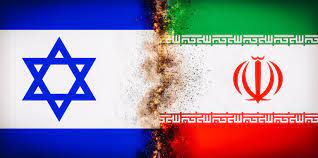
Iran mobilizing one million soldiers to ‘create hell’ for any US ground assault
Western media revealed this week that Iranian forces have laid traps and mines on the strategic Kharg Island. Iran is mobilizing one million soldiers to repel any potential ground invasion launched by the US army against the Islamic Republic. “With the growing speculation about the possibility of a historical folly by the US in launching a ground invasion on the southern front of Iran, a wave of enthusiasm has emerged among Iranian ground fighters to create a historical hell for the Americans on Iranian soil,” one source said. The source added that “in addition to organizing more than one million fighters for ground combat, in recent days there has been a massive influx of requests from Iranian youth directed towards the centers of Basij, the IRGC, and the Army to also participate in this battle.” The US wants to open the Strait of Hormuz with suicide and self-destructive tactics; that’s fine. We are ready for both their suicide strategy to be executed and for the Strait to remain closed,” the source went on to say. On the same day, reported – citing US officials – that Washington was preparing options for a “final blow” in the Iran war, involving ground forces and massive bombing.“We’re waiting for them,” Iranian Foreign Minister Abbas Araghchi told a western news show host earlier this month after being asked if Tehran was “afraid” of a ground invasion. The foreign minister added that Iran has prepared a “disaster” for US ground troops who enter the country. The Iranian forces have been fortifying Kharg Island and “laying traps” in anticipation of a US decision to launch a ground assault. There would be significant risks involved in such a ground operation, including a large number of US casualties. The U.S. and Israeli barrages are causing heavy damage to Iran, but there is little evidence that these strikes have found – or destroyed – Iran’s dispersed and deeply buried missile ‘cities’ spread across the extent of the country. The evidence suggests rather, that in failing to destroy Iran’s hidden military infrastructure, the U.S. and Israel has turned its attention to civil targets aimed at demoralizing the people – as we have seen deployed in the Lebanese and Palestinian arena. Yet what seems incontrovertible is that Iran has a carefully thought-through strategy that is unfolding in distinct phases. Trump however, is without a plan. It changes daily. Israel does have a plan, which consists in assassinating as many of the Iranian leadership as their can detect. Beyond that, Israel’s design is for Iran to be dismembered; divided into ethnic and sectarian statelets; and reduced to weak anarchy (on the Syrian model).
For now, the U.S. stated objectives show up as punctuated threats of escalation ranging from attacks on economic infrastructure (South Pars gas facilities) to two meaningful hits in the very near vicinity to Iranian nuclear sites (Nantaz and the joint Iranian-Russian operated Bushehr nuclear plant). Presumably these near missile strikes are intended as ‘messages’ to imply the possibility of a U.S. or Israeli escalation to the nuclear level. (Iran, however, responded in kind and in close proximity to Israel’s Dimona nuclear facility. After the Dimona strikes that caused heavy damage, Iran made a significant and pointed statement: It had achieved “missile dominance”. This assertion was based on the fact that Israel had been unable to launch any air defense interceptors in the face of Iran’s strike against one of its most heavily guarded strategic state sites. Mohammad Ghalibaf, Speaker of Iran’s Parliament and military leader, warned that the war has entered “a new phase”: “Israel’s skies are defenseless … It seems the time has come to implement the next phase of our pre-designed plans …”. There is little doubt that U.S. reserve missile stocks and sortie generation has collapsed due to maintenance backlog and logistical sustainment incapacity. U.S. manned aircraft still do not penetrate deeply into Iranian airspace. Iran says its missile reserves can last for years, and is still producing currently. Iran has missile dominance, while the combo has air dominance.
Trump in the last days has upped the ante – giving Iran an ultimatum: ‘Open Hormuz within 48 hours or your civilian power plants will be progressively destroyed – starting with the biggest first’. (Iran’s biggest plant happens to be the joint Iranian-Russian operated Bushehr plant). It seems that Trump still looks to a quick Iranian capitulation. However, Iran has already rejected the ultimatum and has responded with one of its own.
Ayatollah Mojtaba Khamenei’s Ultimatum to Trump
In a tightly structured 12-minute address, Ayatollah Imam Sayyed Mojtaba Khamenei moved from familiar rhetoric into something far more consequential. The opening half of his address followed the expected script, but changed: midway through, the tone shifted from retrospective to strategic. Khamenei outlined three concrete demands, each with a defined timeline: A rapid U.S. military withdrawal from the Middle East: a full rollback of sanctions within 60 days, and long-term financial compensation for economic damages. Then came the ultimatum: Fail to comply, and Iran escalates, economically, militarily, and potentially nuclear. Not hypothetically, but operationally: Closing the Strait of Hormuz, formalizing defense ties with Russia and China, and moving from ambiguity to declared nuclear deterrence”. The timing of external reactions was just as telling. Within hours, both Beijing and Moscow issued statements aligning in a carefully worded, yet unmistakable way, with the new Supreme Leader’s framing, suggesting coordination. Iran evidently is ready to match Trump on the escalatory ladder. Iran’s leadership style plainly has changed with the new Supreme Leader: He is no longer interested in incremental ‘toing and froing’. Iran’s leadership is going for decisive outcomes that will change the West Asian geo-strategic landscape. And Iran believes that Hormuz represents the leverage with which to do this. Iran has established a format for approved and IRGC vetted vessels to transit the Hormuz Strait – provided that the cargo is paid in Yuan and subject to a fee. It is estimated that Iran potentially could earn $80 billion a year in fees from such a Suez Canal-type regulatory regime. This, in theory, allows the energy market to be supplied, but with the proviso that Iran would simply close the Strait completely were Trump to implement his ultimatum.
Iran’s new demands are so far-reaching that they seem unthinkable to the West: That Arab OPEC countries must end their close economic ties to the United States, starting with the U.S. data centres operated by Amazon, Microsoft and Google. The recycling of petrodollars has been the basis of America’s financialization and weaponization of the world’s oil trade, and its imperial strategy of isolating countries that resist adherence to this system, but simply follow U.S. ad hoc demands. An Iranian choke-hold over Hormuz – plus the Houthi’s control over the Red Sea – could wrest domination over energy and its pricing from the U.S. — and, absent the petrodollar inflow to Wall Street, pull the plug on U.S. financialized global domination. What is at issue here is not just Iran’s aspiration to eject the U.S. military from the Middle East, but also a geopolitical transformation as GCC and Asian states (such as Japan and South Korea) are compelled by necessity to become ‘client nations’ of Iran to gain access to the Hormuz waterway. And because only Iran would be able to guarantee safe passage. Effectively, should Iran be able to maintain its control over the Straits.
Iran’s Logistics ‘Squeeze’
Israel and the U.S. initially prepared and equipped themselves for a short war. In the case of the U.S., very short – from the Saturday morning when Khomeini was assassinated until Monday, when U.S. stock markets were due to open. Iran responded within the hour of Imam Khamenei’s assassination to the prepared Mosaic blueprint by targeting U.S. bases in the Persian Gulf. Reportedly, the IRGC used old ballistic missiles and drones from the 2012/2013 production cycle. The purpose of using old missiles and drones so prolifically clearly was to degrade the radars and air defenses held by American bases in the Gulf. A similar process of degrading Israel’s interceptor stock was pursued in tandem. Depletion of interceptors across the Gulf and Israel has become obvious. This constituted the first layer of the logistics ‘squeeze’. The second layer is the economic and energy squeeze brought about by gating the Strait of Hormuz to all ‘adversaries’, yet not to ‘friends. The Hormuz gating is intended to trigger a financial and supply line crisis in the West so as to ‘squeeze’ the financial prospects that the war might be seen to offer the West. Weakening markets equates to weakening Trump’s resolve. The third ‘squeeze’ is centered on public support for the war in the U.S. The Iranian refusal to accept a ceasefire or negotiations, but rather to opt for long war, capsizes public expectations, challenges consensus expectations and raises anxiety and uncertainty. Washington has also fired over 850 Tomahawk missiles and 1,000 air-defense interceptors, at a rate the Pentagon finds “alarming”. In the process, “Israel” is rapidly approaching total disarmament. An in-house “ledger tool” tracking the “intense consumption of advanced munitions” by the US and Zionist entity calculates 11,294 fires over this period, which cost a total of approximately $26 billion to produce. Resultantly, US – and thus Israeli – inventories of long-range interceptions and precision strike weapons “are nearing exhaustion.” And it will have to spend staggering amount to replenish what has been lost. On top of enormous expense, even at pre-war production levels, it would take years to replace what was spent in just over two weeks against Iran. Tehran’s closure of the Strait of Hormuz has thrown the Empire’s already shattered defense industrial base into total disarray. Commodities and components central to constructing and maintaining digital and electronic systems, and precision-guided munitions, which hitherto transited the Strait daily in abundance, are now scarcer and ever-rising in cost.
What are Iran’s Probable Strategic Objectives?
What then might be Iran’s ultimate objectives? Firstly, to remove the constant threat of military attack; to force the lifting of the constant siege on the Iranian people through sanctions; the return of its frozen assets, and the lifting of Israel’s occupation of Gaza and Palestinian lands. Possibly Iran believes too that it will ‘flip’ the geo-political balance across the Persian Gulf area to take the regions’ naval choke-points and sea corridors out from U.S. hegemony and open them to the passage of BRICS vessels, without sanction, seizure or blockade by Washington. To launch a reverse ‘freedom of navigation’, as it were, in the original meaning of the phrase. Plainly, the Iranian leadership understands full well that the successful deployment of their asymmetric war plan could upend the geo-strategic balance of not just the Middle East, but of the globe. Iran is already deep into what for all practical purposes is configured as the First Middle East High-Tech war. Strategically, this implies a fascinating new terminology. This is called the “GREAT CONSTRICTION”. The target for the “Constriction” has switched from the IDF to collapsing the very fabric of Israeli society. The, there’s Then there’s the 16-Mach Shield Breaker – whose tech superstars are the Khorramshahr-4 and Fattah-2 missiles, which reach terminal speeds of Mach 16. Translation: as an enemy computer calculates an intercept vector, the missile warhead – a one-ton blockbuster – has already impacted. Israel spends millions of dollars attempting an interception with 100% probability of failure, while Iran spends a fraction to get a certified hit. If true, together these represent major attrition to US’s “eyes in the sky” and ELINT fleets, which blinds US capabilities even further in the region. The current status of the US carrier fleet:
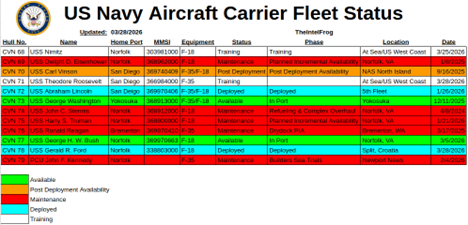
Only 3 aircraft carriers are available – of which one -the Lincoln has been badly damaged, after being struck almost 17 times. Which leaves just 2 carriers available- of these one – the Bush is planning to leave for the Middle East. It can be seen that very few are available despite needing to be dispersed around the world in all of the US’s most important theaters. Despite all this, WaPo reports that the Pentagon is still preparing for “weeks” of ground operations as troops continue streaming in to the region: The Pentagon is preparing for weeks of ground invasion in Iran, as thousands of US marines arrive in the Middle East.
7 Gulf States on Receiving End
The six Arab countries of the Gulf Cooperation Council — Saudi Arabia, the United Arab Emirates (UAE), Qatar, Kuwait, Bahrain, and Oman — as well as Jordan have, for decades, provided generous support to the United States’ nefarious interests in the region. They have given away land for free and built American bases on their own territories from their own pockets. Utilities, infrastructure upgrades, and other similar services are taken care of entirely by the Arab hosts to keep American forces safe, secure, and well-fed in an unfamiliar climate. Short of their salaries, the Gulf regimes give American troops on their territories everything they need. In return, the United States is supposed to be the security guarantor of its host nations. That façade has been burnt down over the past few days of Iranian retaliation to the Judeo-American aggression against its sovereignty. Iran had vowed that in the event of an attack on its soil by the Israelis and Americans, it would target American bases in the Middle East. Living up to its promise, Iran continues to heavily bombard every single GCC state. Bahrain, the tiny artificial construct which hosts the US Navy’s Fifth Fleet, has been particularly severely hit by the Iranian missile and drone strikes. Qatar, which has flushed billions of dollars into Al Udeid Air Base, America’s largest in the region with a capacity for a staggering 10,000 troops, has also borne the brunt of Iranian retaliatory strikes. Iranian drones are patrolling the skies of Dubai as if it were another of those useless airshows that the UAE royalty regularly hosts to showcase all the aircraft it does not build. Suicide drones (and possibly fragments from missile defense systems) have crashed suspiciously close to the UAE’s biggest landmarks: Burj Khalifa and the Burj Al Arab. Kuwait has been scorched. Omani assets have been hit. Saudi Arabia, the biggest GCC state, has had its oil fields left burning in its eastern province. The state-owned Saudi Aramco Ras Tanura refinery — the largest in the kingdom — produces 550,000 barrels per day and has suspended operations after drone strikes. (It’s worth a mention that Iran has denied attacking oil assets in Saudi Arabia, which points to possible false flag attacks by the Judeo-Americans, but that’s a topic for another article.) American presence on the territories of these Persian Gulf states was meant to guarantee American protection from potential aggressors. But they have been left fending for themselves from the Iranian salvo. Indeed, Iran is attacking these countries precisely because they are being used as launchpads for attacks on its territory. If these countries were not playing willing accomplices to the the region, Iran would have had no justification for its attacks.
It is strange that the leaders of these nations believed the US would protect them! The US is legally bound to never sell weapons that would give these monarchies an edge over the Jewish supremacists in Israel. Realistically, the biggest threat these states have historically faced is from the Israelis, who openly dehumanize Arabs and display an unquenchable thirst for their lands. Through their longstanding plans for establishing the so-called Greater Israel, the Israelis have previously spoken about establishing Jewish supremacy on Arab lands in hushed tones. Over the past two and a half years of the ongoing genocide in the Gaza Strip, however, Israeli leaders, including prominent rabbis, have openly aired plans for extending the boundaries of Israel to swallow vast chunks of the Middle East, including nearly half of Saudi Arabia. When there is an explicit law that forbids the United States from providing Persian Gulf Arabs with sufficient resources to counter the Israeli threat, it does not take a genius to figure out the US would hang them out to dry when the Israelis eventually made their move. And that’s exactly what happened last September. the capital of Qatar, when Israel bombed Qatar and killed several Palestinians as well as one Qatari national. The attacks would not have been possible without American approval and green light. Despite hosting the largest American base in the region, the Qataris had their noses rubbed in the sand by the Israelis and Americans in full view of the world. The very belief that the United States would come to the defense of Arabs from Israeli aggression is beyond laughable. It is safe to assume that one of the calculations for the Zionist leadership of these states would have been that closer ties with Israel would keep them safe from Israeli aggression. That belief has no material, logical, or spiritual basis. When Saudi Arabia made no more than performative squeak about the prospect of a Palestinian state in exchange for normalization of ties with Israel, it was viewed by the Israelis as an unforgivable sin. Slighted, Smotrich to “keep riding camels in the desert in Saudi Arabia,” while Netanyahu pushed the Saudis to accommodate Palestinians in their country: “The Saudis can create a Palestinian state in Saudi Arabia; they have a lot of land over there.” Instead of using their enormous resources to build their own military capacities — something Iran and even the much-poorer Pakistan have so commendably done — and domestic industries, these Arab Zionists have poured all their resources in buying inferior American hardware and building their bases for them free of cost.
Domestically, they have fed their populations a steady diet of American junk and degeneracy and built dystopian hellscapes in the desert in the name of “modern architecture” on the backs of migrant workers on slave wages with confiscated passports. Internationally, they have proselytized a Zionism-compliant Frankenstein monster of Islam, spread potent sectarian poison, and prevented all efforts to develop a polity based on Islamic values. Paying no more than customary lip service to the Palestinian cause for years, they have utterly abandoned their Arab brethren; worse, they have even been in the same room as the Israelis and Americans during the genocide. In an ideal scenario, they would have built their industries and militaries independent of the West to pose a challenge to Judeo-Christian hegemony in occupied Palestine and the rest of the Middle East. Who knows, they may have even prevented the ongoing slaughter in the Gaza Strip if they had a spine and an iota of morality. The reception of the news of across the Muslim world — irrespective of the sectarian divide — shows that the Muslim masses, despite the best efforts of these compromised Gulf monarchies, continue to value steadfastness and righteousness in the face of tyrants’ way above those who abuse trafficked children to the Satanists. Now, they are lamenting that America is not coming to help them against Iranian attacks. A Saudi official complained on an Al Jazeera show about being abandoned by Uncle Sam and left at the mercy of the Iranians: “American defense is focused on Israel, with little attention to the Gulf states, where many military bases are located. In my view, there is no doubt that the Gulf countries feel a certain sense of reproach towards their ally or partner. We described it precisely: the American partner focuses on the security, stability, and population of Israel, without regard for the defense aspects of the Arab Gulf countries, which today face Iranian attacks, with no effort from America.” This is humiliation. The Arab Zionists have given the Judeo-Americans everything they wanted, yet have nothing to show for their servitude. Throughout the Muslim world the Gulf regimes are seen as collaborators, especially due to their inaction during the Gaza genocide. While Khamenei ascended as a revered martyr for the Palestinian cause, the Arab Zionists are seen cavorting with the Epstein class.
The so-called surrender and submission agreement – known as the Abrahamic Accords are now dead in the water. In their Faustian bargain with the Judeo-Americans, Arabs have only earned an unending sequence of humiliation rituals. Yet it feels like just the start. American presence on the territories of these Persian Gulf states was meant to guarantee American protection from potential aggressors. But they have been left fending for themselves from the Iranian salvo. Indeed, Iran is attacking these countries precisely because they are being used as launchpads for attacks on its territory. If these countries were not playing willing accomplices to the Americans in the region, Iran would have had no justification for its attacks. Close the base if you do not wish to be attacked. Iran sent a “decisive warning” had been sent to hotel operators, particularly in Bahrain and the United Arab Emirates, cautioning against hosting US forces. Iranian authorities argue that recent regional developments have led to US military bases being “destroyed or rendered inoperative” following missile strikes and coordinated operations involving allied resistance movements. As a result, US forces have begun staying in hotels in several regional countries. Under the warning described by Fars, hotels accommodating US military personnel would be considered “legitimate military targets” and added to Iran’s target list. A senior Iranian intelligence official told on 26 March that the Islamic Republic is preparing a “strong response” against the UAE due to the “active role” it has played in the US-Israeli war on it. “A decision has been made at the leadership level to end the weeks-long tolerance toward this country. In addition to US military barracks and bases in the UAE, which were targeted in Iran’s defensive attacks, the Emiratis also provided some of their own air bases to the US to be used in attacking Iran,” the intelligence officials went on to say, “The UAE is considered a foothold for Israel in the region,” the source continued, adding that Abu Dhabi has “carried out misleading operations against Oman and other countries” – likely a reference to false-flag operations pinned on Iran.
False Flag operations by Mossad
On Sunday, according to a statement from Kuwait’s Ministry of Electricity, Water and Renewable Energy, an Indian worker was killed and significant damage was caused to a service building at a power and desalination plant, as a result of an Iranian attack against the State of Kuwait. Satellite data from NASA has reportedly detected an active fire at the Doha West Power and Water Desalination Station, the country’s largest combined power and water plant. Imagery shows burn marks and smoke across the central section, with heat signals extending toward coastal storage tanks. The facility produces 2,400MW of power and around 110 million gallons of water per day, making up about 38.5% of Kuwait’s desalination output. With around 90% of Kuwait’s drinking water coming from desalination, this damage will quickly put pressure on the country’s water supply. The attack on the desalination plant took place on Sunday. This is not the first attack Tehran has labeled a false flag. Iran has also denied recent strikes on fuel tankers in Oman and a refinery in Iraq’s Erbil, as well as one that targeted an Aramco facility in Saudi Arabia at the start of the month. US journalist Tucker Carlson reported earlier in March that Mossad agents were detained in Gulf states for planning bombings. Iran’s Foreign Minister Abbas Araghchi said on 15 March that the US has been using its new – modeled after the Iranian Shahed – to carry out false-flag attacks in the region and attribute them to the Islamic Republic. Tehran has said only US and Israeli-linked military and economic assets in the Gulf will be struck by its forces. Iran is warning Gulf governments against allowing Washington to use their bases for attacks on the Islamic Republic. The Iranian military on 30 March the recent attack, which hit a desalination plant in Kuwait, labeling the strike a US-Israeli false-flag operation aimed at “destabilizing and destroying the region.” NASA satellite detects fire at the West Doha Power Plant, Kuwait — its largest Power Generation & Desalination Plant. It accounts for 38.5% of Kuwait’s total desalination capacity. “The brutal aggression by the Zionist regime against the desalination facility in Kuwait, carried out in recent hours under the pretext of accusing the Islamic Republic of Iran, is a sign of the vileness and depravity of the Zionist occupiers,” the Khatam al-Anbiya Central Headquarters of the Iranian army said in a statement. “We declare that US bases, personnel, and their interests in the region, as well as the military, security, and economic infrastructure of the Zionist regime in the occupied Palestinian territories, remain powerful targets for us,” it added. The Iranian military went on to urge “countries of West Asia must remain vigilant against the sedition of the US–Zionist axis aimed at destabilizing and destroying the region. “Regional states “must put an end to the presence of the criminal US army and occupying Zionists in the region,” it stressed. Islamic Revolutionary Guard Corps: Companies that are actively involved in terrorist designs will be subject to reciprocal action for every assassination. They are announced as follows: Cisco , HP, Intel, Oracle, Microsoft, Apple, Google, Meta, IBM, Dell, Palantir, Nvidia, J.P. Morgan, Tesla,15. GE, Spire Solutions, G42, Boeing. These companies should expect the destruction of their relevant units in exchange for every assassination in Iran, starting from 8:00 PM on Wednesday, April 1st, Tehran time.
8 Inside Israel
Next, is the doctrine of 4 Vital Organs: Israel’s 9 million people survive thanks to only two primary deep-water ports. That has led Iran to move to Structural Paralysis ode, systematically focusing on four “death points”: the hyper-concentrated nodes of Israeli infrastructure that, if severed, will turn the Israelis into a dark, thirsty and starving cage. The four vital organs are water (hitting 85 % of Israel’s potable water in five desalination plants; The Blackout Protocol (hitting the Orot Rabin power station in the heart of the national grid. A Food Siege – hitting the ports of Haifa and Ashdod, essential for Israel’s essential imports of the 85% of wheat it needs; and energy decapitation – focused on the Haifa refineries, the sole Israeli source of refined petroleum, and even more of a key target after the attack on South Pars. The Ashkenazi Rabbi of Israel, Rabbi Meir Ber was killed by an Iranian bomb. This is the guy who wanted to wipe out Gaza. Karama is a bitch, as the saying goes. After 11 days of fighting, Israel has received 9,115 damage claims for buildings, contents and vehicles. Since then, the next 20 days proved more destructive for infrastructure, etc. A senior Israeli military officer warned Thursday of a emphasizing the urgent need for more soldiers in both regular service and the reserves, as well as reforms to reserve service laws, according to Israeli Channel 13. IOF on brink of collapse: This closely follows warnings by Israeli Chief of Staff Eyal Zamir during a cabinet session that the Israeli military could collapse if its manpower problems are not solved. At the same time, the number of soldiers is not increasing and is actually declining. Earlier this month, Israeli media reported plans to recruit 400,000 reservists by May. Zamir stressed the urgency of bolstering manpower, warning: “The army will collapse on itself if a solution is not found. I am raising many red flags.” The genocide state needs more manpower. The current IDF soldier is weak, scared and totally demoralized. Many are refusing to heed further military call-ups.
The settlers are fleeing the Occupation state. Many times, Ben Gurion Airport was bombed, flights are delayed and cancelled. Others are paying higher prices and are fleeing by boat. The economy is at a standstill. Firms are closed. Shortages are everywhere. In short, the settler’s nirvana days are over. Like in the past, whenever there is a conflict between Israel and its neighbors, Israel takes advantage of the situation and goes on a rampage in the West Bank. Since the beginning of March, the IDF and settler gangs have been pillaging, raiding, burning, stealing sand killing the Palestinians in the West Bank. The Cabinet meeting also included approval for new settlements in the West Bank. amid expanded operations in southern Lebanon and ongoing control over roughly half of the Gaza Strip, alongside the establishment of new settlements.
9 Takedown of a Bully
But here is the part they don’t like to talk about … For years, their favorite playbook has been something they proudly called … “Shock and Awe. “We have seen it before. Same script. Different location. Overwhelming bombardment. Carpet bombing. Flatten everything. Because when you cannot break a people’s will … you try to break their environment. And when that still doesn’t work. They move to what they know best …Assassinations. Target the leaders. Eliminate the thinkers. Remove the symbols of resistance. They have tried it again and again. But here is the problem they are now facing …. That script is not working on Iran. You bomb …they adapt. You assassinate … they multiply. Every fallen leader becomes ten more. Every attack produces a stronger response. Every pressure point creates deeper resilience. Instead of collapse …. you get consolidation. Instead of fear …. you get clarity. Instead of surrender … you get strategy. And here is where it gets even more interesting. Iran is not fighting like the loud, emotional powers we are used to. No! They are playing chess … while others are still playing checkers. The tit for tat strategy. Calculated. Measured. Pain for pain. Strike for strike. No over-reaction. No panic. Just disciplined retaliation. And it is hurting them. Badly. Not just militarily but psychologically and economically. Because nothing terrifies an empire more than losing its aura. And then comes the masterstroke … The Strait of Hormuz. A narrow passage … but the heartbeat of global energy. Closing it, or even threatening to …. is more powerful than a nuclear bomb. Why? Because it doesn’t just destroy cities …It chokes the world. Oil stops. Economies shake. Markets panic. Suddenly, the “superpowers” start speaking the language they understand best …. Fear. What we are witnessing is not just a military confrontation. It is the collapse of an illusion. The illusion that power belongs only to those with bigger budgets. The illusion that technology guarantees victory. The illusion that arrogance equals strength. Iran has done something very simple …. yet very dangerous. It stood. It absorbed. It calculated. And then it responded. Now the same powers that once bombed freely …are calculating consequences. The same jets that once flew uncontested …. Now think twice. The same carriers that once symbolized dominance …Now look vulnerable. And maybe, just maybe …The world is beginning to realize that the bully was never invincible. He was just … unchallenged. Until now!
10 Trump Pushing for Ceasefire & Negotiations
On Tuesday -16th , A diplomatic source in the Iranian Foreign Ministry to Iran Now Network: – For the third time today, Washington sent a message, via one of the region’s countries, in which it requested a halt to the war – This time, the American request was accompanied by a threat to increase the pace of assassinations inside Iran in the event of non-compliance by Tehran.- Iran has affirmed that its position has not changed, so there will be no halt to the war before achieving Tehran’s declared objectives as stated by its officials. Iran has refused to negotiate with Donald Trump’s top envoys, Steve Witkoff and Jared Kushner, accusing them of “backstabbing”. “Vance is preferred,” a Gulf source said of the Iranians. “They don’t want to work with Jared and Witkoff because they stabbed them in the back.” The war is entering a new phase. Trump has an eye on how the war is and will ‘play’ at home in the run-up to the November mid-term elections. U.S. minds on how, or whether, to vote tend to be made by September/October. His team is searching wildly to find the exit from the war that, by the summer, might project a plausible ‘win’ for Trump – if such a thing is even possible. Events are unfolding precisely as we had predicted last time. Trump has issued a “final ultimatum” to Iran, indicating that the US is ready to pull out after a final sadistic sore loser’s lash-out on Iran’s civilian infrastructure. It again becomes clear that the administration is making up these objectives on the fly to suit an ever-changing and ever-shrinking narrative: they will shoehorn whatever objectives they can to retroactively fit the shortcomings of the failed war. Lining up with Rubio’s obvious omission of the key Hormuz demand is the latest news that Trump has flip-flopped again, telling aides Hormuz is no longer necessary for the war’s conclusion: All the while, Iran has continued deconstructing its neighbors’ infrastructure, particularly after Iran’s petrochemical facilities were hit in Tabriz earlier. Iran responded by allegedly hitting Kuwait’s largest desalination plant, at least according to some reports: Israeli petrochemical companies were also hit. Now that Trump has signaled his willingness to end the war without reopening Hormuz, the Gulf states have erupted in a chorus of fear behind the scenes.
Iran’s neighbors are horrified at the idea of Teheran emerging from this war with practical; control over Gulf energy exports as well as a stream of new income. For these Gulf states, such as UAE, Qatar, etc, are well aware that Iranian strikes on their oil installations, or desalination plants could wreak long term havoc on their economies and societies. They may ultimately decide that paying protection money -a tollgate- to Iran is a better option than escalation. Asian and European nations will also pay up and risk the ire of the US rather than getting toppled in a citizen’s revolt. The US has to move forward with the “ground operation” because they simply cannot abide a resurgent Iran emboldened and empowered by its victory in the war. that Israel is pushing Trump to hit Iran’s energy infrastructure to finish off the “collapse of the regime”. Granted, we must admit that our reporting here may appear one-sided given that Iran’s triumphs are extolled and venerated while US-Israeli degradation of Iran’s capabilities is given little coverage. I have already spoken about the fact that I believe this “degradation” is highly exaggerated, and thus at times not worth mentioning. You can see for yourself in the constant walk-backs of damage assessments from official mouthpieces in the Trump administration. That being said, we must still acknowledge that damage is being done to some extent. Many believe it is catastrophic, and that Iran has truly been “set back” for many years, if not decades. An example was yesterday’s strikes on Iran’s largest steel production facilities—Iran is one of the world’s biggest producers of steel. But the BDA satellite photos were inconclusive: the “damage” appeared localized to a few buildings out of a massive city-sized facility. We can certainly acknowledge that the Iranian economy may be taking damage, but the question always remains: how severe, and how capable are Iranians of ignoring it and weathering the storm? The latter answer is likely very capable. You’ve seen Ukraine resist far fiercer attacks from Russia for over four years now, yet Iran is somehow expected to crumble under a laughably weak month-long assault by a country that itself is running out of munitions. Time is clearly on Iran’s side from virtually every possible angle. In particular, politically Iran knows Trump is flushing himself down the toilet, and midterms are fast approaching. Economically, oil continues to rise and it’s been reported that Iran itself is now making far more on oil than it was even before the war. Militarily, the US is running out of all key munitions, and it’s taking greater and greater attrition to its most critical and irreplaceable systems. The biggest wildcard is that we have no idea how much secret support Russia and China—or other allies—may be giving to Iran. There are constant reports of various Russian deliveries via both plane and ship on the Caspian. But what about economic support? China could single-handedly float Iran indefinitely if it really wanted to as the West has done to Ukraine, and will likely do for Taiwan in any future conflict. It is not ‘cope’, but an actual objective lack of evidence that causes me to conclude that Iran is not experiencing any noticeable hardship commensurate with imminent “collapse” of any kind. It is a massive country with vast resources, and most of the targets being hit appear to be civilian buildings in the quest for rooting out IRGC personnel and the like. By the way, in the ongoing tit-for-tat Iran immediately responded and burned out Israel’s steel production complexes shortly after Iran’s were hit:
Conclusion
As we enter the fourth week of war, where next? Firstly, although Iran has been subjected to intensive bombardment, Iran’s ability to strike back at US and Israeli interests in Gulf States continues with increasing power; its leadership operates effectively in its deliberately-chosen opaque mode (called mosaic); and Iran persists with regular missile and drone volleys, whilst incrementally elevating the sophistication of its missile barrage. Popular support for the Iranian State is consolidated. The US and Israeli barrages are causing heavy damage to Iran, but there is little evidence that these strikes have found — or destroyed — Iran’s dispersed and deeply buried missile ‘cities’ spread across the extent of the country. The evidence suggests rather, that in failing to destroy Iran’s hidden military infrastructure, the US and Israel has turned its attention to civil targets aimed at demoralising the people – as we have seen deployed in the Lebanese and Palestinian arena. Yet what seems incontrovertible is that Iran has a carefully thought-through strategy that is unfolding in distinct phases. Trump however, is without a plan. It changes daily. Israel does have a plan, which consists in assassinating as many of the Iranian leadership as their can detect. Beyond that, Israel’s design is for Iran to be dismembered, divided into ethnic and sectarian statelets, and reduced to weak anarchy (on the Syrian model). Our next article is called “Hormuz-Energy wars & Economic Crisis.”
By the time your excellent articles are read, the situation has moved on, sometimes exactly as your summations. I listened to Richard Medhurst who thinks, so far, all going to plan for USA. First they decouple Europe from Russian gas, then they block China from Venez oil, then they blow up Iran gas, depriving China, plus others like land routes. Meanwhile he says US can supply LPG, oil at much higher prices now, making them not just petrodollar but gasdollar too, everyone having to buy in dollars again.