

1 Europe’s Position
2 Energy Infrastructure Wars
3 NATO Takes the Lead
4 Putin’s “Strategic Patience” is nearly over
5 Why doesn’t Russia “attack Europe” in response?
6 Geopolitical Pivots
7 Russia & Israel – Warfare Comparisons
Our last article on Russia was “A US Defeat leads to a global Reset”, dated 5th October. We are now returning to Russia, 10 months later, with an update.
Europe’s Position
By the beginning of this year, a raging dispute between Europe and the US had settled down. In so many ways, the partnership was breaking apart. But there was a counter narrative, spooled out largely in secret. At its center was the C.I.A. The US went from an open partner to a hidden partner in the war. This ruse hasn’t bluffed anyone. The CIA is now the point-man for the US in Ukraine. The US has passed the “management” of the conflict over to the Europeans. Britain, France (both in the Rothschild orbit) and Germany (in the Rockefeller orbit) have taken the lead. They have run out of missiles and air-defense systems. Their only viable options are to increase the terror attacks on civilian infrastructure and people, mainly by using drones. Since many military-industrial facilities have been destroyed by Russia, the 3 nations are building these missiles and drones in their country, and sending them over to Ukraine for assembly and use. The U.S. has been helping Ukraine mount long-range strikes on Russian energy facilities for months in a joint effort to weaken the economy and force Putin to the negotiating table. Moscow said this month that Washington and its NATO alliance were regularly supplying intelligence to Kyiv in the war Putin launched in February 2022.”The supply and use of the entire infrastructure of NATO and the United States to collect and transfer intelligence to Ukrainians is obvious,” Kremlin spokesman Dmitry Peskov told reporters then. U.S. intelligence helps Kyiv shape route planning, altitude, timing and mission decisions, enabling Ukraine’s long-range, one-way attack drones to evade Russian air defenses. The United States is closely involved in all stages of planning, A U.S. official was quoted as saying Ukraine selected the targets for long-range strikes and Washington then provided intelligence on the sites’ vulnerabilities. Advance warning of Russian strikes comes completely from Ukraine’s Western “partners”—Ukraine itself has no capability to detect this. The CIA continued its operations in Ukraine at “full strength” even after the Pentagon, by way of Hegseth, began to curtail its own role: The Ukrainian officials with saying that American intelligence assistance has been helping Kiev plot the best paths for its drones into deep Russian territory, skirting Russian AD and EW systems. Where Hegseth had marginalized his Ukraine-supporting generals, the C.I.A. director, Ratcliffe, had consistently protected his own officers’ efforts for Ukraine. He kept the agency’s presence in the country at full strength; funding for its programs there even increased. When Trump ordered the March aid freeze, the U.S. military rushed to shut down all intelligence sharing. But when Ratcliffe explained the risk facing C.I.A. officers in Ukraine, the White House allowed the agency to keep sharing intelligence about Russian threats inside Ukraine.
While major US systems like ATACMS were prevented from being used against targets inside Russia, the CIA was allowed to facilitate targeting missions for Ukraine’s own drones deep inside Russia. One powerful tool finally employed by the Biden administration — supplying ATACMS and targeting intelligence for strikes inside Russia — had been effectively pulled from the table. But a parallel weapon had remained in place — permission for C.I.A. and military officers to share targeting intelligence and
provide other assistance for Ukrainian drone strikes against crucial components of the Russian defense industrial base. These included factories manufacturing “energetics” — chemicals used in explosives — as well as petroleum-industry facilities. After initial failure, the CIA began to coordinate even more deeply with Ukrainian counterparts, resulting in greater successes. And here comes the clincher: they admit that the CIA was essentially responsible for entirely crafting the new strategy, and with Trump’s permission to boot, owing to Trump’s reported exasperation with Putin who he believed was leading him on. We can deduce that Trump wants to operate under maximal plausible deniability in order to bring leverage onto Putin and Russia while still being able to play coy and pretend the US is not fully involved. In June, beleaguered U.S. military officers met with their C.I.A. counterparts to help craft a more concerted Ukrainian campaign. It would focus exclusively on oil refineries and, instead of supply tanks, would target the refineries’ Achilles’ heel: A C.I.A. expert had identified a type of coupler that was so
hard to replace or repair that a refinery would remain offline for weeks. Trump praised America’s surreptitious role in these blows to Russia’s energy industry. They gave him deniability and leverage, he told Ratcliffe, as Putin continued to “jerk him off.”
Energy Infrastructure Wars
Russia has banned all diesel exports in a bid to secure its domestic fuel market following highly destructive Ukrainian drone strikes on its energy infrastructure. The current Ukrainian campaign is reportedly one of the most aggressive, with longer-range strikes now confirming just how far Ukraine can reach into Russia’s energy infrastructure. The upgraded Fire Point
FP-1 drones traveled over 2,500 kilometers to strike the crude oil processing unit at the Omsk Oil Refinery. By utilizing a redesigned wing that doubles as an additional fuel tank, the upgraded UAVs are capable of flying up to 3,400 km, making it one of the longest one-way drone strikes in the war. Ukrainian drones have now hit over 16 major Russian refineries and fuel terminals, knocking out over 30% of the country’s oil refining capacity. Russia is currently facing a 20% shortfall in domestic gasoline production, and plans to import up to 400,000 tons of fuel per month from neighboring countries to cover the deficit. Indeed, Russia has fuel from India with at least 60,000 metric tons of petrol having already been dispatched. The shipments
have primarily originated from the Nayara Energy refinery in Gujarat. Critically, the CIA was then authorized to help in hitting Russian oil tankers as well:
Ukrainian attacks on Russian vessels, are actions conducted by the (SBU) targeting Russia-linked ships. Primarily carried out in the Baltic, Black and Mediterranean Seas, these strikes represent a significant escalation of Ukraine’s maritime warfare strategy. Among their targets are vessels allegedly used to circumvent energy exports. Ukraine has conducted maritime operations against Russian forces since the 2022 invasion. However, 2025 marked a dramatic shift in scale and geographic scope, with Ukraine developing and deploying advanced unmanned naval systems known as “and “Sub Sea Baby” drones. The campaign focused on
two primary objectives: degrading the oil refineries and disrupting Russia’s “shadow fleet” — a network of roughly 1,000 vessels used to transport Russian oil in violation of Western sanctions and the expansion to the Mediterranean represents an unprecedented geographic escalation, suggesting Ukraine possesses technical capabilities and intelligence networks extending far beyond the Black Sea theater. Zelensky and his Western backers have launched a desperate 40-day “campaign of terrors” — which
includes a mix of military escalations and a massive information/psyops operation designed to portray Russia as collapsing and Putin as facing an imminent uprising or coup. The goal is to force Russia into a ceasefire. Western audiences are being flooded with social media and regular media articles that paint a dire picture of Russia’s military campaign, while touting Ukraine’s incredible accomplishments. It is all a load of crap, but that is all the West has left in its quiver as Russia’s campaign of attrition continues to pulverize Ukraine.
Now for the reality. Yes, Ukraine has hit some Russian refineries and created some spectacular visuals of billowing smoke and fire. However, this is nothing more than military political theater that is intended to distract from Ukraine’s setbacks all along the front. As a side note, Russian oil exports have increased during this same period, putting to bed the narrative that Russia’s oil industry in suffering catastrophic losses. Kremlin warns NATO of ‘devastating response’ following massive Ukrainian drone attack in Moscow Whilst all this was going on, Russia kept on attacking vital targets in Ukraine-such as fuel depots, power stations, gas stations, airfields, military-industrial factories, and more. The frontlines are dominated by Russian firepower and manpower-both in very short supply by the Ukrainians. Drone warfare is rapidly evolving beyond conventional two-stroke engines toward miniature turbojets that sharply increase speed, compress warning and response times, potentially render many existing
small-drone interceptors ineffective, and accelerate the overall tempo of combat across modern battlefields. Russia’s new jet-powered strike UAV, known as the Geran-4, entered combat in May and can exceed 500 km/hr., climb above 5.000 mts, and deliver a 50 kg warhead against targets up to 500 km away. Powered by Chinese-made Telefly turbojets, the Geran-4 compresses Ukraine’s detection and engagement windows while forcing Kiev to deploy faster and more expensive interceptor drones and
missiles. On the night of July 2, Kyiv was hit by a massive combined strike — 74 missiles and some 476 strike UAVs were launched across the country. Numerous facilities of defense and industrial significance, as well as logistics and fuel-energy infrastructure, were damaged. Ukrainian officials said their air defense forces failed to intercept a large share of incoming weapons because of the tactics used: initial waves of drones and cheap ballistic decoys exhausted interceptor stocks, then Zircon missiles were launched, and the raid ended with jetpowered Geran loitering munitions, which can only be countered by interceptor
missiles. In addition to the capital, strikes were also conducted against military airfield infrastructure and fuel stations were hit. The Sumy Thermal Power Plant sustained critical damage and was disconnected from the grid. In Zaporizhzhia, a Nova Poshta terminal and a gas storage facility used in the interests of the AFU were struck, with a fire destroying up to 25 gas containers.
Every few days, a massive Ukrainian attack hits Russia, with swarms of hundreds of drones launched toward Moscow and surrounding areas. Russian authorities claimed over 200 drones were intercepted, but said others reached their targets. The Kapotnya oil refinery sustained heavy damage. Video footage showed massive explosions and destruction at the key energy site. This was the second Ukrainian attack on the refinery that week. week. Shopping centers, residential buildings, and cottages in several districts of the capital were damaged. The Russian Defense Ministry said 1,000 drones and several cruise missiles were launched by Ukraine and intercepted over a period of 24 hours. Russia responded and hit Kyiv with a massive combined strike: 70 missiles And 500 UAVs overnight. These attacks by both sides continue and take place every other day. Russia can withstand these attacks, but Ukraine is unable to do so.
Zelensky had announced his “40-day” secret operation that was supposed to end with Russia on its knees, and Putin begging for ceasefire. Instead, it appears Ukraine itself is in turmoil, with Zelensky earlier today forced to make a speech behind bullet proof glass for fear that his own angered nationalists could turn against him. Not exactly the ‘optics of overwhelming confidence. Ukraine’s “40-day” PR campaign being nothing more than a desperate diversionary ploy to deflect from Ukraine’s terminal deterioration. If the current events seen in Ukraine were happening in Russia, the tone of global headlines would rival the euphoria witnessed in 1991.Sure, Ukraine has been achieving some remarkable successes, particularly with hitting Russian ships in the Azov Sea in the past week. But the successes were supposed to translate into Putin’s downfall, not Zelensky’s—and the latter looks far more likely than the former at the moment. That’s not to mention the fact that Russia has begun to respond in kind, and has laid waste to Odessa and any ship entering the port now. At the same time, for the moment Kiev has completely run out of Patriot missiles which has resulted in a series of damaging ballistic strikes that Russia is now carrying out at-will, with zero interceptions. It seems his 40-day special military operation is backfiring, while Russia has again recorded major advances all across the front this week, with Russian forces closing in on Slavyansk-Kramatorsk as well as pushing forward in Zaporozhye and the northern Kharkov front, as well. Will more hits on Russian refineries or empty cargo vessels in the Azov Sea save Zelensky’s crumbling reputation. The 40-day campaign announced by Zelenskyy, represents an attempt to compel Russia to enter
negotiations on ending the conflict before August. Ukraine’s primary strategy at present is to strike at Russian logistics: the AFU are systematically targeting refineries, fuel depots, bridges, railways, ferries, and military facilities in Crimea. At the same time, Crimea has not yet been fully isolated, and the situation on the Donbas front remains difficult for the AFU: Russia retains an advantage in both manpower and ammunition, employing up to 90 missiles and some 300 guided aerial bombs daily, while
continuing its slow advance in small-unit tactics.
Now NATO is fully backing this campaign to strike the Russian civilian ‘rear’ as much as possible. NATO has apparently decided that Russia can no longer be defeated militarily or even economically. The only way they now deem it’s possible to bring Russia to the negotiating table is by inflicting pain on the civilian population, which they believe will rebound onto the political elite, putting pressure on Putin to end the war. This appears to always be the final equation for the Empire—its last favored standby. The problem is, the Russian population is far more hip to the true contours of global events than the propagandized Western populaces. Russians know they are fighting an existential war led by the West with the goal to destroy Russia completely. As such, Russian people are not being in some way “radicalized” against their own government, at least not in the ways the West thinks. Russia has greatly expanded its countermeasures, including blocking Starlink along large sections of the front which cripples Ukrainian long-range strike attempts. A Ukrainian says that:” Even more critically, unlike the AFU which has put all its eggs in the foreign Starlink basket which could theoretically disappear at any time as Russia has begun to develop its own communications infrastructure. Russia has made significant progress in building mesh networks using drones.” Ukraine’s “effective” strikes come at a major cost to Ukraine itself—not only are the strikes themselves greatly demanding and costly for Ukraine, but Russia strikes back harder. The same is true beyond the front line. Ukraine’s increasingly effective strikes against Russian logistics and critical infrastructure have imposed real costs on Moscow. But these attacks are expensive, technologically demanding and ultimately reciprocal. Russia retains the ability to strike back with equal or greater force. Neither side can rely on this form of warfare to produce a decisive strategic outcome. And in that war of attrition, Russia has major advantages. Moscow understands this. Its strategy increasingly rests not on rapid advances but on exhausting Ukraine economically, militarily and psychologically. Russia still possesses deeper reserves of manpower and industrial capacity in several critical sectors, including ballistic missile production. Air defense alone cannot fully offset that advantage. Ukraine’s entire effort is hinged on Western support, and that there are “worrying signs of strain”—which is putting things lightly.
Over the past year, the West has been de-militarized to a great extent. The shortages of munitions has forced the US to hand over the Ukraine Project to the Europeans. The core of this is the 2 Rothschild countries -Britain and France, along with Germany, a Rockefeller vassal. These three nations are going to support the war against Russia by funding and arming Ukraine. Since the West is demilitarized, and out of air defense systems, their last resort is drones. Why lie about matters of war? The obvious question is, why? If you’re struggling on the battlefield, what could possibly be the point of lying about it and pretending that you’re in control and winning? For anyone paying attention to the last four+ years of war in Ukraine, we’ve witnessed the same consistent, strong push for bullish narratives in that war:
Ukraine is winning
Russians are running out of missiles
The XYZ weapons system is a game-changer
Ukrainians are very resourceful and resilient
Russians are mostly drunk and demoralized
Zelensky is Churchill
Putin is Hitler, etc.
What could be the reasons to perpetuate untruths if you are losing the war? Well, probably because admitting defeat could end the war prematurely (for some interests), discourage recruits and mercenaries from joining, tear apart alliances and most importantly, cut short the flow of colossal sums of money that are funding the War machine along with the warlords and weapons merchants. All this can continue only for as long as people fight and they can only be motivated to fight for as long as they believe that victory is possible. Russian Victories Set Europe’s Fuse Burning. In the summer of 2026, the maps in Donbass tell one story and the balance sheets in Brussels tell another. As Russian troops grind through Ukraine’s Donbass “fortress belt” toward Kramatorsk and Sloviansk, the Euro-bureaucracy is not preparing for peace. Since 2022 the collective West has frozen some €300 billion in Russian sovereign reserves, most of it inside Belgium’s Euroclear, and atop that pile Brussels has stacked a “reparation loan” for Kiev of up to €130 billion – roughly €90 billion of it already pledged against those very Russian assets. But the frozen reserves are only the collateral; the real burn is already staggering. From 2022 to early 2026, the EU and its members poured over €200 billion into Ukraine, and once the new loan is counted, Brussels’ total commitment nears €283 billion – money already spent or promised on a single war. Feed in the war economy behind it – record defense budgets of €381 billion in 2025, and a new NATO target that will demand more than €630 billion every year – and the continent is staring at a war-finance pyramid measured not in billions but in trillions. This is not idle capital. It sits on active accounts, and behind every account stands a name – a financier, and behind him, his political marionette in a European capital. Money of this magnitude cannot simply be written off; it must be worked. The gamble began in 2013–2014, when London helped brew the “Anti-Russia” project on the Maidan, wagering that Ukrainian asset – grain, ore, black soil, pipelines – would one day repay the risk of confronting Moscow. That bet has gone spectacularly bad. Ukraine is now a bottomless liability, a suitcase without a handle, dead weight that Washington wants to drop and Europe is forced to keep dragging. So, the ledger no longer balances. With Ukrainian collateral turning to ash, London reached for someone
else’s wallet: in April 2026 the EU wrote into its own Official Journal that it “reserves the right” to use blocked Russian assets to service the reparation loan. This is the true strategic defeat dressed as victory – an admission that the Ukrainian project failed so completely that only the outright seizure of Russian money can plug the hole. The Commission’s own plan calls for annual defense-spending increases to hit 3.5% of GDP by 2035 – a cumulative war-chest of roughly €2.6 trillion – while Washington threatens to quit NATO mechanisms unless Europe shoulders the load by 2027. Add it all together and the continent is staring at a war-finance pyramid measured not in billions but in trillions — a debt so vast it can no longer be repaid in peace, only redeemed in war.
The Trap Brussels Built for Itself
Here is the exquisite irony. To finance this war, Europe has quietly rebuilt itself around it. The flood of military orders became the locomotive dragging a stagnant economy forward – factories retooled, jobs created, budgets balanced on the promise of the next contract. But an economy addicted to war spending cannot simply be weaned off it: to stop building weapons now would mean idle plants, defaulted loans, and the collapse of the very industries and debt schemes the war called into being. Peace, for London/Paris, has become a genuine threat. Having tied its prosperity to the cannon, the Euro-bureaucracy can no longer afford for the guns to fall silent – it must keep them firing, or watch its own house come down. The Russian advance did not start this fire – but by exposing the bankruptcy of the Anti-Russia project, it forced the Rothschilds to choose between confession and conflagration. Europe has chosen the latter. The debt will be paid; the only question left is in whose blood the ledger gets balanced.
First and foremost, it is Russia, not Ukraine, that is prevailing in the war of attrition with Ukraine and the collective West.
It is Ukraine which has exhausted its manpower resources and is reduced to kidnapping men off the streets to fill its depleted ranks; Russia, meanwhile, recruits’ tens of thousands of troops every month on a voluntary basis, far more than it loses on the battlefield, allowing for effective rotation of forces in and out of the combat zone as well as the accumulation of well-trained, well-equipped reserves. It is Ukraine which has seen its industrial capability plummet as a direct result of Russian missile and drone attacks; Russia, meanwhile, churns out military equipment in quantities not only sufficient to sustain full-scale combat operations against Ukraine, but create strategic reserves capable of sustaining any potential military conflict with NATO. It is Ukraine whose energy network is failing due to the destruction delivered by Russia; Russia, meanwhile, rapidly repairs any damage done all the while maintaining an income-generating energy export market and meeting the domestic energy requirements of its population and industries. It is Ukraine which has seen its air defenses eradicated by Russian offensive operations; Russia, meanwhile, not only produces sufficient air defense capability to blunt Ukraine’s attacks, but is able to expand its air defense capacity by developing and deploying new air defense systems designed to defeat any future threat.It is Ukraine which is left begging for kitchen scraps from the West just to survive; Russia is entirely self- sufficient when it comes to its defense needs.
NATO Takes the Lead
European leaders also pledged to co-ordinate ahead of the NATO summit in Ankara (7-8 July) to achieve increased pledges of military support for Ukraine. The E3 states are explicitly gearing up with new missiles to strike deeper, and more destructively, into Russia. The Ankara Declaration targets Russia and Iran. Washington is seeking to adapt NATO to what it frames
as a new strategic phase, described here as NATO 3.0. This centers on consolidating dominance in the Western Hemisphere, shifting more responsibility onto allies in Europe and elsewhere, and encircling China in the Asia-Pacific through partnerships.In practice, this takes three forms: Europe assumes primary responsibility for its own security, including taking the lead in supporting Ukraine against Russia. Washington’s ‘Asian NATO’ objective: At its core, NATO 3.0 reflects an effort to use the alliance first against Beijing’s partners—Russia and Iran—and, over time, against China itself. The push to reorient NATO toward Asia follows from this. Following the Ankara Summit, NATO 3.0 is expected to serve different priorities: For the US: aligning NATO with its Asia-Pacific strategy. For Europe: maintaining US involvement in European security even as direct support shifts. For Turkey: expanding a military-industrial growth model. Several durable trends have emerged in recent weeks. First, the financial and military burden has shifted from the United States to European allies and Canada. Washington is formally absent from the new 70-
billion-euro NATO package. The result is less a breakthrough than a consolidation of existing commitments and a symbolic display of unity against Trump’s skepticism. Third, the Paris July 13th summit signals a shift from short-term military aid to long-term security guarantees and deeper defense-industrial integration, especially in aviation and air and missile defense.Internal tensions in the United States and among its allies continue, but they do not alter the shared determination to prolong the war and pursue a strategic defeat for Russia. Over time, the war has become too large a financial liability for anyone to absorb. No one wants to take responsibility and write off the losses. The only question is how long Western capitals intend to keep this project alive and when they expect the next major European war to begin. NATO, EU and E3 leaders are taking Europe down a path to be ready for war by 2030. In the light of European bellicosity, Russia could decide to start this sooner. If so, the US would be unwilling to fight Russia on Europe’s behalf. Unable to defend itself against Russia’s conventional ballistic/hypersonic missiles, Europe would suffer a rapid defeat and very high military losses. Even after suing for peace, destruction of Europe’s energy system would plunge Europe into economic crisis.
Rockefeller greed has no limits or bounds
On July 16, 2025, US Army General Christopher G. Donahue, US Army Europe and Africa commanding general, delivered the opening remarks at the LANDEURO Conference in Wiesbaden, Germany. Donahue addressed the requirements needed to bring about the changes necessary to transform the North Atlantic Treaty Organization (NATO) into a military alliance capable of standing up to the perceived threat posed by Russia in a post-Ukraine reality. On July 16, 2025, US Army General Christopher G. Donahue, US Army Europe and Africa commanding general, delivered the opening remarks at the LANDEURO Conference in Wiesbaden, Germany. Donahue addressed the requirements needed to bring about the changes necessary to transform the North
Atlantic Treaty Organization (NATO) into a military alliance capable of standing up to the perceived threat posed by Russia in a post-Ukraine reality. But plans do not exist in a vacuum. The need a purpose, a target objective. And for General Donahue,
that objective was Kaliningrad, a slice of the Russian Federation positioned between Lithuania, Poland, Sweden, and Finland that was carved from the former East Prussia as part of the post-war configuration of Central Europe following the defeat of Nazi Germany. “How do we put that into these regional plans, into the Eastern Flank Deterrence Line?” Donahue asked? “If you look at Kaliningrad, that is—you can argue back and forth, but it’s about 47 miles wide, surrounded by NATO on all sides. There’s absolutely no reason why that A2AD [anti-access/area denial, a military strategy to control access to and within an operating environment] bubble, to deter Russia, we cannot take that down from the ground in a time frame that is unheard of and faster than we’ve ever been able to do. We’ve already planned that. We’ve already developed it. Because we cannot adequately defend against conventional ballistic missiles and have no defense against hypersonic missiles, the damage to our economies would be catastrophic.” While the world is focused on Ukraine, the NATO alliance is quietly preparing for a force-on-force conflict with Russia over Kaliningrad.
The Baltics aren’t the only potential hot spot between NATO and Russia. This past March NATO conducted a massive military exercise, named Cold Response, which focused on confronting Russia in the Arctic regions. Russia’s Arctic regions account for 7.5 percent of the country’s GDP. This figure is likely to increase as global warming and the resultant melting of sea ice open up the Northern Sea Route to shipping. This route is expected to become even more important as Russia is expected to garner substantial revenue from oil and liquefied natural gas extracted in the Arctic region and transported to Asia with costly icebreaker assistance. Likewise, with an estimated $19.2 billion in earnings in 2025, Arctic fisheries are also an important source of revenue for the Russian Federation. as characterized the Arctic as an emerging arena of great power competition, and has not ruled out the use of military force in order to assert US dominance over the region. NATO, EU and E3 leaders are taking Europe down a path to be ready for war by 2030. In the light of European bellicosity, Russia could decide to start this sooner. If so, the US would be unwilling to fight Russia on Europe’s behalf. Unable to defend itself against Russia’s conventional ballistic/hypersonic
missiles, Europe would suffer a rapid defeat and very high military losses. Even after suing for peace, destruction of Europe’s energy system would plunge Europe into economic crisis.
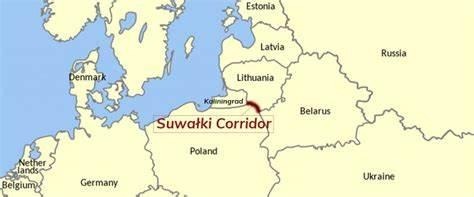
Many military analysts see the Suwalki gap as a potential flashpoint area if there were to be a conflict between NATO countries and Russia. The fear is that if Russia, along with Belarus, were to use military force to close this gap, they could cut off the Baltic republics – Lithuania, Latvia and Estonia – from their NATO allies in Europe. This is a very narrow choke-point – Russia and Belarus together would find it easy to block NATO from sending reinforcements to protect the Baltic states. Russia and Belarus have signed a number of military accords in recent years. Belarus allowed Russian troops to invade Ukraine from across its border, and is allowing Russia to put tactical nuclear missiles on its soil. But plans do not exist in a vacuum. The need a purpose, a target objective. And for General Donahue, that objective was Kaliningrad, a slice of the Russian Federation positioned between Lithuania, Poland, Sweden, and Finland that was carved from the former East Prussia as part of the post-war configuration of Central Europe following the defeat of Nazi Germany. “How do we put that into these regional plans, into the Eastern Flank Deterrence Line?” Donahue asked? “If you look at Kaliningrad, that is—you can argue back and forth, but it’s about 47 miles wide, surrounded by NATO on all sides. There’s absolutely no reason why that A2AD [anti-access/area denial, a military strategy to control access to and within an operating environment] bubble, to deter Russia, we cannot take that down from the ground in a time frame that is unheard of and faster than we’ve ever been able to do. We’ve already planned that. We’ve already developed it.” While the world is focused on Ukraine, the NATO alliance is quietly preparing for a force-on-force conflict with Russia over Kaliningrad.
The Baltics aren’t the only potential hot spot between NATO and Russia. This past March NATO conducted a massive military exercise, named Cold Response, which focused on confronting Russia in the Arctic regions. Russia’s Arctic regions account for 7.5 percent of the country’s GDP. This figure is likely to increase as global warming and the resultant melting of sea ice open up the Northern Sea Route to shipping. This route is expected to become even more important as Russia is expected to garner substantial revenue from oil and liquefied natural gas extracted in the Arctic region and transported to Asia with costly icebreaker assistance. Likewise, with an estimated $19.2 billion in earnings in 2025, Arctic fisheries are also an important source of revenue for the Russian Federation. as characterized the Arctic as an emerging arena of great power competition, and has not ruled out the use of military force in order to assert US dominance over the region. For countries across the Global South, NATO is widely viewed as an outdated military alliance whose role has run its course.
4 Putin’s “Strategic Patience” is nearly over
West no longer hiding plans for war with Russia – Putin. NATO countries have forced Moscow to take action to defend its interests and label it as a threat to justify increased military spending, the president says, “Western nations are no longer hiding their preparations for war with Russia. Putin has said, adding that NATO and EU leaders are using “false claims” about the supposed ‘Russian threat’ to justify rampant militarization. Putin, saying NATO’s posture has shifted from supporting Kiev with weapons and funding to outright preparations for war. The pattern of targets struck points to a clear strategic logic. Moscow is focusing its efforts on dismantling Ukraine’s defense industrial base, particularly the high-tech manufacturing sector that supports Ukrainian drone production. The energy sector is the second priority. Russian-guided drones are destroying gas stations and fuel depots daily across regions bordering Russia. Serious fuel shortages have already emerged in the Kharkiv, Sumy, and Chernihiv oblasts, where lines of hundreds of vehicles have formed at gas stations. If the strikes continue, major regional centers risk grinding to a near standstill. It appears that the Russian leadership held back from this escalatory threshold for as long as possible. Kyiv first launched systematic, large-scale strikes against Russia’s fuel sector, triggering real fuel shortages on Russian soil. Moscow is evidently determined to return the favor — and then some — with the goal of paralyzing life in the border regions and major urban centers. Cities like Kharkiv, Chernihiv, Sumy, and Dnipro are the logistical pillars on which the entire Ukrainian military effort rests. By targeting these cities, Russian command hopes to break the Ukrainian army not on the battlefield but from within through logistical collapse. The war in Ukraine shows no sign of easing. The United States and its European NATO allies have failed to stop Russia on the battlefield, while Moscow continues to strengthen its position and press forward along several sectors of the front. In response, Western capitals have stepped up military aid to Kyiv.“Now, they are openly saying that they are preparing for war with us, increasing military offensive budgets,” Putin said. He argued that Western governments are using the same playbook that has always been used against Russia. “At first, they create threats for our country, force us to take actions necessary for self-defense, and then immediately accuse us of all mortal sins to justify the continuation of their aggressive policy,” he said, drawing parallels to the attempts by Nazi Germany and other Western countries to label the Soviet Union as the aggressor after Germany launched a surprise invasion in 1941.Putin’s remarks come as NATO’s European members and Canada raised defense spending by 20% in real terms in 2025, reaching a combined $574 billion, citing the supposed ‘Russian threat’. Moscow has dismissed speculation that it plans to attack NATO countries as “nonsense.” Turning to Ukraine’s drone campaign against Russian cities, Putin said the strikes on civilian infrastructure are designed “to rock society” rather than achieve military aims. “When the whole West is working for them, with this huge flow of drones, [the aim is] to create doubt in the actions of the Russian Armed Forces,” he said. Putin has warned that any Ukrainian strikes on Russian territory will be met with significantly stronger retaliation.
“Our response will always mirror any strike on Russian territory. We will respond in kind – only several times more powerfully, the enemy will feel it. They already do, I hope. And they will feel it even more in the future.” Russia’s strength lies in its ability to overcome “every difficulty and every challenge,” while the “Russo phobic” part of the collective West continues to wage a campaign against the country . Despite the pressure, Russia is “developing its economy, strengthening its financial system, modernizing its Armed Forces and expanding its defense industry,” he said, adding that these efforts are already changing “the situation on the battlefield – our fighters are advancing, that is why there is no doubt we will achieve victory.” Putin noted, however, that European nations are still reluctant to launch strikes on Russia from their own territory because “they understand that there will be retaliation.” on 23 June. Putin, in summary, told the young officers that the West manufactures a Russia threat, then accuses Russia of creating that very threat. This, said Putin, is a historically repeated pattern going back to 1941. Putin implied that a threshold had now been crossed: He stated that whilst, until recently, NATO countries had limited themselves to supporting the Kiev regime to wage war on Russia, the West today is openly talking about preparing for a war against Russia, and is building up their military offensive budgets. Russia’s response, he said, is focused on modernizing its nuclear triad and its Army, and strengthening the combat capability of the Aerospace Forces and the Navy. The explicit mention of the nuclear triad in direct proximity to the discussion of Western preparation for war against Russia was certainly a pointed message to Trump and the Europeans. Russia has heard the European clamor for war. It has now made the strategic decision in response to prepare for war in Europe. Russia has now made the strategic decision in response to prepare for war in Europe. Ukraine has launched drone attacks on Russian energy infrastructure and residential areas in recent months amid continued setbacks on the battlefield, launching several hundred UAVs a day on average. FPV drones, including AI-assisted models, have increasingly targeted passenger buses and private vehicles. Most Russian strikes in recent weeks have focused on the Ukrainian capital, Kiev, targeting military-industrial facilities, drone assembly and storage sites, and weapons depots. These strikes were a direct response to Ukraine’s escalating attacks on the Russian-controlled Crimean Peninsula and on shipping in the Black Sea.
Russia takes control of the Black Sea
Kyiv’s plans have clearly backfired once again. Ukrainian ports now appear to be under a full-scale blockade by Russian forces. While the Western media continues to hype Ukraine’s drone attacks on Russia as incredible military achievements that are sapping Russia’s will to fight, the reality is that Russia continues an unrelenting bombing and missile campaign that is destroying critical Ukrainian assets and infrastructure from Kyiv to Odessa.Ukraine hits dozens of fuel tankers and other grain ships has forced Moscow to ban restrict shipping near the Sea of Azov, which abuts the Black Sea. Two weeks ago, Ukraine also struck 10 tankers in the Sea of Azov, among almost 50 fuel vessels damaged in the last five days. The energy strikes would cost Russia some $75 m a day. The CIA would also assist with Ukrainian drone strikes on “shadow fleet” vessels in the Black and Mediterranean Seas. Gas lines would start forming across Russia. As a senior US official says:” We found something that is working- for how long, we don’t know”. On July 18–19, 2026 (primarily overnight into July 19), Russia conducted a major combined missile and drone attack, with Kyiv as the primary target. This was described as one of the largest ballistic missile assaults on the capital since the start of the war in February 2022. The previous day, July 17-18, Russia launched seven missiles and 90 drones on the Odesa Oblast. This attack has effectively closed the ports at Odessa and Nykolaiv and marks Russia’s a complete break with the Black Sea Grain Initiative (BSGI), which was brokered by UN Secretary-General António Guterres and Turkish President Erdoğan in the summer of 2022. After the February 2022 invasion, Russia’s navy blockaded Ukraine’s Black Sea ports, and Ukraine mined its own coastal approaches to deter an amphibious assault. Between them, roughly 20+ million tons of grain were trapped in silos, unable to move — Ukraine being one of the world’s largest exporters of wheat, corn, barley, and sunflower oil. Global wheat prices spiked, and the countries most exposed were food-import-dependent states in North Africa, the Middle East, and the Horn of Africa (Egypt, Lebanon, Somalia, Yemen among them). The UN framed it explicitly as a hunger-crisis intervention, not a favor to Ukraine’s economy. The UN signed a separate three-year MOU with Russia, committing to help facilitate Russian food and fertilizer exports to world markets. This is the piece often forgotten… Russian food and fertilizer were never formally under Western sanctions, but Moscow argued that secondary effects — sanctions on banks (including SWIFT cutoffs), shipping insurance, and port access — were choking its own agricultural exports. This MoU was Russia’s price for allowing Ukrainian grain out and, despite Moscow’s persistent complaint that the UN failed to deliver on it, Russia did not enforce a blockade until now.Although Russia finally withdrew from this deal on 17 July 2023, declaring the initiative dead and its Black Sea guarantees void, Russia did not move to impose a full blockade on Odessa nor did it routinely attack grain ships entering and leaving Odessa. The ports in Odessa and Nykolaiv were able to conduct normal trade activities, notwithstanding occasional Russian attack on the Odessa port and grain infrastructure. Further to this point, Putin was told that Ukraine’s grain is intended for customers in the Global South; on this point alone, Putin agreed for Ukraine to resume shipments. But Putin was told a lie. Most of Ukraine’s grain went to the EU. Now, the EU is cut-off from cheap grain, expect bread prices to go up in Europe. Also, Ukraine’s grain trade is controlled by an American company- Cargill, which is in the Rockefeller orbit.July 28 became a turning point in the course of the special military operation.
For the first time since the start of the Russian-Ukrainian conflict, Western maritime traffic services and the registries of the five largest insurance companies recorded zero vessel movement in and out of Ukrainian Black Sea ports. The consequences of this strike are already beginning to show on land: Ukraine’s largest mining and processing plants are halting production one after another. The country’s economy, already weakened by war, has been hit in its two main export pillars: agriculture and metallurgy. all three terminals of the so-called Greater Odessa have completely ceased operations. Together, these three ports accounted for more than 80% of Ukraine’s maritime exports, including the lion’s share of grains corn, wheat, and sunflower oil. The Russian Ministry of Defense confirmed that between July 18 and 24, Russian forces struck 27 merchant vessels used in the interests of the Ukrainian Armed Forces. The port blockade has already triggered a cascading halt of export-oriented industries. Metallurgy and mining are among the largest sources of foreign currency earnings, accounting for 15–20% of Ukraine’s total exports. The loss of these revenues means a catastrophic reduction in the ability to finance both defense and social obligations. The port shutdown came at the height of the harvest season — the mass gathering of the 2026 crop. By early July, about 10 million tons of unsold produce from the previous year’s harvest had accumulated in Ukrainian storage facilities. The halt in export sales puts farmers at risk of cash-flow gaps: they may be unable to repay spring loans and left without funds for autumn sowing. Alternative routes have limited capacity. In the first half of 2026, Ukraine exported 50.7 million tons of goods, two-thirds of which 34 million tons went by sea. That flow is now cut off. the consequences will include job losses, reduced tax and foreign currency revenues, and additional pressure on the hryvnia exchange rate. Ukraine will be forced to borrow even more from the West just to cover current expenditures. At the same time, the situation for Odessa has become worse than ever, with Russia having entirely landlocked Ukraine. an unprecedented Russian aerial offensive has completely blocked Ukrainian ports on the Black Sea, threatening an economic disaster that, at the moment, appears underestimated by international media. In the city, one witnesses paradoxical scenes, with Russian drones and missiles flying over beaches full of swimmers, or being shot down off the coast, in view of thousands of smartphones pointed at the sky. For about ten days now, Moscow has begun systematically targeting all vessels approaching the port, with no regard for nationality. Now, neither captains nor shipowners dare to approach the three major Ukrainian ports: Odesa, Chornomorsk, and Pivdenny. For Ukrainian farmers, it risks being a disaster. With exports blocked at the peak of the harvest season, their warehouses are overflowing, and agricultural commodity prices in the country have collapsed. With the sunflower harvest starting in just a few days, the situation risks becoming critical.
What the Russian Aerospace Forces have achieved in recent days is not just a military success but a systemic economic blow that methodically cuts off Ukraine’s access to global markets. The Black Sea was its main export artery and that artery is now pinched. Every day of downtime in the Black Sea ports inflicts increasingly severe damage on the Ukrainian war machine and the economy as a whole. Against the backdrop of losing $1.5 billion in annual revenues from just two plants, not to mention grain exports, the Ukrainian budget faces a deep crisis. Now the situation is completely different. Putin’s press spokesman, Dmitri Peskov, announced 3 weeks ago that Russia was at war with Ukraine and its NATO allies. This was a clear shift from describing the fight with Ukraine as a Special Military Operation. The intense and varied attacks by Russia since July 6 on Kyiv and other key cities still held by Ukraine, marks a decisive shift by Russia in how it will manage the war with Ukraine in the coming weeks and months.
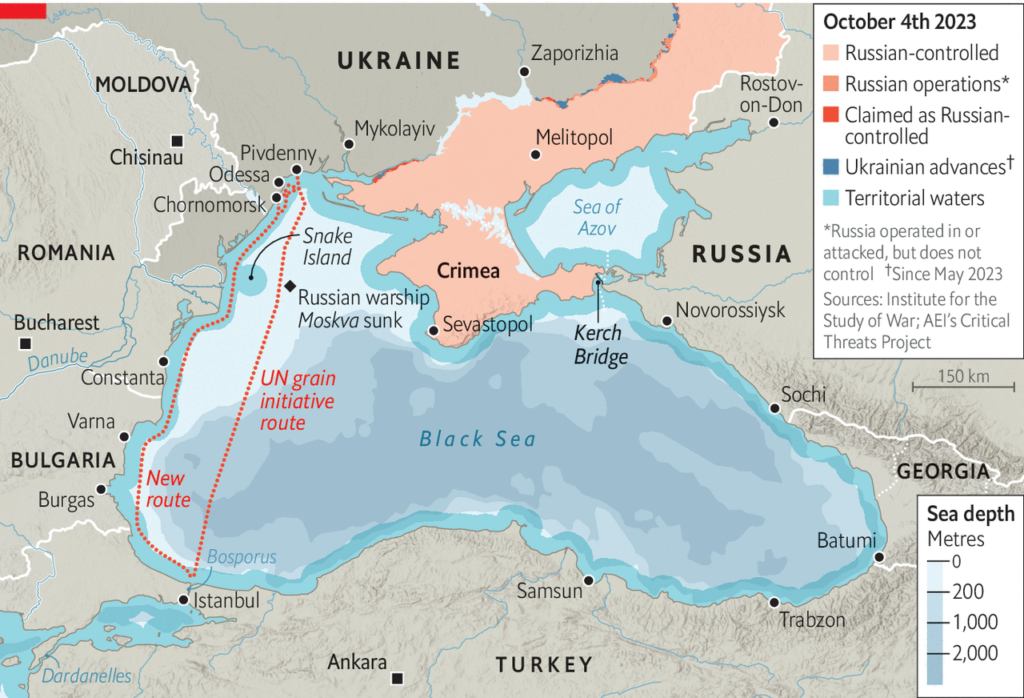
Equally, the security situation in the Black Sea region has dramatically changed. Daily attacks on Crimea are taking place, and the road and the peninsula’s links with the Russian hinterland are disrupted. An emergency has been declared. A massive military push by Russian forces towards Kiev is on the anvil, as the Kremlin seeks an all-out military victory and estimates that nothing short of a change of regime in Ukraine can bring the war to an end.But the biggest story now revolves around Russia’s reciprocal strike campaign against Ukraine’s own cargo carriers. In the last month, from Jube 20 to July 20, Russia attacked 28 merchant ships in Odessa port. In fact, relevant Ukrainian ministers are now in a panic over the total shutdown of Odessa ports. Minister of Agrarian Policy Taras Vysotsky announced that Odessa has been completely shut down with no ships any longer able to enter its ports: The importance of Ukrainian agricultural products for its European sponsors will increase significantly this season – according to estimates by European industry associations, the June heatwave in Europe led to a loss of almost 9 m tons of grain. As we stated last time, Ukraine is only able to effectively reroute 1/5th or 1/6th of the cargo, implying major economic losses to the Ukrainian state which has become one of the primary issues of debate. The contrast is the whole story. For four years Russia struck cranes, berths, silos and fuel tanks, and the ships kept coming: infrastructure gets repaired, and a shipowner insures against damage ashore. In July the targeting shifted to the ships themselves, and eleven days later inbound traffic was zero. Nobody insures against being sunk at sea. The Black Sea has now become a Russian lake. The West’s grain gamble has failed. Kyiv’s plans have clearly backfired once again. Ukrainian ports now appear to be under a full-scale blockade by Russian forces. The pattern of targets struck points to a clear strategic logic. Moscow is focusing its efforts on dismantling Ukraine’s defense industrial base, particularly the high-tech manufacturing sector that supports Ukrainian drone production.
The story continues in Part 2.
A partnership led by BP 9Rocefeller Network) signed agreements with the Venezuelan government to advance offshore natural gas development, including the award of an exploration and production license for Phase 2 of Loran gas field in the Plataforma Deltana area offshore Venezuela.
The strategic patience of Russia had to be related to their own internal calculus of how long it would take for Russian military industries to produce sufficient quantities of drones and missiles to exhaust the West’s defensive missile shield and then how long it would take to stockpile a huge reaeve of hypersonic and supersonic missiles to completely level Ukriane after complete Air Dominanace (full spectrum.dominance) was achieved. We are witnessing that dominance wreak havoc on Ukriane now. And Putin needed a very strong response to convince his citizens that payback was under way, and a line of sight to utter decimation of the Kiev regime was in progress. I don’t know how long it will take to establish MaloRussia with the Black Sea coast forever removed from Ukriane – maybe another 2 years? But it will happen and Russia will be that much stronger as a result, with a strategic defeat having been inflicted on the West. In the end the East will destroy the West. Our 500 year experiment with domination is over. We deserve to be destroyed and humiliated for the billions of people we have killed in our illegal wars of colonialism. It would be great to see the Rockefeller and Rothschild families exterminated as part of the total Eastern victory.