
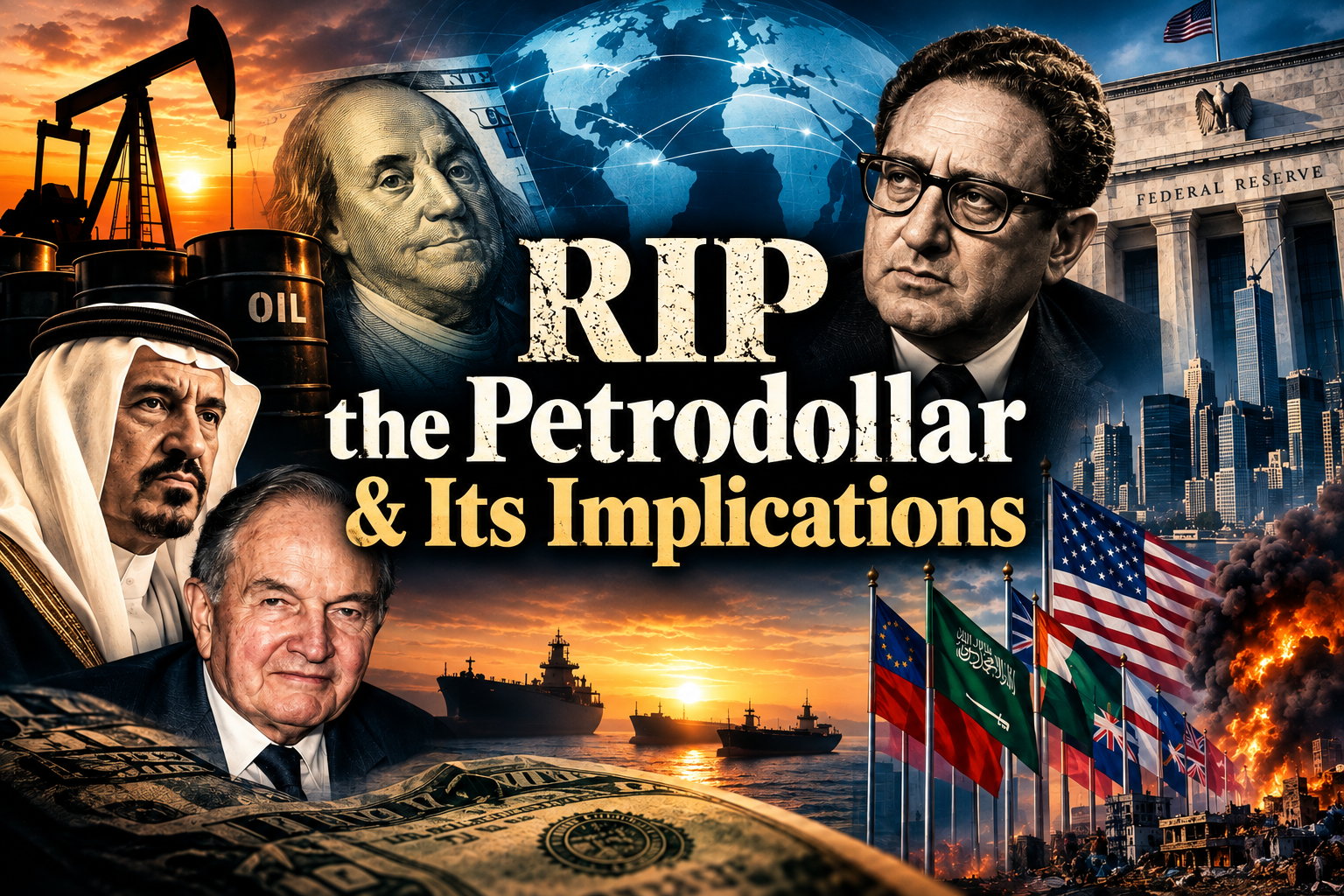
Abu Dhabi — The First Domino Has Fallen
The cascade we predicted is starting.
So why did the UAE just ask Washington for an emergency loan?
Because this is not really about whether the UAE has money. It is about what the UAE would have to sell to get that money.
And that brings us to the pressure point I wrote about two weeks ago: the U.S. Treasury market.
In late April, the United Arab Emirates approached the U.S. Treasury and asked for a wartime financial lifeline.
The Strait of Hormuz has been effectively closed for five months. As a result, the UAE cannot sell oil as it used to, and it has bills to pay.
But here is the thing. The UAE is a fabulously wealthy country. It has not run out of money in the conventional sense.
It holds roughly $95.6 billion in U.S. Treasury bonds alone. It has approximately $270 billion in foreign exchange reserves overall, and it controls trillions more through its sovereign wealth funds.
So, the UAE is far from broke.
But its cash flow has stopped.
And when your cash flow stops, you dip into your savings.
If the UAE had sold its U.S. assets to raise the cash it needed, that would have meant unloading tens of billions of dollars in U.S. Treasuries onto the open market during an already stressed moment.
The price of those bonds would have dropped. The yield on the 10-year Treasury would have climbed.
The exact spiral I described earlier would have begun, and the UAE would have been the country that started it.
So instead, the UAE did something different.
It approached Washington with a proposal:
“We did not ask for this war. We were dragged into it. If we run short on cash and you do not help us, we will have no choice but to raise it ourselves — and you know what that means for your bond market. Let’s avoid this.”
So, the UAE asked for a short-term loan, known as a currency swap line — an emergency credit facility that allows the U.S. Federal Reserve to lend dollars directly to a foreign central bank.
This is not a bailout of the UAE.
It is a bailout of the Treasury market.
The evidence that this prediction is materializing will be simple: the UAE gets its swap line approved.
And Kuwait gets one next.
Why Kuwait?
Because oil revenues fund roughly 90% of Kuwait’s government budget.
Kuwait exported zero barrels of crude oil from March 2026 — for the first time in roughly thirty years.
Kuwait Petroleum Corporation declared force majeure on its export contracts in March, telling clients it could not meet its contractual obligations even if the Strait of Hormuz reopens.
Kuwait holds $66.1 billion in U.S. Treasuries.
Read that again.
Kuwait now has zero oil revenue.
Kuwait runs 90% of its government on oil revenue.
Kuwait holds $66 billion in U.S. Treasuries.
They will either sell their Treasuries, which is the trigger we wrote about, or they will follow the UAE’s lead and ask Washington for a swap line of their own.
A swap line looks like a bailout for the borrower because the borrower receives the dollars.
But in this case, the real beneficiary is the lender.
Because what is the alternative?
The alternative is that dollar-starved countries sell the most liquid dollar asset they own: U.S. Treasuries.
They sell into a falling market.
Treasury prices drop.
Yields rise.
Washington’s borrowing costs climb.
Mortgages, car loans, corporate debt, and government refinancing all get more expensive at once.
That is the spiral.
So, when the Fed opens a swap line, it is not merely helping a foreign central bank. It is preventing that foreign central bank from becoming a forced seller of U.S. government debt.
This is not a bailout of the UAE.
It is a bailout of the Treasury market.
And if the Strait of Hormuz remains closed, the question is not whether more countries will need dollars. They will.
The question is whether Washington chooses to let them sell Treasuries to raise those dollars, or quietly lends them the dollars first.
That is why the UAE matters.
It is not the end of the story. It is the first domino.
Saudi Oil Exports Collapse
The Yemeni blockade in the Red Sea and Iran’s closure of the Strait of Hormuz have crippled Riyadh’s main source of income.
Saudi oil exports have sunk to their lowest levels in nearly a decade as the US war on Iran disrupts Saudi shipping across the Red Sea and the Strait of Hormuz.
The collapse was sharpest at the Red Sea port of Yanbu, where shipments peaked near 4.3 million barrels per day (bpd) in June before sliding to 3.7 million bpd in July and falling again to roughly 2.25 million in August.
Saudi crude shipments averaged roughly 3 million bpd in August, the weakest monthly volume in records reaching back to early 2017.
Sustained attacks on tankers carrying Saudi crude have unnerved buyers, some of whom now refuse to load at the kingdom’s Red Sea terminals.
The July decline followed the Yemeni Armed Forces’ declaration of a blockade on Saudi shipping in the Red Sea, a route Riyadh had turned to precisely to keep its cargoes clear of the Strait of Hormuz.
The Yemeni blockade, imposed as part of a strategy answering more than a decade of Saudi war and siege on Yemen, has also forced Saudi tankers lifting from Yanbu to switch off their transponders to evade attack.
The blackout left export volumes impossible to verify independently, with tracking firms reaching sharply divergent conclusions about the same shipments in early August.
As Saudi Aramco Facility Is Hit Again, Oil Climbs
Aramco’s oil facilities in the Saudi Arabian city of Jizan have been attacked only a month after a separate strike temporarily knocked out some production at its refinery.
The company’s oil infrastructure was hit again on Monday, 6 September.
This vast complex is ultra-modern and produces 400,000 barrels of petrochemical products.
Jizan provides a convenient targeting opportunity for the Houthis given its proximity to the Yemeni border and its importance as a significant Saudi industrial city.
The Iran-linked group has not immediately claimed responsibility for any fresh attacks on the kingdom, however.
The Houthis have sought to impose a blockade on Saudi Arabia’s Red Sea ports since July. This has been coupled with sporadic major drone and missile attacks on Saudi oil sites.
Ansar Allah is no doubt working in tandem with Tehran to keep up the pressure on global energy markets.
Pipeline Bypass Options
The Strait of Hormuz handles roughly 20–21 million barrels of oil and 20% of global LNG every day in peacetime.
When it closes, the world scrambles for alternatives.
This provides the definitive breakdown of the major bypass routes, pipeline alternatives, and emergency rerouting options available — and why none of them are sufficient to replace the Strait.
How Ships Normally Transit the Strait of Hormuz
Saudi East-West Pipeline
- Normal capacity: 7 million barrels per day
- Output port: Yanbu, Red Sea
UAE Habshan–Fujairah Pipeline
The Abu Dhabi Crude Oil Pipeline runs 400 km from Habshan to Fujairah on the Gulf of Oman coast, completely bypassing the Strait.
- Capacity: 1.5–1.8 million barrels per day
Iran Goreh–Jask Pipeline
Iran itself built a bypass pipeline — a tacit acknowledgment that even Tehran sees a Hormuz closure as a double-edged sword.
The Goreh–Jask pipeline moves Iranian crude from the Goreh terminal on the Gulf to Jask on the Gulf of Oman.
- Capacity: 1 million barrels per day
- Significance: Allows Iran to export oil even when its own blockade is in effect
The Bypass Math: Why Pipelines Cannot Replace the Strait
The gap — approximately 11 million barrels per day — has no solution.
This is the fundamental structural vulnerability of the global energy system.
Unlike crude oil, there is no bypass for LNG.
The Petrodollar Under Threat
The yen intervention is not an isolated emergency. It is the fear that foreign governments will sell Treasuries faster than the market can absorb them.
That fear is justified because the selling has already begun, and it is broad.
In March 2026 alone, foreign holders reduced their Treasury positions by $138.4 billion, with Japan selling $47.7 billion, China selling $41 billion, the United Arab Emirates selling $5.8 billion, and India contributing to the same retreat.
Foreign central-bank holdings of American government debt are now near their lowest levels since 2012.
This means that the governments that financed the United States for decades are quietly becoming sellers at the same time that Washington’s need to borrow is becoming larger.
The United Arab Emirates provides the clearest example.
Facing a liquidity crisis worsened by the war with Iran, and having already sold billions of dollars in Treasuries, the Emirates entered into swap discussions with the Treasury this spring. A facility is now being prepared to forestall further selling before it becomes disorderly.
The UAE left OPEC within days of negotiating those terms, a sequence that provides some indication of the leverage now held by a sufficiently large American creditor.
Bessent has acknowledged that other governments across the Gulf and Asia have requested similar arrangements, while the Treasury is separately discussing a swap line worth as much as $20 billion for Argentina.
The United States is currently issuing approximately $2 trillion in new deficit financing per fiscal year, a figure projected to grow toward $2 trillion and beyond through 2027.
The Treasury market, at approximately $29 trillion in marketable debt, is the largest sovereign bond market in the world and, by a considerable distance, the most liquid.
Daily trading volumes exceed $910 billion.
Since 1971, Wall Street has essentially set the price of global commodities through cheap energy and cheap credit.
Cheap energy came from controlling the global energy complex via naval command of strategic sea lanes and anchoring OPEC’s defence shield.
Cheap credit came from maintaining low rates via the Fed and dollarizing global assets.
Both pillars are caving in.
How Is the Dollar System Melting Down?
Since 2022, Western institutions such as SWIFT, the IMF, the World Bank and the US monetary system that enforce network discipline have been losing power.
First, seizing Russian sovereign assets, imposing sanctions, and engaging in proxy war were supposed to break Russia and set an example.
Instead, Putin’s pre-war defensive measures to offload Treasuries in favour of gold, followed by pegging the ruble to energy exports, weathered the storm.
However, the real earthquake was the Global South’s refusal to enforce Western sanctions and Russia’s battlefield victories.
Essentially, the special military operation was a successful proof of concept that exiting the dollar network was possible.
Why is this such a problem for Western bankers?
If there is a ledger switch — ditching the dollar system for a gold-backed one — the legacy system implodes.
A premeditated revaluation of dollar-denominated assets in gold and non-dollar currencies will prompt a massive deflationary collapse.
Prices set in dollars are artificially propped up by low rates and cheap credit.
Gold Repatriation
Since 2002, the base layer of the financial system, which remains gold, has been massively repatriated from Western vaults in New York and the City of London to the Global South, destined primarily for China.
Over the past two weeks, EU countries have withdrawn their gold from New York and repatriated it back home.
Western Financial Collapse, Not World War III, Is the Dollar’s Endgame
The fact of the matter is that the post-WWII world order, and its iterations since, have reached entropy.
Gold will re-emerge to anchor a new multi-nodal system.
The renminbi will not be swapped out for USD.
Major powers will determine reserve status by region.
America will adopt a new currency. Bitcoin will play a role.
The eurozone will collapse, retrenching Europe along historic fault lines.
Many countries in Europe and elsewhere are quietly withdrawing their gold reserves from the New York Fed.
The Dutch central bank recently shifted roughly 86 tons of gold from New York and Ottawa toward London, citing crisis preparedness and the need to make its reserves more accessible and tradable.
Norway’s $2.3 trillion sovereign wealth fund could sharply reduce its holdings of U.S. Treasuries under a proposed overhaul aimed at boosting returns through other types of debt, the institution has announced.
The shift could cut its Treasury allocation by almost $80 billion.
A storm is gathering in bond markets across the globe as yields on government debt are, in many cases, near multi-decade highs.
High and rising government debt levels pose a problem for bond markets for which no solution seems imminent.
The rising deficits, meanwhile, are colliding with diminished demand for government debt.
What it all adds up to is that yields on government bonds across major economies are, in many cases, trading at levels not seen in years or even decades.
- The UK’s 30-year bond yield hit its highest level since 1998.
- Japan’s 10-year yield broke through the 3% mark for the first time in three decades.
- Yields in Germany and France are also trading at their highest levels in a decade.
- The yield on the US 10-year, the single most important interest rate in the world, is at a level last seen in 2023.
It is becoming harder and harder to disentangle all the factors behind the moves in bond markets.
The only thing we can say right now is that they are all pointing in the same direction:
Higher rates — globally.
The Dollar Without Petro Will Lose Value
The war with Iran, launched to strengthen the petrodollar system, has produced the opposite effect — it is undermining the very foundation of American financial power.
The US war against Iran was initiated to expand Washington’s control over the region’s oil and strengthen the petrodollar.
The explanation that the war was supposed to protect Israel was a deception.
The same war crafted to expand the US’s control of Middle Eastern oil — taking Iranian crude, pricing it in dollars, and routing its payment through an account in the US Federal Reserve Bank, as in the case of Iraq — has produced the opposite effects.
However, after only a few months of conflict, the US has not only failed to gain Iranian resources but has also lost control of the flow of resources from Iraq and other dollar-priced crude due to the closure of the Strait of Hormuz and the blockade in the Red Sea.
If the status quo persists for some time, the US financial empire will suffer a serious blow.
Washington is scrambling for other ways of propping up the dollar as an international payment system or preparing how to live with stricter access to low-cost borrowing at a time when the US public debt has reached $40 trillion.
The Rockefeller Empire used the military fist of the Pentagon to defend and support the petrodollar system.
When the US military began to be defeated in both Ukraine and Iran/Gaza, the world saw a chance.
If the Pentagon is unable to enforce the petrodollar system, then there is nothing to fear from American threats.
Globally, the weakness of military power has freed many nations from obeying Washington’s dictates.
A weakness in military power results in a crumbling petrodollar enforcement policy.
The Global South
Most of the Global South is heavily indebted to Western banks, and this leaves them no wriggle room.
When the financial crash happens, these countries need to survive or their elected leaders will be dragged out of their palaces and hung on the nearest pole.
To avoid this, these countries will nationalize their mineral resources and use them as collateral to obtain financing from the East.
It is a first step towards independence.
Essentially, the US no longer holds the monetary whip hand.
It is only a matter of time before USD-denominated assets in the Global South sitting on Western bank balance sheets are placed on a new ledger.
That is to say, nationalized or repossessed by host nations and denominated in a new currency.
The current predicament for a lot of Global South countries is that they are indebted in a currency that they do not control, having pawned their assets — mineral leases, refineries, mines, etc. — to Western private companies.
The Domestic Equation
The US is unable to sustain a higher interest burden.
The government, businesses and individuals have hit a wall.
It will be interesting to see how Washington solves this problem.
Under the current equation:
It can’t.
Iran has studied the psychology of the American consumer.
Nothing external fazes them, except the cost of food, fuel and money.
By reducing the flow of oil, Iran has brought the American consumer to the negotiating table — kicking and screaming.
Iran has just added one more pressure point on Washington.
5. China
On 28 March, the Shanghai Petroleum and Natural Gas Exchange (SHPGX) made history by announcing the first-ever deal on importing 65,000 tons of liquefied natural gas (LNG) from the UAE, settled in the Chinese yuan currency.
China National Offshore Oil Company (CNOOC) and French TotalEnergies finalized the transaction, and TotalEnergies confirmed that the LNG imported was from the Persian Gulf state.
Beijing Pushes Yuan for Energy Trade
The development comes after Chinese President Xi told MBS in December 2022 that his country should make “full use” of the SHPGX as a platform to carry out yuan settlement of oil and gas trade.
This deal represents a departure from the decades-long practice of conducting global oil sales exclusively in US dollars.
A prominent economist speculated that:
“The French either resorted to the yuan due to the acute shortage of Russian gas supplies to the European continent, or they have reserves in the Chinese currency that they want to use.”
The yuan payment also follows the global polarization taking place over the Ukraine war and further demonstrates the reluctance of Persian Gulf states to align with Western hostility toward Russia, China and other US adversaries.
According to the same economist:
“The Emirati move cannot be separated from the changes taking place in the world. Abu Dhabi and Riyadh sense the global imbalance of power, and decided to expand the margins of their international relations.”
Given the current global geopolitical shifts, the yuan is gaining increased acceptance as an international currency.
Since President Xi Jinping assumed office, China has settled agreements with several countries in their local currencies in an attempt to challenge the dominance of the US dollar in global trade.
As a result, the yuan has become the world’s third-largest currency in trade settlement and the fifth-largest reserve currency.
The yuan today accounts for 7% of all foreign exchange trades worldwide and has experienced the most significant expansion in currency market share over the past three years.
Rise of the Petro-Yuan
Since 2009, Beijing has implemented a policy to reduce its reliance on the US dollar in commercial transactions.
This policy includes settling the majority of its goods in foreign markets in its local currency, establishing mutual lines of credit with several central banks worldwide, and negotiating with West Asian and North African countries to conduct trade using the yuan.
These efforts have started to show results recently, with a number of Asian governments partially adopting the Chinese currency.
Iraq is one of the countries that has partially adopted the yuan in trade.
In February, the Iraqi Central Bank planned to allow direct settlement of trade from China in yuan to improve access to foreign currency and compensate for the dollar shortage in local markets.
Egypt also announced its intention to issue yuan bonds last August.
Russia has played a significant role in changing the course of the yuan by signing the Eastern Natural Gas Pipeline Agreement from Russia to China and converting the currencies of gas payments from the US dollar to the Chinese yuan and the Russian ruble.
In a January interview during the World Economic Forum in Davos, Saudi Finance Minister Mohammed al-Jadaan said:
“The kingdom is open to trading in currencies other than the US dollar in order to improve trade.”
The trend towards using national currencies in global trade chains has continued to mature.
Meanwhile, the emirate of Dubai has opened its door to dealing in the Chinese currency in its global financial center, and Brazil and China have agreed to ditch the dollar and use their local currencies in their commercial dealings.
In addition, Brazil and Argentina have announced the start of work on launching a common currency in their commercial dealings, dubbed “Sur.”
China’s gold complex is an insurance policy.
The Chinese have zero interest in destroying the greenback, nor will they open mainland capital markets to international capital, lest they become financialized like the West.
Rather, China’s gold provides a protective moat to insulate them from the monetary mushroom cloud and offers a backup system when the time comes.
6. SWIFT vs CIPS
The renminbi’s share of the payment messages that travel over SWIFT — the yuan’s standing as a currency in global transactions — has hovered in the low single digits, roughly 3–4%.
A related figure, the yuan’s roughly 2% share of global central-bank reserves, tells the same story about the currency.
Both are genuinely small, and both are worth citing when the question is how widely the world holds and invoices in yuan.
SWIFT is a messaging network. It carries instructions — some 45 million messages a day among 11,000-odd institutions — but it does not itself settle anything.
CIPS is not a messaging network.
It is a real-time clearing and settlement system, the yuan analogue of America’s CHIPS, the pipe through which dollar payments are actually cleared.
Comparing CIPS to SWIFT is comparing a settlement system to a telegraph office.
And, crucially, CIPS can generate its own messaging and clear payments without SWIFT in the loop at all — which is the entire reason it matters to anyone Washington threatens to cut off.
The Real Number
Here is the throughput.
In 2021, CIPS cleared about 80 trillion yuan, roughly $12.7 trillion.
By 2023, it was 123 trillion yuan, about $17 trillion, moving some $67 billion every business day.
In 2024, it jumped 43% in value to 175.5 trillion yuan — about $24.5 trillion — across 8.2 million transactions, roughly $91 billion a day.
In 2025, it reached 180 trillion yuan, about $25.5 trillion, and through the first months of 2026 it was tracking an annualized run rate near 190 trillion yuan, on the order of $27 trillion.
The value moving through CIPS has compounded at close to 60% a year since 2016 and has more than tripled since 2020.
This is a system clearing roughly $25 trillion a year — larger than China’s entire annual economic output — and growing at something like 40% annually.
It now links 193 direct and more than 1,500 indirect participants across 124 countries, reaching over 5,000 banking institutions in 190 countries and regions.
On 16 April 2025, it reportedly cleared about $1.76 trillion in a single day, briefly rivaling SWIFT’s daily throughput.
Whatever else $25 trillion a year is, it is not a rounding error.
CIPS is, functionally, an insurance policy against the dollar — and its clientele is a roster of everyone the United States has tried, or might try, to financially isolate.
Russia is the precedent that should have ended the complacency.
When the West cut major Russian banks out of SWIFT in 2022, Moscow did not collapse into autarky.
It rerouted onto CIPS and yuan settlement and, by 2023, had become one of the system’s heaviest users.
Iran is the current chapter — its oil sales to China clearing in yuan, outside the dollar system Washington keeps threatening to bar it from.
And the Gulf is the tell about where this goes next.
Saudi Arabia, the UAE and Qatar have been joining and expanding their use of the network, increasingly for oil and gas.
Every one of these states is hedging against the possibility that Washington will someday point the dollar at them.
The lesson governments drew from watching Russia and Iran is not that the dollar is inescapable.
It is that an escape route now exists — and it has room.
The machinery keeps deepening.
China has established bilateral currency-swap lines with dozens of central banks — Argentina, Pakistan and the UAE among them — to seed the yuan liquidity that trade settlement requires.
And beyond CIPS sits the next layer: the mBridge project for central-bank digital currencies has already processed around $55 billion, the overwhelming majority in digital yuan, with a UAE–China corridor leading the way.
This is financial plumbing that bypasses not just SWIFT but the entire correspondent-banking architecture the dollar system runs on.
CIPS Is Growing Fast — But It Is Not Replacing the Dollar
CIPS is growing fast, but it is not on the verge of dethroning the dollar, and nothing here says that it is.
The dollar’s own clearing system, CHIPS, settles well over a trillion dollars every business day — an order of magnitude more than CIPS moves in the same period.
The dollar remains around 57% of global reserves and roughly half of all trade invoicing.
The yuan, for all the growth of the plumbing that carries it, is still a low-single-digit share of global payments.
A large portion of CIPS volume is still China-linked trade — money flowing to or from China — rather than pure third-country commerce conducted in yuan because the parties prefer it.
And the real ceiling is not the plumbing but the currency itself.
China maintains capital controls and does not allow the yuan to float or move freely, which means a country can settle a trade in renminbi but then struggles to do much with a large yuan balance.
It cannot be recycled as frictionlessly as dollars into global markets.
That single fact is what keeps the yuan a transactional convenience for sanctioned and hedging states rather than a genuine reserve rival.
Until Beijing is willing to give up the control that capital-account convertibility would cost it — and there is little sign that it is — CIPS will remain a powerful bypass rather than a replacement.
That distinction is the whole of it, and it is worth stating precisely:
The dollar is not dying.
What is dying is the American monopoly on the plumbing — the assumption that, to move serious money across borders, everyone must pass through pipes Washington can close.
The correct way to read CIPS is this:
A settlement system that did not meaningfully exist a decade ago now clears some $25 trillion a year, compounds at around 40%, reaches 190 countries, and can operate without touching a wire Washington controls.
It will not overthrow the dollar.
But it does not need to.
It only needs to give a determined government — Russia, Iran and a lengthening line behind them — a working way to move money that American sanctions cannot reach.
That is exactly what it now provides.
And every fresh round of dollar weaponization sends more traffic down it.
Washington’s sanctions are not toothless because Iran is strong.
They are toothless because an alternative plumbing exists — and the harder Washington leans on the dollar, the more of the world goes looking for the exit it has spent a decade building.
The Dollar Network’s Two Remaining Monopolies
Two things made that isolation work:
- No major economy would keep a pipe open.
- Nearly all international trade — including oil — ultimately cleared in US dollars, through banks that had to answer to Washington.
Sanctions are a game of plumbing.
They close the physical pipes — goods and oil — and, more powerfully, the financial ones — dollar clearing.
Break either monopoly and the strategy weakens.
Break both and it fails.
In 2015, the United States held both.
In 2026, it holds neither.
And, most consequentially, the money has left the dollar.
The reason US financial sanctions are so fearsome is that most global trade — oil above all — has historically been settled in dollars, and dollar payments must clear through US-linked banks that Washington can police.
Iran and China have simply stopped using that pipe.
Iran now sells its oil to China — which buys more than 80% of Iran’s seaborne exports — settled in Chinese yuan rather than dollars, routed through China’s Cross-Border Interbank Payment System (CIPS), the renminbi clearing network the People’s Bank of China built in 2015 explicitly to move money across borders without touching the US-dominated dollar-clearing and SWIFT infrastructure.
A transaction that never touches a dollar and never clears through a US-linked bank is a transaction Washington cannot easily see, freeze or block.
That is not sanctions evasion at the margins.
It is the removal of the chokehold itself.
The scale of the shift is visible in the plumbing.
CIPS transaction volumes surged as the war began, hitting a single-day record of around $178.5 billion in March 2026.
Put those shifts together and the strategic picture inverts.
In 2015, the United States pressed on a sealed box whose only exits ran through its own banks.
In 2026, it is pressing on a box with the lid off and a back door cut straight through the financial wall.
The 2026 intelligence-sharing, satellite feeds and air-defence resupply are not the beginning of a relationship; they are the harvest of one planted in 2018, after the US collapsed the JCPOA with Iran.
Washington’s plan to force Iran’s surrender through unprecedented sanctions is built for a world that ended sometime between 2018 and 2025.
The instrument that worked in 2015 worked because isolation was total and because the money still ran through American pipes.
Today, neither condition holds.
And neither can be restored by American action alone, because the decisive variables — the willingness of Russia, China and Pakistan to keep the physical doors open, and the migration of Iran’s oil revenue into CIPS-cleared yuan — lie outside Washington’s control.
Washington cannot unveil a world in which Iran has nowhere left to go, and no currency left to trade in but the dollar — because that world no longer exists.
The story continues in Part 4…