
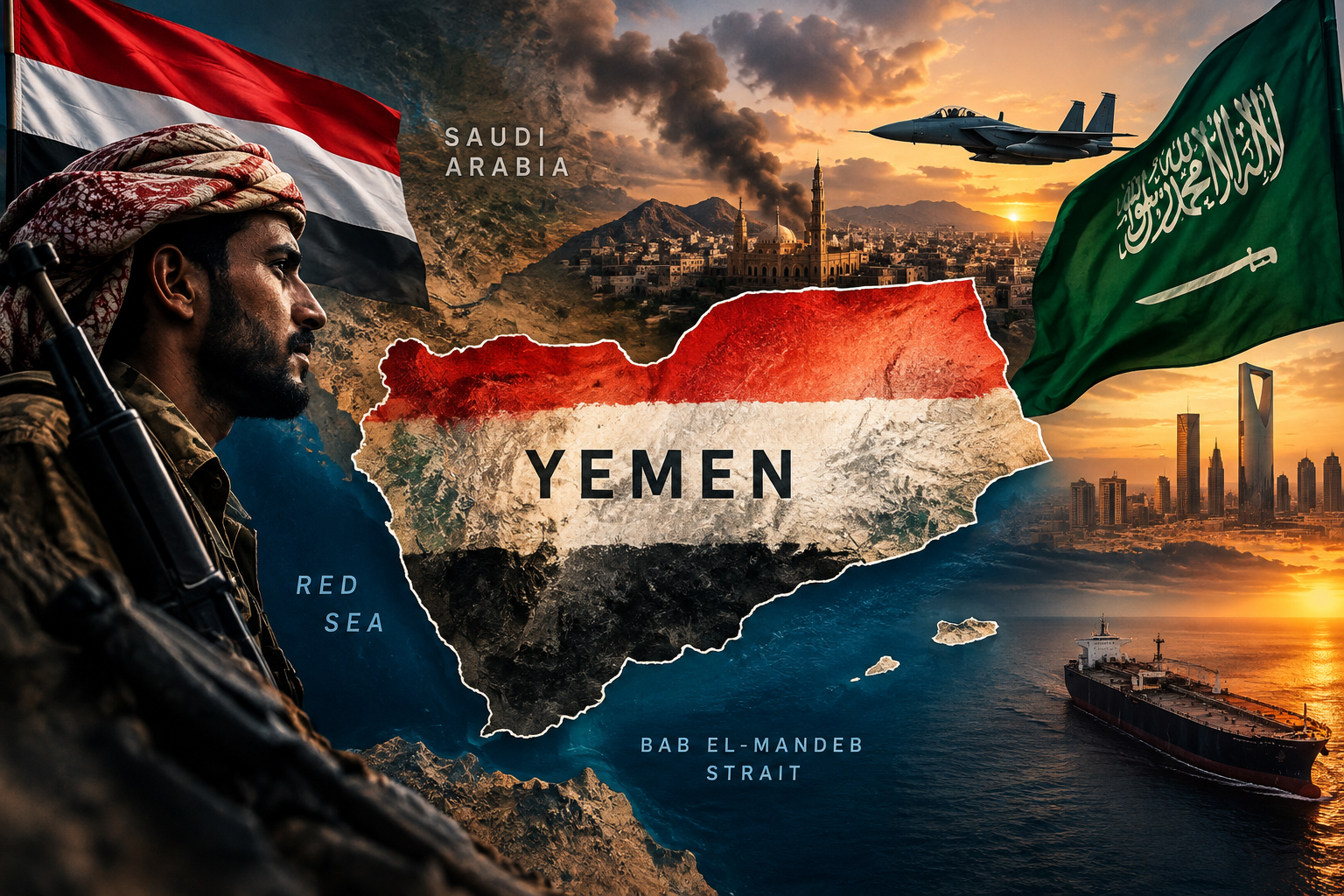
The story continues from Part 3…
4. The End of MBS
How the ruling establishment may jettison MBS to save the House of Saud
For nearly 100 years, the modern Kingdom of Saudi Arabia was grounded in a sacred 1932 Covenant that tied the monarchy, the tribes, and the religious establishment into a single, unified power structure. It was a pact of mutual interest where the crown guaranteed protection and reverence for tribal traditions, and in exchange, the religious and tribal elites, the custodians of the realm’s faith and soil, conferred the sovereign right to rule.
When King Salman ascended to the throne, the established tradition was clear: the king’s brother would serve as crown prince, preserving the horizontal power-sharing arrangement that had kept the Al Saud family unified for generations. This was not merely protocol; it was a survival mechanism. By rotating power among the sons of the kingdom’s founder, the family prevented any single branch from dominating and alienating the others.
Through a combination of political maneuvering, intimidation, and the leveraging of his father’s position, MBS engineered his own elevation to crown prince, displacing the heir. The move did not go unnoticed. Within the corridors of power in Riyadh, the Gulf states, and the royal family itself, MBS accumulated enemies and critics. Some were jailed. Others were placed under house arrest. The message was unmistakable: dissent would not be tolerated.
Last month, Saudi Arabia detained a fourth prince of the royal family over an alleged coup attempt to unseat King Salman and his son. Reports and rumors emerged that King Salman himself was seeking to remove his son as crown prince, with differences over national and international issues, particularly Israel and Palestine, lying behind the royal rift.
The royal family was not the only source of discontent. The tribes, long marginalized by the concentration of wealth and power in the hands of the Al Saud, began to stir. Such grievances could become politically significant under sustained military or economic pressure.
That dream is now fading.
As Saudi Arabia’s resources and monetary power decline, and as the UAE finds itself partially trapped by the same regional dynamics, the smaller Gulf states, Kuwait, Jordan, and others, are increasingly at the mercy of Iran’s patience.
Rather than aligning with Israel against Iran, they are now seeking to negotiate with Tehran directly, recognizing that the United States cannot come to their aid and that Israel offers no solution to their immediate security and economic crises.
Key actors like Saudi Arabia are now prioritizing rapprochement with Iran over normalization with an unpredictable and hegemonic Western bloc. Regional states are finding out that containing and isolating Iran not only failed but also produced a disastrous war that exposed both the unreliability and the stunning limits of the US security umbrella.
Rather than doubling down on Iran’s exclusion, Arab states are pursuing economic interdependence with Iran while incorporating Tehran into a new, region-led security architecture.
Saudi Arabia has emerged as the driving force behind this shift.
In the corridors of power, from Riyadh to Washington, from Berlin to Jerusalem, one question now dominates every strategic conversation:
How did MBS, the architect of Saudi Arabia’s ambitious modernization, become a leader trapped by his own ambitions, isolated within his own court, abandoned by his allies, and presiding over an oil empire that can no longer reach its customers?
The answer, as in all great geopolitical crises, lies not in a single moment but in a cascade of decisions, shifting alliances, and historical fractures that have finally reached their breaking point.
To understand how Saudi Arabia arrived at this precipice, one must first understand the kingdom itself.
Saudi Arabia was not always the unified oil giant we know today. It was a vast desert land of competing tribes, each with its own loyalties, territories, and grievances. The Al Saud family, through a combination of negotiation, alliances, and critically, a pact with the Wahhabi religious establishment, gradually brought these tribes under a single banner.
The arrangement was broadly based on a division of authority: the Al Saud provided political and military leadership, while the Wahhabi religious establishment provided religious legitimacy and exercised authority over religious affairs.
This compact, however, was never truly inclusive. It concentrated wealth and power in the hands of a single family while marginalizing the very tribes that had been persuaded or coerced into joining the fold.
The Saudi monarchy concentrated the country’s wealth in the hands of a single family and called it ‘unity.’ A unity built on exclusion is vulnerable to the demands of neglected tribes, who demand political weight commensurate with their importance and a fair share of the kingdom’s revenues.
For decades, this arrangement held because oil money flowed freely. The United States provided political support, military bases, protection, and weapons. In return, Saudi Arabia kept the oil flowing in Petro-Dollar and served as a bulwark against Soviet influence, and later against Iran.
The formula worked, until it didn’t.
That foundational arrangement, however, was torn down by MBS, who, in his quest to centralize control, dismantled the very pillars that had defined Arabian society for more than a millennium.
By cutting off traditional tribal patronage, seizing ancestral lands for expensive state mega-projects, and enforcing a top-down Westernization, such as opening entertainment venues across the ultra-conservative society, MBS severed the very domestic anchors that guaranteed the monarchy’s survival.
Thereby, ensuring a multi-front crisis that would leave his regime structurally brittle and permanently exposed.
Socially, MBS severed the regime’s historic ties with the nation’s core pillars, the religious establishments and the tribes, by overriding their authority. At the same time, he was seen as aligning himself with the American and Israeli stance on the Palestinian issue. Thereby marginalizing a core Islamic cause and shattering the monarchy’s standing as the true defender of the soil and faith.
The ramifications of his cultural policies, however, didn’t stop at the political and cultural door; it directly bled into MBS’s military realm.
For Saudi Arabia, nothing in its modern history has so brutally exposed the regime’s total dependence on a Western security umbrella as the American war on Iran and the subsequent Iranian response.
Bombarded with massive missile and drone strikes on U.S. bases across the kingdom, Riyadh found the Western defense system completely ineffective in neutralizing the threat.
Far from offering protection, the breakdown of the American defense shield allowed the Houthi forces in Yemen to enforce a total maritime blockade across the Red Sea and seize control of the strategic Yemeni coastline along the Bab-el-Mandeb Strait.
This export collapse was compounded by the closure of the Strait of Hormuz, which severed the kingdom’s remaining maritime oil routes and wiped out state revenue almost overnight.
With sovereign reserves already drained by vanity mega-projects and an expensive war, the regime was forced to pass the deficit onto an already alienated public.
Having personally engineered this existential security trap through his launch of the Yemen war and the total reliance on a failed Western umbrella, MBS was forced to turn to both external allies and internal pillars for relief.
In the case of the latter, MBS turned to the tribes, particularly key southwestern confederations such as the Khawlan bin ‘Amr, Yam, and Qahtan.
However, having been stripped of their financial stipends and sociocultural autonomy, these tribes, along with many others, not only rejected the palace’s demands but actively enabled the Houthis to MBS’s detriment.
In other words, rather than manning the frontier, the tribes abandoned their security roles and allowed the Houthi forces to move openly through key border corridors, thus leaving Riyadh’s southern flank completely unprotected.
For MBS, however, this tribal rift created an unexpected and unsolvable military dilemma.
On one hand, to secure the border and stop the Houthis, he was forced to turn his security apparatus against the non-cooperative tribes.
On the other hand, because those same armed forces, especially the Saudi Arabian National Guard (SANG), were drawn directly from the kin of these same tribes, ordering an internal crackdown risks an immediate mutiny and a deep structural fracture within the security forces.
With external military intervention off the table and his internal armed forces paralyzed by tribal loyalties, MBS turned to his remaining pillar of defense: the religious establishment.
Yet here too, he found no shelter.
While state-salaried clerics in Riyadh issue generic, top-down decrees, local imams and provincial religious leaders across the kingdom have responded with a quiet, deliberate neutrality.
By withholding the sermons necessary to legitimize his autocratic rule or frame his war as a sacred duty, the local clergy severed the regime’s moral core, leaving MBS completely isolated.
This convergence of external isolation, tribal detachment, military strain, and clerical silence leaves not only MBS’s future fundamentally unsalvageable, but threatens the very survival of the dynasty he was entrusted to lead.
For the first time in over sixty years, a royal intervention to remove a sitting Crown Prince is seen as the state’s only structural exit.
We heard this week that there is a rift developing between MBS and his brother, Khalid, who is the defense minister, with each blaming the other for authorizing this new attack on Yemen. Many of the senior royals are taking sides.
Such a reckoning, however, is not without precedent.
When King Saud’s reckless governance threatened the monarchy’s survival in 1964, the family, senior princes, and religious leadership stepped in to strip him of power and enforce his abdication.
Facing total military failure, economic isolation, and domestic abandonment, King Salman, whose ultimate allegiance lies with preserving the dynasty, not his son, may be forced to execute that exact emergency brake to save the House of Saud before the state itself unravels.
The moment King Salman passes away, MBS will be left entirely exposed without the monarch’s legal shield.
Lacking the sovereign legitimacy to command the bay’ah or unite the kingdom’s core pillars, his attempt to claim the throne will meet with open refusal.
Not only from alienated tribal factions and mid-level military officers, but also from the very rival royals and business elites he purged and humiliated in his rise to power.
Deprived of both internal consensus and external military intervention, his assertion of total power will trigger an immediate, irreversible breakdown within the ruling apparatus.
The Saudi attack on Yemen, and its decades-long siege, was bound to end in disaster.
Since its creation in 1932, Saudi Arabia never formed a genuine, stable nationhood: it has been essentially a family fiefdom, propped up by Western powers.
The smoldering resentments of KSA’s subjugated tribes have never been extinguished and their loyalty to the Riyadh government isn’t genuine but coerced.
As a result, the kingdom could only be defended by foreign powers, primarily the United States and paid mercenaries.
It seems that this arrangement has collapsed irreversibly, along with the Kingdom’s fiscal position.
To continue to pay its troops and meet other funding obligations, Saudi Arabia has requested loans from Western financial institutions.
However, its funding requirements are significantly larger than that, given that its oil exports have now dwindled to zero.
New York will not allow MBS to sell off US Treasury bonds, forcing Riyadh to sell off other assets, such as listed shares, stocks, etc.
It has offered to the other Gulf rulers a large range of assets, but they will only buy it at deep discounts.
However, a nation at war may not easily obtain funding, especially if creditors suspect that they’re losing the war, which puts the House of Saud into a potentially fatal trap.
The circumstances seem to have galvanized a revolutionary fervor not only in Yemen and Saudi Arabia but across much of the Arab world.
The way much of that Arab world perceives the Yemeni people was articulated by Muammar Ghaddafi in a speech that may sound prophetic today:
“Yemen is the cradle of Arab civilization. Yemen is the maker of Arab history. The people of Yemen are the ones who spread Arabism in North Africa and the Arabian Peninsula … The people of Yemen are the ones who built the Arab civilization in its ancient glory. You are the builders of Arab civilization! You are the people who should be proud to have shaped Arab past and must shape their future – – the Yemeni people are the ones who built our civilization and extended Arab identity through successive migrations… You are the strongest people today on the Arabian Peninsula… You are stronger than oil! You are stronger than American bases! And stronger than the rich! Strength is not in oil, nor in seeking foreign protection, nor in American bases, nor in submission to foreigners and belonging to zones of influence.”
This all may seem abstract and alien to observers in the West, but it’s very real to the people of the region.
The brewing changes will likely be tectonic and there may be no return to anything remotely resembling the status quo we’ve come to know and love in the rules-based global order.
Either way, if history is any indication, whether through a pre-emptive royal removal to save the dynasty or an immediate post-monarch collapse, MBS’s political future is effectively over.
5. Israel’s Strategic Shock
If Europe was in a dilemma, Israel was in shock.
The Abraham Accords, the diplomatic framework aimed to normalize relations between Israel and several Arab states, had always been predicated on a simple assumption: that the Gulf states, led by Saudi Arabia, would serve as Israel’s strategic partners in containing Iran.
The accords were built on a vision of shared security, economic integration, and mutual benefit.
Saudi Arabia was the crown jewel of this vision: the largest Arab economy, major oil production and reserves, control of Islam’s two holiest cities, substantial military and financial resources, and a central role in the GCC and Arab League.
Whose accession to the Accords would have cemented Israel’s place in the regional order.
Israel’s strategic environment has become substantially more difficult.
Israel is under significant energy pressure because of the regional war. The importance of Saudi Arabia in the region is now irrelevant at the moment, and Israel’s ability to dictate policy and direction in the region has now been relegated.
The Sunni Arab states with Israel PR, that were supposed to serve as a shield against Shia Iran are now losing their grip, and the power vacuum in the Middle East is being temporarily filled by Iran.
Israel’s response may be to prop up the Saudis again, but time is not on its side.
As an analysis noted, this situation could force Israel and the United States to ensure that Iran is brought to ruins rather than allow it to become the regional power, if they can.
The liberation of Yemen by a staunchly pro-Palestinian movement is a nightmare scenario for the Zionist Project in the region.
It ensures that the cause of occupied al-Quds will remain alive and that a new power will emerge to champion it.
To the Israelis, what they are looking at is like the birth of a new Iran in the Arab World.
For long the Ansar Allah-led government of Yemen had been underestimated and treated as little more than a nuisance, one that Saudi Arabia and the United Arab Emirates were handed the task of dealing with.
In 2022, this dynamic began to shift, as the Yemeni Armed Forces demonstrated advanced missile and drone capabilities that shook vital targets in Saudi Arabia, even reaching as far as the United Arab Emirates.
The stalemate of the Marib offensive of 2021 may have also worked to deceive the US-Israeli alliance in the region, who clearly failed to take the armed forces of the Ansar Allah-led government in Sanaa seriously.
However, Riyadh did end up taking them seriously in early 2022, as did Abu Dhabi, hence their decision to agree to a United Nations-mediated temporary ceasefire.
Since then, Yemen’s leadership has become the only government on earth to directly order its military to open fire on the Zionist entity in order to support the people of Gaza.
From the very beginning of the Genocide, the Yemeni Armed Forces began firing missiles at the Israelis, before imposing a blockade on them in the Red Sea.
These measures would have been notable had they come from any nation, let alone one that had suffered 400,000 deaths in brutal conflict and suffered through an illegal and inhumane siege themselves.
There was nothing material that the Ansar Allah-led government sought to gain from its tangible and unapologetic support of the Palestinian Resistance in the Gaza Strip, which is what made it all the more unpredictable in the eyes of the US-Israeli alliance.
Because Sanaa had been so underestimated, the Israelis and the US were essentially left blind inside of Yemen, not having anywhere near the required intelligence to deal a serious blow to Ansar Allah.
Instead, the Zionist regime did the predictable thing: it bombed civilian targets and then called in its US allies to launch three separate military operations in an attempt to break the blockade established in support of Gaza.
Yemen is a nation that, if fully liberated from the proxy forces of Saudi Arabia and the United Arab Emirates, would undoubtedly dedicate its foreign policy to opposing the Zionist entity and supporting the Palestinian Resistance.
This alone is a major threat to the Israeli regime.
Yet, it will also mean something else.
It will be the only Arab country that has an independent government which is not allied with the United States.
In other words, it will serve as an example to the entire region and will represent the spirit of Arabism.
For Riyadh, Damascus, Amman, Cairo and beyond, this is a major problem, because once the example is set, their own populations could begin getting ideas about what their future should look like.
Yemen’s liberation will represent the only truly successful revolution of the Arab Spring.
In the case of every other example, the nation has ended up under US domination, with the latest example being the case of Syria.
A Yemen that can gain access to its own resources, live free of blockade and have influence over the Bab al-Mandab Strait could become a major powerhouse, especially while allied with Iran.
It is a major gain for the regional resistance to US imperialism and an enormous strategic loss to the Zionist regime, along with a blow to the Washington-backed Arab dictatorships.
The only means of combating the gains made on the ground by the Yemeni Armed Forces, is to try and spread as much sectarianism throughout the region as possible.
This, the Gulf Arab regimes and US-Israeli alliance, may believe to be an effective means of combating the revolutionary fervor of the Arab public who have been greatly agitated by the Gaza Genocide.
Part of the reason why the majority of the Arabic-language media, along with the entirety of the Western corporate media refer to the Ansar Allah-led government as the “Houthi rebels” is for this very reason.
They hope to paint the movement as a band of Shia rebel fighters that are “proxies of Iran”.
It works to both delegitimize the Yemeni Armed Forces and government based in the Capital City of the country, while also selling a false sectarian narrative.
To the great misfortune of the US-Israeli-Arab aligned bloc, their attempts to pull the wool over the eyes of the public is wearing thin.
The Gaza Genocide exposed where everyone stands, and now the truth is clear for everyone to see.
Israel Offers Its Services
Saudi Arabia’s allies do not, as yet, appear prepared to offer more than intelligence support and security advice despite Saudi Arabia having exhausted more than two-thirds of its ‘Patriot PAC-3’ ammunition in protecting US facilities.
In this round, Israel has come to occupy a more prominent position in the effort to support Saudi, although it remains reluctant to launch a pre-emptive strike against Yemen, based on the assessment that any new military action might fail to achieve the objective of deterrence.
As an alternative to direct military involvement, Tel Aviv is proposing to strengthen intelligence support and to participate in the construction of air defense systems to protect the Kingdom’s airspace.
Riyadh has – in secret – asked Tel Aviv to bolster its air defenses via a channel brokered by US Central Command, through which Riyadh is integrated into the early warning system and receives tracking and monitoring data to help it detect and intercept threats.
This development reflects a shift in the regional security landscape, characterized by the integration of Israeli intelligence capabilities into Saudi Arabia’s defense mechanisms as Washington appears less willing to bear the cost of direct military intervention.
This as a ‘survival deal’, rather than an immediate precursor to a political agreement between Riyadh and Tel Aviv.
By now, the Arab street and the broader Muslim world are well aware of this recent tie-up between Saudi and Israel.
It has horrified them all.
How can the custodian of the two holy Mosques, Mecca and Medina, ask Israel for help in killing fellow Muslims?
And so openly.
This one fact alone ensures that the entire Muslim world has written off MBS for good.
The Israeli/Emirati Game Plan
Abu Dhabi spent eight years building a ring of bases to control the Bab el-Mandeb. This month the Houthis walked into the positions it left behind.
For a decade the southern approaches to the Red Sea were ordered around one assumption: that the states which counted on this water were those with the deepest treasuries and the closest ties to Washington.
In September that assumption failed.
Fighters of the Houthi movement — the power that had spent eight years assembling the architecture to hold this chokepoint — found that the United Arab Emirates, which was no longer on the coast to contest it, had left behind positions it had built.
The Gulf press reads the episode as a new Iranian front against the United States.
It is that.
It is also the clearest sign to date that the design Abu Dhabi and Tel Aviv pursued across the Red Sea and the Horn of Africa has yielded the reverse of what it promised, and that the actors now setting terms in the region are those who plan around national interest rather than around the guarantees of a fading order.
Since the Arab Spring, Abu Dhabi has pursued a consistent strategy across three theatres: Libya, Turkey, Yemen and Sudan.
In Yemen it built and armed the Southern Transitional Council.
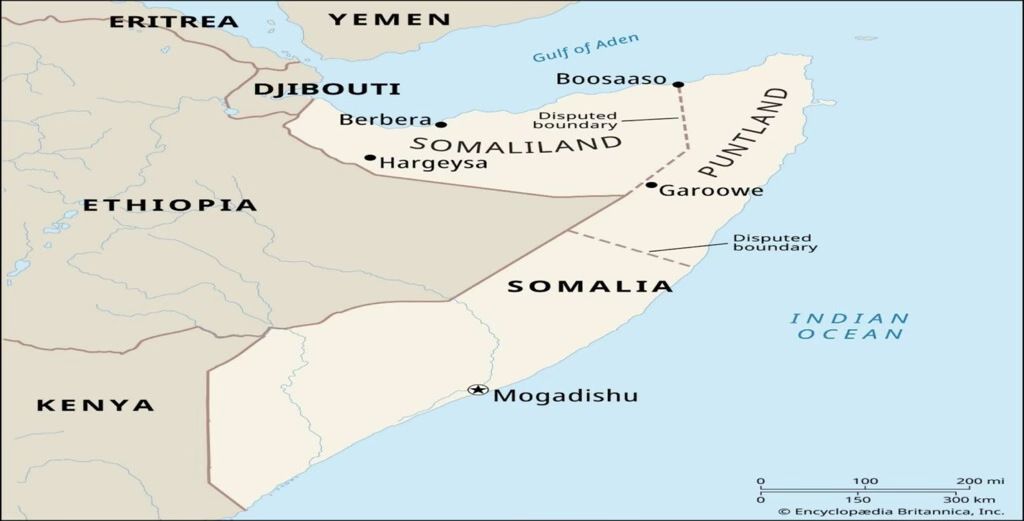
On the Horn it cultivated Somaliland and other regional administrations rather than the federal center in Mogadishu.
The UAE prefers sub-national clients because they let it weaken rivals and carve out platforms for maritime power at the same time.
The two aims reinforced one another.
Every client that undercut a central government also delivered a port, a runway or an island, so the map of Emirati proxies became, over time, a map of Emirati bases.
Those rivals are named plainly in the record.
The Saudi-Emirati axis that formed after 2011 against Iran, Qatar, the Muslim Brotherhood and Turkey, and for years Riyadh and Abu Dhabi moved together against all four.
Until 2018, when a split in policy broke the partnership between Riyadh and Abu Dhabi.
The maritime side of the project was never hidden.
From 2018 Abu Dhabi built what one analysis called a ring of bases around the Gulf of Aden: Socotra, runways on the smaller islands of Abd al-Kuri and Samhah; a base on Mayun itself; and on the African shore, Berbera in Somaliland and Bosaso in Puntland.
The stated aim was to watch the water and weapons bound for the Houthis.
Israeli strategy converged on the same map.
Israel had long been a base in Somaliland to monitor Yemen and the Bab el-Mandeb, and on 26 December it became the first state to recognize the breakaway republic, in language its prime minister tied to the Abraham Accords.
The Horn Divides
On the Yemeni shore the design came apart faster still.
In December the Emirati-backed Southern Transitional Council pushed into Hadramout and al-Mahra, the provinces that run along Saudi Arabia’s southern border.
Riyadh read the advance as an attempt to complete a separatist state on its frontier, and on 30 December it struck the port of Mukalla, striking what the coalition described as an Emirati weapons shipment landed from Fujairah.
The internationally recognized government gave the UAE orders to withdraw, and Abu Dhabi complied.
Within about it lost Socotra, Mayun and the coastal outposts it had taken eight years to build, dismantling its own island infrastructure as it left.
The coalition’s spokesman later accused Abu Dhabi of running a plan to move the STC leader by sea to Berbera and onward to the Emirates, a charge the UAE did not answer.
By 9 January the council had itself disbanded.
The rupture between the two Gulf capitals was strategic before it was personal, and it left the anti-Houthi front without its principal paymaster and without the coastal positions that front had relied on.
The consequences of that vacuum arrived within months.
The timing was decisive.
Iran had been at war with the United States and Israel since late February, and traffic through the Strait of Hormuz was already disrupted.
Saudi Arabia, the largest oil exporter, had rerouted much of its crude through the alternative route, which raised the value of the far end of the same route at the very moment its Yemeni shore stood undefended.
The geography compounds the point.
The Houthi advance has carried the movement to within a short distance of Djibouti, the state across the water that hosts American, French, Chinese and other bases, the densest concentration of foreign force on the Red Sea.
None of it moved to hold the island in the middle of the strait.
For Riyadh the effect is measurable.
The Houthis have declared an embargo on Saudi shipping while letting other vessels pass.
Iran’s allies now hold the Yemeni bank of the Bab el-Mandeb; the UAE and its partners retain the African bank at Berbera and Bossaso.
The chokepoint has, in practice, been partitioned between two rival camps.
Somaliland
While “Israel” is reportedly seeking to build up a military presence near the strategically located port of Berbera in Somalia’s Somaliland, Abu Dhabi began constructing the Berbera airbase as early as 2017, securing access to it for a period of 25 years.
Similarly, the Abu Dhabi–Israeli alliance has extended to the establishment of a joint military presence on Yemen’s strategically located island of Socotra.
The coastline of Somaliland lies only 300 to 500 kilometers from Ansar Allah-controlled lands.
In reality, these militias in Yemen are riddled with al-Qaeda-linked fighters.
The STC’s toughest fighting force, known as the Southern Giants Brigades, is reportedly led by the core of experienced militants who are former al-Qaeda fighters.
Meanwhile in Gaza, Abu Dhabi and the Zionist Entity are also backing five separate proxy militias with links to ISIS.
Abu Dhabi and Israelis are huge funders of these Salafist militants, who are totally obedient to them and adopt a doctrine that they use to justify the mass slaughter of Muslims.
This was the same exact strategy adopted inside Syria by the Zionists, using extremists to do their bidding, while dividing the Muslim World and paving the way for their expansionist agenda.
According to the Zionist vision, they would rule as an empire, whereby they enter into formal alliances with countries broken up into ethno-regimes and sectarian rump States.
Divide and conquer. Divide and rule.
The second move was Somalia.
So, dividing Somalia, in order to help the proxy-militias secure a southern Yemeni State, is precisely in line with the Zionist agenda.
They will attempt to rule these territories through proxy support, using their puppets to destroy the Palestinian cause.
In other words, Somaliland recognition isn’t a small, isolated move; it is a piece being strategically positioned on their wider chessboard.
For the so-called “Greater Israel” vision to come alive, dominance must be secured not only across the Middle East and North Africa, but also throughout the Horn of Africa.
More than a simple recognition of Somaliland, “Israel” is hatching a scheme alongside its Emirati allies aimed at a regional expansion agenda.
The recent decision by Israel to recognize Somaliland as a State has triggered outrage across Africa and much of the Islamic World, while drawing condemnations from most Arab capitals, with the notable exception of Abu Dhabi.
For the most part, analysts have pointed to “Israel’s” desire to use Somaliland as a staging ground for aggression against Yemen as a primary motivation behind the move.
Abu Dhabi and Israeli agendas are one in this regard.
They are inseparable and connected on almost every conceivable level, this is to the point that the de facto head of intelligence operations for Abu Dhabi has long been a man named Mohammed Dahlan, well known for his alleged involvement with Mossad and the CIA; particularly in Africa.
There are rumors that the Israelis used him to poison Arafat back in the early 2000s.
Somaliland, a separatist-controlled region in the northwest of Somalia, has offered Israel and the US more than 2,000 of its soldiers for deployment to Gaza as part of the International Stabilization Force (ISF) under Donald Trump’s so-called Board of Peace.
It is the largest percentage of troop strength offered so far for the ISF, which is tasked, among other things, with disarming Hamas.
With Indonesia indefinitely suspending its commitment of 8,000 troops earlier in March, the contingent offered by Somaliland is also the largest in absolute numbers.
Yet Somaliland is not even a country.
The UN and African Union regard it as part of Somalia.
No country except Israel recognizes the secessionist regime’s claim to sovereign statehood.
It has only 25,000 soldiers, plus 1,500 coast guard personnel.
From this small force, Somaliland’s president, Abdirahman Mohamed Abdullahi, has offered 2,000 soldiers if his offer is accepted.
He is only waiting to be asked for troops by the US or Israel.
“If they ask me, I am ready,” he said.
His readiness comes at a time when Somalia has already lost over half of the territory it had once claimed.
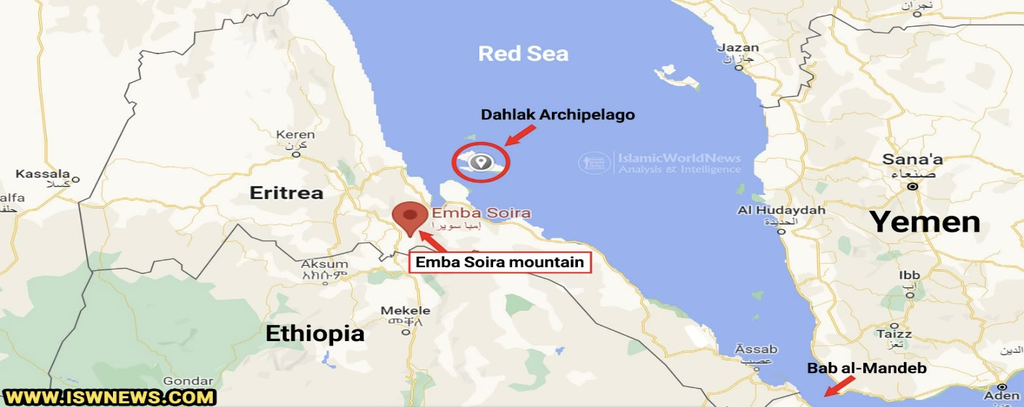
Unveiling Israel’s Dahlak: The Red Sea’s Covert Intelligence Nexus
On August 5th, 2024, several explosions occurred at the Israeli regime’s intelligence base in the Dahlak Archipelago off the coast of Eritrea.
The cause of these explosions has not yet been determined, but it is possible that the Israeli intelligence base was attacked by drones and missiles by the Yemeni Armed Forces.
The Dahlak Islands are part of an archipelago off the coast of Eritrea that is uninhabited, and the supervision of these islands was ceded to the Israeli regime by former Eritrean President Isaias Afwerki in the 1990s.
Afwerki took this step because of the tension he had with Yemen over the Hanish Islands and called on the Tel Aviv regime to support his government against possible Yemeni attacks on Eritrea.
Perched a mere 43 kilometers off the Eritrean coastline and strategically positioned 135 kilometers from Asmara, Dahlak Island has seamlessly evolved into the nerve center for Israel’s intricate intelligence operations.
Concealed within its boundaries lie reconnaissance towers strategically scattered across the undulating terrain, veiled subterranean complexes housing an array of military assets, and murmurs of housing nuclear-capable submarines, purportedly containing Israeli nuclear waste.
Since 2016, the Israeli regime has set up a large database on the Emba Soira Mountains, 135 kilometers south of the Eritrean capital Asmara.
With 3,018 meters height, Mount Emba Soira is the highest mountain in Eritrea.
The purpose of this base is to monitor the Red Sea and maritime traffic, and to have full control over the Bab al-Mandab Strait and intelligence control over the Yemeni coast.
Undoubtedly, the role of this intelligence base during the recent tension between Israel and Yemen has become more prominent than before, and the recent actions of the Israeli special unit against Yemen are commanded and controlled from this base.
The clandestine intelligence stronghold entrenched within Dahlak Island’s rugged expanse signals an unprecedented paradigm shift within the Red Sea basin’s geopolitical landscape.
This covert bastion, meticulously cultivated through an enduring Israeli-Eritrean partnership that traces its roots back to the mid-1990s, stands as a formidable bastion of surveillance, espionage, and strategic oversight.
Entrusted with the mammoth responsibility of monitoring and surveillance of the Red Sea expanse, this Israeli enclave commands a strategic vantage point overlooking the Bab el-Mandab Strait.
Its discerning gaze tracks the intricate dance of maritime traffic, naval maneuvers, and regional conflicts, notably honing in on the turbulence in Yemen and the covert arms shipments to the Resistance.
Under the astute purview of Israel’s venerable Military Intelligence Directorate (AMAN), this base operates as a complex web of sophisticated electronic surveillance units.
A labyrinthine network of cutting-edge reconnaissance apparatus and technological marvels enables the interception and scrutiny of radio frequencies and telephone communications, cementing an influential role in steering strategic, military, and intelligence initiatives within the region.
6. The Global Energy Equation
We’re at the end of the line.
After seven months of unprovoked warfare, the situation in the Middle East has ballooned into a full-blown crisis.
Overnight, Saudi oil exports have fallen to zero.
ZERO!
Let that sink in for a minute.
The “world’s largest oil producer” is presently exporting NO oil.
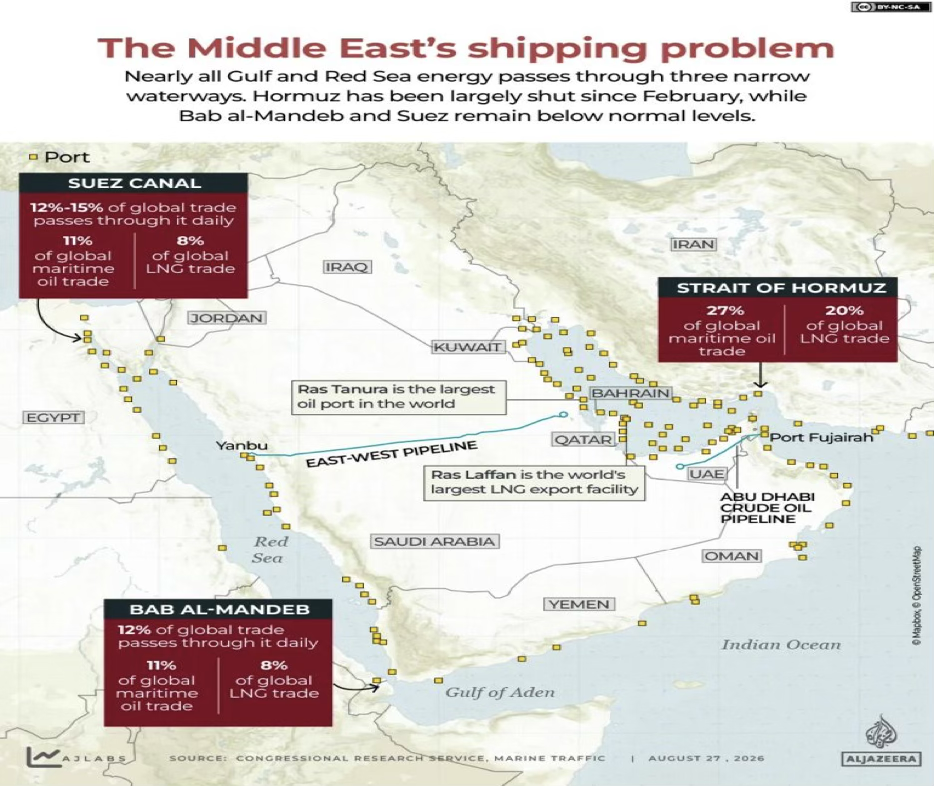
Persian Gulf terminals are effectively shut down due to the war with Iran while the East-West pipeline — the main overland bypass that moves 4 to 5 million barrels per day to the Red Sea terminal at Yanbu — was blown up at nine different locations and is no longer operable.
Why Yanbu, and Why Now
Yanbu is the Red Sea end of the East-West pipeline, the line the Saudis built to move crude from the Gulf coast across the peninsula and out through the Red Sea, bypassing the Strait of Hormuz entirely.
Its whole strategic purpose is to give Saudi oil a way to market that Iran cannot close by threatening Hormuz.
That is why the Houthis aimed at Yanbu, and why they aimed at the export terminal rather than the inland pumping stations.
A pumping station is a repairable dot in the desert, while the terminal is the valve on the ONE route that escapes Iran’s chokehold.
Closing it forces every Saudi barrel back toward Hormuz, where Iran holds the equalizer its doctrine calls energy symmetry.
Strike Yanbu and you do more than dent Saudi exports.
You herd them back under the Iranian gun.
Saudi Pipeline Outage Hits an Oil Market Running Out of Buffers
The oil market’s buffers are rapidly disappearing, with strategic reserves depleted, oil-on-water sharply lower and China ramping crude purchases back up.
Oil-price risks remain firmly to the upside, with inventories falling rapidly and demand destruction increasingly becoming the market’s last major balancing mechanism.
Gone are most of the cushions the market had in the early weeks and months of the Middle East conflict.
The oversupply from early this year has disappeared as oil on water was drawn down quickly when the Strait of Hormuz was closed to tanker traffic in March.
Record stock releases led by the International Energy Agency (IEA) depleted strategic inventories in developed economies.
China, which strategically slashed its crude oil imports by about 4–5 million barrels per day (bpd) in May and June, has started purchases, removing a significant demand-side balancing mechanism that had prevented oil prices from spiking to record highs in the spring.
With few buffers left to absorb the seven-month-long disruption of oil flows at the Strait of Hormuz, the last thing the market needed was an escalation that put a key non-Hormuz flow valve at risk.
However, the closure of the pipeline has now introduced a major risk to about 4 million barrels per day (bpd) of Saudi crude oil shipments from Yanbu.
In the coming months, the markets will have to face the re-escalation in the Middle East with depleted buffers amid rapidly drawing inventories.
Demand destruction remains the only coping mechanism for the oil market that has seen fundamental changes in oil flows and spiking war-risk insurance costs and tanker rates.
An armada of oil tankers loaded with Iranian crude is moving toward East Asia.
China, South Korea, and Japan have purchased nearly all of the Iranian oil currently available for export.
None of it is hitting American or European markets.
Why?
Despite sanctions being removed, Iran refuses to do business with Europe and America.
There is no trust.
The relationship took 47 years to break.
It will not be rebuilt in a 60-day MOU.
The Iranian oil is going East.
The American reserve is going to the spot market.
Iran has progressively decoupled from dollar-denominated trade and Western commodity buyers since 2018.
The decoupling is not theoretical.
It is operational.
Over the coming months, the world will witness massive fuel shortages, including rationing.
Besides, diesel is in very short supply.
These, and other supplies of food and fertilizer, are raising costs globally.
Inflation has gone global.
This is pushing up interest rates.
So, the world is entering a “perfect storm” of rising costs and shortages across the globe.
Which brings us to the last and final point.
Is this what the Rockefeller family had in mind?
To find out the answer as to why, we explain it in our next point.
7. The US Position: The Rockefeller Game Plan for Middle East Energy Resources
Blow up the Middle East if you want to blow up Eurasia
The US dependence on Mideast oil started in 1945 and grew over the next few decades.
Then, over the past two decades, the American shale revolution has fundamentally reshaped America’s role in the global energy landscape — and with it, its leverage in conflicts with adversaries like Iran.
To appreciate this shift, it helps to look back at the limits energy dependence once imposed on U.S. decision-making.
Before the shale boom, the United States was highly reliant on imported oil, especially from OPEC and the Persian Gulf.
This dependence meant exporters could influence the US economy and foreign policy.
Fast-forward to the present.
Thanks to advances in hydraulic fracturing and horizontal drilling — the innovations that powered the shale revolution — the U.S. is now the world’s leading producer and exporter of oil and natural gas.
Today, domestic supply acts like a buffer against shocks in the Middle East, granting Washington strategic freedom.
This transformation has reduced the leverage of oil-producing adversaries.
America’s decisions are less tethered to concerns about price swings, enabling a broader range of policy options, including diplomatic, economic, or military measures.
Whether it’s Iran or another flashpoint abroad, America’s energy independence has reshaped its strategic options.
What was once a strategic vulnerability is now a source of resilience and leverage.
That shift allows the U.S. to approach diplomacy and national security objectives with greater flexibility and confidence, fundamentally changing its role on the world stage.
This breakthrough, which combined hydraulic fracturing, horizontal drilling, and advances in seismic technology, has enabled gas production to increase to 28 bcm per day in 2026 and oil production to rise from 5 million barrels per day in 2008 to over 9 million bpd.
This shift in the US energy profile has major implications for the industry as well as for domestic and global markets.
As American dependence on Middle Eastern oil reduced, it provided the right time to destabilize the region.
US shale production increased year after year, with volumes exported increasing as well.
This was a potential threat to Saudi Arabia.
In March 2014, MBS dropped the price of OPEC oil in a bid to crush US shale production.
Of course, this angered the Rockefeller empire, such that the CIA tried to assassinate MBS several times since, unsuccessfully.
This price war lasted for 2 years.
All the while, US oil and gas production increased, with oil production now at 13 million bpd today.
Of this, shale oil contributes some 9 million bpd.
It was the perfect time to destabilize the Middle East.
This plan began after the 2008 Crash, and over the next 17 years, we see the results in the region.
In 2017/18, a new plan was advanced — Fortress America.
This would turn the Americas into a “fortress”, behind which it would rule the 2 Americas, while it would be free to destabilize the rest of the world.
A decision was made by David Rockefeller jnr.
This was to implement both parts of the plan.
The first was to activate the “Fortress America” plan.
The second was to blow up the Middle East.
We will discuss both.
The Middle East is not a priority of the Rockefeller family in terms of oil supplies to the US.
There are several new supplies that cover what the US was importing from the region.
These new oil provinces are Brazil, Canada and Africa.
Thus, crippling Persian Gulf production would not affect the US, but rather its economic rivals such as Europe and China.
And, thus, we find that as the conflict in the Middle East expands and intensifies, the Fortress America plan is moving to achieve its end game.
There have been two great wars in Eurasia — in 1914–18 and 1939–45.
In both, the US gained huge geopolitical advantages.
Both these wars made America richer and more powerful.
Today, the American economy and financial system are in the doldrums.
The Rockefeller family reckon that if they could blow up Eurasia for a third time, then its empire would gain more breathing space to rebuild its global strength and hold onto its dominance a little longer.
The family does not have time on its side, especially with a crippled military and an imploding financial system.
The fastest way to blow up Eurasia and bring about World War 3, is to blow up the Middle East.
The first step has already taken place.
The region is on fire.
Exports are zero.
Panic has taken over in Europe and Asia.
We read that many EU countries are sending military assets to the Middle East.
Even Japan and South Korea had thoughts about this.
The panic and desperation will increase over the coming weeks as oil supplies dwindle.
Many foreign nations fighting for a dwindling supply of oil will lead to conflict amongst themselves, thus setting the stage for a hot conflict over access to oil.
Thus, we get World War 3.
The Rockefeller family is hoping that Eurasia destroys itself like it did in World War 2.
In this manner, the family reckons that they can recreate the same conditions and opportunities it had in 1945.
The US mainland was not damaged in both these global wars.
It thinks it can do the same this time around.
But this time, its rivals have the technological advantage and means to destroy the American hinterland and its strategic nodes.
Russia, China and Iran are working to make sure that the Rockefeller’s plan fails.
One of them is to make sure that Iran survives.
The next is to achieve the aim of selling all Middle East oil in non-dollar currencies.
And this is where we arrive.
Iran has installed a toll booth in the Gulf.
One enters and exits with Iran’s permission, and to follow procedures and payment rules laid down by Iran.
This would mean that all sales of all goods leaving Hormuz HAS TO BE PAID IN A CURRENCY OUTSIDE THE DOLLAR/EURO SYSTEM!!
Once this system becomes active, the Petro-dollar is dead.
And with it, Rockefeller plans for global domination.
Thus, we find that Washington encourages its vassals to ignore Iran’s rules, and to use the Omani route to enter and leave.
Over the weekend of the 25/26 September, around 19 tankers were struck by Iran.
All of these failed moves are infuriating the Rockefellers and their servants such as Trump, who made a ridiculous statement at the UN recently, stating that he will totally destroy Iran.
He meant that he would use nukes on Iran.
The world was shocked and horrified by such talk.
But we know better.
It reflects panic.
To add to this panic, Iran has given a certain time to the US to end the naval blockade against Iran.
That date is the 30th of September — just a few days away.
Failing which Iran would take pre-emptive action to remove this.
The Story Continues
Oil access and denial.
Rising debt levels.
Diminishing Western military stockpiles.
Outdated military technologies fielded by the West.
And more.
All of this and more will be explained in our next article:
One thought on “Yemen’s Liberation Begins (Part 4 of a 4-part Series)”