
China’s Position
The Three Gates: Iran, Taiwan and Greenland Are ONE War. China Is the Objective.
They are the gates in one wall built to contain China. Taiwan is the sea gate, Iran the land gate, and Greenland the Arctic gate.
America cannot hold all three at once, and China only has to open one.
The Wall: What Containment Actually Is
Let me first start with “The Great Wall”, or, more accurately, the structure America built around China, because everything follows from it.
For approximately 75 years, the United States has contained China behind a system of barriers, most visibly the First, Second and Third Island Chains: the arcs of allied territory and bases running from Japan through Taiwan and the Philippines and out into the Pacific.
The purpose of that architecture is singular: to keep Chinese power, especially naval power, bottled up in its near seas, unable to break out into the open ocean where a true world power operates.
Containment is a wall, and a wall works only if all of it holds. A wall with one open gate is not a wall. It is a formality.
China’s entire grand strategy is the search for the gate. It is NOT trying to scale the wall by outbuilding the US Navy, ship for ship, inside the Pacific, which would be the slow and losing game.
China is trying to bypass the wall entirely, to find or force the openings that make containment irrelevant for its future. And there are exactly three openings that matter, which is why the map looks the way it does.
Gate One: Taiwan, the Sea Gate
Taiwan is the closest and most direct gate, and it is the sea gate.
It sits at the centre of the FIRST Island Chain, and it is the cork in the bottle. As long as Taiwan is aligned with the United States, the Chinese navy is boxed into its coastal seas, with its access to the open Pacific mediated by a hostile chokepoint sitting directly astride its breakout routes.
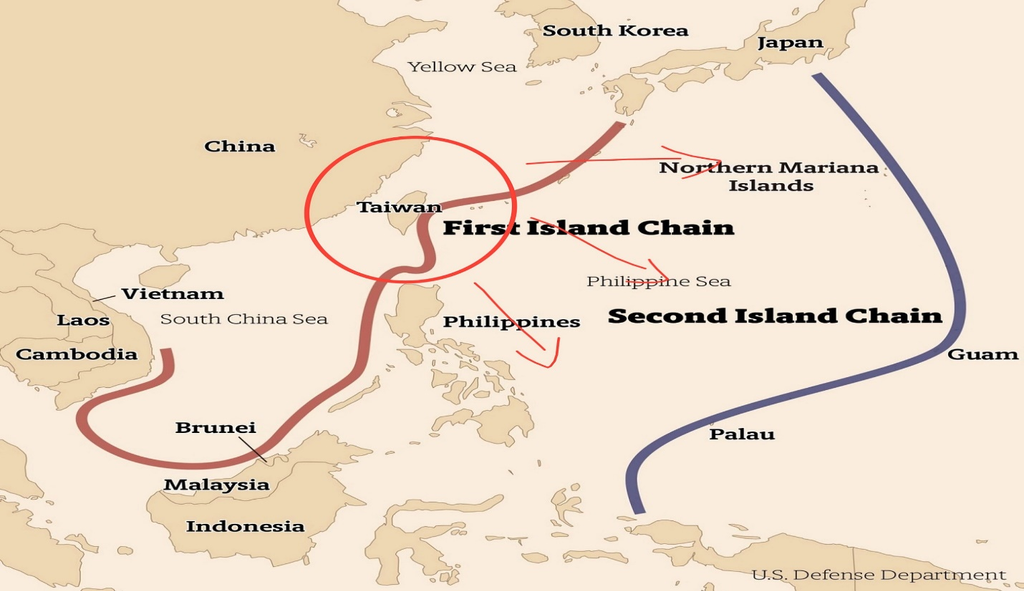
Take Taiwan, and the First Island Chain does not just lose a member. It loses its keystone, and the wall’s most important segment falls open. The gate breaks.
China’s fleet gains direct access to the deep Pacific, and China converts from a “contained regional power” into a confirmed “blue-water world power”. Not rising, but arrived.
This is why Taiwan is not really about Taiwan. It is about whether the sea gate stays shut.
For China, forcing it open is the single fastest route to great-power confirmation. For America, holding it shut is the load-bearing wall of the entire containment system.
Both sides know it, which is why it is the most dangerous flashpoint on Earth.
Gate Two: Iran, the Land Gate
Iran is the second gate, and it is the land gate. Iran does two things for China that nothing else can.
First, it supplies discounted energy outside the reach of the American navy that patrols the maritime chokepoints.
Second, and more fundamentally, the land bridge that connects China overland to Europe and the Middle East does not touch a single body of water controlled by the US Navy.
This is the deeper realist point, and it is ancient: throughout history, the powers that achieved true world status did so by dominating or transiting the Eurasian landmass, because the one who controls the world-island’s overland connections cannot be contained by sea power alone.
China’s Belt and Road Initiative is the modern name for this timeless strategy, and Iran is its indispensable central corridor. The China-Iran overland link is the physical route by which China escapes the tyranny of the maritime chokepoints entirely.
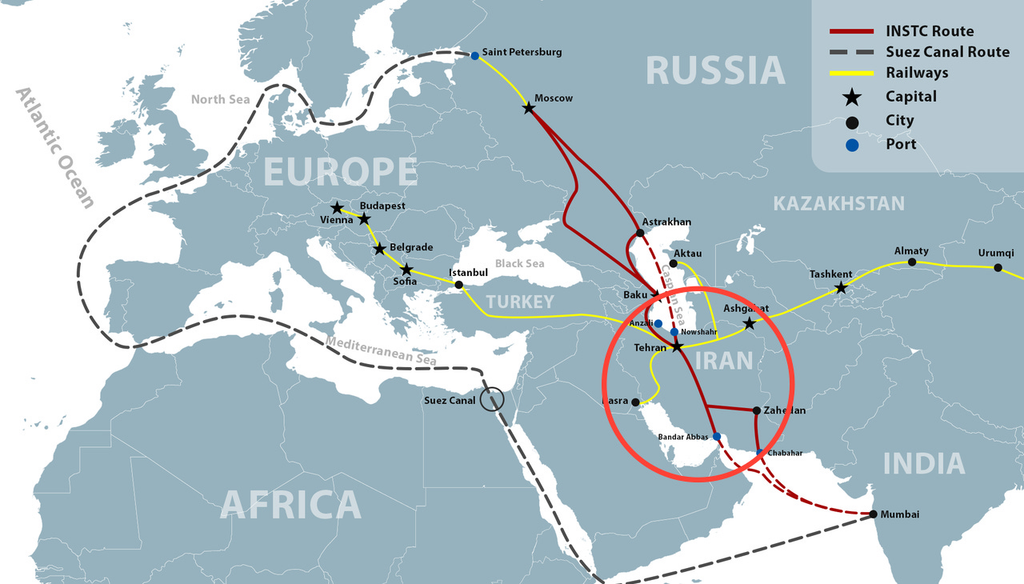
So, Iran is the land gate in the same wall that Taiwan anchors at sea.
IF Taiwan is how China breaks out onto the ocean, Iran is how China renders the ocean irrelevant, by moving its goods, energy and influence across land that the American navy can never reach.
This is why America cannot allow Iran to stand as a permanent, sovereign, China-aligned power, and it is why the Iran-America-Israel war was NEVER really about the nuclear programme.
It was about slamming the land gate shut, denying China its overland Eurasian corridor and its discounted energy in one stroke.
Gate Three: Greenland, the Gate No One Counts
Here is the third gate, the one that reveals the whole structure. It explains a fixation that otherwise looks bizarre, and which many in the media have completely misread or misunderstood in terms of how critical Greenland is.
Why is Greenland suddenly a strategic obsession?
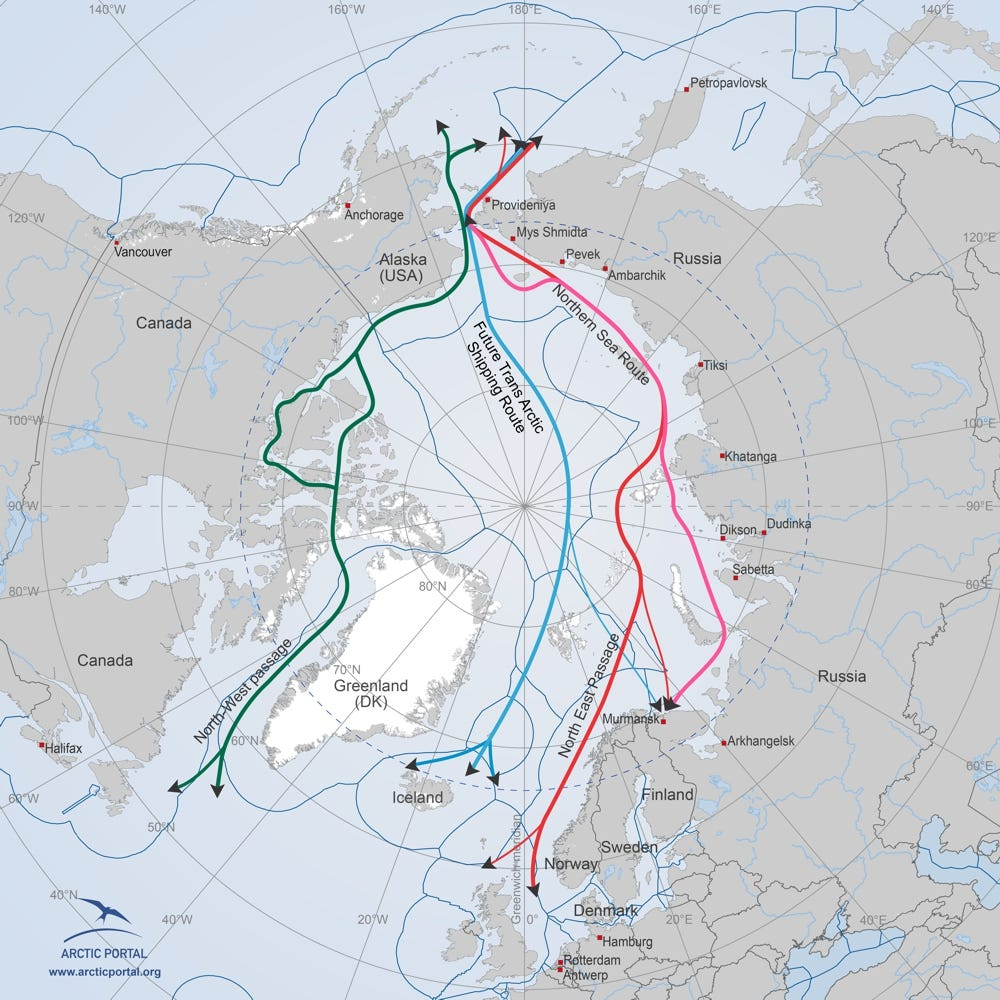
Because China has been quietly opening a third route, over the top of the world.
If the sea gate is Taiwan and the land gate is Iran, the Arctic is the third gate: the polar bypass. Greenland is THE KEY position that commands the Atlantic approaches to it.
America’s fixation on Greenland is not eccentricity. It is the same containment logic extended to the top of the map: if China is opening an Arctic route to escape the wall, America needs the position that closes it.
Greenland is to the Arctic gate what Taiwan is to the sea gate.
Canada
Canada has a long history of being under British rule, dating back to the early 17th century, when British explorers first arrived on its shores.
Over the years, Canada gained more autonomy and eventually became a self-governing dominion within the British Empire.
Canada is a constitutional monarchy, with the British monarch serving as the head of state. However, the monarch’s role is largely ceremonial, and Canada operates as a parliamentary democracy with its own government and constitution.
The Governor General represents the monarch in Canada and carries out ceremonial duties on behalf of the Crown.
Its colonial history is deeply intertwined with both British and French influences, especially with the Rothschilds from 1830 onwards.
Independence and a Fight for the Central Bank (1776–1860)
North America and the United States were the New World. It was a land free of the dogmas attached to Europe, and it was worked by hard, determined people.
There was no restriction on upward mobility, unlike in Europe. It was also a land very rich in natural resources, with a temperate climate.
Since the founding of the Bank of England in 1694, London had been trying to unify the few colonies of North America and get them to use money based on credit, and not gold.
While visiting London, Benjamin Franklin was asked:
“How do you account for the prosperity in the American colonies?”
Franklin replied:
“That is simple. It is because we use our own money. It is called Colonial Script, and we issue it in proportion to accommodate trade and commerce.”
In 1760, the Bank of England (BOE) issued legislation banning the colonies from issuing their own money and requiring them to use the BOE’s money.
This law caused great unemployment when put into effect. Benjamin Franklin refused, and so the BOE went to war against the North American colonies.
The British lost this battle, and the colonies gained their independence in July 1776. The war ended in 1783.
The BOE decided to subvert this process from within the American system, stating:
“If this mischievous financial policy, which has its origins in North America, becomes fixed, then that government will furnish its own money without cost. It will pay off debts and be without debts. It will have all the money necessary to carry on its commerce. It will become prosperous without precedent in the history of the world. The brains and wealth of all countries will go to North America. That country must be destroyed, or it will destroy every power on the globe.”
George Washington saw through the BOE’s manipulation and repeatedly turned down its request for a national bank charter.
In 1787, he made a speech, saying:
“We must protect this young nation from an insidious influence and penetration. That menace, gentlemen, is the Jew. In whatever country the Jews have settled in any vast numbers, they have lowered its moral tone, depreciated its commercial integrity, have sneered at and tried to undermine the Christian religion upon which that nation is founded by objecting to its restrictions; have built up a state within a state, and when opposed, have tried to strangle that country to death financially, as in the case of Spain and Portugal.
“For over 1700 years the Jews have been bewailing their sad faith in that they have been exiled from their homeland, as they call Palestine. But, gentlemen, did the world give it them in fee simple, they would at once find some reason for not returning. WHY? Because they are vampires, and vampires do not live on vampires. They cannot live only among themselves; they must subsist on peoples not of their race.
“If you do not exclude them from these United States, in less than 200 years, they will have swarmed in such great numbers that they will dominate and devour the land, and change our form of government. Our descendants will be working in the fields to furnish them substance while they will be in the counting houses rubbing their hands.
“Jews are Asiatic and are a menace to this country if permitted entry. A leopard cannot change its spots.”
Thus were the above statements supposedly uttered by Benjamin Franklin, at the framing of the Constitution in Philadelphia, nearly 240 years ago!!
US President George Washington appointed Alexander Hamilton, an agent of the BOE, as Secretary of the Treasury in 1788.
In 1790, Franklin passed away. In 1791, the US Government granted a 20-year charter to its first national bank, called the First Bank of the United States.
The bank was capitalised at $35 million, of which 80% was owned by Dutch and English Jewish financiers.
Within a short time, the government was able to pay off its debts and be free.
By 1811, pressure was increasing on the government to renew the charter. Sentiment was running against renewal.
The BOE issued an ultimatum:
“Either the application for renewal of the charter is granted, or the US will find itself involved in a most disastrous war.”
Predictably, Washington refused.
The British government launched the War of 1812, even though it was fighting Napoleon in Europe at the time.
This war was calculated to impoverish the US to such an extent that the government would have to plead for peace and seek financial aid.
The war proved expensive and raised the US debt from $45 million to $127 million.
This war was intended to force the US into creating a central bank to pay for the costs of the war, thus creating interest payments and debt.
The pressure to find a way to pay the costs of the war through the re-chartering of a national bank continued, and in 1816, the Second Bank of the United States was formed with a 20-year charter.
This new bank was given the ability to loan the government $60 million. It now had the power to control the entire fiscal structure of the country.
In 1816, Thomas Jefferson warned the people:
“I believe that banking institutions are more dangerous to our liberties than standing armies. Already they have raised up a money aristocracy that has set the government at defiance.”
It did not take long for the Second Bank to exercise its powers.
The Bank inflated from 1816 to 1818. In early 1819, it reversed its policy and began a contraction, leading to depression.
Gold and silver flowed out of the country, leaving in their wake a trail of bankruptcies.
This cycle benefited the bankers, who were able to repossess assets at a fraction of their value.
By 1834, the war debts of 1812 had been paid up. This did not please Nathan Rothschild, the largest shareholder of the Second Bank.
The Rothschild family was now calling the shots in the British Empire, since at least 1825.
The presidential elections of 1832 were crucial for the Bank, as the main issue was the renewal of its charter in 1836.
Andrew Jackson won the elections on an anti-Bank platform.
After the elections, President Jackson ordered Nicholas Biddle, the head of the Second Bank, to withdraw government funds deposited at the Bank.
Biddle refused and instead called for a general curtailment of loans throughout the banking system.
The order was so sudden, and its financial effects so devastating, that the country experienced an economic panic.
The Bank was punishing the American people for voting against it.
Jackson feared for his life. He told his Vice-President, Martin Van Buren:
“The Bank, Mr. Van Buren, is trying to kill me, but I will kill it.”
On January 30, 1835, a would-be assassin stepped into his path and fired two pistols at close range.
Both pistols misfired, and Jackson survived the first presidential assassination attempt in the US.
The Bank’s charter expired in 1836, leaving the US free of a central bank.
Within months, the economy boomed, but the Rothschilds caused a depression in 1837.
The Rothschilds’ involvement started in 1799, when Nathan, in Manchester, started to buy cotton from the Southern States of the US.
Over the years since the first purchase, the Rothschilds had built up heavy American commitments. Nathan had acquired a considerable stake in the future of the continent.
He made loans to various states of the Union and was also, for a time, the official banker for the US government in Europe.
As America was a developing economy, it had a constant need for funding its economic growth.
In the process, quite a few states defaulted on their loans, and this infuriated the Rothschilds.
State defaults also impacted Federal credit. European investors cursed America as a land of cheats and rascals.
When George Washington sent Treasury agents to Europe in 1842, James Rothschild told them:
“Tell them that you have seen the man who is at the head of the finances in Europe, and that he has told you that they cannot borrow a dollar. Not a dollar!!!”
Gold was discovered in California in 1840.
With the Rothschilds’ desire to monopolise this metal, Alphonse, son of James, was sent to America in 1849 to study the situation.
He toured extensively for six months, familiarised himself with the present state of the family investments in America, and assessed the future potential of the continent.
It impressed him enormously. This was his report of May 1850:
“Without the slightest doubt, this is the cradle of a new civilization. The settlement of California is an event of enormous potential for America, both for her gold and her geographical position. In a few years from now America would have attracted to itself the greater part of the trade with China and the Indies and will be enthroned between the two oceans. The country possesses such elements of prosperity that one would have been blind not to recognize them.”
This recalls the analytical conclusion that made the Dutch Jewish financiers fasten onto England as their ideal base for World Empire.
Alphonse was in no doubt about the implications for the family. They had to get more involved in plotting the destiny of this country according to the dictates of the Rothschilds.
At this time, America was a free country whose citizens were basically industrious immigrants who had escaped socially rigid Europe, with its nobility-caste system and oppressive, usury-ridden economic life.
They asked for nothing more than to be given an opportunity to live and work in such a stimulating environment.
The results of such a unique experiment were so brilliant that America became a legend around the world. Many millions across the globe viewed America as the Promised Land.
America was also blessed for not having Jewish finance controlling the economy.
A key point: Due to this one factor alone — the discovery of gold — the Rothschilds have maintained their hold over California up to the present day.
Its governor, Gavin Newsom, answers to the Rothschilds, not to Washington.
Also, San Francisco is the birthplace of lesbians, gays and AIDS. Hollywood is the place of low morals.
Meanwhile, in America, the railroad companies were building lines across the country.
In order to cultivate the opium habit in America, it was decided to use Chinese labour to work on railroad construction.
Many Chinese refused to go to America, so they were kidnapped at the ports of Shanghai — thus the term “shanghaied” evolved.
By 1846, some 120,000 Chinese had arrived in the US, of whom some 95% were addicts.
The Rothschild criminal network found a ready market to push narcotics.
Once the railroads were complete, the Chinese did not return to China but settled in San Francisco, LA and Vancouver.
This was the birth of all the “Chinatowns” throughout North America.
Wherever Chinatowns were established, drug addiction became a problem.
By 1875, the Chinese narcotics rings in the US were earning the Rothschilds some $1 million a year.
Is it any wonder that San Francisco was the birthplace of the “hippy” culture of the 1960s, as well as the “rock-drugs-counter culture” of the 1960s, and the start of the liberal trend amongst American students?
San Francisco was also the place of the first known AIDS case, a by-product of giving homosexuality a respectful face.
The city is also home to the first pro-abortion-rights movement.
It is now easy to plot how one evil leads to the next.
The Rothschilds Demonetise Silver
Most of the currency of the East was backed by silver — a metal that did not suit the Rothschilds, as gold was the base of international finance.
Silver was also heavily used within the US in financial transactions. It was in competition with gold within the banking system.
It was an annoyance to the family, as they could not obtain absolute control of a nation’s financial system with silver playing a key role.
The London house sent Ernest Seyd to America with large amounts of money to bribe American lawmakers to remove silver from financial transactions.
The bill was made law in 1872.
The resultant withdrawal of currency brought about massive business failures from 1873 to 1892.
The Chinese economy, being totally dependent on silver in its economic system, was brought to its knees.
The Chinese reaction against this resulted in the Yellow War between Japan and China.
To aggravate the removal of silver from the banking system in the US, the Rothschilds activated the services of the Knights of the Golden Circle, whose member Jesse James achieved notoriety by organising gangs to raid and rob stagecoaches and trains of their silver loads being sent to the US Treasury from various mines around the country.
This loot, in turn, was handed over to emissaries of August Belmont in New York. Belmont was the chief Rothschild agent in America at that time.
By demonetising silver, two things were accomplished by the family.
It devastated the two largest economies on the globe — India and China.
Combined, these two nations made up more than 60% of global GNP at that time.
This was before the British, followed by the Rothschilds, took over their nations and plundered them.
The Family’s Plan to Break Up America: The Civil War (1861–1865)
In the ensuing years, the family set about planning a new takeover of America.
The way to go about this was to embroil America in another war, for then she would be in need of funds.
From this need, the Rothschilds could dictate the creation of a new central bank from which they could then control the destiny of this young, vibrant nation.
But the family faced a problem: What nation could they induce to fight against the American government?
The US was too powerful, and no country or combination of countries could match it in a “balance of power” showdown.
Canada to the north and Mexico to the south were not strong enough and could not raise an army adequate for the anticipated conflict.
England and France were 5,000 kilometres away, separated by an ocean that made the supply of an invading army nearly impossible.
And Russia had no central bank, so the Rothschilds had no control over that nation.
In the years following independence, a close business relationship had developed between the cotton-growing aristocracy in the South and the cotton manufacturers in England.
The family decided that this business connection could be exploited.
The policy of “divide and rule” was implemented.
The family made the decision to divide the US into two parts and let the two parts fight.
The issue to be used was slavery.
Next, the family created an organisation that would promote secessionism.
The Knights of the Golden Circle was created in 1854 for that purpose by George Bickley.
A pivotal meeting took place in London in 1857.
It was the marriage of Leonare, Lionel’s daughter, to her cousin Alphonse of Paris, which was attended by many big shots, including Benjamin Disraeli.
In his speech there, Disraeli made this remark:
“Under this roof are the heads of the family of Rothschild, a name famous around the world. If you like, we shall divide the United States into two parts, one for you, James, and one for you, Lionel.”
A distant Rothschild relative, Judah P. Benjamin, was appointed as their Civil War strategist.
Eleven Southern states seceded from the Union to form the Confederacy.
The South started the war in April 1861.
Abraham Lincoln was the US President, and he saw that England and France were siding with the South against the North.
He issued orders for a sea blockade of the Southern states to prevent the South from getting supplies from England and France.
The Russian minister to the US advised his government that:
“England will take advantage at the first opportunity to recognise the seceded Southern states, and France will follow suit.”
In November, England dispatched 6,000 troops to Canada as tangible proof that she meant business in supporting the South.
French Emperor Napoleon III was persuaded by James to extend his French Empire to Mexico.
Accordingly, French troops landed in Mexico and installed their own puppet, Maximillian, as the Emperor of Mexico.
James lent 200 million francs to Napoleon for his Mexican campaign.
When the Confederacy needed assistance in 1863, the Rothschilds offered Napoleon Texas and Louisiana in exchange for French intervention against the Northern states.
New York’s banks applied pressure on Lincoln to issue interest-bearing loans to pay for the war.
Lincoln was playing a deadly game.
He had crossed the Rothschilds when he issued government money, called “greenbacks”, to the value of $450 million.
He pledged the credit of the nation as security behind this money, and it was issued debt-free and without interest.
Besides external threats, Lincoln faced domestic problems when, in February 1863, Congress passed an act to create a federally chartered national bank that would lend to the government at interest.
After the passage of this bill, Lincoln once again warned the American people:
“The money power preys upon the nation in times of peace and conspires against it in times of adversity. It is more despotic than monarchy, more insolent than aristocracy, more selfish than bureaucracy.
“I see in the near future a crisis approaching that unnerves me, and causes me to tremble for the safety of my country. Corporations have been enthroned, an era of corruption will follow, and the money power of the country will strive to prolong its reign by working upon the prejudices of the people, until the wealth is aggregated in a few hands, and the Republic is destroyed.”
Lincoln needed an ally, and he found none in Europe.
In desperation, he sent a letter to the Russian Tsar, Alexander II — a bitter enemy of the Rothschilds.
When the envelope containing Lincoln’s urgent appeal was given to Alexander, he weighed it unopened in his hand and stated:
“Before we open this letter or know its contents, we grant any request it may contain. On that day in which Lincoln was inaugurated, we, Alexander of Russia, signed the protocol which liberated 23 million serfs. Lincoln has freed 4 million slaves. Therefore, whatever he asks of Russia, Russia will grant, for Alexander will not be a factor in the enslavement of any man.”
He informed England and France that, should they actively intervene and give military aid to the South, Russia would consider such an action a declaration of war against the Imperial Russian Empire.
Note: Add one more reason why the Rothschilds hated the Russian Empire.
Unannounced, a Russian fleet stormed into New York in September 1863 and anchored there.
The Russian Pacific Fleet arrived in San Francisco three weeks later.
The Tsar issued orders to his admirals that they were ready to fight any power and to take their orders only from Lincoln.
This was the turning point in the war.
On April 14, 1865, Lincoln was assassinated, and a month later, the war ended, with the loss of over 2 million lives.
In April 1867, the Russians sold Alaska to the US for $7.2 million, thus cementing ties between the two countries.
This sale of Alaska to the US was meant to flank Canada — a geopolitical move.
The purchasing of Alaska from Russia in 1867, while directly related to Canada, was an important step in this broader strategy of extending American control over the northern territories.
Between 1866 and 1876, the bankers reduced the levels of currency in the economy, netting some $2 billion for themselves through repossessions.
Lincoln’s successors cancelled the National Bank charter, once again leaving the Rothschilds with no central bank to control America.
Further, the British were forced to pay a war indemnity to the US of some $15 million in 1872.
Napoleon III withdrew his troops from Mexico, and his puppet, Maximillian, was executed.
The Rothschilds decided then that no Rothschild would set up a base in North America; rather, it would be managed by their top agents.
In 1867, Kuhn Loeb & Co., run by two German-Jewish general merchants turned bankers, was formed.
Kuhn Loeb was now the official outpost of the Rothschilds in America.
By 1900, this position would be assumed by J.P. Morgan on Wall Street.
Historically, Great Britain strategically utilised its colonies as a geopolitical staging ground, military buffer zone and intelligence base to counter and contain the American Revolution through the American Civil War.
Arming Indigenous Confederacies as a Buffer Zone
Following their defeat in the American Revolutionary War, British officials remained eager to undermine the rising United States.
Operating out of Canada and disputed frontier outposts in the Northwest Territory, the British systematically supplied weapons, ammunition and strategic advice to the Shawnee and other allied Indigenous tribes.
The primary objective was to create a sovereign Native buffer zone between the US border and British Canada.
By backing leaders like Tecumseh, the British successfully disrupted American westward expansion and forced the US military to expend massive resources fighting brutal frontier wars.
This proxy strategy peaked during the War of 1812, when British-Indigenous alliances inflicted severe defeats on invading US forces.
Canada served as the anchor for British maritime dominance, which was used to cripple the American economy.
Through imperial trade networks and naval infrastructure based in Halifax and Quebec, Britain strangled American commercial shipping.
Post-Civil War (1865–1930)
Due to the fact that the US government refused to renew a national bank charter for London, the Rothschild family decided it would be expedient to split up the US into two parts.
It would also remove a potential threat to both the British Empire and the Rothschild family — which, in actual reality, functions as one.
Here, the British Empire acts in service to the Rothschilds.
The American Civil War (1861–1865) was a crucial turning point that shifted the perception of US expansionism, especially among British and Canadian leaders.
Prior to the war, Britain and Canada viewed the United States primarily as an economic partner and potential threat, but the Civil War made the reality of American expansionist ambitions much more apparent.
The creation of Canada in 1867 was, in many ways, a complex balance between sovereignty and a strategic buffer against American expansionism.
Britain, deeply engaged in maintaining its empire, was not inclined to give up Canada without a fight.
Yet it also understood the political and military risks posed by an increasingly powerful and unified United States.
To mitigate these risks, British leaders strengthened their commitment to Canada, ensuring that the colony was defensible in the event of an American invasion.
Britain’s shifting priorities also played a crucial role in Canada’s path towards self-governance.
After the Napoleonic Wars and with the end of the US Civil War, Britain began to reevaluate its colonial holdings, particularly in North America.
The British Empire had already begun a process of gradual decolonisation, reducing the costs of maintaining far-flung territories, and it increasingly shifted its focus towards India and the empire’s economic interests in Asia.
The costs of defending Canada — both financially and militarily — were becoming untenable, and Britain no longer saw Canada as a critical part of its global strategy.
The push for Canadian Confederation can be viewed as a compromise: it allowed Canada to govern itself domestically, thus easing Britain’s financial burden, while Britain retained control over foreign policy and defence in the short term.
To defend Canada, the British established strategic fortifications, deployed significant military forces and maintained naval dominance in key regions, all while fostering strong alliances with Indigenous nations as a buffer against American encroachment.
Britain’s economic policies in the 19th century played a key role in preventing Canada from becoming a satellite state of the United States.
By maintaining preferential trade relationships, investing in key infrastructure and providing military subsidies, Britain helped Canada develop its own economic and political identity, independent from US influence.
These strategies allowed Canada to maintain a measure of autonomy while still being tied to Britain within its sphere of influence.
The preferential trade agreements prevented Canada from becoming too dependent on US markets, while British investments in infrastructure and industry kept Canadian economic growth within a sphere of influence that was not dominated by American capital.
The Canadian Pacific Railway (CPR), completed in 1885, was a vital tool in unifying Canada both physically and economically, while also serving as a strategic response to US economic influence and expansionism.
The construction of the CPR was not just about improving transportation; it was about ensuring Canada’s sovereignty, consolidating its national identity and integrating its vast territories into a cohesive whole, making it much harder for the United States to exert control over Canadian lands or exploit its resources.
The CPR was strategically designed to address the economic pressures posed by the United States.
The US had long been Canada’s largest trading partner, and the growing economic dominance of the US presented a significant risk to Canadian economic independence.
However, while Canada successfully resisted direct annexation, the US did not abandon its ambitions.
Instead, it shifted tactics, moving from military conquest to economic assimilation.
Over time, the United States became the dominant economic force in North America.
Canada’s economic dependence on the US grew, especially after the Civil War, as trade, capital investments and industrial developments increasingly tied Canadian markets to American demand.
The US was deeply involved in Canadian industries, particularly resource extraction, and the demand for Canadian raw materials ensured that American economic influence continued to expand.
The transition from military expansion to economic dominance allowed the US to exercise a different form of control over Canada.
Canada’s growing reliance on US capital and markets shifted the balance of power, making economic decisions and cultural influences increasingly shaped by American interests.
Though this assimilation was not as overt as military conquest, it has had a lasting impact on Canada’s ability to control its own economic policies.
Dope Inc.’s Invasion of the USA
In 1919, two critical plans were drawn up by the Rothschild network of law firms and banks on Wall Street.
The first was to impose taxes on women.
Due to the war, many men had joined the army. This left a shortage of factory workers, which was then filled by women entering the workforce.
Wall Street saw a great opportunity here.
Eventually, a law was passed that would tax the earnings of women.
Thus, the government created another income stream, upon which more loans could be taken up.
The income was there to service these additional interest payments on new loans.
Remember, the Federal Reserve had been established just five years earlier.
Another insidious idea emerged from this.
The Rothschilds, ever eager to serve the Talmudic doctrine, reckoned that this was a good idea to break up the family unit and make it easier to manipulate the minds of the children.
The second plan was to “organise crime” in order to make it more efficient.
There were several ways to achieve this. One of them was that, by making alcohol illegal, the Rothschilds would somehow “legalise” crime.
Consuming a “harmless” drink — especially if it is illegal — is the first step down the slippery road of immorality.
And so it came to be.
Alcohol became prohibited when the United States passed the 18th Amendment, completely banning the manufacture, sale and transportation of intoxicating liquors.
Canada became the most critical pipeline for alcohol entering the US.
In short order, an enormous, highly organised cross-border smuggling industry emerged.
The operations relied on legal loopholes, geographic advantages and highly specialised smuggling networks.
Crucially, Canada never banned the manufacturing or exporting of alcohol.
Canadian distilleries could legally produce alcohol, and bootleggers could legally load ships with liquor in Canada.
Smugglers would officially declare their destinations as distant, legal ports like Cuba or Mexico.
Instead of making the long journey, they would simply turn around and drop the cargo at American ports just hours later.
Over the next 10 years, crime became “organised”, like a business corporation.
The Italians were designated to do the dirty work, while management and finance were in the hands of the Jews.
From this point on, the organised crime groups became known as the Mafia.
From alcohol, the Mafia moved into various other illegal activities.
The Bronfmans designated Meyer Lansky to act as the banker and Prime Minister of this new “organised crime” run through the Mafia — an entity itself created by the British Rothschilds in the 1850s.
This family was more responsible than any other family or group in pushing drugs, alcohol, gambling, sexual immorality and other vices onto people globally.
All of these were “re-organised” and placed by the Rothschild family onto unsuspecting nations — especially nations targeted for destruction and takeover — in this case, the USA.
Just as the Rothschilds used opium to first drug, then weaken China in order to loot it and turn it into a vassal, the family is running the same playbook against the US.
The potential of the US to become the world’s greatest power was something the Rothschilds were not happy with — unless it was fully under their control.
Just two years earlier, in February 1917, the capital of international finance moved from London to New York — a portent of London becoming irrelevant in the decades to come.
Alcohol, drugs and gambling are areas that the family specialises in.
The use of these would render a potential enemy into a certain vassal.
Much of the heroin entering the US comes through Canada.
Canada’s role in the drug flow to the US was not much different from its role during Prohibition.
Politically and financially, Canada is run from the top by the Rothschild family — through its Governor General, whom the Queen appoints, the Privy Council, and including the core group of Knights of St John of Jerusalem who manage and control the bulk of Canadian business.
When we examine the structure of Canada’s drug and dirty-money operations, we find that the bulk of drugs entering Canada are flown in through Canadian Pacific Air.
Heavily interlocked with this is the Bronfman family — a Rothschild front.
Bronfman was chosen by the Rothschilds as the head of “organised crime” in North America, since he handled the flow of alcohol into the US.
Among the Rothschild companies in Canada are the Big Five Canadian banks: the Bank of Montreal, the Royal Bank of Canada, the Bank of Nova Scotia and the Canadian Imperial Bank of Commerce.
Thus, the dirty money gleaned from the sale of drugs is channelled through these banks to points further south, to the banks’ offshore centres in the Caribbean.
From there, the money makes its whirlpool round of worldwide laundering.
The two companies that control Canada for the Rothschilds — outside of the five banks — are Seagram’s Inc. and Canadian Pacific.
Tying all this up is the number of members of the Knights of St John of Jerusalem — a Rothschild entity designed to provide elite manpower to manage Canada on behalf of the family — who act as directors, CEOs and power brokers within Canadian big business and finance.
The story continues in Part 3…
One thought on “FORTRESS AMERICA BECOMES ACTIVE IN NORTH AMERICA (Part 2 of a 3-Part Series)”