Contents
- Background
- Greenland
- The Arctic
- Canada
A Note to the Reader
Dear Reader,
I urge you to read the precursor articles on this subject:
Reading these earlier articles will help you develop a better understanding of the background and context, making the subject matter of this article easier and quicker to follow.
1. Background
GLOBAL COERCION, RESOURCE EXTRACTION, AND THE ALIENATION OF ALLIES
The military falling apart, strategic stockpiles running dry, and the staggering cost of these open-ended wars have pushed the US into a foreign policy built on force, aimed at taking foreign wealth, foreign energy, and foreign raw materials by whatever means work. It has thrown out the old diplomacy and the mutual-security pacts that held the world together after World War Two, replacing them with raw economic extortion, the outright seizure of other countries’ assets, and the coercion of both allies and adversaries.
What set this off at home was the dangerous draining of the nation’s strategic energy reserves. The Strategic Petroleum Reserve was built to cushion the economy against exactly this kind of shock: a geopolitical crisis, a market panic, or a broken supply chain.
The real goal of capturing Maduro was never law enforcement or democracy. It was physical control of the largest proven oil reserves on the planet. Right after the raid, the administration moved to take over Venezuela’s export terminals and redirect that heavy crude into American refineries.
At the same time, the administration weaponised energy to force political collapse in the Caribbean. Under Executive Order 14380, signed in January 2026, it imposed a full maritime fuel blockade on Cuba. By cutting off Venezuelan oil after the Caracas raid and threatening secondary tariffs against any third party, such as Mexico, that tried to deliver fuel, it forced the collapse of the Cuban power grid. Hospitals, water treatment plants, and public infrastructure across Cuba went dark for good, with the administration openly using civilian energy starvation as a tool for regime change.
And this coercion is not just for enemies. The administration turned it on its closest democratic allies, dismantling the economic base of the Western alliance itself. In 2025, it hit Canada and Mexico with baseline tariffs of twenty-five per cent, tearing up integrated North American supply chains. Both countries hit back with targeted tariffs of their own, breaking decades of cooperative trade across the continent.
In Europe, it used the threat of thirty per cent across-the-board tariffs to squeeze massive concessions out of the European Union. Japan received the same treatment. Facing the threat of being locked out of American markets entirely, Tokyo caved to fifteen per cent export tariffs and pledged $550 billion in direct investment to build factories inside the United States. The whole trade offensive peaked in late July 2026, when the United States Trade Representative finalised sweeping Section 301 tariffs against more than sixty countries.
That dragnet triggered hard resistance. Brazil and other major developing economies passed reciprocity laws to punish American businesses. By treating longtime allies and trading partners as enemies to be stripped of their wealth and raw materials, the Rockefeller Empire destroyed international trust, accelerated the formation of rival economic blocs, and left the United States isolated in an increasingly unstable global economy.
None of this can be separated from the larger breakdown of the entire international system. Great powers have always chased energy, minerals, trade routes, and territory. What separates a stable world order from a predatory one is how that access gets negotiated.
Treaties, contracts, alliances, and diplomacy allow countries to pursue their interests without turning every economic dispute into a test of military strength. Once coercion becomes the main tool, every relationship changes. An ally starts asking whether today’s security guarantee will become tomorrow’s economic demand. A trading partner starts building other markets. A country selling minerals starts looking for another buyer. A small nation starts wondering what political strings are attached to American money.
The quick economic win produces a much bigger long-term loss of trust.
Energy is especially exposed to this because oil is not just another commodity. It runs transportation, agriculture, manufacturing, aviation, electricity, and the military’s own logistics. A country desperate for oil starts making choices that look smart in the short term while leaving it more vulnerable in the long term.
And taking military control of somebody else’s oil does not automatically give you a usable supply. Wells need investment. Pipelines need maintenance. Refineries need the right grade of crude. Ports need working infrastructure. Workers need security. Insurers need confidence. Markets need predictable contracts. Miss any one of those, and the oil stays in the ground.
The same is true of Greenland and rare earths. Owning an ore deposit is not the same as owning a supply chain. Between a deposit in the ground and a finished part sit exploration, permitting, mining, transport, chemical separation, refining, metallurgy, manufacturing, quality control, and industrial capacity.
Rare earths make the point best because mining them is only the beginning. Processing is technically difficult, expensive, environmentally damaging, and concentrated in just a few places.
A country can therefore discover that its supposed mineral security is a fantasy. It can hold the ground and still not have the factories to turn that ground into magnets, alloys, sensors, motors, or weapons. The real strategic asset is not the rock. It is the entire chain from geology to finished product.
Which is exactly why tearing up your alliances is so self-defeating. The United States does not have every resource or every industrial capability modern defence requires. Its greatest strategic advantage was always the ability to combine its own enormous economy with those of dozens of allies. That advantage is being thrown away on purpose.
The same grab reached all the way into the Arctic. Washington ramped up its long-running push for Greenland, moving from polite offers to open threats of economic and territorial annexation.
What is driving the Greenland push is raw material wealth. Greenland holds huge untapped deposits of oil and some of the biggest concentrations of heavy rare earth elements outside Chinese control, including neodymium, dysprosium, and terbium. Those minerals are essential and impossible to substitute in precision-guided munitions, advanced radar, electric vehicle motors, and modern aerospace electronics.
In July 2026, a politically connected American firm called Greenland Energy tried to circumvent local environmental law and ignore Danish jurisdiction outright. The company landed heavy drilling equipment in the protected Jameson Land region without permits. When Greenland authorities issued a binding cease-and-desist order, the administration threatened Denmark directly, warning that it would face crippling economic retaliation if American operations were blocked.
The urgency comes from a minerals shortage at the core of the defence industry. In March 2026, a Defense Logistics Agency disclosure confirmed that the federal government keeps only a two-month emergency buffer of key processed heavy rare earth elements. Because domestic processing was dismantled or shipped overseas decades ago, the United States now depends on foreign supply chains for more than ninety per cent of its defence-grade minerals.
To grab foreign minerals through pressure, the administration issued the Critical Minerals Executive Order in January 2026. Instead of spending the decade it would take to rebuild domestic processing, the order weaponises trade penalties against poorer nations. It used the threat of secondary tariffs and total market exclusion to force mineral-producing countries, including Congo, Malaysia, and Thailand, into exclusive long-term deals sending their raw lithium, cobalt, and rare earth ore to the United States.
U.S. CLAIMS TO UNCONTESTED HEGEMONY IN THE WESTERN HEMISPHERE
The United States has not given up its attempt to sustain global hegemony, but it now wants to focus more heavily, and in a different manner, on the Western Hemisphere. This is understood very broadly, meaning not only Latin America and the Caribbean, but also Canada and Greenland.
The Western Hemisphere, from Greenland all the way to Patagonia, is supposed to be the uncontested area, the area where there is uncontested U.S. hegemony.
So, we have had, notably, the military intervention in Venezuela with the kidnapping of the President of the country, Nicolás Maduro. We have had the intensification of the blockade against Cuba. And there has been an intensification of economic conflicts with Canada recently, as well as with Europe over Greenland since Trump came in.
Venezuela is the main concern because not only has the President been kidnapped, but the regime that has been put in place is effectively allowing the country to become a protectorate of the United States.
U.S. STRATEGIC ERRORS
The United States, the superpower, is committing enormous strategic errors in this early 21st century.
The first was opening three fronts of battle and war: against Russia through Ukraine, against Iran directly, and against China in economic and political terms.
Now, what has that produced for the United States? It has produced a difficult situation in which it has to spread its resources across three fronts. And it has brought these three countries, Russia, Iran, and China, together like never before.
So, unite your enemies. That is the dilemma the United States has been following since 2021.
The second blunder, now under Trump, is the fragmentation of the Western bloc by the United States: hostility towards Canada, hostility towards Europe, hostility towards the UK, and even hostility towards Japan.
Everyone has seen that U.S. allies are being treated as near-enemies. And this is, of course, making the international situation more difficult for the United States.
Unite your enemies and disunite your allies, or break away from your allies. That is what the United States is trying to do.
So, the blunders committed by the US help the world a lot because they reduce the effectiveness of international action by the United States, particularly its aggressive international actions.
Iran has shown the possibilities of what is being called asymmetric warfare by a smaller, middle-sized country. Cheap military equipment — missiles and drones — is sufficient to inflict major damage, destroy very expensive equipment, and deter action.
Iran has proved that deterrence, the capacity to resist aggression, does not necessarily depend on nuclear deterrence.
We are living in a world of hyper-imperialism, as some have called it; and against force, only force will prevail.
2. Greenland
Greenland’s strategic importance was clear during World War II and the Cold War, when the United States realised that control of the North Atlantic and the northern approaches to North America depended on access to the island.
During World War II, American forces established a presence in Greenland to prevent Germany from gaining a foothold there. During the Cold War, the island became a critical component of the early-warning system against Soviet bombers and missiles.
That legacy continues at Pituffik Space Base.
Located in northern Greenland, the American installation provides missile warning and military aircraft surveillance that contribute to the defence of North America. Sensors operating from Pituffik also monitor activity in the Arctic approaches, track objects in polar orbit, and contribute to early warning of potential threats moving through the Northern Hemisphere.
Greenland is, in effect, a strategic lookout post for North America.
Washington already enjoys extensive military access under a 1951 defence agreement, amended in 2004. During the Cold War, the US operated 17 installations and stationed more than 10,000 personnel in Greenland. Today, its presence is concentrated at Pituffik Space Base, with roughly 150 US military personnel stationed there.
THE 1951 DEFENCE OF GREENLAND AGREEMENT
The text is breathtaking in its scope. It grants the U.S.:
- Free access to all Greenlandic territorial waters and airspace.
- Authority to “control landings, takeoffs, anchorages” of every ship and aircraft in defence zones.
- The power to construct and operate military infrastructure without compensation.
“We already run the place — we just don’t own it. And ownership matters when your partner tries to revoke access,” a former U.S. European Command officer admitted.
Copenhagen twice attempted to terminate the agreement: once after WWII, and again in the 1990s.
“Both times, we applied pressure,” the American officer said, not without some discomfort. “State Department cables, defence contract leverage, whisper campaigns about Denmark’s NATO commitment. The Danes backed down — but the lesson for American planners is clear: leases break. Treaties bend. Ownership endures.
“The sensitivity is so extreme that Denmark forced the U.S. to reduce its Greenland troop presence from over 10,000 during the Cold War to just 150 today. The Danes used domestic politics to gut the US Arctic footprint at the exact moment the ice began retreating. Acquisition bypasses their veto power over force posture.”
The surrounding landscape is littered with abandoned Cold War infrastructure: radar domes, fuel depots, and barracks that could be reactivated within months. It is all still there. The Americans maintain it quietly. The Danish government pretends it is obsolete.
During the Cold War, the Greenland-Iceland-UK (GIUK) gap was the West’s moat — a frigid barrier that forced Soviet submarines through narrow, detectable channels.
Now, melting ice creates an underwater superhighway where Russian and Chinese ballistic missile submarines can approach America’s East Coast with barely ten minutes of warning time.
The classical reality is underwater acoustic surveillance.
“These are arrays stretching hundreds of kilometres into the Arctic Ocean. They can hear a submarine’s propeller blade count from 800 kilometres away.”
THE OFFER DENMARK COULDN’T ACCEPT
In 2018, a Chinese state-owned enterprise called China Communications Construction approached Greenland’s government with a proposal: $550 million to build or expand airports in Nuuk, Ilulissat, and Qaqortoq.
The number was staggering: 17% of Greenland’s entire GDP at the time.
“The terms were vague,” a former State Department official stated. “The contract would have given China preferred creditor status, which in international law can be converted into sovereign leverage. We’ve seen this movie. It ends with a ‘99-year lease’ on a port that hosts ‘civilian’ shipping, until one day it doesn’t.”
Then-Secretary of Defense James Mattis personally called Copenhagen to block the deal.
The Danes, already nervous about U.S. commitment to NATO under Trump, complied. They took on sovereign debt to finance the airports themselves, essentially paying to keep China out.
“But the near-miss rattled Washington,” the State Department official said. “If China had succeeded, they would have gained — that wasn’t about runways. It was about sovereignty erosion through infrastructure. We pioneered that playbook in the 1950s. They nearly beat us with it.”
Pituffik’s latitude makes it one of the few places on Earth where the U.S. can track every polar-orbiting satellite and ICBM simultaneously.
The 2004 radar upgrade was publicly billed as “missile defence support”. The classified mission: anti-satellite (ASAT) early warning.
China’s 2007 ASAT test proved that space is now a battlespace. Greenland’s sensors provide 10–15 minutes of warning for a satellite-killer launch, critical time to manoeuvre billion-dollar assets or initiate countermeasures.
THE OWNERSHIP REQUIREMENT
When Trump says, “You need ownership, not just bases,” he is clumsily voicing a Top Secret/SCI assessment that leaseholds can be revoked by a future Danish parliament, but sovereignty grants permanent basing rights for programmes that Denmark’s public might reject.
“Imagine trying to explain to Danish voters why we need a space-based kinetic interceptor ground station in Greenland,” a space official said. “It’s easier if it’s just… ours.”
“The post-1945 order is cracking. Greenland is where America’s lack of Arctic sovereignty becomes militarily fatal. We’re trying to close a vulnerability window before it seals shut in 10 to 15 years.”
In a quiet corner of Copenhagen’s National Archives, a researcher found the 1946 U.S. offer letter: President Truman proposing $100 million in gold for Greenland — a sum that would be $10 billion today.
Denmark refused, but the document’s significance is buried in its subtext.
The offer acknowledged Danish sovereignty as transactional, not absolute. In international law, that matters. It means sovereignty was never indivisible.
FROM MONROE TO FORTRESS AMERICA
Trump floated buying Greenland during his first presidency in 2019. After his re-election, the proposal became more aggressive. In December 2024, he declared US “ownership and control” of Greenland.
Trump’s Greenland demand belongs to a wider hemispheric policy.
The Monroe Doctrine of 1823 warned European powers against new colonial intervention in the Americas. Presented as anti-colonial, it evolved into a claim of US supremacy.
Theodore Roosevelt’s 1904 policy asserted a right of intervention in Latin America, furnishing ideological cover for occupations, regime changes, and control over strategic assets.
In late 2025, the White House formally proclaimed an upgrade to the Monroe Doctrine, asserting US leadership throughout “our hemisphere”.
Greenland is swept into this sphere because it is geographically part of North America, even though it is politically tied to Denmark and its Inuit people possess their own right of self-determination.
Trump’s threats produced an extraordinary rupture between the United States and Europe. Denmark is not an adversary, but a NATO ally whose troops fought alongside US soldiers in Afghanistan.
Washington announced in September that the United States had reached an agreement with Denmark and Greenland that gives America permanent control over security in Greenland and the ability to stop adversaries from establishing military bases or making what he called “sensitive investments”.
This new deal grants the US control of Greenland.
This is now a permanent arrangement: whereas the existing 1951 deal only lasted as long as NATO existed, this one “does not have an end date and may only be amended by mutual consent”.
The US is set to establish a military presence at two additional sites in Greenland under a security agreement with Denmark.
FOLLOW THE MINERALS
Greenland is rich in rare earths and other critical minerals at exactly the moment the United States is desperately trying to loosen China’s grip on mineral supply chains.
China’s advantage is not simply that it has mineral deposits. Its real power comes from its control over processing and refining.
The United States can find new deposits and open new mines, but if the material still has to move through Chinese-controlled processing before manufacturers can use it, China continues to control the choke point.
Rare earths remain one of the major strategic issues between Washington and Beijing today.
Rare earths are the new oil.
For generations, governments obsessed over oil fields, pipelines, refineries, and shipping routes because control of energy meant economic and military power. Critical minerals are increasingly playing a similar role.
WHY GREENLAND AT ALL COSTS: THE STRATEGIC PLANNERS’ BRIEFING
Last November, China imposed sweeping restrictions on rare earth exports to the U.S., then abruptly suspended them after Trump and Xi reached a framework in Seoul.
“They turned it on and off like a light switch,” a former Pentagon supply chain analyst said. “That was the proof of concept. In a war with China, they don’t need to sink a carrier. They just cut off F-35 production for 18 months to two years. Game over.”
3. THE ARCTIC AWAKENS
The Arctic is the world’s newest strategic frontier, and Greenland is its most valuable prize.
For most of human history, the Arctic was a barrier. Its frozen seas, shifting ice, brutal storms, and extreme isolation protected it from the political struggles that shaped the rest of the world.
Explorers ventured into it. Scientists studied it. Indigenous communities adapted to its harsh environment. But for nations seeking trade routes, military advantage, or economic resources, the Arctic remained inaccessible.
That era is ending.
The Arctic is changing more rapidly than almost any other region on Earth. Rising temperatures are reducing the duration of sea ice, opening waters that were frozen for much of the year.
Advances in navigation, communications, and ship design are making sustained operations in the High North increasingly possible.
A region that once separated continents is becoming a place where continents meet. The implications of that are enormous.
For global commerce, the Arctic offers the possibility of new maritime routes linking Asia, Europe, and North America.
For military planners, it represents a new strategic environment where submarines, aircraft, satellites, and missile systems operate across a region that was once considered nearly impassable.
Governments find that it offers minerals important to advanced technologies and national security.
The Arctic is no longer simply the top of the map. It is becoming one of the world’s strategic centres.
THE NEW ARCTIC SEA ROADS
Emerging maritime routes illustrate the transformation.
The first is the Northern Sea Route, which follows Russia’s Arctic coastline. Moscow has invested heavily in developing that route, including a large fleet of icebreakers and nuclear-powered vessels capable of operating in severe conditions.
Russia possesses the world’s largest icebreaker fleet, including nuclear-powered vessels. These ships serve commercial as well as strategic purposes.
They escort cargo ships along the Northern Sea Route, extend the navigation season, and demonstrate Russia’s ability to operate in an environment where few nations can.
For Moscow, the Northern Sea Route is therefore more than an economic opportunity. It is a strategic corridor under Russian influence.
The second route is the Northwest Passage, which winds through Canada’s Arctic Archipelago.
Every new shipping route creates strategic questions:
- Who controls access?
- Who protects commercial traffic?
- Who establishes the rules?
Those questions are already being answered through military deployments, infrastructure investments, and diplomatic competition.
The Arctic is becoming not merely a region of opportunity, but a region of rivalry.
THE NEW POLAR MAP: WHY GREENLAND MATTERS
For centuries, maps shaped how nations understood the world.
Most maps placed Europe, Asia, and North America across a horizontal plane, with the Arctic appearing as a white expanse at the top of the page.
From that perspective, Greenland looked like a remote island at the edge of civilisation.
But the Arctic is not viewed from the Equator. It is viewed from above.
Seen from the North Pole, the map is transformed. The continents of the Northern Hemisphere appear to converge around a single ocean. The distances between North America, Europe, and Asia shrink dramatically.
Routes that once seemed impossible reveal their strategic importance.
In that view, one landmass commands immediate attention: Greenland.
The world’s largest island occupies a position unlike any other. It lies between North America and Europe, near the northern approaches to the Atlantic, and adjacent to the emerging Arctic routes that could reshape global commerce.
Geography has not changed. Our understanding of geography has.
That is why a territory once considered inaccessible has become one of the world’s most strategically valuable locations.
THE BRIDGE BETWEEN CONTINENTS
Greenland’s importance is not its size. It is its location.
The island lies beneath some of the shortest air routes connecting North America, Europe, and Eurasia. Aircraft travelling across the polar region pass through the geographic space surrounding Greenland.
That position gives the island exceptional value for radar systems, satellite tracking, and early-warning networks.
During the Cold War, the shortest route between the United States and the Soviet Union ran across the Arctic.
But today’s Arctic is more complicated than the Cold War Arctic. Military security, commercial access, resource competition, and technological development now overlap.
The island sits where military geography, emerging trade routes, and critical mineral resources converge.
Greenland sits at the intersection of all four issues.
RUSSIA RETURNS TO THE HIGH NORTH
The Arctic is becoming a new strategic frontier, and Russia is now well established there.
No nation has a greater geographic stake in the Arctic than Russia. Its northern coastline stretches across more than half of the Arctic Ocean, giving Moscow direct access to the emerging sea routes.
After the Soviet Union collapsed, many Arctic military facilities were abandoned.
Then Russia rebuilt its military infrastructure along its Arctic coast, reactivating and modernising 50 former Soviet installations since 2014.
The network includes 14 operational airfields and numerous radar stations, air-defence systems, and naval and border facilities.
At its centre is the Northern Fleet and Russia’s nuclear submarine force on the Kola Peninsula.
The Russian objective is clear: maintain the ability to operate in the Arctic throughout the year.
CHINA LOOKS NORTH
Russia may dominate the geography of the Arctic, but China has made clear that it intends to influence the region’s future.
At first glance, China’s interest appears unusual. Unlike Russia, Canada, Denmark, Norway, and the United States, China has no Arctic coastline.
But Beijing describes China as a “near-Arctic state” and regards the region as connected to its broader economic and strategic interests.
In 2018, China formally introduced its vision of a “Polar Silk Road”, an Arctic extension of its Belt and Road Initiative.
The concept reflects Beijing’s belief that future Arctic routes, resources, and infrastructure will become part of China’s global network linking Asia with Europe.
Chinese companies are pursuing investments in energy, mineral exploration, infrastructure, and scientific research.
Such activities will provide economic benefits to Greenland while also creating long-term influence.
The United States and its allies are particularly attentive to China’s interest in critical minerals.
China’s approach differs from Russia’s.
Moscow emphasises territory, military infrastructure, and control of northern waters. Beijing emphasises investment, partnerships, scientific activity, and economic influence.
Both approaches seek a larger role in shaping the future of the Arctic.
That competition places Greenland in an unusual position.
The United States now faces an Arctic environment greatly different from the one it confronted during the Cold War.
Then, the principal adversary was the Soviet Union. Today, the challenge involves Russia, China, new technologies, expanding commercial activity, and a rapidly changing physical environment.
The proposed expansion of Arctic surveillance and missile-defence capabilities reflects that new reality.
The Arctic is becoming important not because nations seek conflict there, but because the region provides access, warning, and strategic positioning.
Greenland is central to all three.
GREENLAND’S MINERAL POTENTIAL
Greenland contains deposits of rare earth elements and other strategic minerals, including graphite, copper, gold, zinc, iron ore, and uranium.
The island’s mineral potential has attracted international attention, particularly because rare earth elements are essential to many technologies and because China occupies a dominant position in global processing.
But Greenland’s resources exist in a difficult environment.
Approximately 80 per cent of the island is covered by ice. Its enormous distances, limited infrastructure, severe weather, and difficult transportation conditions make large-scale extraction expensive and technically challenging.
The resources are valuable. Accessing them is the challenge.
Despite Greenland’s mineral potential, large-scale mining has progressed slowly.
The Arctic competition has reached a point where Greenland can no longer be viewed simply as a remote territory of Denmark.
It has become a central element in the strategic balance involving the United States, Russia, and China.
Four American interests converge in Greenland:
- The defence of North America.
- Surveillance of emerging Arctic approaches.
- Access to critical minerals.
- Limiting Russian and Chinese strategic influence.
Together, these factors explain why Greenland has become one of the world’s most strategically valuable locations.
Every era of great-power competition has had a defining geography.
During the twentieth century, that geography was Europe. The dividing line of the Cold War ran through Berlin, where the confrontation between the United States and the Soviet Union became a symbol of two competing visions of the world.
Control of Europe was central to the balance of power.
The twenty-first century is creating a different strategic frontier. The dividing line is moving north.
That is why Russia has expanded its Arctic presence. That is why China seeks influence through investment, scientific activity, and access to resources. And that is why the United States regards Greenland as essential to the security of North America and the Western alliance.
When geography becomes valuable, nations compete to shape it.
The Arctic is becoming the next great arena of that competition.
And Greenland has become its gateway.
RUSSIA’S POSITION
The Arctic Front of the “Cordon Sanitaire” Is the Most Threatening to Russia
The military-technical developments there aim to greatly mitigate Russia’s nuclear second-strike capabilities.
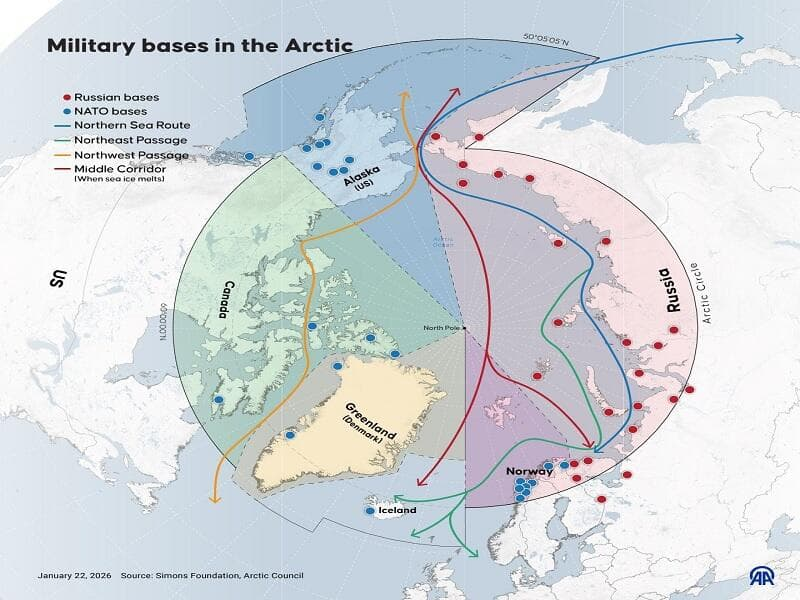
The 2026 Russian Military Yearbook is meant only for senior members of the national security apparatus. Here, we will focus only on the section concerning the Arctic.
This is in reference to escalating NATO-Russian tensions in the Arctic. The Yearbook details NATO’s large-scale military drills in the Arctic, its allies’ arms build-ups, and their deep displeasure with Russia’s increasing hold over the Arctic.
Most alarmingly, the Yearbook mentioned that Finland plans to acquire 64 F-35s, while Canada will receive 88 of them. Norway already has 52 F-35As, which is more than double Russia’s estimated 20 F-57s, its fifth-generation analogue.
Sweden does not yet have any fifth-generation fighters, but those other three Arctic states will have over ten times as many as Russia does.
If the US’s 500 F-35As are included, then Russia’s fifth-generation fighters will be outmatched by 35:1.
The US is actively implementing its 2021 strategic plan for the Arctic.
To summarise, Trump 2.0 is pursuing a three-pronged strategy against Russia:
- Build Golden Dome missile-defence infrastructure in the Arctic to greatly mitigate Russia’s nuclear second-strike capabilities.
- Arm Canada and the Viking Bloc (Denmark, Norway, Sweden, and Finland) to threaten Russia.
- Likely push Russia’s limits along the Northern Sea Route for the purpose of provoking a crisis that would then render this corridor dangerous and thus greatly reduce its use, at a minimum.
The pressure that the US is placing upon Russia along the Arctic front through these means complements the pressure it is also applying through Ukraine.
All of these fronts consist entirely of US mutual-defence allies that have been assembled around Russia. This containment noose is being tightened more through military-technical developments along the Arctic front than anywhere else.
Until recently, this was the quietest front of them all.
The Kremlin has been monitoring these developments all along and is therefore planning its response. This front will likely heat up.
The story continues in Part 2.