1. Background
2. Rebuilding the Energy Infrastructure
3. Who absorbs the shocks?
4. From Abundance to Shortage
5. The War on Refineries
6. The War on Food and Energy
7. Competition is a Sin
8. The Sea-Air-Land blockade
9. The US Military build-up for the next round
10. Global Financial Situations
11. Conclusion
1. Background
Twice in a century a scramble for the fuel of industrial power hardened into blocs, an arms race, and a general war. The war on Iran carries the same signature. We are now seeing the third one begins. Every world war of the last century was a fight over who controls the inputs that run an industrial economy. The war forming around Iran is the existential war and the opening of a third world war. In the First World War, the European powers were racing to lock down colonies across Africa and Asia that fed their factories, coal, iron, rubber, and the nitrates that made both explosives and fertilizer. Germany came to empire late, found the map already carved up, and felt boxed in by rivals who held what it lacked. An arms race that itself devoured steel and coal piled on the pressure, and a killing in the Balkans was enough to set the whole structure alight. On the surface the war was about alliances and honor. Underneath, it was about access to the materials of modern power. The Second World War ran the same logic, amplified. Germany and Japan both cast themselves as “have-not” nations, states with the industry and the ambition but not the raw materials to feed either. Hitler’s drive east into the Soviet Union reached for grain, coal, and above all the oil of the Caucasus. Japan’s push into Southeast Asia was a lunge for the oil of the Dutch East Indies after an American embargo cut its supply off. By 1939 oil had become the decisive resource, the one whose control or denial could settle a campaign before the first shot. Name the single thread that ties the two wars together and it is OIL. Coal still mattered, and both sides poured fortunes into synthetic fuel to escape the shortage. But oil was the one whose absence bent strategy and timing more than anything else. Germany lost in part because it could never secure enough of it. Japan went to war in large part to seize it. Rommel stalled in the North African desert for the want of it. A “have-not” power moves to secure the inputs it lacks, and to the powers that hold them, the move looks like preparation for aggression. Each countermove looks, to the have-not, like encirclement.
The war against Iran is the closing move on a board that has been in play for 3 decades. Iran holds oneof the last great pools of accessible conventional oil and gas still outside Western control, and it sits astride the Strait of Hormuz, through which roughly a fifth of the world’s oil still passes. Securing that prize, or denying it to a rival, settles the last open front in the age of land oil. Closing that front does not end the contest. It relocates it, offshore and north, into the deep ocean and into an Arctic that is melting open for the first time in human history, where fields and sea lanes are appearing that no power yet owns. The world is assembling the pre-conditions of a general war – a fight over the last accessible oil. Two world wars were fought to decide who fuels the world. This is the THIRD, and it is brewing now. There is ONE KEY REASON why the US won’t give up on bringing Iran to its knees, or regime-changing Iran. It has ZERO to do with nuclear issues (which was just a cover to negotiate with Iran), but rather the control of oil flows from Hormuz AND ITS SALE OF OIL IN DOLLARS. That’s what the immediate fight is about. Were Iran to achieve this, it would mean the end of the Petrodollar system. Secondly, it would make Iran the regional power-not Israel or Saudi Arabia. Both of these outcomes are NOT ACCEPTABLE to the Rockefeller Empire in New York, and as well as the Rothschild family in London and Paris, as this would mean the end of Project Israel, and no military presence by the US to dictate the outcomes on energy matters. Since the end of July, Iran has been selling oil, and the ships are paying tolls to Iran. The US and its Gulf vassals – Saudi Arabia, Qatar and Abu Dhabi- are avoiding the Iranian authorized northern route – and are using the southern route bordering Oman. They are doing this to avoid Iran’s direction and as well as to not pay Iran tolls, as these tolls are not paid in dollars but gold, crypto, yuan and Iranian riyals. The tankers and ships moving product through the southern route are getting hit, on a daily basis. Since the beginning of August, the weekly rate of ships getting hit averaged about 5 per week. Since the beginning of October, the weekly hit-rate has increased to about 10, and since the beginning of November, it has increased to 20 plus tankers and cargo ships. Iran is not budging. There is some smuggling by Abu Dhabi, Qatar and Saudi, but it cannot move the desired volumes. The only countries shipping oil out of Hormuz is Iraq and Iran. Most of this oil is going to China, and a bit to India and Pakistan. No oil is going West!! Oil flows out of Hormuz are about 5 million BPD. This compares to 21.5 million BPD before the war started in February.
The U.S. has reduced its dependence on Middle East oil -the Middle East presently produces about a third of the world’s oil. For reference, U.S. oil production in 2018 was 15.3 million BPD (That number includes natural gas liquids). the high point for U.S. oil imports from Persian Gulf countries was 2.8 million BPD in 2001. At the time, that accounted for 23 percent of all U.S. crude oil imports. By 2008, U.S. oil production had begun to rise, but so had U.S. demand. Total crude oil imports had risen to 12.9 million BPD, but the share from the Persian Gulf had fallen to 2.4 million BPD (18.6 percent). In 2018, the impact of U.S. shale oil production was readily apparent. Crude oil imports to the U.S. had fallen to 9.9 million BPD, and the share from the Persian Gulf had fallen to less than 1.6 million BPD (15.9 percent). Of the total crude oil imports from that region, 57 percent came from Saudi Arabia and 33 percent came from Iraq in 2018. These Middle Eastern imports are primarily coming into the Gulf Coast and West Coast. Canada is now the most important source of U.S. oil imports, supplying 4.3 million BPD in 2018 (43 percent of the total). So, U.S. dependence on Middle East oil has fallen, but production of Middle Eastern oil has risen by about 5 million BPD in the past decade. So, the rest of the world uses more oil from the region than they did a decade ago. As long as the US depended on US oil imports, it made sure that its control over the region was tight. As soon as the US reduced its dependence on the region, then, at this point, we knew that the region would now become a contested geopolitical space-whose outcome would be determined by New York. Unfortunately, that didn’t quite work out the way they planned.
2. Rebuilding the Gulf Infrastructure
The war’s damage to Gulf energy infrastructure is not a disruption that ends when the shooting stops. It is a reconstruction problem measured in years and trillions of dollars, and while it is solved, the world will be short of the fuels that run its economy. A ceasefire is not a repair crew. A ceasefire can reopen a shipping lane overnight. It cannot manufacture a compressor, mobilize commissioning engineers, or pay a contractor.
The next phase of this crisis, is a competition for cash, equipment, qualified contractors and finished fuel. Rebuilding the damaged Gulf energy system requires $2 trillion in total program funding. Under prolonged stress, with scarce equipment, rising prices and delays, the bill reaches $3 trillion. Every month of delay makes the same repair more expensive, because the global market for specialized equipment and crews is already stretched by LNG expansions, refinery maintenance and power projects elsewhere. The timeline is just as stark. Weighted by cost, the rebuild averages almost five years from today. Only 60% of the work finishes by 2031, and the longest-lead packages run to seven years. The money problem comes first. A damaged refinery may be worth rebuilding and technically repairable, and still sit idle because the government that owns it has to pay for food imports, salaries, electricity and water first. Lost export revenue doesn’t stop those bills. When a state borrows to keep paying them, that money can’t also pay an engineering contractor. Iraq shows the problem in practice. In July, it faced a monthly public salary obligation of about $5.96 billion with a funding shortfall of $2.52 billion. A government in that position rebuilds nothing. It pays its people, and the export capacity that would restore its revenue waits. This trap can stop reconstruction before it starts: without engineering funds and vendor deposits, factory slots go to other customers and delivery dates slip. The fuel gap is the global transmission belt. For the rest of the world, the damage arrives through diesel and jet fuel. Gulf diesel net exports in August were just over a quarter of prewar levels. Combined Gulf and Russian diesel exports were 1.6 million barrels a day below February. Global oil stocks had fallen 1 billion barrels since February, and global refinery throughput in August was 4.2 million barrels a day below a year earlier. A severe case assumes a shortfall of at least 3 million barrels a day of diesel and jet fuel, every year for five years. That’s about 1.1 billion barrels a year and 5.5 billion barrels over the period.The economic damage extends well beyond the missing barrels. When supply falls short, buyers bid for the marginal cargo, and that bid sets the price for all the fuel still being bought. Scarcity also reprices credit. At $150 a barrel, a buyer purchasing 1 million barrels a day needs $2.25 billion to hold 15 extra days of inventory, and $3 billion at $200. Longer voyages tie up more fuel and more money in transit. A supplier can have the barrels while its customer can’t get a letter of credit. And a cargo that wins a bidding war for one country leaves another short. Competition redistributes the shortage before it eliminates it.
Case study: Europe. The continent burns about 5 million barrels of diesel a day, fuel for the trucks that move its goods, the tractors that plant its crops and, as winter approaches, the boilers that heat millions of homes. How much does Europe produce, and how much does it import? Running flat out, EU refineries can produce roughly 4.5 to 5 million barrels a day of diesel and gas oil, and they are already operating close to their maximum. The conclusion for Europe is stark. It produces most of its own diesel but has no spare refining capacity. It depends on imports for the margin that sets prices, and those imports now come mostly from a single supplier that has shown it will use them as leverage. And its emergency reserve is both perishable and finite. Europe is one of the buyers most exposed to the marginal cargo, and the least able to wait out a five-year shortage. The implications for the global economy. Analysis describes a world economy facing a prolonged supply shock, not a temporary one. Fuel costs feed into nearly everything, so central banks fighting the inflation this crisis has already produced will face pressure for longer than they expect. Emerging-market importers face a combination of high fuel bills, weak currencies and tighter credit that has historically produced debt crises and unrest. And the reconstruction itself will absorb capital, equipment and specialist labor that would otherwise build new energy supply elsewhere, so the shortage may delay the investment needed to end it. In a significant, albeit underreported development for global energy, and for the US-Iran standoff in the Persian Gulf, the Iranian parliament has this week announced it is exempting several key trading partners from its oil transit restrictions in the Strait of Hormuz.
A senior Iranian Parliamentary official said that at a moment when Iranian export flows are struggling under the many months-long US naval blockade of the country’s ports.
“We have currently exempted India, China, Iraq and Qatar from transit restrictions in the Strait of Hormuz. Ships from these countries pass freely,”
Hayat-Moghaddam stated in an interview to the Iranian Student’s News Agency (SNA). He described that this also aimed at shoring up “mutual interests” among countries that have long done business with one another. The Iranian official also sought to frame the change as arising out of joint humanitarian and stating that Iran does not levy transit tolls on Qatari vessels and that each exemption was granted based on specific considerations and agreements. Hayat-Moghaddam remarked:
“We are conducting business, and each of these exemptions has a distinct reason.”
Tehran is facilitating the movement of Indian ships for the purpose of medicines, while Chinese ships are exempted from the restrictions to “secure” Beijing’s political support. The US Navy doesn’t block these ships from passing, which could explain how Iran has continued to get oil and wares out to global markets despite the blockade. “The Americans do not interfere with them either,” he claimed.
The Loss of Tankers
The loss of tankers is creating a global shipping crisis, especially in the VLCC fleet. The ships that survive have problems too, such as maintenance and barnacles. Somewhere in Washington, someone is surely saying that the market will simply build more ships. It will. Eventually. A VLCC is an industrial project: hull, propulsion, cargo systems, commissioning, sea trials and classification approval, all before it carries a single barrel. The owners’ contracts show how long that takes: Worldwide, 20 VLCCs are scheduled for delivery in Q4 2026 and Q1 2027 combined. Another 138 VLCCs on the orderbook are scheduled for 2029 and later. Those 20 near-term ships are not an emergency reserve waiting in a parking lot for the Gulf’s insurance claims. They already have owners and charters. Chartering an existing tanker only moves the problem to someone else’s trade. And a ship that has been hauling crude cannot load jet fuel next week. Its tanks need cleaning, inspection, technical approval, crew, insurance and a route that nobody is shooting at. If you lost a ship in September 2026, expect its replacement sometime during the next decade. The Gulf has not stopped exporting. Late in October, non-Iranian Middle East crude exports were several million barrels a day. The bottleneck was how fast ships could be loaded. Some damaged ships do come back. That restraint is what makes the conclusion hard to dismiss. Exports are flowing because the surviving fleet is being worked hard, and because buffers are being drawn down at nearly a billion barrels worldwide. Shipping and logistics have climbed from $3 to $30-40 per barrel.
Since the end of July till the end of September, around 79 tankers in the Gulf were damaged. Thirty-five of them are VLCCs, the 2-million-barrel workhorses of the crude trade. the physical damage and replacement burden as “catastrophic,”. A tanker is not a barrel. It is a delivery service that loads, sails, discharges, sails home and does it again. Lose the ship and you lose every cargo it would have carried for the rest of its working life. That is for the VLCCs alone. It leaves out the Iranian fleet, the two sunk medium tankers and the product carriers. Around 18 non-Iranian VLCCs are likely out of operation. That is 36 million barrels of loading space. How much daily delivery that represents depends on how long the full round trip takes: Now for diesel and jet fuel, the products that actually keep trucks and airliners moving. Before the war, about 750,000 barrels a day of diesel and gasoil and 400,000 barrels a day of jet and kerosene came through Hormuz. Those volumes are down or zero. Diesel stocks in some markets are at their lowest seasonal level in 35 years. Now you know part of the reason. A chokepoint is not a wall. It is a tollbooth — expensive, annoying, survivable — and the traffic always finds another way around.
A fleet of more than 350 aging tankers moving Iranian crude with their transponders dark, ship-to-ship transfers off Malaysia and in the Sea of Oman, a web of front companies that reconstitutes within weeks of each designation, and a discount deep enough — Iranian barrels have lately traded well below Brent — to keep Chinese refiners buying no matter how many vessels are blacklisted. The result is the fact that ought to trouble the architects of “maximum pressure” most: Iran is now exporting more oil than at almost any point since 2018, sanctions and all. Power exercised through a choke point measures itself in throughput, not in walls, and throughput can be rerouted. The sea could be evaded by anyone with a fast hull and a false manifest. The dollar can be evaded by anyone willing to build a parallel rail and eat a discount. In both cases the hegemony mistakes the choke point for control, and in both cases the adversary gets to work on the bypass. Hold that pattern in mind; everything else follows from it.
The United States cannot physically stop every tanker, but it does not need to. It controls the plumbing through which oil is paid for — the dollar-clearing system, the correspondent-banking network, the marine-insurance market — and it uses access to that plumbing as its blockade. The stated goal is maximal. Washington has declared it means to drive Iran’s oil exports to zero — the twenty-first-century equivalent of sealing the coast. Every turn of the sanctions screw against Iranian and Russian oil tightens the global supply of it, and the price is paid at every pump in the West. Every time Washington weaponizes the dollar, it teaches the rest of the world to build a system that routes around the dollar. The shadow fleet, the ship-to-ship transfers, the rial-ruble settlement, the Iran-Russia-China trilateral, the BRICS payment rails — these are not accidents. They are the predictable response to a chokepoint, and each one makes the next chokepoint less effective. The dollar blockade is being evaded by a new financial plumbing that, once built, does not disappear when the sanctions lift. The dollar is a stickier chokepoint than the sea. A fast ship could always run a blockade in a single night; unwinding dependence on the world’s reserve currency and its clearing system takes years, and the alternatives remain clunky, illiquid, and expensive. The workarounds are real, but they are not yet cheap, and Washington’s leverage is correspondingly deeper than London’s ever was. Washington is betting that the dollar is a wall, rather it is a tollbooth — and the traffic is already finding another way around.
What it costs to get those barrels out
We are looking at two carrier strike groups in the sea near Iran, tens of thousands of military personnel, supply chains running thousands of kms back to Diego Garcia, and drones flying cover on top of EACH tanker as it transits every single day that they can. Every crew is bubbled down and praying it makes the far side by nightfall. Every convoy is force projection military operation, not trade. Trade cannot work like this. A US Carrier Strike Group used to escort oil through the Straits of Hormuz and Bab Al Mandeeb. That cost structure does not hold. When the cost of a barrel includes two carrier groups and a prayer, that barrel is not cheap, whatever the screen prints. And the defense never ends, because the moment anyone announces that a damaged node is back online, that announcement becomes the marker for the next strike, and the convoy has to run the gauntlet all over again. Underneath the flow figure sits the number that should be the headline and almost never is. Roughly 15 million barrels a day of production is shut in right now, knocked out or held off the market. That is around 15 % of global production gone and that number is large enough to matter. It is one of the largest sustained supply withdrawals the market has ever seen, and it sits there quietly while everyone argues about the barrels still moving or not. The first is an 18.5 mb/d exportable-supply deficit — the market-facing shortfall, the prewar flow no longer reaching buyers. The second is a 13.5 mb/d upstream outage — the production capacity actually shut in. The five-million-barrel gap between them is the tell: it is not oil waiting in the ground, it is oil that cannot move because the processing plants, storage tanks, pipelines, terminals, and loading berths between the wellhead and the tanker are damaged or offline. Reopening the strait addresses none of it. Let me explain why a shut-in is not a pause but is physical. When wells sit dead for months, many things go wrong, including equipment, waiting on long-lead replacement parts. Even a healthy well produces nothing marketable until it clears a chain of serial gates: mechanical, reservoir, process, product and export. A single failed gate strand everything behind it. Open a well before the next gate is ready and you create no supply — and may force another shut-in.
Even fully funded, the rebuild runs into two hard limits. The first is working capital, and its timing is brutal: restart cash leaves before production cash returns. Deposits and procurement come before mobilization, mobilization before intervention, intervention before stable output, stable output before an on-spec cargo, and the cargo before anyone collects a dollar. A region whose operators need spendable cash now — for payroll, security, chemicals, spares, war-risk insurance — is asked to spend for a year or more before revenue recovers, which is why the model calls for a purpose-built financing stack: super-priority restart revolvers, hard-currency procurement lines, contractor-mobilization facilities, and export-receivable bridges. Reconstruction itself will absorb capital, equipment and specialist labor that would otherwise build new energy supply elsewhere, so the shortage may delay the investment needed to end it. Ending the conflict removes one source of disruption. It does not repair the energy system, which requires a separate sequence of financing, engineering, manufacturing, construction and commissioning that will take years. Until that is done, reliable fuel and the cash to buy it will determine which economies absorb the burden. Neither will be distributed evenly.The second limit is industrial capacity, and money cannot conjure it. Certified crews, drilling and workover rigs, offshore vessels, ROV and diving spreads, OEM field service, and long-lead sour-service components — tubulars, downhole safety valves, ESPs, compressors — cannot be summoned on demand, least of all when the entire Gulf is bidding for the same scarce equipment at once. The five-year curve is an industrial-capacity curve as much as a reservoir curve.
For anyone trying to understand why the diesel and crude squeeze of the past months will not simply evaporate with a ceasefire, this is the answer. The tightness in the middle-distillate and crude markets is not a headline that clears when the shooting stops and the shipping lanes open. It is the leading edge of a multi-year structural shortfall, front-loaded into the next twelve to twenty-four months, and priced accordingly. Reopening the strait ends the blockade. It does not restart the Gulf. Rebuilding the damaged Gulf energy system requires huge funds- which are now in short supply. Under prolonged stress, with scarce equipment, rising prices and delays, the bill reaches $2.50 trillion. Every month of delay makes the same repair more expensive, because the global market for specialized equipment and crews is already stretched by LNG expansions, refinery maintenance and power projects elsewhere. The timeline is just as stark. Weighted by cost, the rebuild averages almost five years from today. Only 60% of the work finishes by 2031, and the longest-lead packages run to seven years. A damaged refinery may be worth rebuilding and technically repairable, and still sit idle because the government that owns it has to pay for food imports, salaries, electricity and water first. Lost export revenue doesn’t stop those bills. When a state borrows to keep paying them, that money can’t also pay an engineering contractor. Iraq shows the problem in practice. In July, it faced a monthly public salary obligation of about $5.96 billion with a funding shortfall of $2.52 billion. A government in that position rebuilds nothing. It pays its people, and the export capacity that would restore its revenue waits. This trap can stop reconstruction before it starts: without engineering funds and vendor deposits, factory slots go to other customers and delivery dates slip. For the rest of the world, the damage arrives through diesel and jet fuel. Gulf diesel net exports in August were just over a quarter of prewar levels. Combined Gulf and Russian diesel exports were 1.6 million barrels a day below February. Global oil stocks had fallen 3 billion barrels since February, and global refinery throughput in August was 4.2 million barrels a day below a year earlier.
Currently, we can assume a shortfall of at least 3 million barrels a day of diesel and jet fuel, every year for five years. That’s about 1.1 billion barrels a year and 5.5 billion barrels over the period. Damaged refineries don’t come back at full capacity on the first day. Without enough new supply, the balance can close in only one way: by using less fuel. The economic damage extends well beyond the missing barrels. When supply falls short, buyers bid for the marginal cargo, and that bid sets the price for all the fuel still being bought: a $40-a-barrel premium across 10 million barrels a day of purchases adds $146 billion a year to fuel bills. Scarcity also reprices credit. At $150 a barrel, a buyer purchasing 1 million barrels a day needs $2.25 billion to hold 15 extra days of inventory, and $3 billion at $200. Longer voyages tie up more fuel and more money in transit. A supplier can have the barrels while its customer can’t get a letter of credit. And a cargo that wins a bidding war for one country leaves another short. Competition redistributes the shortage before it eliminates it.
3. Who absorbs the shock?
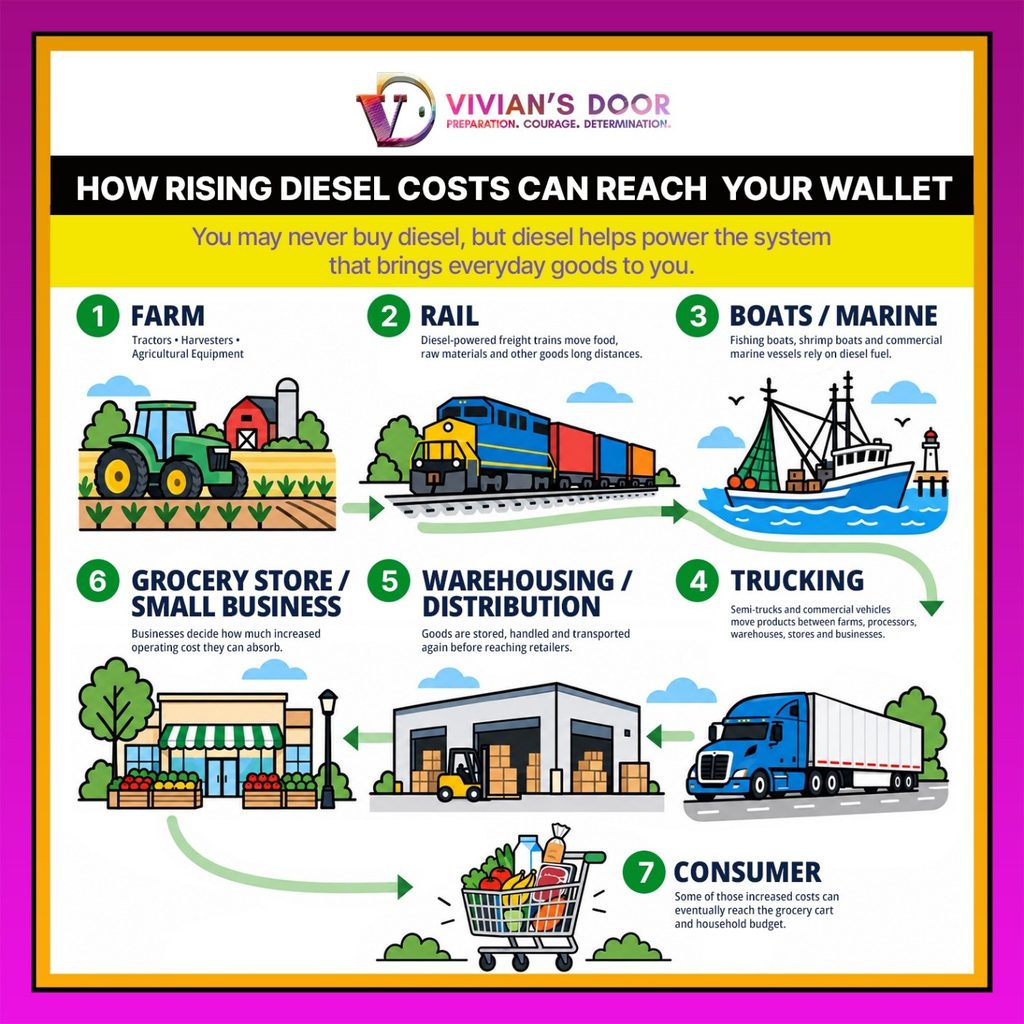
Diesel carries the crisis into the real economy. It runs road freight, farm machinery, mines, construction fleets and backup generators, none of which can switch fuels quickly. Higher diesel costs pass straight into freight rates and food prices, and when diesel isn’t available at any price, activity simply stops. Jet fuel carries the shock into aviation: higher fares, fewer routes and higher air cargo surcharges. Kerosene hits the households with the least room to adjust, in countries where it is still used for heating, cooking and lighting.The regional assessment follows the money:
- Europe competes for replacement diesel and jet cargoes while running its refineries close to their limits.
- South and Southeast Asia face higher import bills, currency pressure and greater need for trade credit.
- Africa and smaller importers are the most vulnerable. Tenders fail, credit lines run out, and small cargoes become uneconomic long before global stocks are exhausted.
- The United States and other Atlantic suppliers face export demand competing with their own diesel needs, with refineries running so hard they have little tolerance for outages.
The ultimate balancing mechanism is demand destruction: freight deferred, low-margin factories idled, flights cancelled, and poorer importers losing every bidding contest. Lower consumption caused by rationing through price or credit is not a repaired energy system.
Case study-Europe
Europe shows what this framework looks like in practice. The continent burns about 5 million barrels of diesel a day, fuel for the trucks that move its goods, the tractors that plant its crops and, as winter approaches, the boilers that heat millions of homes. How much does Europe produce, and how much does it import? Running flat out, EU refineries can produce roughly 4.5 to 5 million barrels a day of diesel and gas oil, and they are already operating close to their maximum. That leaves Europe roughly 85-90% self-sufficient at best. The remaining 10-15% comes from imports, and that margin sets the price for the entire market. Europe’s diesel depends on imported crude as well. Its refineries run almost entirely on foreign oil: the EU imports about 97% of the crude it consumes. The Gulf supply Europe really lost was finished diesel from Gulf refineries, and that is what the United States has replaced. The result is a double dependence: Washington is now Europe’s largest supplier of both the crude its refineries run and the diesel they can’t make. How long can Europe store diesel? This is where Europe’s apparent cushion turns out to be thinner than it looks. Unlike crude oil, which can sit in salt caverns for decades, diesel degrades. Under ideal conditions, conventional ultra-low-sulfur diesel can typically be stored for six to twelve months. With stabilizers, biocides and well-managed tanks, that can be extended to 18 to 24 months. Oxidation forms gums and sediment, water collects, and microbes grow in the fuel.
The conclusion for Europe is stark. It produces most of its own diesel but has no spare refining capacity. It depends on imports for the margin that sets prices, and those imports now come mostly from a single supplier that has shown it will use them as leverage. And its emergency reserve is both perishable and finite. Europe is one of the buyers most exposed to the marginal cargo, and the least able to wait out a five-year shortage. The world economy facing a prolonged supply shock, not a temporary one. Fuel costs feed into nearly everything, so central banks fighting the inflation this crisis has already produced will face pressure for longer than they expect. Emerging-market importers face a combination of high fuel bills, weak currencies and tighter credit that has historically produced debt crises and unrest.
Saudi Arabia
Here is the part that should keep Saudi oil ministers up at night. Look at the energy targets on a map, and you realize the Houthis are not just hitting oil facilities. They are claiming to hit every single link in the one supply chain Saudi Arabia has left. With the Strait of Hormuz closed to normal traffic, the kingdom’s exports depend on a single route. Crude comes out of Ghawar and Shaybah in the east. It is processed at Abqaiq, which has a capacity of 7 million barrels a day and is the heart of the entire Saudi oil system. It is then pushed 1,200 kilometers west across the desert through the East-West pipeline, which has been running at its full 7 million barrels a day since March, by a string of pumping stations. And it is loaded onto tankers at Yanbu on the Red Sea, which was shipping about 5 million barrels a day of crude. The Houthis claim to have hit the fields at the beginning, Abqaiq at the processing stage, the pumping stations in the middle and Yanbu at the exit. That is not a target list. That is a flowchart. Four of the 11 pumping stations on that pipeline had been severely damaged and were not functioning. The Houthis’ latest claims suggest they intend to finish the job. The strikes on the pipeline, the pumping stations and Yanbu have cut the Red Sea exports to nearly zero, plus nearly zero exports from the Gulf, then Saudi is losing the income from 7 million BPD. That’s about $700 million per day, or $250 billion a year. Then add the refineries. Ras Tanura has a capacity of about 550,000 barrels a day. Rabigh has roughly 400,000. Yanbu is home to three more. Take the claims at face value and the Houthis have struck plants representing well over a million barrels a day of refining. That is not merely lost revenue for Aramco. It is diesel, jet fuel and gasoline that the world, already short of all three, can’t buy from Saudi Arabia, and that Saudi Arabia may have to import for itself. A petrostate buying refined products from abroad is the energy equivalent of a bakery buying bread at the supermarket. And then there is Abqaiq. We have seen this movie before. In September 2019, a drone and missile strike on Abqaiq and Khurais knocked out 5.7 million barrels a day, half of Saudi production, overnight. The Houthis’ need to hit anything else. Abqaiq is the chokepoint inside the chokepoint.
The real damage is political. The oil losses are serious, but they are temporary. Pipes get welded. Refineries restart. The political damage to Crown Prince Mohammed bin Salman is far harder to repair. MBS has staked everything on Vision 2030, the promise that Saudi Arabia will become a global hub for business, tourism, sport and investment. Every one of those businesses depends on one thing: the perception that the kingdom is safe. The Houthis are attacking that perception directly, which is why the capital’s airport is the most frequent name on their list. You can’t sell Riyadh as the Dubai of tomorrow when the Houthis are telling the world’s airlines not to land.
Saudi Arabia carries the most stacked set of existential stakes on the board :
The first is territorial. The Houthi grievance runs to the 1934 war and the Treaty of Taif of the same year, which handed Riyadh the provinces of Asir, Najran, and Jizan under terms Yemen “never fully” accepted. If the Houthis win, the prize is a claim on Saudi land itself. Losing this war can reopen Saudi Arabia’s own borders. The second is economic, and it is acute right now. Saudi Arabia lives on oil exports, and this war is choking them. Its production has fallen to levels not seen in decades, its East-West pipeline, the very line built to bypass Hormuz, keeps burning, and the Houthis are squeezing the Red Sea exit as Hormuz is squeezed on the other side. And some reports suggests that there were days where ZERO oil was exported as a result of the war.
UAE
The UAE had rebuilt its ability to pump and ship crude. What it had not rebuilt was its safety margin: the product stocks, the gas chain, the bypass capacity around Hormuz. Record oil, empty tanks. Fujairah product stocks had fallen to roughly 7 million barrels from about 20 million before the war. the ADCOP pipeline to Fujairah moves 1.5 to 1.8 million barrels a day against a claimed national production capacity of 4.85 million, and that the second pipeline remains under construction. Every buffer the UAE counted on, has eroded (accessible stocks, product inventories, alternative routes, spare refining) is precisely where the UAE is running thin. If the global system’s cushion is gone, the country sitting at the chokepoint, with its storage hub inside Iranian missile range and drawn down to a fraction of its prewar level, is not the exception. It is the case study.
4 From Abundance to Shortage
Key shortages of essential product-LNG, helium, Sulphur & Urea
The global economic damage caused by the closure of the Strait of Hormuz is generally not understood by most policymakers. Public and policy discussion of the Strait of Hormuz closure has fixated on crude oil: tanker counts, Brent prices, strategic petroleum reserves. That focus is understandable, but it misses much of the damage. The Persian Gulf is also a dominant global supplier of liquefied natural gas, urea, sulfur and helium. Each feeds a different part of the world economy (power and industrial gas, food production, phosphate fertilizer and metals refining, and semiconductors and medical imaging), and none can be replaced by drawing down an emergency stockpile the way oil can. The loss of these flows has received a fraction of the attention given to oil, even though for several import-dependent countries it is the more consequential shock. Urea and sulfur are low-value bulk commodities that sit underneath two of the world’s most important production systems: food and metals. Urea is the world’s main nitrogen fertilizer. Sulfur, converted to sulfuric acid, is the indispensable input for phosphate fertilizer and for leaching copper, nickel and cobalt. The Persian Gulf is the single largest export source of both, and the effective closure of the Strait of Hormuz since 28 February 2026 has removed most of that supply from world markets. The damage is not evenly distributed. The countries hit hardest share three characteristics: heavy import dependence on Gulf product, little or no domestic substitute, and thin stockpiles. On that basis the most adversely affected are India, Bangladesh, Pakistan, Sri Lanka and Nepal in South Asia; Brazil and Australia among major agricultural exporters; Indonesia, the Democratic Republic of the Congo, Zambia and Chile on the sulfur-to-metals side; Morocco and China as phosphate producers; and a group of low-income East and Southern African importers that WTO analysis flags as the most exposed of all. Urea prices have largely retraced their April spike thanks to Chinese export quotas and weaker demand. Sulfur has not, because it is a byproduct with no quick replacement, and because Russia and China have simultaneously restricted their own exports. The sulfur shock is therefore the more durable and less appreciated of the two.
Why Urea Matters
Urea (46% nitrogen) is the most widely traded nitrogen fertilizer and the cheapest way to deliver nitrogen to cereal crops such as rice, wheat and maize. It is made by converting natural gas into ammonia and then reacting the ammonia with carbon dioxide. Gas is roughly three-quarters or more of the cash cost of production, which is why the industry has clustered where gas is cheapest: the Gulf, Russia, North Africa and, for domestic use, China. Nitrogen cannot be skipped for a season without yield loss, so demand is inelastic in the short run. When urea becomes unaffordable, farmers in poorer countries apply less and yields fall the following harvest; the food-price effect therefore arrives with a lag. Beyond agriculture, urea is used in diesel exhaust fluid for trucks, in urea-formaldehyde resins for wood panels, and in animal feed.
Why Sulfur Matters
Sulfur matters almost entirely because of sulfuric acid, the most heavily produced industrial chemical in the world. The largest single use is the acidulation of phosphate rock to make phosphoric acid and from it DAP, MAP and TSP fertilizers. The second strategic use is hydrometallurgy: heap and agitation leaching of copper ores (SX-EW), and high-pressure acid leaching (HPAL) of nickel and cobalt laterites, which is the backbone of Indonesia’s battery-metals industry. Sulfuric acid is also used in petroleum refining, titanium dioxide pigment, viscose, paper and water treatment. Two features make sulfur shocks unusually severe. First, almost all elemental sulfur is a byproduct of removing hydrogen sulfide from sour gas and crude, so no producer can raise output in response to price. Second, consumers who process metals often cannot run at partial rates: Kpler notes that HPAL plants are effectively either on or off. One industry estimate holds that without sulfuric acid about 30% of nickel processing, 50% of copper processing and 70% of cobalt processing would stop. The Middle East produces about a quarter of the world’s sulfur but supplies about 45% of seaborne trade (SMM); IFA puts the share at 49% of global sulfur trade, or about 15 Mt/yr. through Hormuz. Because Gulf states consume little of what they recover, nearly all of it is exported. Producers with domestic gas and captive acid, notably the United States, Canada and integrated smelter-acid copper operations, are relatively insulated. Urea will normalize first once ships move, because Gulf plants outside the damaged sites can restart quickly and other exporters have spare capacity. Sulfur will lag, because recovery depends on gas and refinery throughput in Qatar and the UAE, some of which is damaged, and because Russian and Chinese export restrictions run at least to year-end.
LNG and helium belong together because they come from the same place. Qatar’s helium is extracted from the same natural gas that feeds its LNG trains at Ras Laffan. When Iranian missiles hit Ras Laffan in March and Hormuz closed, the world lost a large share of its LNG and roughly a third of its helium in one stroke. LNG is the bigger economic shock by far; helium is the smaller, stranger one, because a gas most people associate with party balloons turns out to be indispensable to memory chips, MRI scanners and rockets. The LNG shock has fallen hardest on poor, import-dependent South Asian economies, where it has shut fertilizer plants, idled garment factories and darkened grids, and from there it feeds directly into the urea and food problems. The helium shock has so far been managed through stockpiles and allocation rather than shutdowns, but it has handed the United States a new form of leverage and quietly raised the cost of the AI buildout. And the most lasting effect may be on LNG itself: importers burned once are turning to coal, nuclear and solar, which threatens the long-term case for the very exports that America and Qatar are betting on.
LNG
Liquefied natural gas is how gas crosses oceans. For importing countries, it fuels power stations, heats homes, supplies industry and, crucially, is the feedstock for ammonia and urea. Gas is also the flexible fuel that balances grids when demand peaks or renewables dip. Countries such as Pakistan, Bangladesh, Taiwan, Japan and South Korea have little or no domestic gas, so LNG is their only option. About a fifth of global LNG supply passed through the Strait of Hormuz last year, almost all of it from Qatar and the UAE. Qatar alone exported about 120 BBCM in 2025.
Helium
Helium is a byproduct of certain natural gas streams; it cannot be manufactured. It is the only practical coolant for superconducting magnets and other systems that must run near absolute zero, and its small atomic size makes it the standard gas for leak detection. Its critical uses are semiconductor manufacturing (wafer cooling, etching and EUV lithography), MRI scanners, space launches, defense systems, fiber optics, quantum computing and research cryogenics. For most of these, as the US Geological Survey notes, there is no substitute. Helium is also logistically fragile. It ships as a liquid at about −269°C in specialized cryogenic containers and begins to boil off after roughly 35 to 48 days. That means it cannot be stockpiled at sea or rerouted slowly the way oil can.
The Scale of the Supply Shock
The headline volume figures understate the damage for one reason: the replacement supply did not go to the countries that lost it. US cargoes flowed largely to buyers who could pay, chiefly in Europe and Northeast Asia. Spot LNG in Asia and Europe is near its highest level since late 2022. This is where the LNG shock joins the urea shock. Gas is the feedstock for urea, so losing LNG means losing domestic fertilizer production on top of lost Gulf imports. In India, LNG supplied 80% of the fertilizer sector’s gas in 2025; the government intervened to restore supply to fertilizer plants, which is why Indian farmers have been relatively protected. Bangladesh could not do the same. Six of its major urea plants have closed or cut output, and the state-owned Ashuganj plant has been idle for more than a year. Bangladesh is also the world’s second-largest garment exporter, and garments are about 80% of its export earnings. Hundreds of factories, including textile mills, have cut production or shut down, and knitwear makers have switched to expensive diesel generators. Factories face delayed shipments, penalties and order cancellations. The buyers are mostly European and American apparel retailers; risk is that some of that business shifts permanently to suppliers with reliable power. In India, the Morbi ceramics cluster in Gujarat, one of the world’s largest tile-making centers, saw gas supply cut by half and some units shut. Glass, petrochemicals and refining also lost gas. Pakistan’s textile industry, its largest exporter, depends on gas-fired captive power and has been exposed to the same outages.
Egypt
Egypt was hit twice: Israeli pipeline gas stopped when the war began, and its Qatari LNG deal fell under force majeure. With 82% of its power coming from gas, it nearly tripled its monthly energy import bill. Egypt is also a significant exporter of urea and other gas-based products to Europe, and in past gas shortages it has shut fertilizer plants first, so its exports are exposed to the same squeeze. For Pakistan, Bangladesh and Egypt, every replacement cargo bought at spot prices drains scarce foreign exchange. As one Bangladeshi economist put it, relying mainly on imports “is not a viable option because Bangladesh does not have sufficient foreign exchange.” The energy shock is therefore also a balance-of-payments and debt problem for the countries least able to absorb it.
Taiwan & Korea – chips
Taiwan’s position is the most precarious among advanced economies. Gas supplies nearly half its electricity, Qatar about a third of its LNG, and it holds only about 11 days of gas in reserve. TSMC alone uses almost 10% of the island’s electricity. Taiwan has avoided rationing by buying US and Australian cargoes, but an extended shortage during peak summer demand would force a choice between households and fabs.
Helium – Chips, Scanners & Rockets
Helium supply is allocated by a handful of industrial gas companies (Linde, Air Liquide, Air Products, Messer, Iwatani), and in a shortage they decide who gets it. Medical users are typically served first; research labs, welding and party balloons are cut first. Chipmakers can afford to pay almost any price, because helium is a tiny fraction of wafer cost; their risk is not getting it at all.South Korea is the most exposed chip producer. Samsung and SK Hynix make about 70% of the world’s DRAM and took about 65% of their helium from Qatar. They signed new long-term contracts with Linde and Air Products, accepted higher prices and expanded recycling, and the Korean government secured about four months of semiconductor-grade supply. TSMC held more than two months of inventory and recycles 80–90% of its helium. No confirmed production cuts have been reported. US fabs, which draw on domestic helium, have been the least exposed. Beyond chips, MRI scanners each hold about 1,500–2,000 liters of liquid helium and can be permanently damaged if allowed to warm; healthcare accounts for roughly 30% of helium use. Space launch, satellite testing and defense cryogenics are also heavy users.
Food Security
The LNG shock compounds the food risk. Lost gas in Bangladesh and Pakistan means less domestic urea, which means more import demand in a market already short of Gulf urea, and lower yields if farmers cannot get it. In Bangladesh the crisis has reached households directly: rural families are switching to wood stoves when piped gas fails. The helium shortage is unlikely to be the main driver of memory prices, which were already rising on AI demand, but it adds to the pressure. Industry analysts expect scarce high-purity helium to be steered toward high-margin AI memory rather than chips for ordinary consumer devices. The hyperscalers have committed about $1 trillion to AI infrastructure this year, and that spending depends on a steady supply of memory from two Korean companies that were dependent on Qatari helium.
What actually comes out of the Gulf?
A good share of what moves through the strait isn’t crude at all. It’s the stuff the modern economy is actually made of: the feed stocks for plastics, the methanol for chemicals, the urea and ammonia for fertilizer. And those markets are far less forgiving than oil. Start with plastic. The Middle East is the world’s largest exporter of polyethylene, the most widely used plastic on the planet. In 2025 the region shipped 18.7 million tons out of global exports of 43.8 million tons, more than 40 percent of the world total. About 84 percent of the region’s polyethylene capacity depends on the Strait of Hormuz to reach the sea. Polypropylene and ethylene glycol, the raw material for polyester and PET bottles, follow the same route. Then the feedstocks. Before the war, nearly 1.2 million barrels a day of naphtha moved through Hormuz, meeting 60 to 70 percent of Asia’s import needs. Asia’s steam crackers turn that naphtha into ethylene and propylene, the building blocks of nearly every plastic you own. The Gulf also supplies most of the propane and butane that feed Asia’s other plastics plants. Then the chemicals. The Middle East exported more than 17 million tons of methanol in 2025. Iran alone shipped well over 9 million tons, and roughly 70 percent of China’s methanol imports came from the region. And fertilizer: nearly a third of global urea exports, 44 percent of sulfur exports and almost a fifth of ammonia exports pass through or originate west of the strait. That’s the cargo Iran is shooting at. Not just oil, but the raw material for packaging, textiles, car parts, medical supplies and the fertilizer that grows the world’s food.
Why Plastic Bleeds faster than Oil?
Crude has escape hatches. Saudi Arabia can push oil across the peninsula to Yanbu, and the UAE can pipe it to Fujairah. Governments keep strategic petroleum reserves for exactly this kind of emergency. Petrochemicals have none of that. There is no strategic polyethylene reserve. Nobody stockpiles methanol for national security. And the giant plants at Jubail, Ras Laffan and Ruwais sit on the Gulf coast, built to load ships, not pipelines. As one analyst put it, most petrochemical products cannot be rerouted the way crude can. The buyers can’t easily switch, either. Asia’s crackers were built around Gulf naphtha. Some can burn more LPG instead, but that flexibility is limited, and the LPG comes through the same strait. When the naphtha stops, the crackers cut rates or declare force majeure: naphtha has moved beyond economics, and availability is now the core concern. The numbers show it. UN data comparing April 2026 with a year earlier show Middle East methanol exports down 80 percent, urea down 83 percent and ammonia down 75 percent. Even polypropylene, the least affected of the twelve commodities the UN tracked, fell 24 percent. Here’s the part that matters for petrochemicals. Iran doesn’t need to sink a single chemical tanker to choke the chemical trade. It only needs to make each transit risky enough that the owners of small, low-margin ships stay home. The crude may limp through under Navy escort. The naphtha, methanol and polymers ride on the ships least able to bear the risk.
Who gets the bill?
Asia first. Japan, South Korea and India depend on imported Gulf feedstocks, and their crackers have spent the year cutting rates or declaring force majeure. China’s polyethylene output in April fell 8.2 percent from a year earlier because its naphtha-fed crackers couldn’t get enough feedstock. The disruption has taken nearly 20 percent of global ethylene capacity and as much as 40 percent of Asian naphtha supply off the market. Europe, whose crackers also run-on naphtha, is not far behind. Then everyone else. Polyethylene prices nearly doubled between the end of February and April. Dow and Celanese raised prices. Plastic is in the packaging for your groceries, the dashboard of your car, the syringes at your hospital and the polyester in your shirt. When the price of the resin doubles, it doesn’t stay in the chemical industry. It works its way onto store shelves, quietly, a few cents at a time. And then there is food. Urea, ammonia and sulfur are not plastics, but they ride the same strait and suffer the same insurance math. Farmers who pay more for fertilizer either pass it on or plant less. Either way, you pay. In fairness, there is one winner. American petrochemical producers, sitting on cheap shale gas along the Gulf Coast, have enjoyed a windfall as buyers scramble for resin that doesn’t pass through Hormuz. So, if you were wondering who benefits from this war, check the quarterly earnings in Houston.
The Math Washington skipped
The planners who started this war modeled oil. They had the SPR, the escort plan and the pipeline workarounds. What they apparently didn’t model was that the Persian Gulf is also one of the world’s great chemical plants, and that its output has no pipeline, no reserve and no Navy escort sized to protect a fleet of small, uninsurable ships. Iran figured that out. Its tanker campaign doesn’t have to win at sea. It only has to keep the strait dangerous enough, long enough, for the world to run short of the things that are made from what passes through it. Each strike resets the insurance clock and keeps the small ships away for another month. So, the next time someone in Washington tells you the oil is still flowing, ask them about the naphtha, the methanol and the polyethylene. Then go look at the price of a pack of diapers. That’s where this war is being lost.
The US
The United States is the clearest winner on 4 commodities. Its LNG exports rose 26% in the first four months of 2026, and it is the world’s largest helium exporter and the main source of replacement supply. Industrial gas companies and producers such as ExxonMobil have gained. But Americans are paying part of the bill: residential gas costs were up about 14% from a year earlier and near three-year highs, and lawmakers have begun to question export volumes ahead of the midterms. On helium, the United States sold its Federal Helium Reserve to Messer in 2024, so the strategic buffer that might have stabilized this shortage is now a private commercial asset.
The story continues in Part 2 – – –