
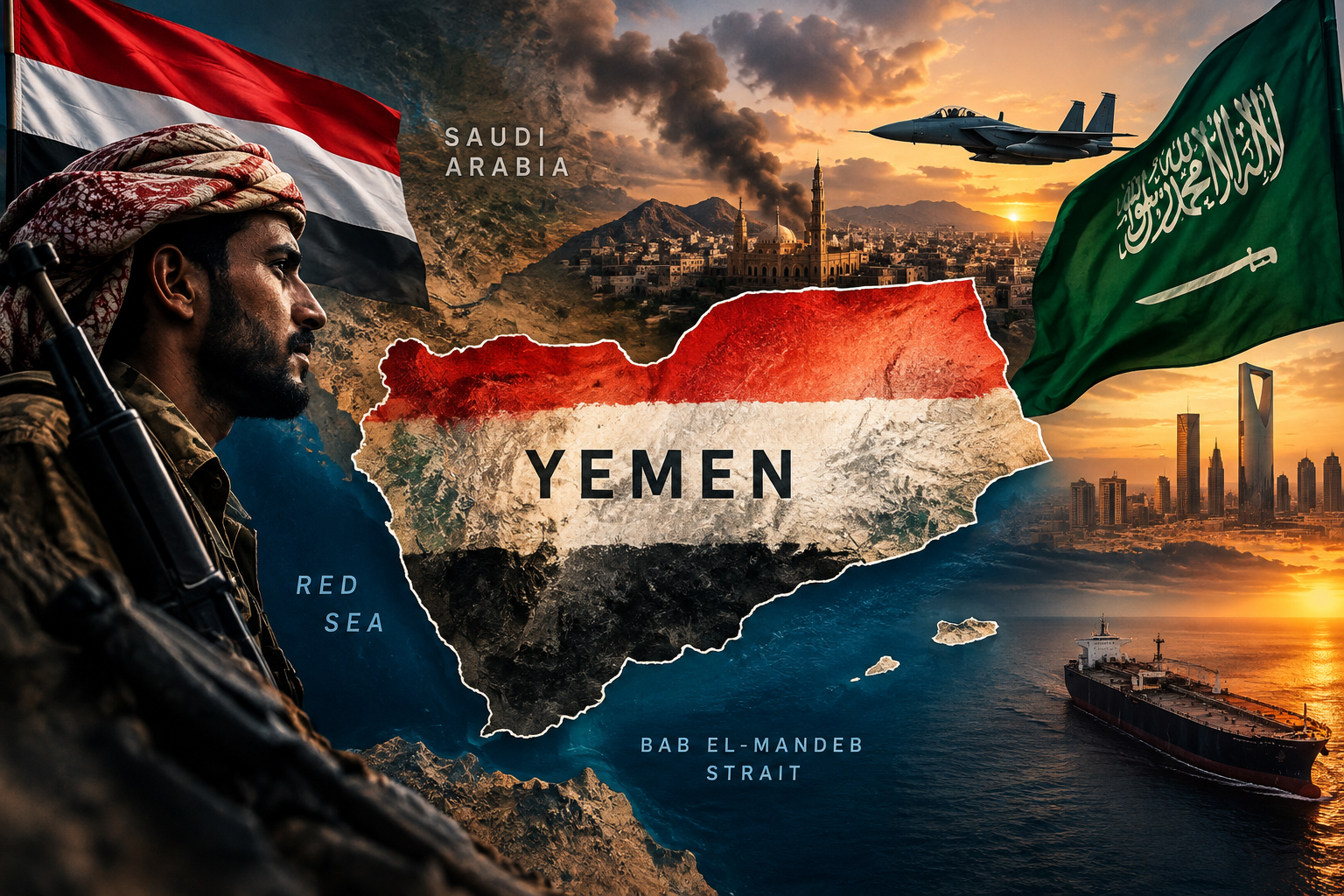
The long-running Saudi-Yemeni conflict has entered a new and potentially decisive phase. What began as a dispute over territory and borders nearly a century ago has evolved through civil war, regional proxy conflict, Saudi intervention and the wider confrontation involving Iran, Israel and the United States.
Now, in 2026, the balance of power appears to be shifting once again.
The history of the Saudi-Yemen rivalry, examines the latest escalation and looks at the strategic consequences for Saudi Arabia, the Red Sea, Europe and the wider Middle East.
Contents
- Background to the Saudi-Yemen Rivalry
- Liberation Begins
- MBS Scrambles for Allies and Help
- The End of MBS
- Israel’s Strategic Shock
- The Energy Equation
- America’s Position
1. Background – The Saudi-Yemen Rivalry
The Saudi rivalry with Yemen began soon after Ibn Saud established his kingdom in 1932.
We can describe the history of this rivalry as four distinct rounds, with the latest beginning in July 2026 following the attack on Sanaa airport.
Round One – 1934
By 1932, Ibn Saud controlled almost all of Arabia except Yemen and the smaller coastal states, many of which were then British protectorates such as Oman and Kuwait.
Between the Hejaz and Yemen were several tribal regions over which the Ottomans had previously held nominal suzerainty. Both Ibn Saud and the Imam of Yemen aspired to control these territories.
The Dispute Over Asir
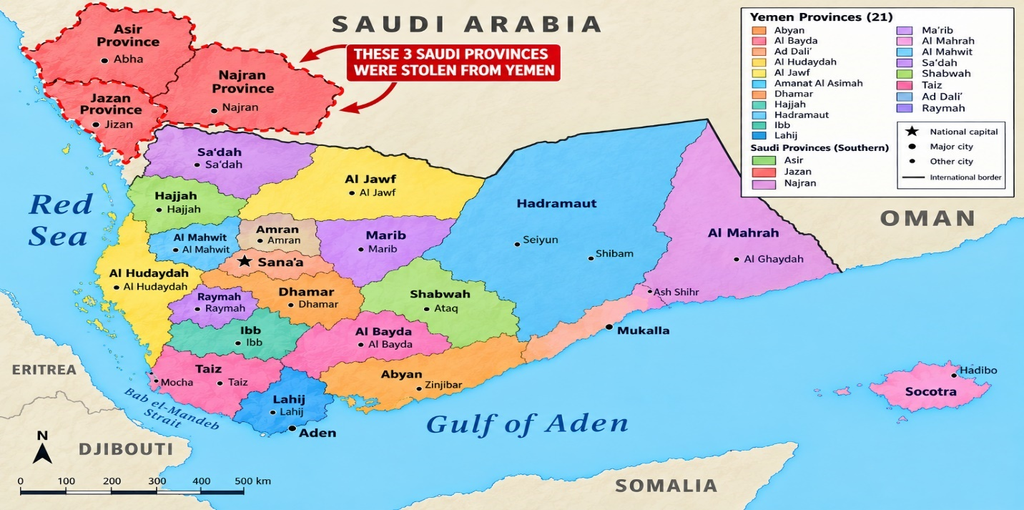
In 1923, Emir Idrissi ruled an independent state situated between Nejd, Hejaz and Yemen. He remained at peace with his traditional rivals in Hejaz but was in dispute with Imam Yahya of Yemen to the south of Asir.
The territory controlled by the independent Idrisi emirate fluctuated throughout the ten years of its existence.
In 1926, the Emir of Asir accepted Saudi suzerainty, and in 1930 the territory was incorporated into the Nejd and Hejaz Kingdom.
The new Saudi kingdom subsequently expanded at the expense of Idrissi-controlled areas. Both Asir and Jizan had formed part of the independent Idris Asir emirate during the 1920s.
A treaty was signed in 1931, but it was soon broken.
In November 1933, Yemen declared war and advanced towards Najran. A peace delegation that included one of Ibn Saud’s sons was imprisoned by King Yahya.
Ibn Saud’s efforts reportedly prompted Imam Yahya to ask:
“Who is this Bedouin coming to challenge my family’s 900-year rule?”
In February 1934, at the beginning of the war, the Yemeni government and the British representative signed a “treaty of friendship”. The agreement resolved several disputes between Yemen and Britain concerning Aden and the border between Yemen and the Aden Protectorate.
Britain also guaranteed Yemen’s independence for forty years, while the Imam agreed to stop attacking Aden.
At this point, Britain had treaties of friendship with both sides of the conflict.
The 1934 Saudi-Yemen War
In 1934, only two years after the official unification of Saudi Arabia, King Abdulaziz Ibn Saud faced a new threat from the south.
Imam Yahya of Yemen claimed the provinces of Asir, Najran and Jizan.
The resulting Saudi-Yemeni War was brief but decisive. Saudi forces pushed deep into Yemeni territory and captured Taif before a British-brokered ceasefire led to the Treaty of Taif.
The conflict solidified Saudi Arabia’s southern borders and established approximately two decades of peace.
However, the expiration of the treaty in 1954 helped set the stage for later tensions, including the Yemen Civil War that began in 1962.
The legacy of British colonial policy would continue to influence the region for decades.
Round Two – 1962–1967
In 1962, a group of Yemeni officers known as the Free Officers Movement successfully organised a coup against the Yemeni royal family.
The subsequent Yemen War, also known as the North Yemen Civil War, was fought between the Royalists of the Kingdom of Yemen and Republican factions of the Yemen Arab Republic.
Although the conflict began as a Yemeni civil war, it quickly became a regional proxy conflict.
Egypt supported the Republican government with conventional military forces, while Saudi Arabia supported the Royalists with money and equipment.
The conflict became part of the wider struggle between Egypt and Saudi Arabia for regional influence.
Egyptian forces arrived in Yemen on 5 October 1962 to support the new Republican regime.
By 1965, approximately 60,000 Egyptian soldiers were involved in the conflict.
The war became known as “Egypt’s Vietnam.”
Egypt reportedly spent enormous sums on the conflict, while more than 20,000 Egyptian soldiers were killed.
The conflict also placed considerable strain on President Gamal Abdel Nasser’s government.
The Six-Day War and Egypt’s Withdrawal
The 1967 Six-Day War became a turning point.
Nasser’s government was already looking for a way to disengage from Yemen. Egypt’s defeat by Israel further changed the strategic calculations.
Following the Six-Day War, Arab states began attempting to rebuild their unity against Israel. This provided Nasser with an opportunity to disengage from the Yemeni conflict.
At the Arab Summit in Khartoum, Egypt and Saudi Arabia agreed on a framework for ending their involvement.
Egypt withdrew its forces from North Yemen, while Saudi Arabia ended its support for the Yemeni Royalists.
By the end of 1967, Egyptian forces had left North Yemen.
The civil war itself continued until 1970, when both sides reached a peace agreement that created a unified government containing Republican and Royalist representation.
The eight-year war was finally over.
The Two Yemens
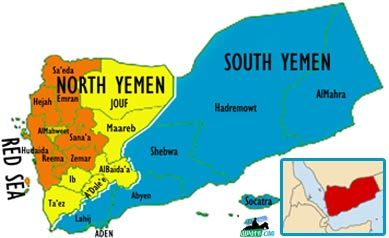
Before 1990, Yemen consisted of two separate countries.
North Yemen, officially the Yemen Arab Republic, controlled the north-western portion of modern Yemen. Before 1962 it had been known as the Mutawakkilite Kingdom of Yemen.
South Yemen, officially the People’s Democratic Republic of Yemen, was a Marxist-Leninist one-party state closely allied with the Soviet Union.
South Yemen had previously consisted of British colonies and protectorates centred around Aden.
In 1990, the two countries unified to form the modern Republic of Yemen.
Round Three – 2014–2022
The next major phase began in late 2014.
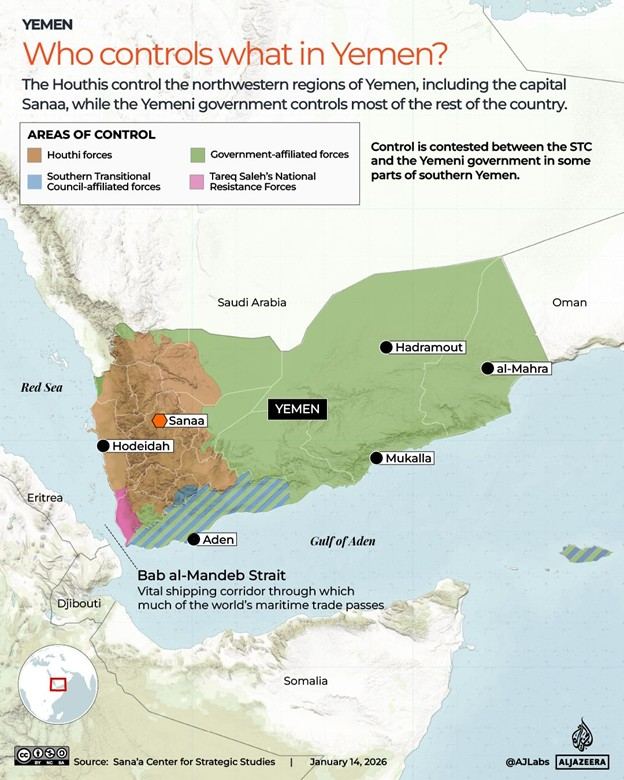
Ansar Allah, commonly known as the Houthis, seized control of Sanaa and rapidly took control of large parts of the former North Yemen.
The UN-recognised government fled to Aden.
Neither side subsequently succeeded in completely defeating the other.
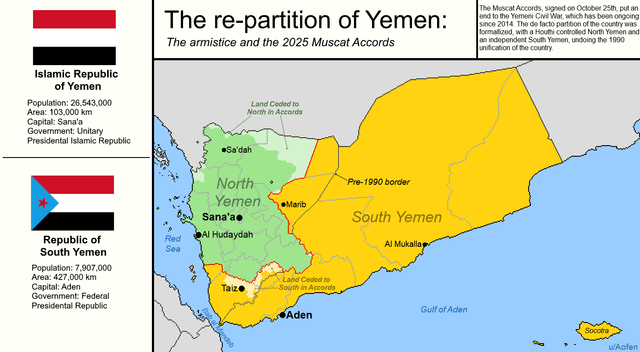
The Houthis consolidated control over much of the north, while Saudi-backed forces and the Southern Transitional Council gradually expanded their influence across parts of the former South Yemen.
Saudi Intervention
In March 2015, Saudi Arabia launched Operation Decisive Storm with the stated objective of reversing the Houthi takeover and restoring the internationally recognised government.
The Saudi-led coalition received military and intelligence support from the United States and other Western countries.
Instead of producing a decisive victory, the intervention developed into a prolonged conflict.
Years of bombing devastated large parts of Yemen and created an enormous humanitarian crisis.
The conflict resulted in hundreds of thousands of deaths according to various estimates, including deaths resulting directly from fighting as well as hunger and disease.
By 2022, Saudi Arabia had increasingly concluded that Yemen had become a strategic quagmire.
A UN-mediated truce reduced the intensity of the fighting, while Saudi Arabia began looking for a way out.
The subsequent Saudi rapprochement with Iran also opened the possibility of a wider regional de-escalation.
The Birth of the Houthis
The Houthis did not begin as an Iranian proxy army.
The movement emerged in northern Yemen during the 1990s from Yemen’s Zaydi Shiite community.
Zaydi Islam has deep roots in northern Yemen. Zaydi religious leaders ruled parts of the country for centuries.
The movement that eventually became known as Ansar Allah was initially concerned with Zaydi religious and cultural identity and opposition to the growing influence of Saudi Arabia and its conservative Sunni religious establishment in Yemen.
Beginning in 2004, the Houthis fought a series of rebellions against President Ali Abdullah Saleh.
From 2004 to 2015, this was fundamentally an internal Yemeni conflict.
Saudi Arabia became increasingly involved as the fighting spilled across its southern border.
The Arab Spring demonstrations of 2011 eventually forced Saleh from power after more than three decades as president.
However, Yemen did not become a stable democracy.
Instead, the country continued to fragment.
In September 2014, Houthi forces captured Sanaa.
They continued moving south, and by early 2015 President Mansur Hadi had fled the country.
Saudi Arabia then entered the war.
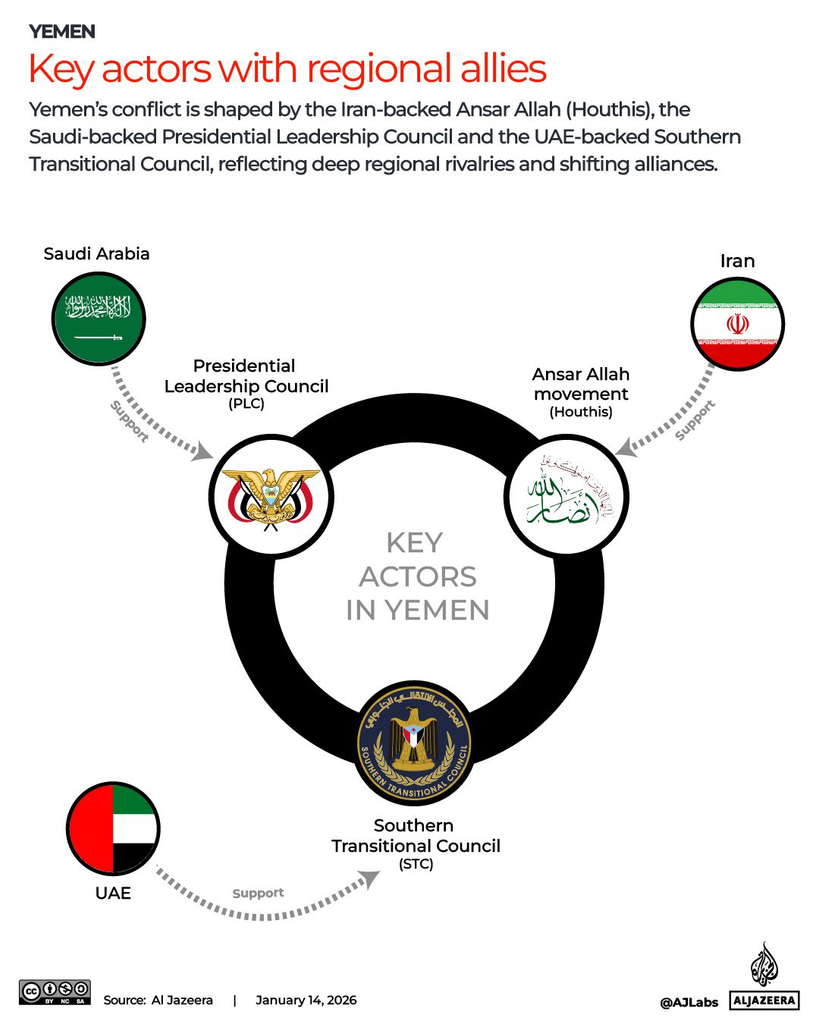
From Riyadh’s perspective, a Houthi-dominated Yemen represented a major strategic threat immediately on its southern border, particularly because the Houthis were developing an increasingly close relationship with Iran.
Saudi Arabia therefore organised a coalition of Arab states and intervened militarily in March 2015.
Iran Enters the Equation
Saudi Arabia and its allies possessed overwhelming air power and received support from Britain and the United States.
But the Houthis proved extremely difficult to defeat on the ground.
Yemen’s mountainous terrain favoured defenders. The Houthis also possessed years of combat experience, while their opponents were divided among competing factions.
Iran subsequently became an important player.
Tehran provided weapons, training, technology and other assistance, particularly involving missiles and drones.
However, describing the Houthis simply as an Iranian puppet ignores an important part of the story.
The Houthis have their own leadership, ideology and Yemeni political objectives.
Iran did not create the movement.
Rather, Iranian assistance helped transform an already formidable local movement into one capable of projecting military power far beyond Yemen.
Houthi missiles and drones eventually began reaching deep into Saudi territory, threatening cities, airports and oil installations.
A guerrilla movement originating in the mountains of northern Yemen had developed the ability to threaten one of the world’s wealthiest countries.
By 2022, however, the war had reached something close to a stalemate.
A UN-mediated truce reduced the fighting and Saudi Arabia increasingly searched for an exit.
Yemen and the Wider Regional War
After the Hamas attack on Israel in October 2023, the Houthis began attacking Israel as well as container and cargo ships in the Red Sea.
They stated that the attacks were being carried out in support of the Palestinians.
The attacks brought American and British military strikes against Houthi targets, followed later by Israeli strikes.
This illustrates one of the defining characteristics of the modern Middle East.
Conflicts that once appeared to be separate are increasingly interconnected.
A Yemeni civil war became a Saudi-Iranian proxy conflict.
That conflict then became connected to the Gaza war and the Red Sea crisis.
The United States and Britain were subsequently drawn into Yemen, turning the country into another front in the wider regional confrontation.
2. The Liberation Begins
Round Four – July 2026 to the Present
The fourth round began in July 2026.
The collapse of the Yemen-Saudi ceasefire was triggered by a strategic mistake committed by Riyadh.
An Iranian aircraft travelled to Yemen to collect a delegation travelling to Iran to attend the funeral of Ayatollah Khamenei.
Saudi fighter aircraft attempted to intercept the Iranian plane but were prevented from doing so by Yemeni air defences.
When the aircraft returned from Iran, Saudi aircraft subsequently attacked the runway at Sanaa airport.
Fortunately, according to the account, Hodeida airport had been repaired only days earlier, allowing the Iranian aircraft to divert there and land safely.
Saudi Arabia reportedly stated that former US President Donald Trump had explicitly approved the airport strike.
Whatever the precise chain of authorisation, the strike became the breaking point.
The Houthis declared the 2022 ceasefire over and launched a retaliation against Saudi Arabia, including missile and drone attacks on Abha Airport.
They then announced a blockade of Saudi imports and exports.
Their message was clear:
“Blockade for a blockade, siege for siege, and escalation for escalation.”
They declared that the objective was to liberate Yemen from what they described as Saudi-Emirati subjugation and the destruction of Yemen and its people.
Saudi Arabia’s Energy Vulnerability
The impact was immediate.
Saudi Arabia’s oil exports were already under pressure because of the wider disruption around the Strait of Hormuz.
Yemen’s ability to threaten Saudi infrastructure created a second pressure point.
On 10 September 2026, Yemeni drones and missiles reportedly struck Saudi Arabia’s East-West Pipeline in the Riyadh and Madinah regions, together with pumping stations.
The attacks reportedly forced Saudi Arabia to shut down critical oil infrastructure as a precaution.
The pipeline had reportedly been transporting between four and five million barrels of oil per day towards the Red Sea port of Yanbu.
A subsequent Houthi attack reportedly targeted Saudi Aramco facilities in Yanbu.
This represented a major strategic vulnerability for Saudi Arabia.
Saudi Aramco subsequently notified at least two European refining customers that they would receive no crude oil allocations in October under their long-term agreements.
If sustained, the disruption would have implications far beyond Saudi Arabia.
Europe Gets Caught in the Middle
For Europe, disruption in the Red Sea comes at an extremely difficult time.
The continent is already dealing with the consequences of changing Russian energy flows and the slow development of alternative supply routes.
The Red Sea is a critical artery for global commerce.
Approximately 12% of world trade passes through the Bab el-Mandeb and Suez Canal according to the figures.
Rerouting shipping around the region has already increased logistics costs and caused significant delays.
The result is a much narrower range of options for European governments and businesses.
Europe faces a combination of:
- disrupted maritime routes;
- higher energy costs;
- increased shipping costs;
- pressure on industrial supply chains;
- limited alternative energy routes; and
- an approaching winter.
The conflict in Yemen is therefore no longer simply a Yemeni or Saudi problem.
It has become an international economic problem.
Who Actually Governs Yemen?
One of the central questions is that of legitimacy.
The international community has generally supported the Saudi-backed Yemeni political structure and referred to it as Yemen’s internationally recognised government.
This interpretation, however, is contested.
Ansar Allah is the effective governing authority in Sanaa, controlling the country’s largest population centre and a substantial portion of Yemen’s territory.
The so-called internationally recognised government, meanwhile, remains heavily dependent upon Saudi and Emirati support.
The terminology used to describe Ansar Allah is also significant. The common designation “Houthis” can obscure the broader nature of the movement, which is a wider political and military organisation in which the Houthi clan represents one component.
This distinction is important because it reframes the conflict. Rather than simply being a struggle between a recognised government and a rebel movement, the conflict can instead be understood as a contest between competing Yemeni political structures, each claiming legitimacy and authority.
The Saudi-backed Presidential Leadership Council is particularly dependent on Riyadh, with its leadership operating from Saudi Arabia.
The Houthi Demands
The Houthis are not simply fighting Iran’s war.
Their demands remain centred on Yemen.
The demands originally associated with the 2023 roadmap included:
- an end to Saudi military operations in Yemen;
- removal of restrictions on Houthi-controlled ports and airports;
- payment of government salaries;
- a share of Yemen’s oil and gas revenues; and
- war reparations.
These demands remain negotiable, but that the strategic environment has changed dramatically since 2023.
The Bab el-Mandeb Strait has become an increasingly valuable strategic asset.
There are also reports of a possible Houthi-enforced toll system for vessels passing through the strait.
Saudi Arabia’s Strategic Dilemma
Saudi Arabia now faces a difficult choice.
It can attempt to negotiate with Ansar Allah and accept some of its demands.
Or it can continue fighting and risk becoming trapped in another prolonged conflict.
The dilemma is particularly serious because Saudi Arabia’s ability to export oil through the Red Sea has become increasingly important following the disruption around Hormuz.
Saudi Arabia is now facing an equation in which attacks on Yemeni territory can produce direct retaliation against Saudi energy infrastructure.
In other words:
Saudi military action against Yemen increasingly carries an economic cost for Saudi Arabia itself.
That fundamentally changes the strategic equation.
Yemeni Strikes on Saudi Arabia
Yemeni drones and missiles have targeted military, energy and power infrastructure in Saudi Arabia, including areas around:
- Jazan;
- Abha;
- Khamis Mushait; and
- Najran.
Satellite imagery was reportedly used to identify possible damage to strategic facilities.
Reports of attacks on Aramco’s Jazan facilities, King Abdullah Airport, the Asir Central Power Plant and other infrastructure.
Further claims that several pumping stations were destroyed and that Saudi military aircraft were damaged or destroyed.
Saudi-backed forces were also reportedly targeted with ballistic missiles and other weapons.
The Strike South
The next stage of the conflict saw a rapid Houthi advance along Yemen’s western coast.
In little more than a week, forces that had previously been pressing against Saudi-backed positions reportedly transformed a contested front into a major territorial breakthrough.
The offensive began on 3 September.
Rather than relying on one major thrust, the offensive was conducted along several axes.
The principal pressure points were reportedly:
- Western Taiz
- Southern Hodeida
- The Mocha sector
The Strategic Plan
The operation as a coordinated strategy involving several stages:
First: advance down the western coast.
Second: seize control of strategically important Red Sea islands.
Third: strike northwards towards the Saudi border and target military, energy and aviation infrastructure.
Fourth: move westwards towards Marib.
Fifth: advance towards Taiz and ultimately Aden.
The strategic objective is to cut Saudi logistical support to its Yemeni proxies, whose principal base and headquarters are in Aden.
Ansar Allah forces had reached approximately 25 kilometres from Taiz and were seeking negotiations with tribal leaders rather than relying solely on military force.
The message was reportedly straightforward:
You can keep your weapons. Tell us what you need and how we can help.
This approach was beginning to gain traction.
The Fall of Mocha
The offensive was designed to break the coastal defence system at its weakest points.
The objective was not necessarily to destroy every Saudi-backed government unit.
Instead, the aim was to make the network connecting those units unusable.
Once pressure was established around western Taiz and southern Hodeida, Mocha became increasingly vulnerable.
Saudi Arabia was then forced to fight on two interconnected fronts:
- supporting its Yemeni allies on the ground; and
- defending Saudi territory and infrastructure against increasingly long-range Yemeni attacks.
This made Saudi airpower increasingly expensive and politically difficult to employ.
On 8 September, missiles and drones reportedly targeted Abha, Khamis Mushait, Jazan and Najran.
The attacks forced Saudi Arabia to devote increasing resources to air defence and energy security at the same time that its Yemeni partners were coming under pressure.
Further attacks followed on 9 September.
Saudi aircraft responded with strikes across Marib, al-Jawf, Taiz and Hodeida.
The balance was shifting rapidly and that the supporting infrastructure of the Saudi-backed forces was beginning to unravel.
On 10 September, Houthi fighters reportedly entered Mocha after Saudi-backed forces withdrew.
Mocha was more than another coastal town.
It had been an important logistical and military base for the anti-Houthi coalition on the Red Sea.
Its capture gave Ansar Allah access to a port, coastal infrastructure and, crucially, a position from which it could threaten the approaches to the Bab el-Mandeb Strait.
The next stage came rapidly.
Houthi forces moved towards Dhubab, overlooking Bab el-Mandeb, while boats carrying fighters reportedly reached Mayun, or Perim Island, situated inside the strait.
Yemeni officials also reported Houthi control extending towards Zuqar, while fighting continued around the Hanish Islands.
At the same time, projectiles reportedly struck pumping stations along Saudi Arabia’s East-West oil pipeline, causing fires and damage.
On 11 September, Yemeni officials told several outlets that the Houthis had effectively secured the western coastline and critical island positions around the strait.
Then, on Wednesday 16 September, Yemen reportedly shot down a Saudi F-15 over Marib using a locally produced surface-to-air missile system and repelled additional Saudi aircraft.
What Comes Next?
The conflict has now moved well beyond the original Saudi-Yemeni border dispute.
The struggle for Yemen has become a contest over:
- the future political structure of Yemen;
- Saudi Arabia’s southern border;
- the Red Sea;
- the Bab el-Mandeb Strait;
- Saudi oil exports;
- the regional balance between Saudi Arabia and Iran;
- the wider Gaza and Israel conflict; and
- the ability of the United States and its allies to influence events in the region.
The central question is no longer simply whether Saudi Arabia can defeat Ansar Allah.
The question is whether Riyadh can find a political settlement before the economic and strategic costs of the war become too high.
For Ansar Allah, the opportunity is equally significant.
After years of surviving overwhelming military pressure, the movement now appears to believe that it has an opportunity to fundamentally change the political balance in Yemen.
The next stage could therefore determine not only the future of Yemen, but the strategic balance across the entire southern Red Sea.
The story continues in Part 2.
One thought on “Yemen’s Liberation Begins (Part 1 of a 4-part Series)”