1 A Brief Back-History
2 The West turns East
3 A Century of Humiliation
4 China gains Independence
5 The Korean War
6 David Rockefeller & The Gold Deal with Mao
7 Kissinger goes to China
8 Let’s “Do Business”
9 The 2000 WTO deal
10 The “Overseas” Chinese
11 Today
12 How China & Iran beat US sanctions
13 The financial trap
14 The Race is On – – –
1 A Brief Back History
The year 1500 was an inflection point in modern human history. It is the date we can pin as to the beginning of the move East by the European powers. And, this is how it came about. In 1453, the Ottomans conquered Constantinople. This city was the key city on the Silk Route between China and Europe. In 1492-94, the Spanish kings took over Muslim Spain. Both the Muslims and Jews were expelled from Moorish Spain. At this time, the two largest economies in the world were China and India. Both accounted for more than 60 % of global activity. Through two key trade routes, China did trade with the world. The first was the Sil Route. The second was a maritime route, whereby China traded with the Middle East, East Africa and south-east Asia.
Zheng He’s Last Voyage: How Ming China Closed Themselves to the World
In the 15th century, Zheng He led seven naval expeditions, spreading the influence of Ming China overseas. Yet, following the great admiral’s death, China shut itself away from the world. The last voyage of admiral Zheng He and his Treasure Fleet marked the high point of China’s influence on the world’s stage. A seventh naval expedition took Zheng He across the Indian Ocean to Arabia, and to the far-flung shores of East Africa. It also solidified the Ming Chinese tributary system, contributed to by over thirty foreign countries. Zheng, He commanded more than a hundred ships, including giant “treasure ships” — the largest vessels to sail the high seas up to the end of the 19th century. but Zheng He never saw China again. On his return trip, the 62-year-old admiral died and was buried at sea. Following his death, the voyages ceased, and the Treasure Fleet was dismantled. Ming China shifted its priorities inwards and closed itself to the world — only a few decades before the European explorers ushered in the Age of Exploration.
Ming China’s (& Zheng He’s) Last Naval Expedition
It is January, and the year is 1431 CE. The place: Nanjing, the southern capital of Ming China and its main port. Everything is ready for another naval expedition to the “Western Ocean.” The mission commander — admiral Zheng He — makes the final preparations and orders his mighty fleet to set sail. as Zheng He commands 27, 000 men and over a hundred ships, including giant nine-masted “treasure ships” over 120 meters long and over 50 meters wide. This grand fleet, known as the Treasure Fleet, is on a diplomatic mission to reassert Ming China’s influence and power overseas. The crew knows that they will not see their families for two years, as their trip would take them far west, across the Indian Ocean, to Arabia, and the shores of East Africa. Zheng, He states that he has already traveled over 50 000 kilometers. At first, this sounds unbelievable, as we are in the early 15th century, several decades before the Age of Exploration. Yet it is true. This is the seventh voyage for Zheng He, who has already traversed the Indian Ocean six times.
The Treasure Fleet and Gunboat Diplomacy
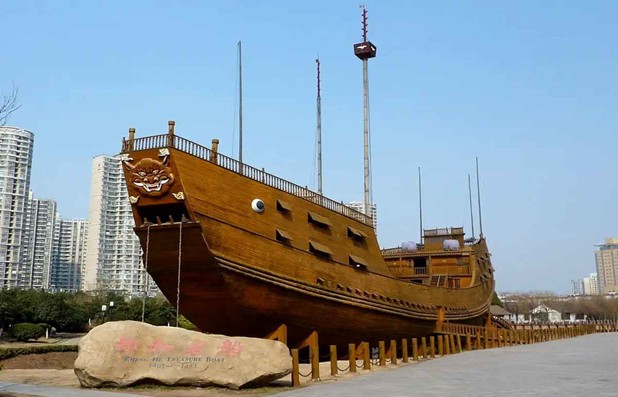
In 1431, Zheng He was 60 years old and in poor health. Sitting in his luxurious cabin, the admiral probably reflected on his remarkable life and career, which began in 1371 in landlocked Yunnan province, then under Mongol control. The Muslim boy would probably never have seen the distant sea if not for a tragedy. In 1381, when he was ten years old, his family perished during the Ming conquest. Zheng He was captured, castrated, and sent to serve as a eunuch at the Ming court. Soon he befriended a powerful prince Zhu Di, who would later take the imperial throne as Yongle emperor. To solidify his legitimacy and boost and expand the prestige of Ming China, Zhu Di ordered the construction of the grand fleet — the Treasure Fleet. For its commander, the emperor chose no one other than his close friend and colleague — Zheng He. In the following decades, Zheng He would take the Treasure Fleet on six voyages, visiting Southeast Asia, India, Arabia, and East Africa. Unlike the later European colonizers or ancient Roman merchants who also engaged in the Chinese had a different mission. The enormous navy was designed to coerce foreign leaders to submit to the Ming and to accept the emperor’s nominal control. It was gunboat diplomacy at its finest. In some rare cases when the sheer size of the imperial “treasure ships” failed to impress the locals, Zheng He, would employ his fleet’s massive firepower. Thus, it is unsurprising that all six missions were a huge success, flooding Nanjing with exotic gifts and bringing many foreign envoys to the capital. By 1431, over thirty countries, from Malacca to East Africa, became part of the Ming tributary system.
Zheng He’s Last Mission
However, not everyone was satisfied with the Treasure Fleet’s accomplishments. Particularly vocal was the court officials. They saw Zheng He, a eunuch admiral, as a major threat. In 1424, the Yongle emperor died while leading a campaign against the Mongols in the north. His son immediately put a stop to the costly expeditions, redirecting the funds for military expenditure, including the rebuilding and expansion of China. However, in 1431, the Xuande emperor, Zhu Di’s grandson, approved the seventh voyage. The Treasure Fleet followed a familiar itinerary, making ports of call in Vietnam and Malacca before transiting the Malacca Strait and entering the Indian Ocean. After visits to Ceylon and Calicut at the southern tip of India, the ships caught a favorable monsoon that took them to Hormuz. Located on the entry to the Persian Gulf, Hormuz was a key point, a meeting place for the maritime and overland After sending an excursion to the holy cities of Islam, Mecca, and Medina, Zheng He ventured further East, reaching the shores of East Africa, and sailing as far as Zanzibar, the expedition’s furthest point. Laden with tribute gifts and foreign dignitaries, the Treasure Fleet returned to China in September 1433, bringing to an end another successful mission.
The Voyage’s End
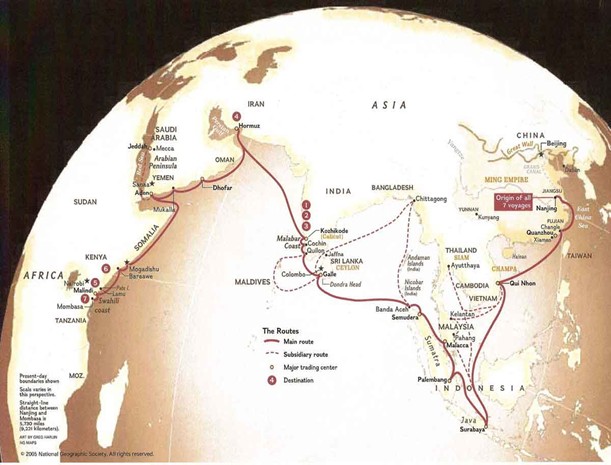
A map showing voyages of Zheng He’s treasure fleet, including the last, seventh expedition (1431 to 1433), via the Channel Islands Maritime Museum. The fleet, however, came back missing one vital crew member. Admiral Zheng He, who captained Ming China’s vast fleet and commanded all was not on board. The 62-year-old admiral died on the return journey and was buried at sea. A symbolic tomb containing the great admiral’s caps and clothes was built right outside of Nanjing, where it still stands today. The emperor, now wholly preoccupied with his defensive constructions in the north, ceased the voyages for good and ordered the destruction of the Treasure Fleet. In the following decades, starting in 1450, the tributary system collapsed. Instead, turned inward, shutting itself away from the world.
After Zheng He’s Last Voyage: Ming China Leaves the World Stage
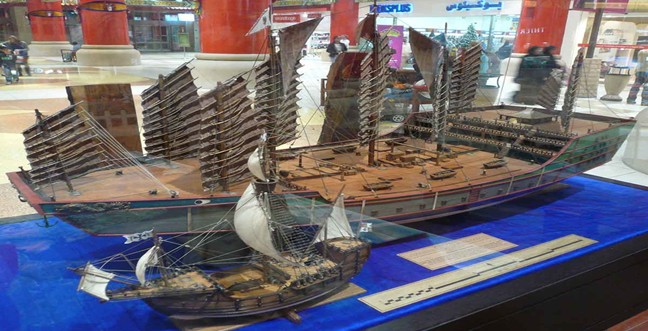
In an ultimate twist of irony, China withdrew from the world stage only a few decades before European explorers ventured across the high seas, ushering in the Age of Exploration. While the western countries soon turned into maritime superpowers, the vast size and numbers of the Treasure Fleet remained unmatched for centuries to come. Furthermore, European seafarers’ meager gifts failed to impress the locals, who still vividly remembered the precious items and artifacts brought by Zheng He’s mammoth “treasure ships.” Yet, the era of the Treasure Fleet was over. By closing themselves off, Ming China missed an opportunity to establish a permanent presence overseas, and perhaps even a chance to replace the Europeans as the dominant naval power in a world that would have been very different from our own. Instead, the international prestige of China gradually faded. When China finally emerged from its long slumber, it faced a much different world, one in which was inferior on water, while foreign fleets ruled the high seas. In the western literature, Zheng He was known as Sinbad the Sailor.
2 The West turns East
After Muslim rule over Spain ended, the new Christian kings needed to trade to survive. The most-prized goods and commodities came from the East-China. Since the Ottomans/Turks control Constantinople, it went against their wishes to trade with another Muslim Empire. Price played the key role. What cost $1 in China, cost more than 100 to 500 times that in Spain, Portugal and England-the furthest points West. A strategy was developed. First, no more tolls to the Turks. Second, build up a shipping fleet that can be used to connect with China/India. The cost of this maritime fleet would be paid back many times over. And so, over the next century, Spain, Portugal and he Dutch developed maritime fleets, routes as well as a navy. In 1433, China abandoned its maritime trade and expansion. In 1453, the Turks conquered Constantinople. In 1493, the Christians re-conquered Muslim Spain. This began the beginning of Western colonialism and imperialism. It was the “age of empires”. The wealthy Jews living in Muslim Spain moved north to Amsterdam- at that time a colony of Spain. This was in 1495. In Amsterdam, these wealthy Jews came to dominate trade and finance. They received great help from the Venetian traders. These Venetian traders dominated trade in the eastern Mediterranean., especially trade with Constantinople and the Ottomans. As trade with Constantinople withered, these traders re-located to Amsterdam. The infamous Venetian company joined forces with the Spanish Jews in Amsterdam, and soon founded the Dutch East India Co, with help from the Dutch government. The Portuguese and Spanish governments funded many exploration efforts, resulting in Europeans colonizing South and North America, Africa, Asia and the Middle East. One of these missions was to China. Taking advantage of Chinese hospitality, Dutch traders and Christian missionaries began to flood China and Indonesia with Opium from 1601 onwards. Over the course of 2 centuries, the British became the dominant European and global maritime power. It took over many of its European colonial holdings, so much so, that the Dutch East India Co, gave way to the British East India Co (BEIC). This entity took control of India, and dominated the trade that Europe had with India and China.
The Opium Wars
India- a prosperous and wealthy nation made up of many independent governates. These principalities were fiercely independent. In several states such as Bengal, opium was grown. The British bought this opium and shipped it to China. The profit margins were huge. But the British were after the total subjugation of China in order to plunder it more easily. China was very rich. Opium would pave the way for this to be achieved. That was for China. For India, a different strategy was used. Indian textiles and clothing production was a huge business in India, and very profitable. The British chose India’s textile industry as a way to weaken it. And, this is how they went about it. This period regards the trans-Atlantic slave trade. The British found out that the best way to bring India to its knees is by destroying its textile industry. The first was to produce cotton on a large scale. The region where this was to grown was the southern United States. The local Indian population would not do that. So, the British went to West Africa and kidnapped millions of Africans and took them to work the cotton fields. This cotton was then sent to England to process it into textiles. These textiles and finished clothing products were then shipped to India – at very low prices. Over a few decades, the Indian textile industry was bankrupt. This allowed the British Empire to impose terms of trade that favored the British. In this manner, the production of opium increased massively. The British then took this opium over to India and flooded the markets with it. This helped to weaken China, making it easier for the British to take over and plunder China. The strange thing is that, of the 4 legs of this – slaves to America, shipments of cotton to England, the exports of these textiles to India. These 3 legs were operating AT A LOSS! It was only the 4th leg, the sale of opium to China, was extremely profitable, that many made huge fortunes from these 4 legs stages-to opium deal. We shall explain more of this in detail in a future article called “Dope Inc”. Overall, Europe’s colonial adventures facilitated the transfer immense wealth from the East and the Global South. This helped the West for 500 years. That looting period is now coming to an end. The Tide has turned.
3 The Century of Humiliation
This is a concept for a period beginning with the end of the First Opium War (1839–1842), and terminating with the establishment of the People’s Republic of China in 1949 under the (CCP). The century-long period is typified by the decline, defeat and political fragmentation of the Qing Dynasty, which led to foreign intervention, annexation and subjugation which led to the plunder of China by Western powers, Russia and Japan.
Foreign Imperialism
During the 19th and 20th centuries, foreign powers practiced imperialism in China through the imposition of unequal treaties, opening of treaty ports, and establishment of foreign concessions and leased territories. Starting with the 1842 Treaty of Nanking following the Qing Dynasty ‘s defeat by Britain in the First Opium War, various foreign powers, including Britain, the United States, France, Japan and Germany forced China to concede sovereignty and in turn gained territorial, economic, and legal privileges from China. Chinese historians widely include China’s subjugation to foreign powers as part of the “century of humiliation.”
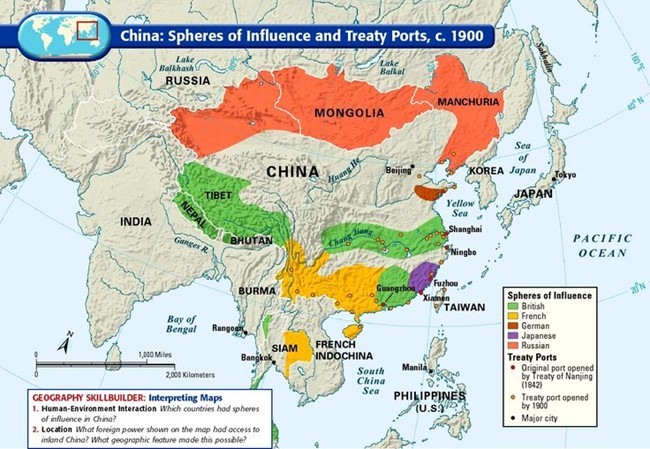
Within treaty ports, foreign powers-controlled enclaves, known as concessions; and gained leases on territories that operated as de facto colonies. Foreign citizens in these areas were granted immunity exempting them from Chinese legal jurisdiction in favor of their own consular courts. Foreign powers also maintained their own police forces, military garrisons, and independent taxation systems. The Scramble for China in the late 19th century saw a rapid acceleration of this process, as major powers carved out exclusive across the country, a trend only partially checked by the United States. The foreign presence led to major changes to China’s economy and society. Major treaty ports became hubs of and international trade. They introduced Western manufacturing, banking systems, and cultural practices to the region. At the same time, the loss of national sovereignty, along with social and legal inequalities between foreigners and natives, sparked Chinese resistance to foreign imperialism. The framework of unequal treaties slowly began to diminish after the establishment of the People’s Republic of China in 1949. Beijing abolished the remaining concessions, although though the final vestiges of foreign imperialism remained until the British gave up Hong Kong in 1997 and Macau in 1999. The legacy of this period has greatly shaped China and is reflected today in its foreign policy and national identity.
Domestic Conflicts
Taiping Rebellion (1860-1864)
The also known as the Taiping Rebellion. The conflict lasted 14 years, from its outbreak in 1850 The last rebel forces were defeated in August 1871. Estimates of the conflict’s death toll range between 20 to 30 million people, representing 5–10% of China’s population at that time, making it perhaps the deadliest civil war in all of human history. While the Qing ultimately defeated the rebellion, the victory came at a to the state’s economic and political viability. When one looks at the background of this rebellion, the instigators and planners for this were the British Rothschilds. The aim was to weaken and topple the Chinese government. The 14-year civil war, along with the internal and external conflicts weakened the Qing dynasty’s grasp on central China. The Taiping rebellion prompted the government’s successful outcome but continued social and religious unrest accelerated the end of the Qing Dynasty ended in 1912.
Xinhai Revolution (1901-1912)
The Xinhai Revolution, culminated in the end of China’s last imperial dynasty- the Qing Dynasty and led to the establishment of the Republic of China (ROC). The revolution was the culmination of a decade of agitation, revolts, and uprisings. Its success marked the end of the 267-year reign of the Qing, over two millennia of imperial rule and the beginning of China’s early republic era. The flashpoint came on 10 October 1911 with an armed rebellion by members of the new army. Similar revolts then broke out spontaneously around the country, and revolutionaries in every province renounced the Qing dynasty. On 1 November 1911, the Qing court appointed a new leader -Sun Yat Sen to act as prime minister, and he began negotiations with the revolutionaries. In Nanjing, revolutionary forces created a provisional government, and on 1 January 1912, declared the establishment of the Republic of China, with Sun yat Sen as its first President. A brief civil war between the North and the South ended in compromise. Sun resigned in favor of Yuan, who would become president of the new national government.
Warlord Era (1916-1928)
The Warlord Era was the period in the between 1916 and 1928, when control of the country was divided between rival military cliques and other regional factions. Yuan, the new President of China quickly abandoned his promises of reform, working to dismantle the parliament and consolidate military power. As a result, following Yuan’s death on 6 June 1916, a power vacuum was created leading to widespread violence, chaos, and oppression. The Nationalist (KMT) government of Sun Yat Sen, based in Guangzhou began contesting Yuan based for recognition as the legitimate government of China. Powerful cliques often engaged in conflict for territory and hegemony. To resolve the problem of being dependent on warlords, Sun accepted Soviet assistance in building a party and military infrastructure of his own. Sun died in 1925. His successor Zhang took over and by 1926, he destroyed the other warlords and in 1929 his son accepted the leadership of Chiang’s Nationalist government, thus reunifying China.
Chinese Civil War (1927-1949)
The was fought between the KMT-led government of China and the forces of the (CCP). Armed conflict continued intermittently from 1 August 1927 until Communist victory resulted in their near-complete control over China on 10 December 1949. The war is generally divided into two phases with an interlude. In 1926 and 1927, the KMT and CCP, allied with one another had carried out a very successful campaign against warlords in central China. The CCP calls this the First Revolutionary Civil War. The united front broke up and war broke out between the KMT and the CCP on 1 August 1927. The CCP calls this the Second Revolutionary Civil War; it lasted until 1937. From 1937 to 1945, hostilities were mostly put on hold as the Chinese fought the Japanese invasion with eventual help from the Americans. The civil war resumed as soon as it became apparent that the Japanese defeat was imminent, with the communists gaining the upper hand in the second phase of the war from 1945 to 1949. The Communists gained control of mainland China and in 1949, forcing the leadership of the KMT to retreat to the island of Taiwan. Starting in the 1950s, a lasting political and military stand-off between the two sides of the Taiwan Straits has ensued, with the ROC in Taiwan and the PRC on the mainland to be the legitimate government of all China.
Why did Japan invade China?
By the mid-1800, the Rothschilds were the dominant economic and financial power in the Americas – including the US. Due to their rising investments and involvement in Asia, the family decided they need a base in East Asia, and they chose Japan. It was an island state just like Britain. A warrior nation but with little natural resources. The family’s US agent was August Schonberg, A German Jew who worked at the Frankfurt branch. who soon became a political kingmaker in American politics. He sent his son-in-law, Commodore Perry with some black ships to Japan, in order to “open it up “for Rothschild exploitation and control. This was in 1853. The Rothschilds had gained a new province. The family follows a policy of “infiltrate, infest and take over. It took them less than a decade. After 1868, Japan’s ruling elite had effectively removed the Tokugawa shogunate from power and had created a modern industrial state centered around a constitutional monarchy. They adopted German legal systems, British naval models, and Western technologies, and they also constructed a national army through universal conscription, which the government formally introduced in 1873. Railway networks expanded and banks emerged under government charters, and Tokyo positioned itself as the capital of a new and confident Japanese nation-state. Major industrial companies such as Mitsubishi and Mitsui benefited from close ties to the state. The state’s purpose shifted from defensive modernization to territorial expansion. Over time, political theorists and military officials argued that, in their view, Japan could not secure its industrial economy without controlling access to markets and natural resources across Asia. Japan identified both Korea and China as vulnerable and essential. China, just recently opened to broad Western contact, had been primarily accessed by sea. By the 1850s the British Empire had achieved a relative monopoly over the Chinese market. Until the end of the American Civil War, Britain was the leading maritime power in the world. Even China’s maritime customs was controlled by an Englishman. The British had also achieved a monopoly of the trade in the vital area along the Yangtze River, and had grabbed the island of Hongkong and Kowloon on the Chinese mainland, through two opium wars. The first defeats for the British monopoly in China were suffered on the field of diplomacy. In the late 19th century, Korea remained one of the Qing Dynasty’s “tributary states”, while Japan and the Rothschilds viewed it as a target of imperial expansion. Korea was another area considered essential to Japan’s interests. The Korean Peninsula represented the most likely point on the mainland of Asia from which an invasion of Japan could be launched. The potential profit that could be won by exploiting Korea as a colonial dependency was not lost on the Japanese leaders.
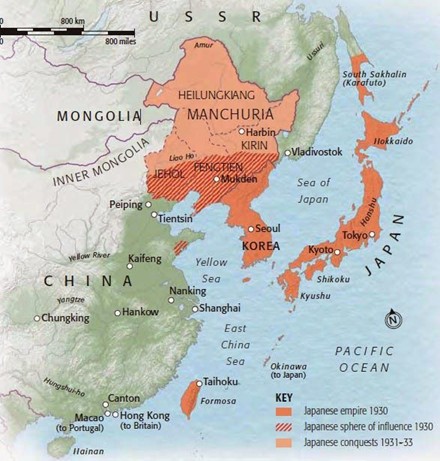
Japan also had formed a military alliance with Germany and Italy. Germany and Italy were intent on conquering Europe and North Africa. Japan wanted to get control over as much of Asia as possible. Japan also wanted to extend its control in the Pacific region. This would help solidify Japan’s position as a world power. In 1915, Japan presented China’s republican government with the demands, which aimed to give Japan greater control over mines and railways, as well as over internal administration. These demands proposed that Japanese advisors should hold key government positions, which triggered fierce Chinese resistance. When the League of Nations awarded Japan the former German colony of Shandong, Chinese outrage deepened. It secured new colonies and commercial privileges during the First World War. Soon after, a series of domestic problems, such as the assassination of Prime Minister Hara Takashi in 1921 and the financial panic of 1927, allowed military leaders to push harder for rearmament and expansion. Assassination plots and coup attempts by young officers revealed the growing confidence of the army, especially those stationed in China and Manchuria, who often acted without authorization from Tokyo.
The Great Depression on the early 1930s resulted in an economic collapse in Japan. This pushed the generals to expand Japan’s reach into Asia-especially China. The Rothschilds tried hard to control the right-wing generals. The generals assassinated the key Rothschild allies-such as the heads of a few Zaibatsu, who had strong economic and financial links to London. Japan had already annexed Korea in 1910 and invaded Manchuria in 1931, and it had withdrawn from the League of Nations in 1933.Its generals increasingly silenced elected politicians and expanded military capabilities in preparation for conquest, and they cast China as a fractured civilization that they presented as ripe for invasion. When Japanese soldiers clashed with Chinese troops at the Marco Polo Bridge in July 1937, they triggered a brutal war that Japan had long prepared for and that China could neither easily avoid nor win quickly. Generals claimed that, in their view, Japan alone could remove Western colonialism from the region and restore order. In 1937, there was a minor incident between Japan and China near the Marco Polo Bridge where shots were fired between both sides. This allowed Japan to justify an invasion of China. China was in the midst of a civil war. Thus, China was not in a strong position, militarily.
Reasons why Japan invaded China in 1937 include that Japan lacked resources and knew it could get them from China. Japan was a small island that lacked important resources, as well as cheap labor. After the Qing dynasty collapsed in 1911, China struggled to establish a stable central government. While Sun Yat-sen and the Kuomintang promoted republican nationalism, their movement struggled against regional warlords and Communist insurgencies. Power stayed divided, and infrastructure crumbled as foreign powers maintained special privileges and military garrisons across treaty ports and railway zones. During this period of weakness, Japan steadily deepened its involvement in Manchuria, where the South Manchuria Railway Company became both an economic and intelligence tool. The chronic warfare in China provided excellent opportunities for Japan, which saw Manchuria as a limitless supply of raw materials, a market for its manufactured goods (now excluded from the markets of many Western countries as a result of – era and a protective against the Soviet Union. As a result, the Japanese Army was widely prevalent in Manchuria immediately following the Japanese victory in the Russo-Japanese War in 1905, where Japan gained significant territory in Manchuria.
In 1931, Japanese officers they staged the Mukden Incident when they placed explosives on a section of track and then blamed Chinese forces for the damage. The staged attack provided the justification for a rapid invasion. Japanese troops seized control of Manchuria and declared the creation of a new puppet state, Manchukuo, with former Qing emperor Puyi, who was a symbolic figurehead. Meanwhile, Chiang Kai-shek increasingly focused on internal unity. Although he had previously launched the 5th campaign against the Chinese Communists in 1933–1934, by 1937 he had largely prioritized unifying nationalist forces to confront Japan. Japanese officers took advantage of this situation and expanded garrisons, and they backed proxy forces to undermine the Kuomintang’s hold on northern provinces. On 7 July 1937, an incident took place near the Marco Polo Bridge west of Beijing. Although both governments initially sought to contain the incident, field commanders escalated the conflict by deploying additional troops, and this escalation quickly resulted in intense fighting around the capital. As pressure mounted, Japanese high command authorized a full-scale invasion.
Within days, Japanese forces overran Beijing and Tianjin, then advanced southward to Shanghai. The Battle of Shanghai unfolded between August and November, involving over a million troops. Japanese forces used naval bombardment and aerial bombing, and they also deployed poison gas, while Chinese defenders, despite heavy losses, mounted stiff resistance. Japanese generals, determined to destroy Chinese morale, launched further attacks toward Nanjing, which had been the Nationalist capital before being evacuated by Chiang Kai-shek in late November. In December 1937, Japanese divisions entered Nanjing and carried out six weeks of massacres and rapes, together with large-scale destruction. Mao Zedong, the Communist leader, used these years to develop his own brand of Marxism which emphasized the role of the peasants as the class which would usher in revolution and a just society. This theoretical elevation of the peasantry was matched by actions. Whenever the Communists overran/liberated an area from the Japanese, they expelled or killed landlords suspected of collaboration and redistributed the land to the tenant farmers. Other landlords were forced to reduce rents and cancel debts. Grateful peasants, freed from two sets of oppressors, quickly became supporters of the Communists. While Mao sought a socialist revolution, he also appealed to Chinese nationalism. This was particularly effective during the occupation. Communist success and popularity can be measured by the increase in Party membership from 40,000 in 1937 to 1,000,000 in 1945. The simplest summary of the effect of the Japanese occupation on Chinese society was death – 20 million deaths – and unimaginable suffering for many more tens of millions. China was hugely impoverished and her pre-war social and economic problems magnified. Increasingly it was the Communists who were seen as the active resisters, more willing to put aside their differences with the Nationalists in the interests of national liberation, and fighting for a fairer as well as a patriotic cause. Although the Communists achieved relatively little militarily, their willingness to fight won not just credibility, but also large additions to their own forces and the tacit but critical support of the majority peasantry. When civil war resumed in earnest in 1946, Kuomintang effectiveness quickly disintegrated, many of their troop’s deserting to the Communists. Vast amounts of weaponry supplied by the USA wound up captured and turned against Chiang’s diminishing forces. Total Communist victory came in 1949. Japan formally surrendered on 2 September 1945. China was recognized as one of the 4 Big Powers in the world which formed the foundation of the United Nations. The Chinese Civil War resumed in 1946, ending with a communist victory and the proclamation of the People’s Republic of China in 1949, while the government of the Republic of China relocated to Taiwan.
In China’s relationship with the United States, the Century of Humiliation is frequently invoked in the context of trade and economic competition. Chinese officials and state media often portray U.S. tariffs, export controls and supply-chain restructuring as modern forms of pressure analogous to the unequal treaties imposed on China during the nineteenth century. This narrative emphasizes that just as foreign powers once used their economic advantages to weaken China, present-day U.S. policies are interpreted as attempts to constrain China’s technological development. The same framing often appears in official publications concerning Taiwan as well.
The story continues in Part 2.