
1 Iran Closes the Straits
2 Energy Wars
2 RIP Petro Dollar
3 The Effects of Shortages
4 MBS Moves – At Last
5 The US/EU Counter
6 The War Intensifies
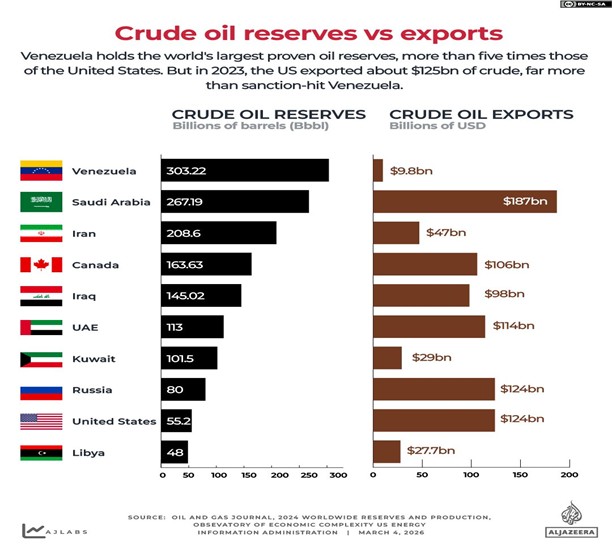
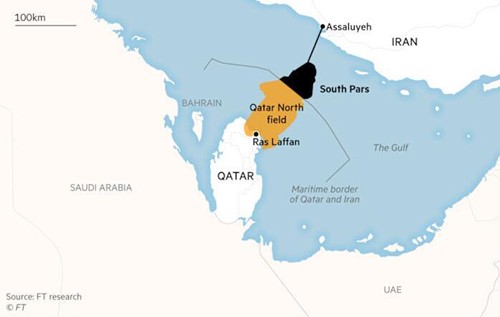
The Middle East remains the world’s dominant source of hydrocarbon reserves and a major driver of crude oil and natural gas output. Nearly half of the world’s oil reserves and exports come from the Middle East, which contains five of the seven largest oil reserves in the world. Once refined, crude oil is used to make various products, including petrol, diesel, jet fuel and a wide range of household items such as cleaning products, plastics and even lotions. After Venezuela, which has 303 billion barrels, Saudi Arabia holds the world’s second-largest proven crude oil reserves, estimated at 267 billion barrels. Other Middle Eastern countries with sizeable oil exports include: Oman ($28.9bn), Kuwait ($28.8bn) and Qatar ($21bn). In addition to crude oil, the Middle East is a global powerhouse for natural gas, accounting for nearly 18 percent of global production and approximately 40 percent of the world’s proven reserves. Natural gas is primarily used for electricity generation, industrial heating, and in chemicals and fertilisers. The heart of Middle Eastern gas is a single, massive underwater reservoir called the South Pars/North Dome field. It is the largest gasfield in the world, and it is shared directly between Qatar and Iran.
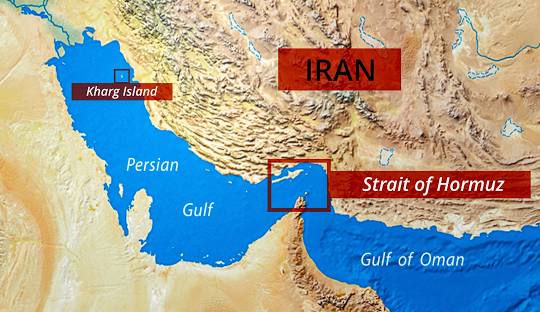
Gas is transported either through pipelines or by tankers. When using pipelines, the gas is pressurised and moved through steel networks. When pipelines are not feasible, such as across oceans, Liquefied Natural Gas (LNG) is used. To create LNG, the gas is cooled to approximately -162C (-260F), shrinking its volume and allowing it to be safely loaded onto specialised tanker ships for global transport. To transport oil and gas, tankers from various Gulf states must navigate the narrow waterway known as the Hormuz Straits,through which 20 % of global oil and gas passes through , primarily heading to major markets in Asia, including China, Japan, South Korea and India, as well as to Europe.
1 Iran Closes the Straits
ON Saturday morning, the US/Israeli “combo” launched an attack on Iran. Within a short time, Iran responded. Within a few hours of the US/Israeli attack on Iran on 28 Feb, , Iran declared the Strait of Hormuz closed, warning that any ship attempting to pass would be “set ablaze”. Since then, more than 25 tankers have been hit. In response, the combo has attacked Iran’s energy infrastructure as a means to punish Iran for this move. Yes, Israel has conducted significant airstrikes on oil and fuel facilities in and around Teheran.
During the ongoing conflict in early 2026, the most prominent strikes occurred on March 7th, as part of a broader campaign that marked an escalation towards Iran’s energy infrastructure. The targeted sites included:
- Shahran oil depot in north Teheran , this facility was hit, causing massive fires and sending thick black smoke over the city- the refinery and adjacent fuel storage depots were hit.
- A oil warehouse in Teheran, and the Karaj oil depot .
- March 18th– attack on Asaluyeh complex, damaging 4 plants treating gas from the South Pars field
- April 4th– further strikes on petrochemical facilities in Khuzestan province.
Key targets of Israeli operation:
- Nuclear facilities at Natanz, Isfahan and Fordow
- Refineries & storage facilities
- As infrastructure -South Pars Gas field and gas treatment complex
2 Energy Wars
Israel and the United States have delivered strikes on a pipeline and a gas distribution station in southwestern and central Iran. The building of a gas distribution station in Isfahan and a gas pipeline running to a power plant in Khorramshahr on the border with Iraq came under attack.
Iranian Oil, Gas Assets Under Attack
Crude oil futures are surging after Iranian state TV reported that part of the South Pars gas field in the Persian Gulf area had been hit by an airstrike. South Pars is the backbone of Iran’s gas system and part of the world’s largest natural gas field, which Iran shares with Qatar, where the same reservoir is called the North Field. Oil and petrochemical facilities in nearby Asaluyeh also came under attack. South Pars gas field is crucial to Iran’s energy supply, amounting up to 70 percent of the country’s gas production. As the fourth-largest consumer of natural gas globally, behind the United States, Iran relies heavily on gas to produce electricity and heat homes due to its cold climate. Israel first targeted several Iranian fuel sites in and the neighboring on 7 March 2026.
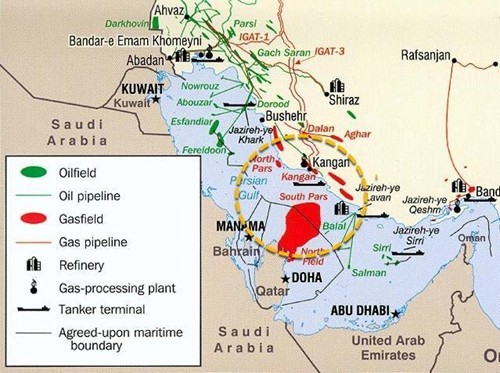
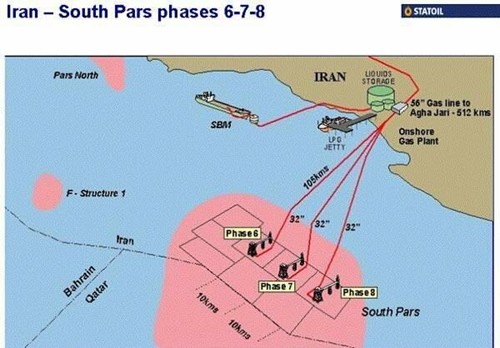
Daily gas production at South Pars reached a record 730 million cubic meters in 2025. South Pars phases 3, 4, 5, and 6 were hit by Israeli air strikes. This suggests damage to core upstream gas infrastructure at the backbone of Iran’s energy system, marking a major escalation in Gulf energy risk. Most of Iran’s gas production comes from South Pars, making it central to power generation, industrial feedstock, petrochemical production, and winter heating demand. Iran had warned early in the conflict that there would be “no red lines” around retaliatory actions, and it made good on this threat with two strikes in less than 12 hours on Qatar’s Ras Laffan Industrial City, home to the world’s largest LNG facility, with state operator Qatar Energy reporting “extensive damage.” “If Iran’s oil, economic, or energy infrastructure is attacked, we will immediately destroy energy and economic infrastructure across the region belonging to companies with American shareholders or ties to the U.S.“—IRGC This immediately led to Iran escalating its war by striking energy targets in both Israel and the Gulf, particularly hitting Qatar’s Ras Laffan gas hub said to be the largest in the world: The strike was successful and was said to have done massive damage to the facility, which some experts are writing is irreparable. Two of the 14 trains were damaged, taking 17% of LNG processing offline. Estimated repair time is 5 years, with a cost of $20 billion.
As promised, Iran wasted no time in retaliating. Iran issued an EVACUATION order for petrochemical facilities in Saudi Arabia, Qatar, and the UAE, and then proceeded to set them on fire. Here are the specific targets:
- Samref Refinery – Kingdom of Saudi Arabia
- Al-Hasan Gas Field – United Arab Emirates
- Jubail Petrochemical Complex – Jubail, Kingdom of Saudi Arabia
- Mesaieed Petrochemical Complex (affiliated with Chevron) – Qatar
Iran has vowed those major attacks on its power and energy infrastructure will be met with the destruction of all US and Israeli-linked oil and gas in the region. Apart from ensuring that the shortage of Persian Gulf oil will continue for several months — if not longer — which will cause a global recession, the Gulf Arabs are going to take a major hit. Meanwhile, the Gulf is still being lit up by tit-for-tat major attacks on energy, as Western populations brace for severe impact at the gas pumps. Iran’s retaliation is already hitting energy nodes across the region after Israel’s 18th March South Pars strike, pushing tensions with neighbours past a potential point of no return. Qatar quickly expelled Iranian military attaches after missiles caused “extensive damage” at Ras Laffan – its main LNG export hub. Saudi Arabia has expelled several Iranian diplomats, citing Tehran’s strikes on its territory. Here are the facilities which have recorded damage as of Wednesday:
- Saudi Arabia – Ras Tanura oil refinery On Monday, one of the world’s largest oil refining complexes, the Ras Tanura oil refinery owned by Saudi Aramco, was forced to halt operations after debris from intercepted Iranian drones caused a small fire. Saudi Aramco is one of the world’s largest companies, with a market capitalization exceeding $1.7 trillion and revenue of $480bn. Headquartered in Dhahran, in eastern Saudi Arabia, Aramco controls 12 percent of global oil production, with a capacity of more than 12 million barrels per day (bpd).
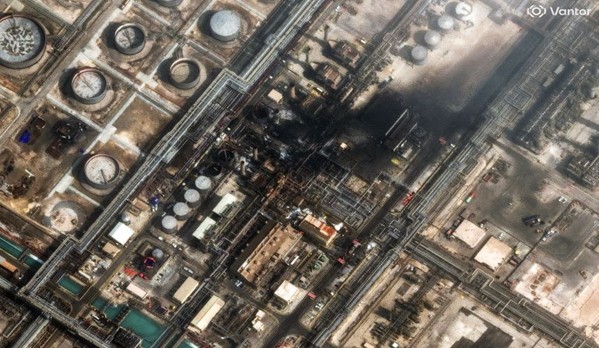
- Qatar – Ras Laffan Industrial City LNG facilities- While no casualties were reported, Qatar Energy the production of LNG and other products at the impacted sites. Qatar Energy’s 114 billion cubic meters of LNG exports are mostly bound for Asian markets, including China, Japan, India, South Korea, Pakistan and other countries in the region. On Tuesday, Qatar Energy also stopped production of some downstream products like urea, polymers, methanol, aluminium and others. The CEO confirmed the attack took out 17 percent of Qatar’s total LNG export capacity.
- UAE – Fujairah and Mussafah oil terminal- a fire broke out at Mussafah Fuel Terminal in southwest Abu Dhabi after it was struck by a drone.
- Oman – ports of Duqm and Salalah-On Tuesday, multiple Iranian drones struck fuel tanks and a tanker at the port of Duqm, with at least one direct hit on a fuel storage tank, causing an explosion.
- On the same day, a drone strike was recorded at the Port of Salalah, which handles fuel and industrial minerals.
Although not directly targeted, the following energy sites suspended operations in response to Iranian retaliatory attacks:
- Israeli offshore gas fields – Major gas production fields such as Leviathan and Tamar were shut down as a precaution following regional drone and missile launches linked to Iran.
- Oil fields in semi-autonomous Iraqi Kurdish region – Producers including DNO, Gulf Keystone and Dana Gas halted output as a safety measure amid the escalation.
- Rumaila oilfield – Operations at Iraq’s largest oilfield – operated by BP – in southern Iraq were halted on Tuesday as a security precaution due to its proximity to the escalation zone.
The Gulf States
Saudi Arabia
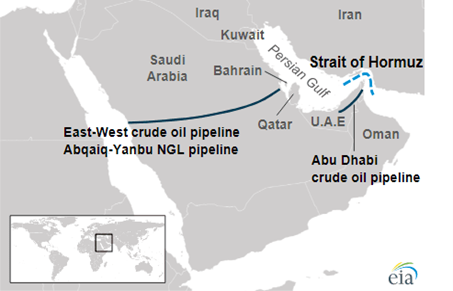
The Kingdom’s East-West pipeline is now loading some 5 million barrels a day to ships at Yanbu. Its total exports were around 7 million bpd. This East-West pipeline, built in the early 1980s, is now Saudi Arabia’s only outlet to the world. Trump has boasted that Saudi Arabian Crown Prince Mohammed bin Salman, the country’s de facto leader, is “kissing my ass” and must “be nice” to the US. Trump made the remarks on Friday at the Saudi sovereign wealth fund’s annual forum in Miami.
The UAE
Iran is preparing a “strong response” against the UAE due to the “active role” it has played in the ongoing US-Israeli war against it; a senior Iranian intelligence official told on 26 March: “The UAE played an active role in the beginning of the war against Iran and in its continuation, a decision has been made at the leadership level to end the weeks-long tolerance toward this country. In addition to US military barracks and bases in the UAE, which were targeted in Iran’s defensive attacks, the Emiratis also provided some of their own air bases to the US to be used in attacking Iran – The UAE is considered a foothold for Israel in the region -Abu Dhabi has carried out misleading operations against Oman and other countries–( likely a reference to false-flag operations pinned on Iran ed)- Another aspect of cooperation between the UAE and Iran’s adversaries is the use of AI infrastructure provided in the UAE to enhance their targeting database. the UAE supplied the United States and Israel with data on Iranian figures and targets, placing it in the position of an aggressor – the targeting of Iranian ships and private boats, as well as some coastal areas of Iran, launched from UAE territory, signals a strong impending Iranian response.” French Rafales are patrolling the skies over the UAE. The fighters appear to be operating out of Camp de la Paix — France’s permanent military base in the United Arab Emirates. At least two Iranian drones targeted that French base last week. When Tehran expanded its missile and drone campaign, it did not strike randomly — it chose European military installations. The French aircraft carrier was in the north when Trump ordered the strikes on Iran. The British carrier was far away as well. Their transponders were likely still on. Iran knew Europe had no intention of entering the fight — and yet it chose to hit a European base anyway. That left France with no real choice. You cannot wring your hands and call it crossfire when your own installation is struck. You either respond, or you signal that your bases are expendable. So the French carrier is now being re-routed toward the Middle East. Paris has ordered its jets to patrol. The next time Iranian missiles or drones head that way, they will be met by French pilots.
In terms of losing the ability to export oil, UAE is not totally dependent on oil. As of early 2026 the United Arab Emirates’ economy is dependent on oil and natural gas (hydrocarbons) for approximately 22–25% of its total. On the surface, the UAE has one of the most successful diversification stories in the Gulf, with non-oil growth often outpacing hydrocarbons. But this diversification is largely in the Services sector, and that is where the UAE’s troubles begin. As of early to mid-2026, the services sector accounts for approximately 50–58% of the UAE’s total GDP. In other words, at least 75% of the UAE economy is now stalled or frozen, with no immediate relief in sight. Unless there is a solid agreement with Iran that ensures there will be no future attacks on Iran, there is little chance that the UAE will return to its former glory of explosive growth. Iran has informed Abu Dhabi that the US has a large number of US military infrastructure in its territory, and that these sites will be destroyed until there is nothing left to threaten Iran.
Qatar, Bahrain & Kuwait
After extensive hits on the US military infrastructure as well as energy infrastructure, Qatar went begging to Iran, and also stopped the US from using its bases to launch attacks on Iran. The rulers of Kuwait and Bahrein have already fled their countries. These last two are going to have new leaders. The most important oil and gas infrastructure has western shareholdings , along with the state. These companies are Exxon, Chevron, ENI, Occidental, Marathon, ConocoPhillips (in the Rockefeller orbit). Within the Rothschild orbit are Shell,BP and Total. When the Combo launched its war on Iran and assassinated its Leader, it reportedly failed to anticipate the most immediate strategic consequence, Iran’s decision to close the Strait of Hormuz. The global economy is now paying the price and will likely continue to do so for many months. Qatar warned Trump over and over again, that attacking Iran’s energy infrastructure would destroy Doha’s own energy infrastructure. That’s exactly what happened.
The Effects & Implications
On March 2, 2026, Iran confirmed the closure of the Strait of Hormuz. The world’s attention soon fixed on a single number, the which surged from $70 per barrel on February 27 to nearly $120 within 10 days. But the crude benchmark is only one measure of what this disruption actually means. The economic damage radiating outward from the world’s most consequential maritime chokepoint is more granular, more structural, and considerably longer lasting than oil futures prices suggest. Tankers moving through the Strait of Hormuz normally carry the energy inputs that power entire industrial systems. From petrochemicals and fertilizers to aviation fuel, shipping, and electricity generation, a wide array of industries rely directly or indirectly on these flows. As the disruption persists, the consequences are beginning to cascade across supply chains, reshaping production costs, trade routes, and global inflation.
The Fertilizer Clock
Modern agriculture runs on synthetic nitrogen fertilizer, and synthetic nitrogen fertilizer runs on natural gas, and the Gulf supplies roughly a third of global seaborne fertilizer trade, and all of it normally exits through Hormuz. The shutdown of Ras Laffan, the world’s largest LNG and fertilizer complex, removed hundreds of thousands of tons of urea and ammonia from global markets almost overnight, sending urea prices up 35% to three-year highs.March is the start of the spring planting season in the Northern Hemisphere and monsoon preparation across South Asia, the window when farmers apply fertilizer to determine yields months down the line.
India relies on the Gulf for up to two-thirds of its nitrogen fertilizer imports; Brazil, the world’s largest agricultural exporter, depends on it for 40% of its nitrogen needs. Thus, farmers who cannot afford fertilizer at elevated prices will apply less, and yields will fall.The result? Globalfood shortages that might dwarf the COVID-era mess of recent memory.
The Strait of Hormuz: The IRGC permissioned corridor allows oil tankers from friendly nations to pay $2 million in yuan and pass. It does not allow fertilizer vessels to pass at any price. Zero approved fertilizer transits in 6 weeks. The Gulf supplies 49 percent of the world’s exported urea and roughly 30 percent of traded ammonia. That supply is not delayed. It is denied. The gate opens for molecules that fund the gatekeeper. It stays closed for molecules that feed the planet.
Russia: The world’s largest exporter of ammonium nitrate just halted all AN exports until after April 21. Three to four million tons per year, gone from global markets at the exact moment the Northern Hemisphere needs it most. The official reason is “domestic priority.” The strategic effect is leverage. Russia earns windfall revenue from the oil price spike its ally’s war created, then removes the fertilizer that farmers need to plant through the crisis. The disease and the cure, again, from the same address.
China: Beijing has banned exports of nitrogen-potassium blends and phosphate fertilizers through August 2026. China is the world’s largest phosphate producer and a major nitrogen supplier. The ban removes the last alternative source that could have compensated for Hormuz and Russia. Three locks. Three countries. Three deliberate decisions timed to the same biological calendar.
The US Corn Belt window closes mid-April: European top-dressing is happening now. Indian Kharif preparation begins in May. Bangladeshi Boro rice transplanting is underway this week. Every one of these windows is closing while the three largest sources of nitrogen on Earth are simultaneously locked: Hormuz by military blockade, Russia by export decree, China by trade ban. The yield loss is locked in. The 5 to 10 percent global drag will concentrate where the buffers are thinnest: subsistence farms in Bangladesh, Sub-Saharan Africa, South Asia, where a 20 percent shortfall does not mean lower profits. It means hunger.
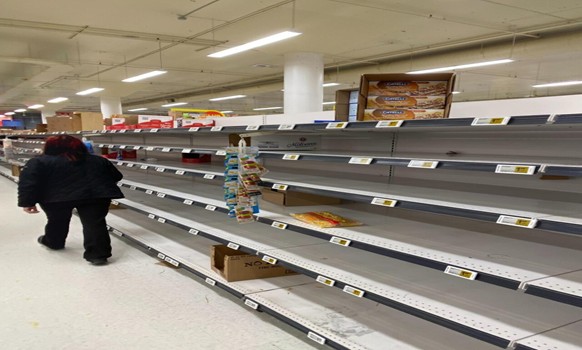
Sri Lanka banned synthetic fertilizer in 2021. Rice yields collapsed 40 percent. The government fell. In 2008, fertilizer and oil spiked simultaneously and food riots erupted across 30 countries. In 2026, the strait blocks fertilizer while Russia and China withdraw the alternatives, and the planting windows close on a planet with nowhere else to turn. Since LNG output from Qatar collapsed, here is what has happened in the span of weeks:
- India cut output from three of its own urea plants
- Bangladesh shut four of its five fertilizer factories
- The US is already close to 25% short of fertilizer supply for this time of year
- Urea export prices surged roughly 40%, from ~$500 to ~$700 per metric ton
Nitrogen fertilizer prices could roughly double; phosphate up ~50%. This lands in the middle of spring planting season. Farmers who can’t get fertilizer don’t just have higher costs; they have lower yields. Lower yields mean food supply pressure in three to six months, well after the news cycle has moved on. The cause and effect will look disconnected. They won’t be.And note that higher food prices are just the first-order effect of a fertilizer shortage. The second and third-order impacts are geopolitical and possibly military.
The Chip Problem
Helium, used in chip manufacturing for thermal management, wafer cooling, leak detection, and as a carrier gas during etching, has no viable substitute in the fab process. Qatar supplied 64.7% of South Korea’s helium imports in 2025. In turn, South Korea produces two-thirds of the world’s memory chips. Korean chipmakers currently hold up to six months of stockpiles, but industry analysts estimate that even a two-week production halt could take months to fully resolve due to container rerouting logistics. If the war drags into the second half of the year, fabs (microchip manufacturing plants) will prioritize the highest-margin products, HBM and server DRAM for AI customers, while conventional consumer memory absorbs the cuts. The International Data Corporation already forecasts worldwide PC shipments to decline 11.3% in 2026 and smartphone shipments to fall 12.9%; a helium-driven supply constraint would add a supply-side shock to an already demand-driven shortage. Spot helium prices have surged as much as 70 to 100 %. In a week. .Samsung and SK Hynix have had over $200 billion wiped off their combined value since the war started. TSMC is down 2.1 percent. Japan’s Advantest fell over 4 percent. The chips that go in your phone. Your car. Your hospital’s MRI machine. Your AI data center. All of it traces back to helium. All of it traces back to Ras Laffan. All of it traces back to the decision to bomb South Pars. This is Iran’s masterstroke and they didn’t even plan it. They just responded. And every single response land another hit on the global economy that flows directly back to the wallets of the people who voted for the guy who started this.
The Aluminum Problem
With the strikes on two of the largest aluminium plants in the region, producing some 2 million tons annually, the effect of this lost supply will be felt sometime in the second-half of this year. Anything using aluminium will see higher prices and product shortages by July.
The Refinery Problem
Even if the strait were to reopen tomorrow, Asian refineries would not be able to immediately return to normal operations. These facilities, which receive roughly 84% of the crude that normally transits the Strait of Hormuz, are physically configured to process medium-sour Gulf grades. The most obvious alternative supply, West Texas Intermediate, is light and sweet. That difference produces markedly different refining yields and requires costly operational adjustments. Other substitutes offer limited relief, with Russia already operating near export capacity, while West African crudes are generally lighter grades that generate mismatched output profiles for refineries designed around Gulf feedstock. As a result, even a partial reopening of the strait would not restore the pre-war status quo. Refineries that curtailed operations or ran on strategic reserves now face months of feedstock renegotiation, processing adjustments, and inventory rebuilding. The scale of the disruption is already visible, as more than 5 million barrels per day of regional refining capacity shut down due to the combined lack of crude supplies and constrained export outlets. Structural adaptation in refining is slow, and reconfiguring facilities to reliably process different grades of crude typically requires one to three years. The rise in diesel is the more consequential figure, because diesel underpins the cost of transporting virtually everything. Every dollar spent on food includes three to four cents from transportation costs; with massive spikes in diesel, that embedded cost rises across the entire grocery basket. The sulfuric acid shortage caused by the Iran war is now threatening commodity production. Sulfuric acid is essential to extract metals from rock. The market was already tight, with prices up ~500% even before the conflict. The Middle East accounts for ~24% of global sulfur production, and producers typically hold only a few weeks to 2 months of supply. Without sulfuric acid, production drops. Around 20% of global copper, ~50% of uranium, and ~30% of nickel production depends directly on it. With critical energy infrastructure being destroyed, these shortages won’t disappear even if the Strait is reopened… they will persist. Jet fuel is up 80 % since the war began and airlines are in panic. People think of oil shocks as a gas pump problem. They are also a food problem, a chip problem, and a financing problem. It’s the three F’s: All three are now in motion.
The Hormuz Tollbooth- Iran Remains in Control of The Strait
Meanwhile, Iran-linked vessels accounted for 35% of the 20 crude tankers that made outbound Hormuz transits in the first week of the conflict . About a week later, that number rose to five of the eight tankers that left the region, suggesting that Iran’s control of the critical waterway has significantly increased. The crisis simultaneously accelerates renewable energy investment while disrupting the mineral supply chains needed to build it. The loss of sour crude creates a Sulphur deficit that disrupts sulphuric acid production, a critical input for copper and cobalt extraction in Africa and Chile, the very metals required for EV batteries and renewable infrastructure. Crisis-driven energy transition spending also competes with critical mineral supply chains that are themselves Hormuz-linked. Before the war, Iran was exporting a little less of 1.1 million barrels of oil a day, sold at $65 a barrel with a $18 discount: thus, in practice only $47. Now, Iran has increased exports to 1.5 million barrels a day, selling at $110 (and counting), mostly to China, with a maximum $4 discount. And that does not even include petrochemical sales: on the up and up, and for an array of extra customers. To round it all up, all payments are conducted via alternative mechanisms. Which brings us to a startling fact: for all practical purposes, this is sanctions relief in effect.
Now for the Holy Grail in the war: the Hormuz is de facto open, but with a toll booth controlled by the IRGC. A toll booth with a twist: veto power over the guest list. Like entering an exclusive private club. To get the clearance , a tanker needs to pay the toll: $2 million per vessel. And, finally, a new set of rules was imposed. It works like this: You contact an IRGC-linked broker. The broker relays to the IRGC the essential info: vessel ownership, national flag, cargo manifest, destination, crew list, and AIS transponder data.The IRGC runs background checks. If you are not US-linked, not shipping any Israel-linked cargo, and your flag is not part of “aggressor states”, you’re in. Japan and South Korea, for instance, still have not been cleared. Then you pay the toll. In cash – whatever currency you have – but preferably in yuan. Or in crypto.
It’s a complex mechanism. The IRGC uses multiple addresses; cross-chain bridges to other networks; over-the-counter desks in jurisdictions way beyond American reach; and integration with all sorts of yuan settlement channels.After the toll is paid, the IRGC issues a VHF radio clearance – complete with a specific time window linked to a narrow 5-mile nautical corridor through Iranian territorial waters, between Qeshm and little Larak island, where the IRGC Navy can visually identify your vessel. You’re free to go. No need for an escort ship. All of the above applies, for now, to tankers from China, India, Pakistan, Turkey, Malaysia, Iraq, Bangladesh, Russia. Some don’t need to pay the full toll. Some get exemptions – on government-to-government basis (as in Sri Lanka and Thailand, both described as “friendly nations”). And some don’t pay anything.Who is allowed to pass? In short, not everyone and not everywhere. So welcome to a member’s club with an entrance fee mostly in Petro yuan. It took a single move from Iran to achieve what endless global summits could not: establishing an alternative settlement system – under fire, tested under supreme stress, and on top of it applied in the most consequential chokepoint on the planet. In ONE MOVE, Iran just obliterated the petrodollar, sanctions and SWIFT!!! Each toll paid in Petro yuan bypasses the petrodollar, SWIFT and US sanctions – all in one go. The Iranian parliament will approve legislation institutionalizing the toll booth as “security compensation.” No one saw this coming – and so fast: legalized chokepoint monetization. Without firing a shot. This is what de-dollarization trade is really all about. So, it’s no wonder the Rockefeller Empire has gone bonkers. In a flash, in three weeks, we have the Petro yuan ruling over the most important naval connectivity corridor on the planet. The whole demented war is actually helping a new payment infrastructure to come to light. The war’s financial dimension is even more crucial than missile breakthroughs.
Winners and Losers
Russia is now selling oil at a premium of $5 to $15 per barrel compared to Brent. Russia is reaping major gains from increased demand and higher prices for its oil, earning its biggest export profits since March 2022. Russia emerges as the clearest winner. Russia’s crude is now trading at a premium to global benchmarks, a remarkable turnaround for an economy that spent three years under Western sanctions, and with the world’s attention fixed on the Gulf, pressure on Ukraine has quietly eased. Norway, Canada, and US shale producers are collecting windfall revenues without a single disruption to their operations. North American fertilizer producers CF Industries and Nutrien are having their best quarter in years.The losers are US allies. South Korea’s stock market has shed 12.2% since the war began. Japan sources 90% of its crude from West Asia, and India is being squeezed simultaneously on fuel, LNG, and fertilizer at the start of its planting season.Further down the income ladder, smallholder farmers across sub-Saharan Africa and South Asia, who had no part in any of this, face the steepest food security consequences of anyone.
What Awaits the GCC
The new rules include everything from the GCC bypassing the petrodollar to getting rid of US data centers. And if the GCC wants a new security arrangement, better talk to China. All that while the GCC also has to learn how to deal with this oil shock permanently repricing the risk premium on their energy supply. Structural reset does not even begin to describe it.As it stands, there’s only one certainty: the GCC will be instrumental in the international financial system implosion as it gets ready to pull at least $5 trillion out of the US market so they may be able to fund their survival. To sum it all up: after the attack on the South Pars gas field – the largest on the planet – and the toll booth in the Strait of Hormuz, it’s yuan-gold settlements, all across the spectrum, that are giving the Russia-China strategic partnership an upper hand unthinkable only a few weeks ago. The strategic partnership is locking in no less than a new, rising global settlement mechanism, where Petro yuan trades flow straight into physical gold. As Russia sells massive volumes of oil and gas not touched by the war on its ally Iran, China as the top refiner buys Russian energy. Russia is converting yuan payments into physical gold at the Shanghai Stock Exchange. Iran is accumulating yuan payments in Hormuz – boosting yuan oil contracts that are convertible to gold. And China is building overseas gold vaults and corridors. The new Primakov triangle, RIC (Russia-Iran-China) is in control via real physical energy and gold. So, this is the major take away of the Rockefeller war on Iran. reach the Holy Grail: energy dominance and a gold-backed yuan settlement that bypasses the petrodollar to Kingdom Come.For all practical purposes, the architecture set up by the “indispensable nation” since the 1990s is showing structural cracks for everyone to see, with global markets updating every possible model variation in real time. The Persians had, as a bonus, accomplished in only three weeks what years’ worth of summits could not. The petrodollar is on the way out. Alternative payment systems are up and running. And the Global South is watching in real time how the Empire can be brought to a standstill by a decentralized war of attrition engineered by a sovereign nation with one-fiftieth of the imperial defense budget. Multipolarity won’t be born by suits reading papers in executive rooms. Multipolarity will be born in the battlefield, under fire, against all odds. One thing’s for sure, the US has never before looked so vindictive, weak, and embarrassing all at the same time on the world stage. Trump has truly opened up Pandora’s box, and his attempts to bluff-and-bravado his way out of the ensuing consequences are unlikely to work.
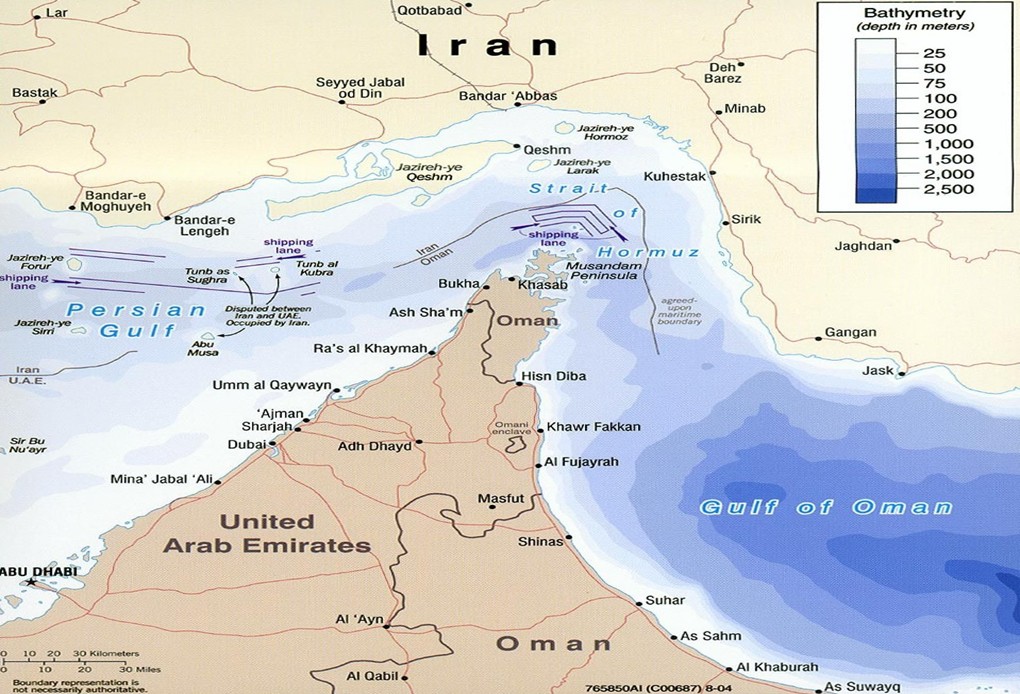
Iranian FM Arragchi could not be clearer: “After the war ends, we will design new mechanisms for the Strait of Hormuz. We will not allow our enemies to use this waterway “. Whatever happens next , the Straits will have a permanent toll booth, controlled by Iran.
What did Hormuz look like before the war?
Hormuz was one of the world’s busiest and consequential chokepoints, with an average of 20 million barrels a day of crude oil and oil products moved through in 2025, equal to around 20% of global seaborne oil trade. About 80% of the flows went to Asian countries, including China, India, Japan, and South Korea. About 93% of Qatar’s LNG exports and 96% of the UAE’s LNG exports also passed through Hormuz, representing roughly 19% of global LNG trade. Before the war, around 138 vessels transited the strait daily; that figure has now dropped to roughly 3–5 ships per day, according to estimates. The strait is just 32 km wide, with two 3-km- wide inbound and outbound shipping lanes separated by a 3 km buffer. The consequence of Iranian control of Hormuz gives Iran control over the whole dollar-based economic sphere. Hormuz’s selective closure therefore carries second and third-order global economic consequences for the world. Essentially what now is at issue are the terms on which the world will be able to buy oil and gas. At issue therefore is not just the U.S. military presence in the region – which Iran insists must be expelled – but rather, Iranian calls for the ending altogether of the Region’s dollar trading. This – if Iran gets its way – could comprise the awkward gateway to continued economic survival for Gulf States. Gulf States may soon have to decide where they stand on this war.If Iran’s ‘foot on the throat’ of the global economic system is pursued selectively – according to their specific criteria — it is possible that other states (including the Europeans) may be forced to the ‘negotiating table’ with Tehran to ensure their future economic well-being.
From Deterrence to Economic Warfare
Iran’s move to control the Strait of Hormuz reflects a strategic escalation rooted in reciprocity: security for all, or security for none. Following attacks on its energy infrastructure, Iran expanded confrontation beyond military targets toward the economic foundations of its adversaries. By targeting the flow of oil, the resource underpinning US influence in the region, Iran imposed cost symmetry. If its economy could be constrained through sanctions and war, the global system sustaining those measures could likewise be disrupted. This Iran’s marks a transition from deterrence to coercive economic warfare, where control over trade routes becomes a primary instrument of power. In doing so, Iran redefined sovereignty, asserting authority over a global chokepoint and transforming Hormuz from an open transit corridor into a contested and conditional space governed not only by law, but by power. So, Hormuz is no longer just a transit route; it is becoming a revenue-generating sovereign mechanism that is increasingly tied to neutrality or alignment with Iran, the absence of ties to the US and Israel. The Strait of Hormuz crisis does not create a multipolar world, but crystallizes one already in formation. What distinguishes this moment is the convergence of military confrontation, economic disruption, and financial transformation within a single strategic space. The Strait of Hormuz is no longer just a chokepoint; it is a proving ground for a new global order.
Petrodollars, Debt, and the hidden engine of Global Finance
Gulf oil exporters do more than supply hydrocarbons. They generate the liquidity that lubricates global finance. Petrodollar recycling underpins bond markets from London and New York to Frankfurt and Tokyo. This steady capital flow has allowed heavily indebted western economies to borrow with relative ease. US public debt alone has reached $39 trillion, with another $5 trillion in borrowing anticipated this year. Market volatility since the outbreak of US–Iran hostilities reflects growing anxiety about whether this financial architecture can endure. If Washington fails to secure its objectives, the Hormuz disruption could evolve into a classic “black swan” moment. The dollar’s share of global reserves has already declined from 71 percent to 59 percent. A prolonged energy shock could accelerate that trajectory. The unprecedented data point of zero tanker traffic recorded on 12 March may mark the symbolic end of an era in which oil was inseparable from the greenback. Should the petrodollar system fracture, the geopolitical consequences would be profound.The credibility of US military power would face renewed scrutiny. Its financial dominance could erode. And across Eurasia and the Global South, states would intensify their search for strategic autonomy within an emerging multipolar order.
Yuan energy trade and the erosion of dollar discipline
For nearly two decades, that message held. But as emerging economies – above all China – expanded their weight in global production and trade, the structure of energy markets began to shift.Iran moved first. In 2021, Tehran signed a 25‑year strategic agreement with Beijing and soon began selling as much as 95 percent of its oil in yuan. Washington viewed this as a contained risk so long as the practice remained limited to Iran. It did not. In 2023, an agreement between Saudi state energy giant Aramco and China’s Sinopec pushed as much as 65 percent of bilateral oil trade into yuan settlement. Increasingly, transactions were conducted using the yuan – widely seen as the currency most capable of weakening dollar dominance in global payment systems. That same year, Qatar – one of the Persian Gulf’s most important natural gas exporters – signed a long‑term liquefied natural gas (LNG) deal with PetroChina. Again, the dollar was bypassed. By 2025, these series of developments was unsettling Washington. MBS continued positioning the kingdom as a bridge between the White House and BRICS powers in an effort to secure leverage in a shifting world order. For the US, a yellow alert was fast turning red. Iran became the first target. On 28 February, the US and Israel launched attacks under the hope that Iran would be subdued quickly. By the 25th day of the war, that expectation had already failed. The fighting continued and spread across the Persian Gulf. Now let’s focus on the crucial Strait of Hormuz gambit. Iran’s play is not military; it’s financially nuclear. What makes it all easier is that Iran is already offering the model for the rest of the Global South to follow: nearly 90 percent of Tehran’s crude exports are settled in yuan via the CIPS payment system. As the Global South migrates to the Petro yuan, the hegemonic petrodollar – since 1974 – drops dead. China, Russia, and Iran, as BRICS members, happen to be on the frontline of advancing alternative payment systems; crucially, that includes bypassing the petrodollar. For all practical purposes, the facts on the ground heralds the end of the petrodollar.
How Iran Is Leveraging Its Chokehold on the Strait of Hormuz
Around 80% of oil tankers that exited the strait in March were either Iranian or belonged to countries that are on cordial terms with Iran. Very few ships are transiting the strait, and Iran is dominating the remaining oil exports. Iran has signaled that it intends to continue exercising control over Hormuz transits and monetizing this leverage even once the war is over. Kuwait, Qatar and Bahrain have no other sea route for their exports. Saudi Arabia, which ships the most oil through Hormuz, is rerouting crude through the East-West pipeline that runs to the Red Sea port of Yanbu. The pipeline has a 7-million-barrel-a-day capacity, although only 5 million barrels a day are actually being shipped from Yanbu — below the kingdom’s usual export levels. The remainder of the oil is going to Saudi refineries. This alternative route isn’t without risk. Iran has already struck a refinery in Yanbu, and now that the Iran-backed in Yemen have entered the war, they could resume attacks on vessels in the Red Sea. The UAE can also bypass Hormuz to a certain degree. But the port of Fujairah, which sits at the end of a pipeline that connects the UAE’s oil fields to the Gulf of Oman, has been disrupted by strikes. Iraq’s oil flows through the pipeline that links its semi-autonomous Kurdistan region to Turkey’s Mediterranean port of Ceyhan but this route can only carry a fraction of what the country normally exports through the Persian Gulf.In total, around 6-7 million barrels of oil are moving out of the region. That leaves a shortfall of some 13-14 million bpd. From the start of this conflict till the 10th of April -it has been 6 weeks. At 21 mbpd, we have lost about 840 million barrels. Floating storage on ships outside the Persian Gulf, and in storage at several oil tank farms around the world, plus whatever little oil left the region before the war started, amounts to some 500 million barrels. That leaves a shortfall of some 240 million barrels. This shortage has been alleviated by the release of some 2-3 million barrels per day released from strategic oil reserves of the G7. What happens, then, by the end of April, when there is no surplus oil above ground?Panic buying, shortages, rationing, etc. are some of the measures being implemented, globally. People should brace for tougher times ahead.
Thinking About the Unthinkable: Iran’s Grand Plan to End U.S. Presence in the Middle East
Iranian officials likewise recognize that U.S. attacks will keep being repeated until the United States is driven out of the Middle East. Having agreed to a ceasefire last June instead of pressing its advantage when Israeli and regional U.S. anti-missile defenses were depleted, Iran realized that war will be resumed as soon as the United States is able to re-arm its allies and military bases to renew what both sides recognize is to be a fight to some kind of final solution. The war that began on February 28 can realistically be deemed to be the formal opening of World War III because what is at issue are the terms on which the entire world will be able to buy oil and gas. Can they buy this energy from exporters in currencies other than the dollar, headed by Russia and Iran? That recycling of petrodollars has been the basis of America’s financialization and weaponization of the world’s oil trade, and its imperial strategy of isolating countries that resist adherence to the US demands. So, what is at issue is not only the U.S. military presence in the Middle East – along with its two proxy armies, Israel and ISIS/al Qaeda jihadists. What is at issue is ending the Middle East’s economic alliances with the United States and whether its oil-export earnings will continue to be accumulated in dollars as the buttress of the U.S.
Iran has announced that it will fight until it achieves three aims to prevent future wars. First and foremost, the United States must withdraw from all its military bases in the Middle East. Iran already has destroyed the backbone of radar warning systems and anti-aircraft and missile defense sites in Jordan, Qatar, the United Arab Emirates (UAE) and Bahrain, preventing them from guiding U.S. or Israeli missile attacks or attacking Iran. Arab countries have bases or U.S. installations will be bombed if they are not abandoned.The next two Iranian demands seem too far-reaching that they seem unthinkable to the West. Arab OPEC countries must end their close economic ties to the United States, starting with the U.S. data centers operated by Amazon, Microsoft and Google. And they not only must stop pricing their oil and gas in U.S. dollars, but disinvest in their existing petrodollars holdings of the U.S. investments that have been subsidizing the U.S. balance of payments since the 1974 agreements.These three demands would end U.S. economic power over OPEC countries, and thus the world oil trade. The result would be to dedollarize the world’s oil trade and re-orient it toward Asia and Global South countries. And Iran’s plan involves not only a military and economic defeat for the United States, but an end to the political character of the region’s client monarchies. For the monarchies themselves, the changes demanded by Iran to end the U.S. war against the Middle East would have an effect similar to the aftermath of World War I: the end of monarchic regimes in many of the Arab countries whose economies and political alliances have been based on an alliance with the United States. And, this new paradigm pushed by Iran will mean telling the US to leave their lands. Will they? Ending U.S. access to bases in their territory runs the risk that the United States may simply seize their dollar holdings to force them to change their mind. But if they try to avoid being offensive to the United States, they will leave themselves open to Iranian accusations that they are not really opposing the war.
Collateral effects of Iran’s goal to drive the United States out of the Middle East
Pursuit of Iranian aims means a long war. It will escalate as Israel and the U.S. military exhaust their supply of anti-aircraft and missile defense, enabling Iran to launch its serious attack on a scale that it stopped short of last June when it agrees to a ceasefire. In coming weeks Iran will start using its most sophisticated missiles to attack Israel and other U.S. proxies. Throughout the world, rising oil and gas prices will force economies to choose between having to cut back domestic social spending in order to pay their dollar debts and higher oil-import prices, or declare a moratorium on servicing their dollar debts falling due. This war is splitting the US/NATO West from the Global Majority, by creating strains that Japan, Korean and even Europe can no longer afford. A change in consciousness is occurring – and that is the context for how countries will act (or be forced to act by their populations).The effect of this U.S. attack has destroyed the narrative that has enabled U.S. diplomats to demand subsidy and tribute for its global military spending and demands for U.S. subsidy and special tribute to finance it. The predicate fiction is that the world needs U.S. military support to protect it against Russia and China – and now Iran, as if these countries pose a real threat to Europe and Asia. The pretense of U.S. foreign policy is that the United States is protecting the rest of the world by waging the present Cold War. But the consequences of its attack on Iran show that the United States actually is the greatest threat to the security of its allies. The backwash of America’s war on Iran thus has dispelled the great enabling fiction underlying the claim that America is protecting the world from attack by Russia, China and Iran. The United States has not been able to protect the OPEC countries, and its attack has hurt Japan, South Korea and Europe, whose gas prices have soared and stock market has plunged. All this is shifting support for removing U.S. control of Middle Eastern oil.
Iran is still standing
Now let’s talk about the cost of shooting back. Shahed drones’ cost between $20,000 and $50,000 to produce. The interceptors used to shoot them down cost between $3 million and $12 million each. The cost ratio, per shot per interception, is at best 10 to 1. It could be more like 60 or 70 to 1. In favor of Iran. Read that again slowly. For every dollar Iran spends building a cheap drone in a shed somewhere outside Tehran, Israel, the US and the Gulf states may spend $20 to $28 on defensive fire, with individual interceptors often costing more than $1 million each. Iran isn’t trying to win a conventional war. They gave up on that idea decades ago. What they’re running is the ultimate asymmetric grind. The doctrine is simple. Make the war more expensive for the other side than it is for you. Make it hurt where it counts. Make it hurt economically. Make it hurt politically. Make it hurt at the servo. Make it hurt at the electricity bill. Make it hurt in the polling booth. It does not matter how many you launch as long as you maintain a credible threat. It takes one successful drone to shatter a sense of security. drone. One missile. One hit on the right piece of infrastructure. And suddenly 20 percent of the world’s LNG is offline for half a decade.That’s not military strategy. That’s economic warfare dressed in military clothing. And Iran has been perfecting it for the past two decades. And here’s the part that should terrify every person in Washington. They’re still manufacturing. Despite Trump claiming the US had decimated Iran’s drone manufacturing capacity. Amid the threat of a ground invasion of Iran, the Iranian Defense Council issued a statement on how it would respond: “Any attempt by the enemy to encroach upon Iranian coasts or islands will naturally cause all access points and communication lines in the Persian Gulf and the coasts to be mined with various types of naval mines, including floating mines releasable from the coasts – in which case practically the entire Persian Gulf for long periods will find a status similar to the Strait of Hormuz, and this time alongside the Strait of Hormuz, the entire Persian Gulf will in practice be blocked, and the responsibility for it will be on the invader.”
Faced with the possibility of these decisive shifts in the region’s political and economic balance of power, the prospect is nothing less than a return of Iran to its position as a global power, a role it held for centuries. Its loss of power in recent decades was largely due to the alliance between the US and its allies in the region — a predominantly Sunni one — who worked to “weaken and transform Iran into a vassal state”. While it did not become a vassal, the country ceased to be a “major global power”, something it had been for centuries. However, the war initiated by the imperialist-Zionist axis would enable Iran to “change the entire paradigm in West Asia and restore Persian power”. There won’t be negotiations. Why should there be negotiations? They sit on Hormuz. The US is not going to drive them out of control of Hormuz. Whether they put in troops or not, or continue to put pressure on Iran in other ways, that is not going to happen. Most US and Wesrern military systems and equipment in the Gulf and Israel have been completely destroyed. Some of the equipment, like the radar, cost a billion dollars. But that’s not the point. It takes five to eight years to replace it.It would be much quicker, that’s for sure. It takes a lot of time, because the US has so few suppliers now. In any case, they don’t have the means to do it. At the moment, there is huge indignation in the Arab states, in the Gulf states, saying this is outrageous, that they will never accept it, and that they will join the war against Iran. The UAE is saying it is willing to join the war against Iran, because the straits must be open and they don’t accept this. But since they won’t be able to dislodge Iran from Hormuz, and America won’t be able to dislodge it either, then surely in time they will begin to understand that if they want to continue to exist as an economic entity, they have to work with Iran. Both the Gulf states and the global economy has till the end of May before factories grind to a halt. Iran has the luxury of time- all they have to do is hold Hormuz, block energy supplies to the West for a few months. That’s right. So, it’s not as if Iran has to last for years to impose its new process. So, even though America is self-sufficient largely in energy per se, its financialized economy is structurally geared to a different non-manufacturing way of life. They need to change it in such a way that they can stop the binary economy, which the West has created for itself, whereby you have the upper elite, billionaires, who get more and more money, without any effort to. Then you have a sinking 90% of the population who cannot afford houses, who cannot afford health care .And so this is why Iran’s sitting on Hormuz and Bab al-Mandab is so existentially threatening to the United States. Now, the Iranians understand this fully, and they understand the economics. And of course, they will allow vessels to pass through Hormuz, but they will be controlling the volume. And therefore, who controls the volume controls the price. So America will lose control over the price of energy. So they lose the control of pricing, and therefore the control of energy supply. And this has been the basis of the whole construct to destroy the BRICS.
The West was already at war with one BRICS member – Russia – and is now at war with another BRICS member, Iran, which is defending itself by attacking US assets in the United Arab Emirates – also a BRICS member. At the same time, China and Russia are providing crucial support to Iran. It’s quite a complex situation . BRICS is nothing more than a forum. People write papers, they talk, and they have conferences, and things like that, but they do not operationalise their space. There is India, which likes to try and keep one foot in one camp, and another foot in another camp, and will not commit to anything. Brazil too, to a certain extent. And you have Emirates…Well, Emirates maybe won’t be participating in BRICS in the future, who knows? This is the sort of kickstart that BRICS needed to start thinking. It needs a security strategy, just for a start. Not a Russian one, separate, and a Chinese one, separate, but some larger principles of what is the frontier between the NATO sphere of influence and the Asian sphere of influence? Maybe the BRICS states need to have their own sanctions, or to impose sanctions. Anyway, these are just things that are sort of up in the air in some respect. China could implement a new financial trading system across Asia, just like that. If you take something like WeChat, which you can do payments and everything across it, it has 1.4 billion Chinese users. So, scaling it up for another few hundred million, it’s gone. It could go out tomorrow, the Chinese will decide it. I don’t know when they will decide, because they are playing this very carefully, This is what a Chinese industrialist said : “the West chose the military implementation of AI”, which requires huge data centres and requirements like that. And he says: “we’ve done it completely differently. We use diluted AI in every factory space to provide – not full AI – but sort of advanced robotics, advanced automation”. So, he said: “if you take one of my factories, which at the beginning of the year was probably 2000 people, today it’s 200. And we are so competitive”. The Chinese have price deflation while the West have price deflation, has price inflation and accelerating price inflation. It means the West can’t compete with them. At the same time the cost of a gigawatt of energy in China is currently one-sixth of that in the United States. So, with their data centres and AI, they would have to devalue the dollar by about 145% to be competitive in terms of the power input, because AI is all about gobbling power. And it’s six times more expensive in the US. So, the competitive element is almost impossible. You’re going to have to manage this paradox of the Chinese are rising and the West is becoming uncompetitive.
Iran was a great civilisational power. It still is a great civilisational power, but it is no longer a great power. And what we are seeing is the process, and this is part of the plan: to change the whole paradigm in West Asia, and to restore the Persian power. So, for a long time, from the 70s, America juxtaposed Sunni power against Iranian power and Shiite power as a whole. It was particularly apparent in 2006, after the war in Lebanon. When the Americans tried to upend the whole Middle East order, Sunnis were going to dominate. And that hegemony would contain and weaken and turn Iran into a client state. That was the plan.
The War Continues
Additionally, facts on the battlefield show how China have also changed the rules of war in Iran. The Iranian grid is now fully connected to the BeiDou satellite system. That explains how Iran now strikes with precision, and every move by the US-Israeli combo faces a China-tech Digital Wall (over 40 BeiDou satellites in orbit). As part of their 25-year Comprehensive Strategic Partnership, China has also supplied Iran with long-range radars, integrated with satellite systems. The key takeaway is Iran’s now much shorter response time compared to the 12-day war. Russia has helped on a parallel track, allowing Iran to apply in spades what Russia learned in Ukraine about western systems such as Patriot and IRIS-T. It’s not only about mass-drone saturation tactics; it’s learning. With Iraq, Lebanon and Yemen joining in the war, the combo’s geographical area of combat is stretched. Iran’s air defense is picking up, and are able to down more drones and fighter jets over the skies of Iran. The level and intensity of strikes on Israel and US military infrastructure has increased. Among the US military targets that have been battered by Iranian drone and missile attacks is the Fifth Fleet Base in Bahrain. Bases in the UAE, Kuwait and Saudi Arabia have also been hit. Iran can absorb the level of strikes by the combo, with its underground missile cities and its production bases are intact. Israel, due its small size and concentration of its key infrastructure over a smaller geographical area, means it is easier to degrade Israel’s key military/industrial nodes. It remains to be seen who will win this war of attrition-the combo or the Resistance. The story continues in Part 2


Since you penned this, US has set up a blockade, fired on an Iranian ship’s engine, military of US on board, plus persuaded other ships which got through, to come back. I read also, that US set up to invade the island imminently. I do also wonder, if they are all in this together because of the ponzi financial system. BRICS were all in with the plandemic and so I’m not sure what to believe anymore.