Tariff and Naval Wars
The years between the end of the Great War in 1918 and the London Naval Conference of 1930 saw considerable strain in Anglo-American relations.
Britain and the United States struggled with one another throughout this period: Britain sought to retain its position as the only truly global power in the face of the American challenge, while the United States sought to achieve its own global status over British opposition.
The general course of Anglo-American relations in the 1920s is well known. It was dominated by two central issues: economic competition and naval rivalry.
The US became a manufacturing powerhouse during World War I. When the war ended, Britain placed tariffs on goods imported from the US into the vast British Colonial Empire.
This infuriated Wall Street.
When negotiations turned bitter, Wall Street decided to invade Canada as a means of punishing Britain.
Wall Street’s thinking was:
“If Britain refuses to allow our goods to trade in its global colonial empire, then we just take Canada.”
The second issue of contention was Britain’s naval dominance. Britain, which had the largest naval power at the time, pushed for limitations on the size of US naval power as well as its commercial shipping.
In short, Britain wanted to control America’s access to global markets.
Canada Made a Plan to Invade America
One of the stranger chapters in US-Canadian military history began in 1921.
Canada’s military developed Defence Scheme No. 1, a contingency plan for what it might do if the United States invaded Canada.
Lieutenant Colonel James “Buster” Sutherland Brown, Canada’s director of military operations and intelligence, helped develop the plan using military intelligence reports and reconnaissance.
Canadian records describe it plainly as a plan for a defensive war against an American invasion.
The scheme contemplated Canadian forces conducting counterattacks across the border while buying time for British reinforcements to arrive.
The Canadian Army’s official history says the plan was circulated beginning in April 1921 under a “Very Secret” classification.
Work continued for several years, although it was never completed in final form and was no longer being updated after 1926.
Canada had drawn up an invasion plan of its own.
British and Canadian military planners continued mapping out aggressive contingencies well into the 1920s.
This culminated in a Canadian military directive that detailed pre-emptive surprise strikes into the northern US, targeting cities such as Seattle, Minneapolis and Detroit, to destroy American infrastructure and buy time for the British Empire to send reinforcements.
Britain needed Canada’s ports to get troops across the Atlantic and resupply the powerful Royal Navy.
During the interwar period, the US Army and Navy developed a series of colour-coded contingency plans for possible wars against different countries.
One of these contingencies considered what would happen if the United States went to war with Great Britain.
The US Army and Navy approved War Plan Red in 1930 as a contingency for a possible war with the British Empire.
Completed in 1930, Joint Board 325, Serial 435 became known as War Plan Red.
The document remained classified until 1974 and is now preserved in the National Archives.
For a country that would eventually become one of America’s closest military partners, it was an extraordinary scenario.
It was also still a contingency plan.
War Plan Red – The US Invasion of Canada
When the United States went to war with Great Britain in 1812, American forces repeatedly invaded British Canada in an unsuccessful effort to conquer territory there.
More than a century later, after the border had been peaceful for generations, US military planners quietly worked out how they might do it again.
The resulting document was called “War Plan Red”.
Completed in 1930, the plan envisioned a hypothetical war between the United States and the British Empire.
Its colour-coded vocabulary sounded almost like a board game: the United States was BLUE, Britain was RED, and Canada was CRIMSON.
If BLUE went to war with RED, American planners expected CRIMSON to become one of the most important battlefields.
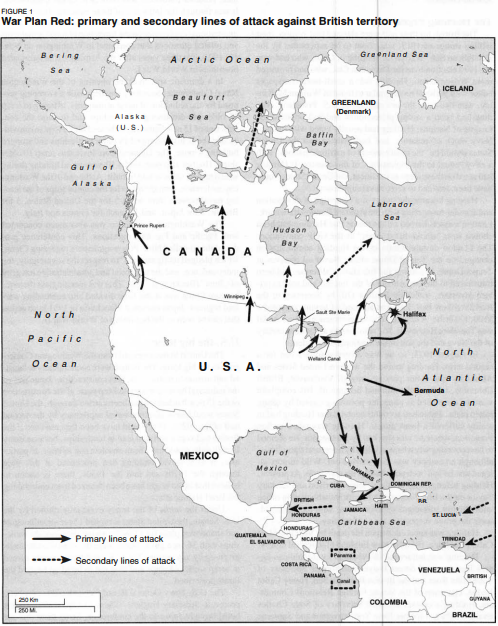
The plan laid out how US forces could invade Canadian territory, attack Halifax, seize critical infrastructure and prevent Britain from using Canada as a staging ground against the United States.
The year was 1930, and the British Empire was at war with the United States.
It seems unthinkable now, but this was the situation foreseen by US generals in the secretive WAR PLAN RED.
The US was standing victorious after defeating Germany and the Central Powers in World War I.
But the UK was counting the cost, having lost nearly one million men in the mud-churned fields of Europe.
As well as the lives lost, King George V’s government owed what would amount to billions in today’s money to America.
Even as relations normalised into the late 19th and early 20th centuries, Canada remained Britain’s military counterweight to the United States.
When the tariff negotiations were going nowhere, both sides began planning to invade the other.
And so, in the late 1920s, American commanders feared a new war, with their enemy being the British Empire.
Trade rows were the cause of potential war between the world’s two most powerful states.
Washington’s top brass were determined to prevent Britain from rapidly deploying up to 100,000 soldiers from its expeditionary force to Canada.
They feared that if Britain gained a foothold in Canada, it could rapidly increase this force to more than two million.
Such a force could launch a devastating invasion into the continental United States.
Britain, which remained the world’s mightiest force at sea, was a key piece on the board that the US wanted to neutralise.
Until the start of World War II, the British fleet remained the largest in the world, numbering up to 1,400 warships.
Within 30 days of a war starting, the Americans feared the British would have up to 14 battleships, five aircraft carriers and well over one hundred other vessels massed around Canada.
This was not an advantage the Americans would allow to stand.
They therefore needed control of all ports in the western Atlantic.
The North Atlantic would become the central theatre of a new Great War.
US warships would then be deployed to control the coast of Canada to fend off any British attacks from the Pacific or Atlantic.
The separation of Canada from Britain would seriously impair Britain’s war-making power.
US generals planned to prevent this from happening with a lightning raid to occupy huge swathes of Canada.
The plan was officially signed off on May 8, 1930, all while Adolf Hitler was gathering power in Germany.
War planners dubbed the moment the US mobilised for war against Britain as “M-Day”.
And so, the Americans decided they must strike a rapid “vital blow” against Britain.
Halifax, Nova Scotia, on the Atlantic coast, was identified as the first target for the US.
Troops and war machines would descend on Canada to seize or destroy anything of value to the British.
Some 25,000 troops were to be deployed to seize control of Halifax.
Should they succeed in neutralising their northern neighbours, US forces would then move to attack British colonies.
Total victory would only come when the United States had managed to destroy all British armed forces in North America and the Western North Atlantic.
Washington would seek to “seriously damage” British interests and occupy as much of the Empire as possible, rendering the US the leading power worldwide.
Elsewhere, the US would also attack British interests in the Caribbean Sea and the West Indies.
Jamaica, the Bahamas and Bermuda would all be attacked by the Americans.
Chemical warfare from day one against their nearest neighbour was US policy if they went to war with Britain.
But, of course, the Empire would strike back.
British Vice Admiral Sir Osmond Brock had this to say in 1921:
“The late war has removed Germany as a possible enemy, but the other effect of the war has been that the United States has become our rival for the carrying trade of the world. The best way to defeat the United States in a war was to neutralise the US using the Royal Navy. They would mobilise the fleet quickly and seek to smash the American warships and strangle the world’s shipping lanes.”
War Plan Red, however, gives a much larger-scale estimate of the British response.
It predicts a full-scale invasion of the northern American states by Britain, starting with the seizure of the Great Lakes.
Warships and warplanes would also pummel US bases in the Philippine Islands, Guam and Samoa, after which Britain would seize the Panama Canal.
Elsewhere, the British fleet would establish dominance in the Atlantic and destroy the US Navy at the “earliest practicable date”.
The UK had the world’s best and most advanced battleships at this point.
The Americans worried that the Empire would quickly bolster its troop numbers with soldiers from its many dominions.
War Plan Red states that the Americans wanted to “crush” Canada before Britain could come to the aid of its dominion.
The plan states that victory for the US would mean Britain surrendering its overseas territories to Washington.
But if Britain had won, the opposite would have happened, including the surrender of Alaska to Canada.
The world map would have been redrawn at the cost of huge amounts of war material and what could have been millions of lives.
And all the while, a great evil would have been allowed to rise as Hitler dreamed of his new empire, the Third Reich.
The stage was set for war — a war that would have changed the course of history as the two great allies tore themselves apart in a storm of iron and blood.
From Invasion Plans to NORAD
History was already pushing the two countries in another direction.
Less than a decade after War Plan Red was completed, the United States entered World War II in 1941, and the British, Americans and Canadians found themselves fighting the same enemies.
By 1940, President Franklin Roosevelt and Canadian Prime Minister Mackenzie King were already discussing the joint defence of North America.
The United States and Canada established the North American Air Defense Command in 1957 and formally approved the binational agreement the following year.
Renamed the North American Aerospace Defense Command in 1981, NORAD continues to provide shared aerospace warning, aerospace control and maritime warning for the continent.
Its commander answers to both the US president and the Canadian prime minister.
The Americans had always nourished a dream of integrating Canada into the US, by military means if necessary.
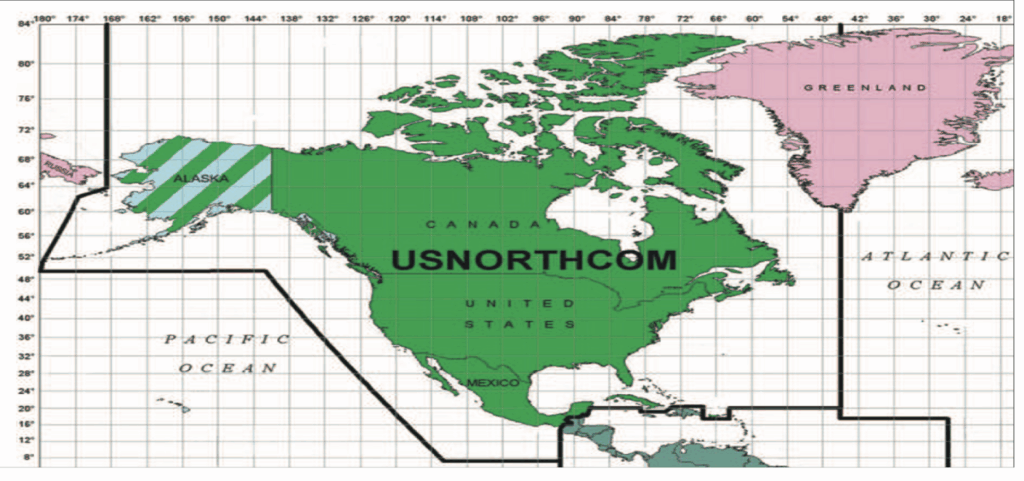
But most Canadians are totally unaware that, under the clauses of US Northern Command, the US has the right to invade both Canada and Mexico.
The map below reveals the territory of USNORTHCOM, which allows the US military to deploy from Mexico and parts of the Caribbean up to the Northwest Territories and the Canadian Arctic.
The map indicates why the Trump government is intent upon acquiring Greenland.
In July, the US slapped tariffs on a wide range of Canadian exports, including items such as dairy, alcohol and cement, with the Trump administration citing alleged Canadian trade discrimination against various US goods.
In response, Carney’s government implemented dollar-for-dollar counter-tariffs targeting US goods such as steel, aluminium, appliances and electronics, as the tit-for-tat tariffs and trade war between the two nations escalated.
Despite Trump’s frequent bluster, Canada remains the United States’ second-largest trade partner behind only Mexico, as well as its largest foreign supplier of crude oil, accounting for approximately 60% of total US crude imports.
On August 27, 2026, Trump went a step further in his ongoing dispute with the country, signing an executive order directing the federal government to rename Lake Ontario “Lake America”.
The order requires federal maps and documents to adopt the new name, though Canada has no obligation to recognise it.
Carney quickly rejected the change, saying Canadians would continue calling the lake by the name it has carried for centuries.
The rhetoric has added a strange new chapter to a relationship now defined by an escalating trade fight.
Trump has previously floated eliminating the border altogether and making Canada a US state, an idea Canadian leaders have repeatedly dismissed.
Asked about his idea that Canada should become a US state, Trump said:
“You get rid of that artificially drawn line, and you take a look at what that looks like, and it would also be much better for national security. Don’t forget, we basically protect Canada. They’re great, but we’re spending hundreds of billions a year to protect it. We’re spending hundreds of billions a year to take care of Canada. We lose in trade deficits.
“What is certain is that if we take Canada, Greenland, Panama, after having taken Sweden and Finland, the USA will regain world power.”
The entire EU and the UK, not to mention Mexico, the Philippines and the southern continent, are clearly subjects of the star-spangled empire.
The Rockefeller Empire Dominates Canada
Canada is contiguous to “the centre of the empire”.
Territorial control over Canada is part of the US geopolitical and military agenda.
Military integration is intimately related to the ongoing process of integration in the spheres of trade, finance and investment.
Needless to say, a large part of the Canadian economy is already in the hands of US corporate interests.
In turn, the interests of big business in Canada tend to coincide with those of the US.
Canada is already a de facto economic protectorate of the USA.
The US-Canada FTA and NAFTA have not only opened up new avenues for US corporate expansion; they have also laid the groundwork, under the existing North American umbrella, for the post-9/11 integration of military command structures, public security, intelligence and law enforcement.
No doubt, Canada’s entry into US Northern Command will be presented to public opinion as part of Canada-US “cooperation”, as something that is “in the national interest”, which “will create jobs for Canadians” and which “will make Canada more secure”.
The Rockefeller Empire is the single largest foreign investor in Canada, if one takes into account the Empire’s interests in banking, energy and other sectors.
The family has been investing in Canada since the late 1890s.
Foreign affiliates, including many US-owned companies, accounted for 14% of Canada’s GDP and employed 12% of its workers in 2016.
US companies form a major portion of this foreign presence across sectors.
ExxonMobil holds around 69.6% ownership of Imperial Oil.
Canada’s Prime Minister Mark Carney: A High-Level Rothschild Agent of Influence
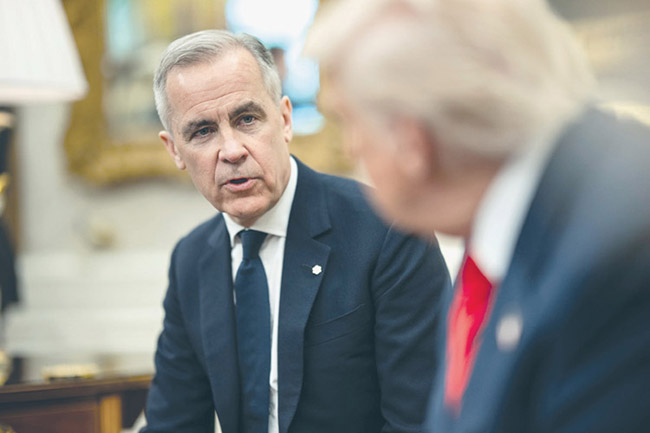
The recent Canadian campaign and election of Mark Carney was the latest case of a senior British Crown agent being deployed from Canada to damage the United States.
Mark Carney is this century’s version of a handful of Canadians highly trusted by the Rothschilds (the Crown and the City of London) and who, in the course of the 20th century, were strategically deployed in defence of British Empire interests whenever the Empire faced an existential “American” threat.
Carney, back in August 2019, lectured the world’s central bankers at the Federal Reserve’s annual conference about replacing the dollar as the world’s reserve currency with a “synthetic digital currency controlled by central banks”.
Trump vows to keep the dollar dominant indefinitely.
Now, leveraging his eight years as Britain’s chief central banker, Carney has made Canada part of the “Coalition of the Willing” of European nations opposing Trump’s negotiations with Putin and determined to keep Ukraine at war, with their weapons and manpower support.
Carney immediately brought British King Charles III, his mentor on “climate” and politics, to Canada to rouse Canadians against the American “threat” — the first British monarch in 70 years to personally give a “speech from the throne” in Ottawa.
For nearly four decades, Canada built its economy around closer integration with the United States.
Trump has turned that dependence into leverage, imposing tariffs, threatening Canada’s sovereignty and openly seeking to pull Canadian industrial production south.
Carney is urgently building a future in which Canada is less dependent on America.
Europe Becomes the Alternative
Carney embraced the prospect of Canada joining the EU, not as a step towards full membership, but as a way to reduce Canada’s dependence on any single country without ceding control over its own decisions.
“Canada and Europe will build an alliance for the future that will strengthen our collective resilience so we can live our lives as we choose based on the values that we share,” Carney said while standing alongside Macron — a Rothschild banker.
Trump has suggested that Canada’s closer relationship with the EU could amount to a “hostile act” and threatened “very heavy tariffs” on Europe if he judged the move unfriendly.
Mark Carney has taken Trump by surprise by leading negotiations towards a vast new trade alliance uniting Europe and the Indo-Pacific — an initiative widely interpreted as a direct effort to counter Trump’s MAGA-driven trade agenda.
These talks bring together the European Union’s 27 member states and 12 Indo-Pacific economies that belong to the Comprehensive and Progressive Agreement for Trans-Pacific Partnership (CPTPP).
If consolidated, the framework would link nearly 40 countries, forming one of the largest economic groupings ever attempted.
Canada is steering the discussions, which reflect Carney’s view that so-called “middle powers” must band together to blunt the impact of unilateral tariffs and economic pressure.
The objective is not only to expand trade but also to knit supply chains across North America, Europe and Asia in ways that reduce exposure to policy shocks emanating from Washington.
Japan has emerged as a key voice from the Indo-Pacific side.
Carney said the world is no longer moving through a smooth transition but a structural break, marked by the growing use of tariffs, financial systems and supply chains as tools of leverage.
He predicted that allied nations would respond by diversifying trade relationships and reclaiming economic autonomy.
A successful agreement, Carney said, could eventually encompass a market of roughly 1.5 billion people, with far-reaching consequences for global trade patterns.
Though still in its early stages, the scale of the proposed alliance already represents one of the most significant coordinated challenges to US trade policy in years.
It is highly probable that if a major financial storm were to hit the transatlantic world and beyond with full force, panicked heads of state would certainly be encouraged by their respective finance ministers and the financial predators of the City of London and Wall Street to rapidly apply an emergency plan nominally concocted by the most celebrated central banker of the 21st century, Mark Carney, under the guiding “invisible hand” of his British masters.
Wall Street and the City of London have drooled their way towards creating a $3 quadrillion speculative bubble that cannot conceivably be paid, no matter how many wars they launch or how much they slash countries’ budgets.
They have destroyed the productive economies of Europe and the United States, packaged as post-industrial gobbledygook.
They have looted the nations of the Global South through debt servitude and related colonial policies.
To summarise, the Rockefeller Empire will not stop in its takeover plans for Canada.
The fight between London and New York will become brutal in the coming months.
Trump has a short window to achieve this outcome for his master, David Rockefeller Jr.
London will have to fold its hands and walk away defeated.
Our next article is: “Fortress America Goes Active in Latin America”.