- How Britain begat the UAE & Qatar
- The US takeover of the Gulf
- Qatar
- Abu Dhabi
- Israel “periphery “ strategy
- Ethiopia
- The Saudi-Abu Dhabi rivalry
- MBS forges a new alliance
- The two families are forging a “new Arab” world
- Conclusion
1 How Britain begat the UAE & Qatar
The winter of 1967-1968 was a time of crisis for the British economy. Many Arab leaders were convinced Britain had secretly helped Israel to victory over its Arab neighbors in the Six Day War of June 1967. Israel had captured East Jerusalem, the West Bank, Gaza, the Sinai Peninsula, and the Golan Heights. In retaliation, the oil-rich Gulf states began selling off their holdings of the British currency. The pound crashed. Desperate to save money, London decided it was time to terminate Britain’s commitments in the Middle East. Britain never officially had colonies in the Gulf, but it had been the pre-eminent foreign power there since the 18th Century. The Arab emirates of Bahrain, Qatar and the Trucial States (Abu Dhabi, Dubai, and their smaller neighbors) had signed treaties of protection with Britain. This meant Britain controlled their defense and foreign policies, while local leaders mostly oversaw local affairs. In 1965, the most politically, socially and educationally progressive of the ruling sheikhs in the Trucial States, Saqr bin Sultan al-Qasimi of Sharjah, fell afoul of the British. His offence was to have cozied up to Egypt’s President, Gamal Abdel Nasser, the mainstay of the Arab nationalist movement. Sheikh Saqr was removed in a British-sponsored coup d’état and replaced by his cousin. Officially, the ruling family agreed he had to go. Sheikh Saqr was invited to Dubai for a meeting. Britain’s local military force, the Trucial Oman Scouts, were waiting. It was a trap, and Sheikh Saqr was sent into exile. Sir Terence Clark (later Britain’s ambassador in Iraq) revealed for the first time how it was done: “A detachment of our Trucial Oman Scouts arrived. They disarmed Saqr’s bodyguards. When I saw they were sitting calmly, I told the Deputy Political Resident, ‘The message has been delivered’. This was the signal. The Deputy Political Resident told Sheikh Saqr that the ruling family had decided to remove him. “In shock, Sheikh Saqr stood up. He saw his men sitting unarmed. He could do nothing. “He had to accept the decision.”
By the summer of 1971, the shape of today’s Arab Gulf states was becoming clear. Bahrain and Qatar each became fully independent that August, and plans were set for Abu Dhabi, Dubai, Sharjah and four other emirates to establish a new federation called the United Arab Emirates. By December 1971 Britain’s presence in the Gulf – the last vestige of its empire in the Middle East – was over. Britain withdrew from the Persian Gulf in the early 1970s primarily due to severe domestic economic pressure and the broader process of decolonization following the decline of its global power. The formal announcement of the intention to withdraw all forces East of Suez, including those in the Gulf, was made in January 1968, with the process completed by the end of 1971. The withdrawal was part of a wider pattern of British decolonization as it transitioned from an imperial power with worldwide responsibilities to a more regionally focused European power. Although the U.S. initially opposed the withdrawal due to Cold War concerns about a power vacuum, the British decision forced the Gulf states (Bahrain, Qatar, and the Trucial States) to form their own cooperative security arrangements, leading to the creation of the United Arab Emirates and the independence of Bahrain and Qatar.
2 The US Takeover of the Gulf
The Greater Israel Project and the Pentagon’s a project for “full spectrum” (global) political and military dominance, are closely aligned. Whereas the fracturing and balkanization of the Middle East is integral to regional Zionist dominance and hegemony, at the same time, it fortifies the Rockefeller Empire’s pursuit of global dominance and supremacy. The US now began to look for a pretext to station forces in the Middle East, now that the threat from the Soviet Union was over. Iraq was the perfect bait. The war between Iran and Iraq ended in August 1988. An American business forum visited Baghdadin July 1989. It was an organized attempt to boost business. This trip was organized by the Rockefeller Empire. A key executive of Kissinger Associates met privately with Saddam Hussein, and spoke for several hours. Saddam Hussein encouraged American participation in reconstruction. He also took them around many industrial facilities, and the Americans were very surprised at the advanced state of Iraqi engineering and other facilities. At that time, Iraq was the only Arab/Muslim country to have a domestic machine tool capacity to build machine tools. But what the Americans wanted was to invest in Iraq’s oil industry. Saddam, very wary of the CIA and the US, politely declined. This sealed Saddam’s fate. Within 3 months, the US closed off all further financial aid to Iraq. By February, the orders went out from New York to “destroy” Iraq. The year 1990 was an inflection year. The Soviet Union had ceased to exist. Its borders were now open. As a result, more than 2 million Jews left Russia and went to Western Europe, the US, while the bulk went to Israel. Now, whenever there is a huge inflow into Israel, it’s a sign that Israel is going to launch another war in the region. It needs more land to house these Jews from Russia and Eastern Europe. Saddam knew the game plan very well. He turned his army west to face Israel, including working with Jordan to monitor Israel. The CIA used Kuwait as bait to trap Iraq into invading Kuwait and, using this as a pretext, to invade Iraq. And so it came to pass. By years end, Iraq was defeated, and would soon be placed under sanctions. These constructs gave the US the reason to station troops, build bases and expand its footprint in the Persian Gulf. Within 2 decades, the US has multiple bases in the region with nearly 40,000 troops stationed there, along with plenty of hardware, equipment, and arms.
After this war, a peace summit was held in Madrid, where the first Bush administration was making sincere efforts to bring about peace between Israel and Palestine. Israel was furious. The Rothschilds were furious. They tried to sabotage this summit. It all failed. Nonetheless, this eventually led to the Camp David Accords signed at the White House in 1993, between Arafat and Rabin. Within 3 years, the Mossad killed Rabin. To bring about hatred and problems between the Americans and the Arab street, the French Rothschilds funded and financed the Arab TV station, Al Jazeera. A few years later, it added an English version to cater for an international audience. In short, the founding of Al Jazeera was the Rothschild response to the US-sponsored Camp David Accords. With that background, we turn our focus on the two vassals of London in the Gulf-Qatar and Abu Dhabi.
3 Qatar
The al Thani dynasty, is the ruling family of Qatar. The family is from the Tamim tribe, which migrated eastward from central Arabia to the Qatar peninsula and emerged as a dominant ruling family in the mid-19th century. The second ruler Qāsim (1878–1913), is considered Qatar’s founder. The seventh sheikh, (1972–95), was instrumental in obtaining Qatar’s independence from Britain in 1971 and became the first emir. His son, Hamad (1995–2013), oversaw the Gulf state’s shift away from oil production toward the development of an LNG industry. The shift helped Hamad’s son Tamim (2013–) navigate rifts with Qatar’s oil-producing neighbors and carve out a direction in policy for Qatar that was independent of the other Gulf dynasties. The clan is especially large among the ruling families of the Gulf states: numbering in the tens of thousands, they make up the plurality of Qatari citizenry.
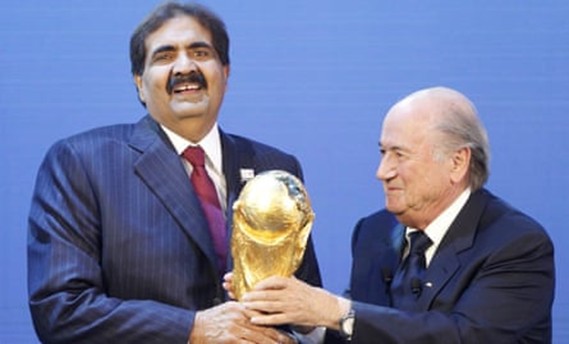
Sheikh Hamad at the 2010 announcement that Qatar had been awarded the 2022 World Cup. Both FIFA and the World, along with the International Olympics Committee are all entities funded, founded and started by the Rothschild family. This award was given to him as a favor for doing the upcoming dirty work in Libya and Syria. The Al Thani family has no loyalty to their own, as we see sons toppling their fathers-repeatedly. If they have no loyalty to their own blood, do you think they have any sympathy for their fellow Arabs and Muslims? Their only loyalty is to their worldly masters-in this case the Rothschild family. As we read further down, we see that both the key Rothschild countries-Britain and France have favored Qatar in ways they haven’t favored any other Arab leaders. Even in their off-shore investments, it is all directed to various entities within the Rothschild orbit, both in Britain and Europe. This even extends to the national airlines of these two-Qatar and the Emirates- buying Airbus (a Rothschild entity), instead of Boeing (a Rockefeller entity). In many ways, Hamad is the founder of the new assertive Qatari identity. He picked his fight with the Saudis first on the battlefield when commanding a brigade of Qataris against Saddam Hussein in the Persian Gulf war almost 30 years ago. The soldiers of the Hamad brigade were among the first coalition troops to engage Iraqi forces at the battle of Kafji in February 1991. When Saudi forces joined the battle, however, US marines ended up protecting Saudi troops because their Arab allies from Qatar were accidentally raining “friendly fire” on them. Things were patched up swiftly after the war but worry lingered, especially as Hamad returned as supreme military commander and a newly decorated war hero. He continued to rile Riyadh, telling the Saudis over a border dispute in 1992 that they would answer to the “barrel of a gun”. These fears were realized when the young sheikh deposed his father, Khalifa, who had left the country for Geneva, where he was allegedly undergoing medical treatment. Hamad sent tanks to surround the royal court, which surrendered meekly. This coup was done by British Intelligence as they found that Khalifa was not willing to go along with London’s plans for a “future “Middle East. London installed his son, Hamad. The father was told that he can pass the rest of his life in exile as he still has a few billion in his bank account. Since then, he has been a disruptive force in the region. Hamad founded Al-Jazeera, which, along with social media, has in recent years stirred public opinion in ways Arab governments – especially the Saudis – did not appreciate. Many believe the current conflict may be rooted in these old rivalries.
Diplomats in Middle East say issues cannot easily be resolved partly because they are personal as well as political-that is roiling the Middle East, pitting the wealthiest and most influential Arab sheikhdoms against each other, and sparking weeks of shuttle diplomacy. However, behind the Saudi Arabia-led blockade of Qatar’s air, land and sea ports lies a long-running family feud. Saudi Arabia, the Bahrain and Egypt severed diplomatic with Qatar in 2018. The bloc accused Qatar of supporting terrorism. “The rulers have familial relationships and the kinship ties between the Saudis, the Emiratis and the Qataris … they are very, very close to each other,” said one highly-placed source in the region. “This means big political issues are also family issues. Those become very difficult to solve, especially when the Saudis and the Emiratis want regime change. “In the fractious world of Middle Eastern politics, where absolute monarchs trade on their bloodline and piety, family dissent is often stalled by dispersing privilege and cash. However, these are tumultuous times in the Arab world, which makes this “Game of Thrones” dispute all the more dangerous. This was the backdrop to a rivalry between the Saudis and the Thanis who are bound together by marriage and religion. Both the Thanis and Saudis originate from the peninsula’s Nejd interior. MBZ has often intervened in royal politics, backing different branches of the Thani clan. On paper, the current ruler of Qatar is Emir Tamim bin Hamad al-Thani, the 37-year-old son of Hamad. Hamad’s most influential adviser is a Thani, Hamad bin Jassim (HBJ), who bet that buying influence within the rising force of political Islam would carve out long-term stability for the tiny state, a departure from the rest of the Gulf states.
HBJ-the most powerful figure in Qatar
Hamad bin Jassim bin Jaber Al Thani, was born in Qatar in 1959, and is also known informally by his initials HBJ. He is a Qatari politician. He is the fifth son of Jassim bin Jaber Al Thani. Through his father, he is the grandson of Jaber bin Mohammed Al Thani. Jaber was a younger brother of the founder of modern Qatar. HBJ is a billionaire member of the Qatari royal family who served as Qatar’s Prime Minister (2007–2013) and Foreign Minister (1992–2013). He is the key man in Qatar for the Rothschilds. As a cousin to the former Emir, he was a key power broker, transforming the Qatar Investment Authority (QIA) into a major global investor. He was a central figure in Qatari politics for over 30 years, often acting as both a politician and a businessman, with significant influence in foreign policy and economic development. “The Man Who Bought London”: He was nicknamed this due to his involvement in high-profile London investments, including Harrods, The Shard, and the Olympic Village. Through his family office, he maintains massive international investments, such as a controlling stake in the luxury fashion brand Eleventy and a significant holding in many companies.
On 1 September 1992, HBJ was appointed as foreign minister of Qatar. He retained his post when the Emir’s son, came to power in 1995. Hamad played an important role in the overthrow of Hamad Al Thani. On 16 On 2 April 2007, he was appointed as Prime Minister. HBJ also continued to serve as foreign minister. HBJ had vast foreign policy goals for Qatar during his tenure. These were policy goals that are in line with the Rothschilds vision for the Middle East. HBJ has strong connections with the US government. He serves on the International Advisory Council of the Brookings Institute. The Brookings Institution is a think tank in the Rockefeller orbit. Following joint military operations in 1991 against Iraq in 1991, Qatar and the IUS concluded a Defense Agreement that has been subsequently expanded. In 1996, Qatar built-at its own cost- the Al Udeid Air Base at a cost of more than $1 billion. HBJ’s vast fortune includes the historic Connaught Hotel in London. In June 2014, Hamad acquired 80% of Heritage Oil, which was listed as a London exploration and production company. The stake, valued at £924 million and dated April 30, 2014, transferred to a “wholly owned subsidiary” of Al-Mirqab Capital, an investment company privately owned by Hamad and his family. In 2010 Hamad acquired 10% of El Corte Ingles in Spain, the country’s largest department store chain.
Business and wealth
Hamad bin Jassim bin Jaber Al Thani is one of the richest people in the world, having overseen Qatar’s $230 billion sovereign wealth fund until 2013. He has been named “the man who bought London” by British tabloids; his holdings in London include the Shard, Harrods and the InterContinental Hotel in London’s Park Lane. and the London Park Lane. He also bought two Rothschild banks making one of the largest banking groups in Luxembourg. He also owns 3.05% shares of the Deutsche Bank-Europe’s largest – a Rothschild entity. In May 2015, Hamad purchased Picasso’s Les Femmes d’Alger for $179.4 million including fees, a record price for a painting at auction. He also owns a super-yacht, the Al Mirqab, worth $300 million. In 2021, his net worth at $4 billion- an understatement. In May 2025, reports emerged that Trump was considering acquiring a Boeing 747-8 aircraft owned by Hamad. The aircraft, was originally delivered to Qatar Amiri Flight in 2012 but later transferred to Global Jet Isle of Man and used privately by Hamad after his retirement from political office. Although some media initially described the jet as a “gift from Qatar,” subsequent reporting clarified that the aircraft was no longer owned by the Qatari state but was instead part of Hamad’s private portfolio of assets. Between 2011 and 2015 Prince Charles accepted €3 million in cash from Hamad. The funds were said to be in the form of 500 Euro notes, handed over in person in three tranches, in a suitcase. He remains a highly influential figure in Europe and the Middle East, and is still pulling the strings – a view widely shared in the Middle East- on behalf of the Rothschilds. He has stakes in many strong businesses such as Qatar Airways, and property holdings in Qatar and London. The French government made Qatar under Hamad’s guidance a strategic partner, and the list of partnerships between the two states includes Rothschild companies such as Total, EADS, Technip, Air Liquide, Vinvi SA, GDF Suez, and Areva. France was, during the Hamad government, the primary arms supplier to Qatar In February 2009, under the Sarkozy government, France accorded special investment privileges to Qatar, its ruling family and its state-owned enterprises, one example of the privileges is capital gains exemptions in France. Due to being an Arab and a Muslim, he has been able to meet other Arab leaders, and present them with bribes as well as threatening Israel’s enemies in the region. A leaked cable shows that “HBJ told then US senator John Kerry that he had proposed a bargain with the Egyptian president, Hosni Mubarak, which involved stopping anti-Israeli broadcasts in Egypt in exchange for a change in Cairo’s position on Israel-Palestinian negotiations, and that ‘we would stop Al-Jazeera for a year’ if Mubarak agreed in that span of time to deliver a lasting settlement for the Palestinians.”
It was under Hamad that Qatar began assisting rebels in Syria by supplying them with arms. In June 2021, a court in London issued a claim, according to which HBJ’s private office was at the heart of clandestine routes by which money was transferred to al Nusra Front, which was re-named HTS. In March 2022 HBJ said to a Qatari television that the Military Operations Command in Jordan and Turkey have spent $2 trillion to remove Syria’s President Bashar al-Assad. HBJ has worked actively to settle political conflicts in various hotspots over the last 20 years, especially in Yemen, Eritrea, Sudan, Lebanon and in Gaza and the West Bank. This approach enabled him to spot any potential future leaders that could be useful to London. Then we find that Qatar has been supporting, funding and taking part in the overthrow of Qaddafi in Libya. Qatar has also been involved in destabilizing Syria, Kuwait, Saudi Arabia, the UAE and Bahrein- for and on behalf of London. The pending attack by the US against Iran has scared the living daylights out of the royal family. They know that Iran would most likely destroy the US airbase in Qatar in the event of a war breaking out. Just last week, a royal family member informed the US that it “is a tenant, and not the oner of the airbase “. It’s too late. The US has zero respect for vassals. The release of the Epstein files shows that Epstein tried to insert himself in the rift between Qatar and its neighbors. This was back in 2017. Epstein told a senior Qatari official that Qatar “must sing and dance “to Israel, and that Israel would solve this issue. To make it faster, Qatar should “donate” $ 1 billion to a special fund in Israel, and that this Qatari official should inform the other GCC members to each pony up $1 billion as well! These are some of the tricks of the Zionists thieves and monsters. The mandate and area of responsibility given by the Rothschilds to Qatar are several. The first was active participation in the operation to topple Qaddafi in 2011. Next, Syria has been also given to them, with the instructions to make every effort to topple Assad. Qatar has funded many tens of billions for this operation. Finally, Qatar is actively trying to destabilize Saudi Arabia, Egypt, Jordan and Kuwait from the inside. None of the Gulf countries like Qatar or its leadership. They know why it is behaving in this manner.
4 Abu Dhabi
Modern Abu Dhabi traces its origins to the rise of an important tribal confederation in the late 14th century. By the late 18th century Abu Dhabi was formed. In the early 19th century, Dubai and Abu Dhabi branches parted ways. Into the late 19th century, Abu Dhabi’s economy continued to flourish mainly by herding, production of and vegetables and fishing and diving off the coast of Abu Dhabi city, which was occupied mainly during the summer. This continued until the late 1950s, when oil was discovered in the emirate and its coastlines. In 1939, oil concessions were granted, and oil was first found in 1958. At first, oil money had a marginal impact. A few low-rise concrete buildings were erected, and the first paved road was completed in 1961, but the ruler a cautious approach, preferring to save the revenue rather than invest it in development. Zayed al Nayhaan saw that oil wealth had the potential to transform Abu Dhabi. The ruling Nahyan family decided that Zayed should replace his brother as ruler and carry out his vision of developing the country. On August 6, 1966, with the assistance of the British, Zayed became the new ruler. With the announcement by the UK in 1968 that it would withdraw from the area of the by 1971, Zayed became the main driving force behind the formation of the UAE. After the Emirates gained independence in 1971, oil wealth continued to flow to the area, and traditional mud-brick huts were rapidly replaced with banks, boutiques and modern high-rises. The emirate’s political form is an absolutist, hereditary monarchy. The current ruler of the emirate is MBZ, who began his reign on May 14, 2022, upon the death of his brother. The ruler of Abu Dhabi is traditionally also elected as the president of the UAE by a custom that began with the UAE’s first president. The mandate and area of responsibility given by the Rothschilds to MBZ and Abu Dhabi is Yemen , the Horn of Africa and Africa as a whole.
Gaza & The West Bank
From weapons and trade to logistics and espionage, Persian Gulf monarchies are quietly underwriting the occupation state’s war on Gaza and its broader regional aggressions. The Persian Gulf states’ silence – and in many cases, complicity – during Israel’s ongoing war on Gaza has not come as a shock. These governments, long detached from the Palestinian struggle, have for years cultivated warm, if discreet, ties with Tel Aviv. While Bahrain and the UAE made normalization of ties with Tel Aviv official through the US-brokered 2020 Abraham Accords, other states like Qatar have played but equally pivotal roles. Though much of this remains behind the scenes, it has been repeatedly acknowledged by US and Israeli officials. Abu Dhabi is an even greater threat to the Palestinians that Israel is. The UAE does not broker peace. It choreographs betrayal. This choreography is visible in the UAE’s deployment of humanitarian aid to Gaza, routed through Israeli-controlled channels and coordinated without Palestinian leadership — transforming relief into a bypass mechanism that reinforces occupation. In May 2021, while Israeli airstrikes leveled civilian infrastructure in Gaza, the UAE announced plans to build a field hospital in Rafah. The gesture, widely publicized in Emirati media, was negotiated with Israeli authorities and coordinated with Egypt, bypassing Palestinian sovereignty even in a multilateral framework. The UAE’s participation in the Negev Summit of March 2022 — alongside Israel, Egypt, Bahrain, Morocco, and the United States, and without Palestinian representation — exemplifies summit diplomacy as a tool of erasure. Palestinian exclusion is not incidental; it is structural. It reflects a broader pattern of denial and replacement across diplomatic, humanitarian, and media frameworks. This pattern continued at the 2025 Arab-Islamic emergency summit in Doha, convened in response to Israel’s airstrike on Qatari territory. The UAE delegation, led byMBZ condemned the attack and affirmed solidarity with Qatar. But its presence functioned less as rupture than recalibration. The UAE’s rhetorical alignment masked its deeper entanglement with Israeli security architecture and its strategic silence on Palestinian representation. The summit’s communique denounced Israeli aggression as “an attack on diplomacy,” yet stood in tension with the UAE’s history of bypassing Palestinian leadership in its bilateral dealings with Israel.
These acts are not anomalies. They are part of a system in which the UAE uses care to deflect critique and diplomacy to reframe complicity as leadership. Even in moments of collective condemnation, the choreography remains intact — offering gestures of solidarity that obscure the structural logic of alignment. The UAE’s diplomacy is transactional. In the first half of 2024 alone, UAE–Israel trade reached $1.66 billion, with $271.9 million exchanged in June alone. The UAE has publicly committed to expanding this figure to over $10 billion annually within five years—making it the largest trade agreement between Israel and any Arab country. This is not economic pragmatism. It is ideological alignment. These figures do not just reflect commerce—they reflect complicity, scaled and monetized. Its alliance with Israel delivers expanded trade, access to surveillance technology, and strengthened ties with the United States. These benefits consolidate state power and enhance internal control. But the costs are stark: regional legitimacy erodes, public resentment grows, and isolation from grassroots Palestinian movements deepens. The same tools shared with Israel to monitor borders and suppress dissent are deployed internally. The mirroring is structural. External complicity reflects internal repression. While the UAE’s alliance with Israel is marked by overt normalization, strategic exclusion of Palestinians, and the criminalization of domestic solidarity, Qatar’s posture reflects a more calibrated form of complicity. Both states engage in diplomacy that reinforces Israeli control — routing aid through Tel Aviv, participating in summits that sideline Palestinian leadership, and aligning with U.S. strategic interests. Yet the mechanisms differ. The UAE embraces visibility, using humanitarian optics to sanitize its partnership with Israel and suppress dissent at home. Qatar, by contrast, maintains a posture of ambiguity: it hosts Hamas’s political bureau, funds Gaza’s civil infrastructure, and positions itself as a mediator, but always within parameters acceptable to Western allies. Where the UAE builds barricades, Qatar builds corridors — narrow, monitored, and contingent. Both reinforce the system. One does so through overt alignment; the other through managed proximity. Qatar’s brokerage operates within a tightly managed bandwidth — one shaped by its alliance with the United States, its regional ambitions, and its need to maintain strategic ambiguity. It hosts Hamas’s political bureau in Doha, providing the faction with diplomatic space and logistical continuity, yet this hosting is calibrated to avoid rupture with Western allies. For example, Qatar’s mediation in ceasefire negotiations between Hamas and Israel is often conducted in coordination with U.S. and Egyptian interlocutors. Its financial support to Gaza — such as monthly stipends for civil servants and fuel subsidies — is routed through Israeli-controlled mechanisms, negotiated with Tel Aviv, and monitored to prevent diversion to military activities. This sustains Gaza’s basic infrastructure but reinforces Israeli gatekeeping. The UAE and Qatar are not outliers. They are part of a regional choreography that trades Palestinian sovereignty for strategic positioning. Arab regimes invoke Palestine as symbol while abandoning it in practice
Globally, bipolarity offers no refuge. Russia and China do not challenge Zionism. They trade with Israel, abstain from UN votes, and offer strategic ambiguity — not ideological rupture. The idea that multipolarity will open space for justice is a mirage. Russia’s military and technological ties with Israel — including cooperation on cybersecurity and drones — persist even as Moscow postures as sympathetic to Palestinian suffering. During key UN votes, Russia abstains or issues diluted statements. China maintains robust trade with Israel and avoids direct challenge to Zionist policy. Its abstentions during the 2023 Gaza bombardment reflect calculated neutrality. Neither power has leveraged its influence to isolate Israel or support Palestinian sovereignty. Multipolarity does not disrupt the architecture of suppression. It redistributes impunity. It leaves us in a moment of devastation inching toward rupture. Gaza is being dismantled. The West Bank is splintered. What is hardly ever mentioned is the enormous natural gas deposit off-shore of Gaza in Gaza’s maritime territory, an estimated value of at least a trillion US dollars equivalent. Clearly, these resources belong to Gaza, to the Palestinians. The trillion-dollars-worth of natural gas, it is plenty to rebuild Gaza, estimated at a minimum at US$ 80 to US$ 100 billion, and an economy so badly destroyed that some reports (World Bank) put the figure for recovery at over 30-40 years, No humanitarian idea from anyone in the world has admitted and suggested that Gaza’s off-shore hydrocarbon resources should be used to Make Gaza Great Again – a different kind of MAGA – as part of an independent autonomous, sovereign, neutral, democratic Palestine – free from foreign interference. Free from Israel.
Arab Complicity reaches New Heights
It is Abu Dhabi, however, that has emerged as the true driver behind the shift in US posture, its harsh maneuvers over Gaza even raising concerns among allies. Cairo, for one, reportedly sought Saudi help to contain the Emiratis, while the US-backed, West Bank-based Palestinian Authority (PA) – though eager for Hamas’s downfall – fears being sidelined in the process. Egyptian sources describe aggressive UAE lobbying for immediate displacement of Gazans, while Israeli crossings have seen a drop in aid shipments, despite Abu Dhabi holding privileges for such transfers – privileges now withheld even from Jordan. Meanwhile, high-level UAE–Israeli coordination continues, exploring “scenarios” that deliberately exclude aid deliveries, despite repeated Egyptian pleas. According to the sources:“There are inappropriate Emirati moves that threaten Egyptian interests, national security, and even the Palestinian cause directly, but we cannot speak out and confront Abu Dhabi directly for many considerations. Egyptian fears now are that the UAE is trying to carry out large-scale plans to blow up the Gaza Strip from within by stimulating protests against Hamas and creating confrontations between the people and the resistance. It even amounted to Emirati funding through Israel for any Gazan who wants to demonstrate against Hamas.” Cairo believes Abu Dhabi is even more eager than Tel Aviv to realize Trump’s displacement scheme and is willing to bankroll it. With Egypt refusing to agree to mass displacement, alternate US–Israeli plans involve evacuating Gazans by sea to Cyprus, then to third countries. Observers say the occupation army’s evacuation maps point not to Rafah but to the Mediterranean Sea. Abu Dhabi has even sounded out an African state – via its own channels – on Israel’s behalf to accept displaced Gazans. The Israeli domestic security agency -Shin Bet- has many of its officers stationed in Abu Dhabi and Dubai, and are ensconced in important institutions of the UAE.
Occupied West Bank next in line for Fragmentation
Israeli plans to fragment the occupied West Bank into autonomous city-states, and replacing it with local councils. The blueprint begins in Hebron (Al-Khalil), where Israel intends to install a compliant local leadership working directly with the occupation. The plan was reportedly discussed during a secret UAE meeting that brought together West Bank Jewish settlement leaders and Emirati officials at a Ramadan iftar. The UAE’s role appears increasingly active – amplifying PA corruption accusations while building direct ties with the Jewish settler movement, bypassing Israel’s own government. This calculated outreach undermines any pretense that normalization with the Arab world might lead to Palestinian statehood. During Ramadan, a West Bank settlement delegation visited Abu Dhabi and met with Dr Ali Rashid al-Nuaimi, UAE National Council member, Israeli Ambassador Yossi Sheli, UAE businessmen, and social media influencers. The Israeli newspaper also quoted the head of the settlement council, Yisrael Gantz, as saying, “There is a new world order that requires new alliances and thinking outside the box. “The delegation sought to assure UAE officials that normalization does not require evacuating Jewish settlements. UAE ties with settlement leaders like Nablus Council head Yossi Dagan date back years, with trade links forged under the Trump administration. Settlers now openly bypass Tel Aviv to deal directly with Persian Gulf capitals. The story continues in Part 2.