1 US strikes Iran
2 Iran hits Al Udeid Air Base
3 Iran’s Intel heist
4 The Samson Option
5 Lessons from the war
6 After Iran, Israel targets Pakistan
7 Pakistan backs Iran
8 The Geopolitics of Trade – INSTC vs. IMEC
9 If Iran falls, the rest of civilization will fall too
Background
As we have written many times in our articles, the US needs to blow up Eurasia in order to hold onto its global power and empire. Since the US failed to defeat Russia, and since time was running out (the impending financial collapse), the US-led attack on Iran was meant to hurt Russia, China and the Arab world. New York was hoping to regime-change Iran this year, and start with China next. But, this plan backfired- just like all other moves in the past few years. Of the 3 major BRICS countries- Russia, China and Iran, Iran was the weakest link for the Empire to regime change. Were this to succeed, the task then to take down Russia and China would have proceeded much faster. The US would then use Iran to destabilize southern Russia and Central Asia. The Rockefeller Empire would then use Russia to destabilize and regime-change C1hina. Had that succeeded, then the world would enter a period of slavery and extreme injustice. It would cement the Empires global domination. Furthermore, the Axis of Resistance (headed by Iran) would be weakened, allowing Israel to expand its Zionist Project and make the Arab states slaves to the new reality through the Abrahamic Accords. But, the plan failed spectacularly. A quick chronology will help to explain this better:-
October 2024- Israel attacks Hezbollah by going for its leadership-
December 2024 – In a joint operation, the US, Turkey and the Trinity (Britain, France and Israel) topple the Assad government and replace it with the jihadist head-choppers
May 2025 – The US green-lights M16 operation to create a false flag operation in Kashmir, thus providing a pretext for India to attack Pakistan. The aim of this mission was to make sure that Pakistan does not come to the aid of Iran. That plan failed miserably when India was defeated in a humiliating manner
June 12, 2025 Israel attacks Iran-which then retaliates
June 17, Israel begs for help from the US
June 21 the US steps in, and bombs Iran’s nuclear sites
June 22 Hostilities PAUSE
The American people are not being told why Israel agreed to a ceasefire with Iran. Yes, Israel was rapidly running out of air-defense interceptors (making it more vulnerable to Iranian attacks.) But that issue is only of secondary importance. The real reason they wanted a ceasefire was because they were getting systematically pulverized and needed to stop the bleeding fast. By day 5, Israel knew it had lost against Iran. Extreme pressure was put on Trump, who finally agreed to step in to help Israel. That’s why Israel ‘threw in the towel’ less than 2 weeks after the opening salvo, because Iran was decimating one target after another with no end in sight. So, Israel capitulated. Iran has faced war before. But with Trump’s attack on Iranian soil on 22 June – coming days after Tel Aviv’s own raid – Tehran now finds itself confronting a renewed imperial offensive. Iranian Foreign Minister Abbas Araghchi, in Geneva, did not mince words: “So they had perhaps this plan in their mind, and they just needed negotiations perhaps to cover it up. We don’t know how we can trust them anymore. What they did was in fact a betrayal to diplomacy.”
There were, in fact, two betrayals. The first came when Trump proposed direct talks with Iran, just hours before Netanyahu launched his sneak attack. The second followed when Trump declared he would decide “within two weeks” whether to join Tel Aviv’s war effort. Faced with these betrayals – and with Trump’s own raid on Iranian soil – Tehran has little choice but to recalibrate its priorities. This is no limited skirmish. The role-play between Washington and Tel Aviv is neither new nor covert. But never before has the division of labor between principal (US) and proxy (ISRAEL) been this transparent. Together, they are escalating a campaign to fracture the region, weaken its sovereign actors, and impose subjugation.
It’s a joint operation – America calls the shots and lets its attack dog and proxy – Israel- does the dirty work on the ground. This is how it has worked since the 1967 war. The master is America (the Rockefeller Empire), and the servant is Israel (the Rothschild Empire). But, always the narrative reads that it is Israel that is the master and Washington is its servant. The Rockefeller family clearly hides behind its proxies. This is nothing new for the family, as they diligently follow the advice of the founder –John D Rockefeller. Under increasing government pressure from Washington against Standard Oil, which eventually led to a break-up of the cartel in 1911, the founder advised his son and grandsons to never associate publicly with their oil companies, but rather direct and control them very discretely. And, so it has been for many of their corporate and financial holdings, including multi-lateral institutions that the family owns/controls such as the UN and the IMF, as well as the US Federal reserve bank. This is the family’s modus operandi. In the case of the Middle East with its huge oil and gas reserves, rather than destabilize the region directly, the family allowed Israel to do its dirty work. Naturally, blame falls on Israel, thus, once again, shielding the US and its real owner-the Rockefeller family and its allied networks of power- from any public criticism. Trump deserves an Oscar for his public performance in “kissing Netanyahu’s feet “at the White House. This is meant to distract the public, and make them believe that Israel, the Zionists and Netanyahu are the real power in Washington, What a show. What a farce. Many-especially Americans and others have been taken in by this masquerade.
But, as we see, over the past 3 years, this mask of deniability has fallen off. The true reality of power is becoming obvious to everyone. David Rockefeller Jnr needs to hide the fact that he is the guiding hand behind the White House, and many media outlets controlled by the family push this line, thus adding to confusion. At the same time, these actions are turning more people away from their support of Israel, Zionism and Jews. Over time, these increasing levels of hatred of Zionism will force many Zionists and Jews to flee from America. Not in the short- term, but it is building up very fast, and will be very obvious when the coming financial collapse creates a hatred for the bankers. An obvious target for the disenfranchised society will be the Jews.
US Strikes Iran’s Nuclear Sites
As B-2 Spirit bombers departed Missouri on a 37-hour flight to at Fordow, Natanz, and Isfahan, Araghchi was in Geneva, conferring with his European counterparts in a last-ditch bid for a peaceful resolution. The attacks were premeditated, their diplomatic cover already exposed. Iranian conclusions have sharpened. Pezeshkian observed that the US intervened only after Israel was being hit hard under Iran’s counterstrikes. Tel Aviv lacks the muscle to face Iran alone, and Washington’s hand was visible from the start.
The timeline matters. What came before 13 June, and now 22 June, belongs to a different era. The accusation that Iran exaggerates western threats is now definitively exposed as misinformation. First, let us briefly overview how the strikes reportedly went down. Chatter erupted when B-2s and refueling craft took off from their home base of Whiteman AFB and began tracking west toward Guam (for further refueling) and Diego Garcia. However, that “visible” strike package was the decoy, while the real package flew east from mainland US under complete cover, to hit Iran directly from its western flank. During the night, the US military used seven B-2 bombers and 14 GBU-57 MOP bombs, two dozen BGM-109 Tomahawk cruise missiles to attack Iranian nuclear facilities in Fordow, Natanz and Isfahan. The damage to the sites hit was a joke. Not only are these sites deep underground, but all the critical equipment and the enriched uranium were moved out to unknown sites weeks before the US/Israeli strikes.
In reality, the subterfuge appeared part of an elaborate game, given that emerging details point to the entire charade being just that. Trump informed Iran of the strikes, implying that as long as Iran does not respond it will be a ‘one-off’ attack. If true, this would be clear indication that the proposed back-channel agreement would require Iran allow the US strike package to pass unmolested, to give the US its face-saving off-ramp from the conflict.
This is not Trump’s first time: recall the infamous 2017 Tomahawk attack on Syria’s Shayrat base which was billed as some kind of ‘devastating’ deathblow, when it turned out to be a show-strike nothing burger which left a few potholes on the runway and did no real damage. This is Trump’s way of alleviating neocon pressure—a sort of purity test for his Israeli handlers. The Iranians also clearly had ample warning, most likely a back-channel agreement was made for the B-2s to have safe passage to do a limited ‘show strike’. That means Fordow only received six hits, far fewer than needed. By signaling a ‘token’ strike, Trump likely mollified Iran into not responding. The second piece of evidence is that that Iran had dozens of dump trucks carrying out “unusual activity” at Fordow two days before the attack. These dump trucks filled Fordow’s tunnel entrances in order to fortify them against blast damage.
Trump endorsed strikes on Iran’s nuclear facilities at a meeting with advisers on Wednesday. His talk of a negotiating period on Thursday was a deliberate deception and “smokescreen.” The timeline seems to be that Trump made up his mind Wednesday during the big meeting with his advisors, then back channel deals trickled through by Thursday, at which point Iran rushed gear to begin backfilling the tunnels—give or take a day. Given that the attacks happened early Sunday morning Iranian time, it would have given Iran up to three days to do some last minute work. So, yes, Iran decided to take US’ offer and allowed safe passage of the strike package to rain a few insignificant ‘token’ strikes on Fordow with the understanding that this was the US’ price for exiting the conflict. Now, there are rumors that Israel may use the given ‘off-ramp’ as pretense to likewise conclude a new deal and end hostilities, given that Israel has exhausted itself and is now losing a war of attrition against Iran.
2 Iran hits largest US base in Persian Gulf with Retaliatory Missile Attack
Iran’s IRGC announced late on 23 June the launch of “Operation Glad Tidings of Victory,” targeting Al-Udeid US Airbase in Qatar in retaliation for Washington’s on Iran’s nuclear program. “The American military bases and mobile targets in the region are not a point of strength, but rather a great weakness and the Achilles’ heel of this warmongering regime,” the statement highlights. According to local reports, 14 Iranian ballistic missiles directly hit Al-Udeid air base, Washington’s largest military base in the region. Iran’s National Security Council revealed that the number of missiles launched in the operations “is equal to the number of bombs used by the United States against our nuclear facilities.”
Al-Udeid serves as the main headquarters for the US Central Command (CENTCOM) and hosts nearly 11,000 American troops, along with more than 100 aircraft, including strategic bombers, tankers, and surveillance assets. Nearly all US military aircraft and non-essential personnel were evacuated from Al-Udeid base earlier this week. No personnel were killed, but substantial damage was done to key installations, such as the radar dome, barracks and aircraft shelters. As is usual with the US and Israel, they hide damage to their facilities, just like they hide their true casualty figures. Minutes before missiles were launched, Qatar and the UAE shut down their airspace. Air raid sirens were also activated in Kuwait and Bahrain, where Washington maintains other military bases. Israel launched a flurry of final attacks on Tehran immediately prior to the 4 am (Tehran time) deadline for the ceasefire to go into effect. Meanwhile, in Iraq, there were several attacks on US bases prior to 4 am by Iraqi groups aligned with Iran.
Israeli Army Took Out More Iranian Jets, Missiles and Drones
Israel announced on June 22 that it had attacked a base in the central Iranian area of Yazd where Khorramshahr medium-range ballistic missiles were stored. Fighter jets of the Israeli Air Force (IAF) flew some 2,200 kilometers from Israel to attack the key missile base, according to the military, which said that Iran had previously launched some 60 missiles from the base. With a range of up to 2,000 kilometers and a warhead weighting some 1,800 kg, Khorramshahr is considered one of the heaviest missiles in Iran’s arsenal. “In broad daylight, we surprised the Imam Hussein missile headquarters in central Iran, the furthest target we’ve struck to date,” said IAF chief Maj. Gen. Tomer Bar.
The deepest strike in Iran was in fact last week’s IAF bombing of Mashhad Airport in the east of the Islamic Republic, over 2,300 kilometers from Israel. Earlier, the IDF said that 30 IAF fighter jets dropped 60 munitions on targets in Yazd, the southwestern areas of Bushehr and Khuzestan, as well as in the area of Isfahan in the center of the Islamic Republic. In Isfahan, Bushehr and Ahvaz, the military said that it targeted missile launchers, air defense battery production sites, a headquarters of an Iranian drone regiment and a drone storage facility. Amid the strikes, an IAF drone identified Iranian soldiers “arming missile launchers, and eliminated them shortly afterward.” This was the second wave of Israeli strikes to hit Iran since the United States carried out its first attack on the Islamic Republic in the early morning hours. These attacks in east Iran was done by Israel, using bases in Azerbaijan. Besides fighter jets, drones were also launched. More on Azerbaijan in our next article. Despite the recent escalation by Israel and the U.S., Iran will not likely back down. In fact, Tehran has already vowed to respond.
Shortages of Interceptor Missiles
Israel has a real problem with its air-defense system, especially with the Arrow interceptor missiles. Arrow interceptor missiles are built and assembled in Israel by Israel Aerospace Industries (IAI). The US Missile Defense Agency and MDA budgets have consistently funded half or more of the Arrow program annually—e.g. $119 million out of a $163 million total on Arrow 2 in FY 2014. Since 2003, Boeing has manufactured around 35–50% of critical components for both the Arrow 2 and Arrow 3 systems—covering electronics, motor casings, radar seekers, booster casings, and missile canisters—at its Huntsville, Alabama facility. Arrow interceptors cost roughly $2.5–3 million each. During the conflict, Israel has fired at least two Arrows for every single Iranian missile launched at Israel. It is estimated that IAI produces perhaps 20–50 Arrow interceptors annually, across both Arrow 2 and Arrow 3. Just do the math… Israel will run out of these missiles if Iran continues to launch multiple ballistic missiles, and neither Israel, nor the US, has the production capability to replace Israel’s supply. There are genuine fears in Tel Aviv and Washington that Israel will exhaust its supply of missiles is genuine.
Iran makes final strike before ceasefire – Kheibar-Shekan in first use.
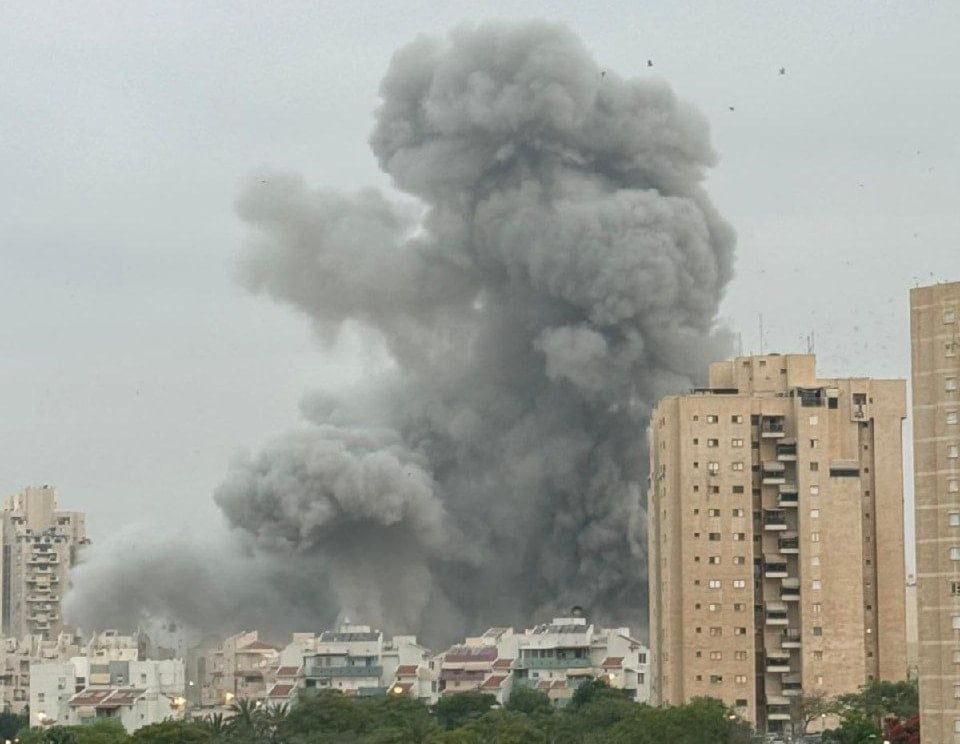
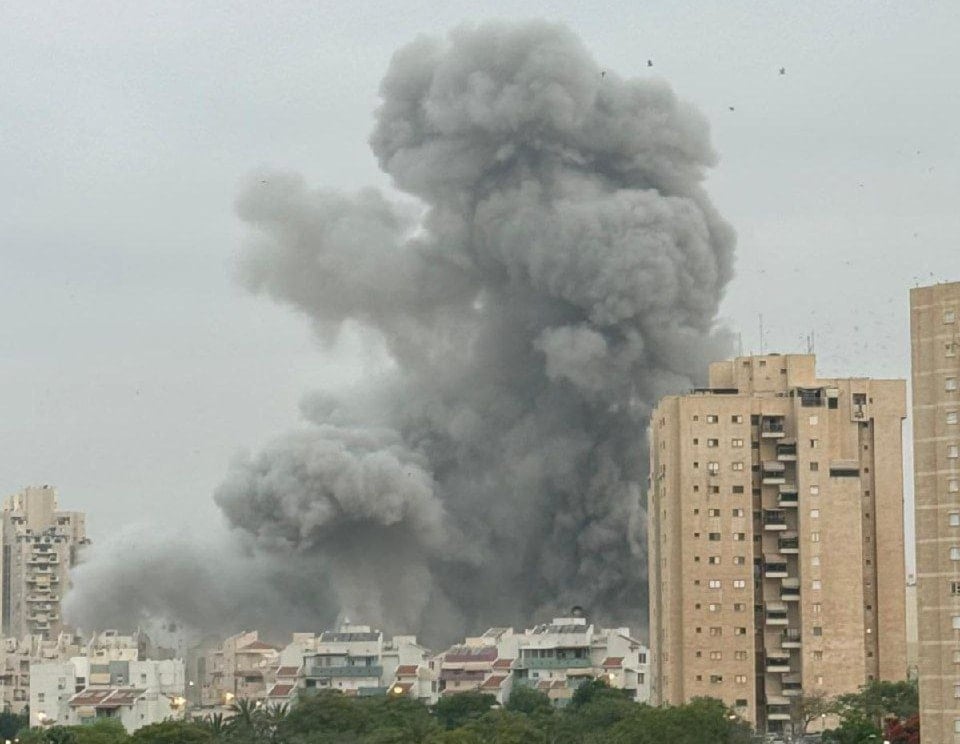
The IRGC announced the launch of the targeting key sites across the occupied territories with a combination of long-range ballistic missiles utilizing advanced strike tactics. In its first major response to US and Israeli airstrikes, Iran targets Ben Gurion Airport and military hubs with a new wave of ballistic missile attacks. Over 20 missiles landed in various locations across the occupied territories- this would mean that Israeli air defenses intercepted 50 % of the incoming missiles. A first wave of in the north and the al-Naqab desert. Minutes later, a second wave of missile strikes launched from Iran, this time targeting central areas including Tel Aviv and al-Quds. At around 6:15 am (local time), the Israeli military warned of a third wave of strikes, prompting renewed sirens in central areas, including Tel Aviv and Bir al-Sabe’. Shortly after, at 6:33 am, the military issued a brief message permitting settlers to leave protected areas, only to reverse the instruction a minute later as a fourth missile salvo was launched. By 6:41 am, sirens were again sounding across Tel Aviv and its surrounding areas. Confirmed missile impacts were recorded in Haifa, Tel Aviv and other areas. In the aftermath of the attack, the Israeli military’s spokesperson called on the public and media to refrain from sharing footage or images of the impact zones. Despite this, footage continued to come in from the impacted areas, showcasing the massive destruction. The latest phase of the operation employed missiles powered by both liquid and solid propellants, equipped with high-impact warheads and enhanced features specifically designed to bypass enemy air defense systems.
The IRGC confirmed that the targets struck during this wave included Ben Gurion Airport, a biological research facility, and command, control, and logistical support bases at multiple levels. Significantly, the operation featured the first combat deployment of the third-generation a development the IRGC described as a major advancement in strike capabilities. According to the statement, the missiles used in this wave were equipped with highly destructive, maneuverable warheads capable of being guided all the way to impact. The IRGC noted that the warheads are designed to penetrate enemy defenses and detonate with devastating effect. “We have adopted new and surprising tactics to achieve more precise, destructive, and effective strikes,” the IRGC stated, adding that the use of advanced guidance and terminal maneuverability caught the enemy off guard. In a notable assertion, the IRGC said that air raid sirens in the targeted areas sounded only after the missiles had already hit their targets, contributing to confusion and disruption among enemy forces. The timing, they said, caused “the enemy to lose its balance.” The IRGC concluded by emphasizing that the full strength of Iran’s military capabilities has not yet been revealed. “The most significant capabilities of the Armed Forces of the Islamic Republic of Iran in this sacred defense have not yet been deployed,” the statement warned.
Not only were that, but Trump declared the sites “totally obliterated.” This was an obvious lie. This gives us a key clue that Trump bombed Iran to satisfy the Zionists, but in such a smart way, by declaring that Iran’s nuclear sites are finished. Thus, this ongoing nagging from the Zionists ends. Now, any more noise from the Zionists cannot bring this subject of Iran’s nuclear program up ever again. New York knows the capability demonstrated by Iran against Israel. Thus, the Empire will not take the chance of seeing its entire military infrastructure in the region wiped out. The US will continue to apply pressure on Iran over the coming months. They have no choice but to bring Iran down. The way things stand now, they either defeat Iran or risk a complete collapse of their Empire. The Rockefeller aim is to shut down the Straits of Hormuz, but for them, the time is not now. In retaliation, Iran’s parliament voted to the closure of the Strait of Hormuz—a critical maritime chokepoint through which 20% of the world’s oil flows—sparking renewed anxiety among global energy traders over the threat to vital tanker lanes.
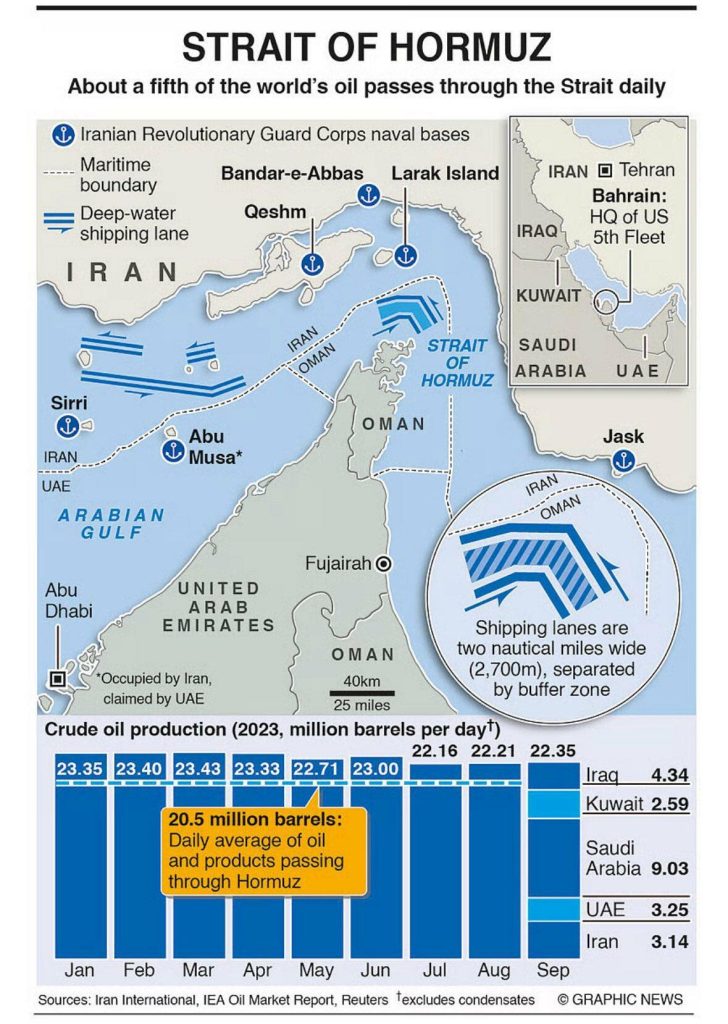
Iran has several military and asymmetric tools at its disposal to disrupt or close the Strait of Hormuz, including: Fast Attack Boats & Swarm Tactics, Anti-Ship Missiles, Submarine Operations, Seizing or Boarding Tankers, Shore-Based Artillery or Rocket Attacks or Drone Strikes, GPS Scrambling, Cyber-attacks on Port Infrastructure and Coordinated Proxy Attacks. In addition to put a selected ban on oil tankers “going to unfriendly countries”. Tehran was preparing to blockade the Strait of Hormuz using one of its most effective and low-cost tactics: littering the narrow shipping corridor with naval mines. The loading of the mines – which have not been deployed in the strait – suggests that Tehran may have been serious about closing one of the world’s busiest shipping lanes, a move that would have escalated an already-spiraling conflict and severely hobbled global commerce. It is also unclear if the mines have since been unloaded. Iran’s legislature reportedly voted to close the Strait of Hormuz, but the final decision remains with Iran’s National Security Council. Iran has a range of military, political, and asymmetric options to try to close or disrupt the Strait of Hormuz, a key chokepoint through which about 20–30% of global oil shipments pass. These include:
Iran’s ultimate decision hinges on a number of factors. First, Iran is not likely to shut off the flow of oil that would harm India or China, which means Iran is likely to consult with those governments. Second, Iran is not eager to sabotage its relations with Saudi Arabia, and is also going to talk with MBS before taking this step. A further possibility is that Iran could impose “selective sanctions”, by stopping any oil tankers going to the West, but allowing oil flows going to “friendly countries”. When Trump found out that Israel bombed Iran, after agreeing with Iran to end the US-Iran clash, he blew up, got angry, and he used the F word. It was shocking, as never before has a sitting US President admonished Israel in public before.
The other important thing is, while the US boasts of triumph, in reality the off-ramp may have very well saved US future humiliation as well. The rare GBU-57 bunker busters used against Iranian sites number only 20 in total, which means the 14 dropped on Iran represented 70% of the entire US arsenal of this highly unique weapon. If true, that means the US essentially lost its capability to even significantly damage Iranian underground sites after this one attack—whether it was ‘fake’ or not. Sure, the US could slowly produce more, but if 20 represented the entire arsenal, we can only assume their production rate is glacial. That’s not to mention, next time Iran may not be so ‘agreeable’ in rolling out the welcome mat for that B-2A squadron. The main takeaway: It is now clear that Israel relied on a favored go-to modus operandi in its past three conflicts. Israel has now lost against Hamas, lost against Hezbollah, and lost to Iran. Each time, its face-saving strategy was to “decapitate the leadership”, particularly the well-known personalities like Nasrallah and co., and pretend this is somehow a war winning stroke. In reality, it did nothing each time. Israel still lost the fight on the ground—or in the air, as it were, against Iran. Israel’s putrid army proved incapable of winning real conflicts and had to rely entirely on PR victories and America’s bank to fund various sabotage and extortion schemes against enemy political and military figures.
Think about it this way: in ten or twenty years, what will be remembered about today, the names of a few random “Iranian generals” that Israel “masterfully killed” via cowardly sneak attacks, or the fact that Israeli cities burned for the first time, Israel failed to defang Iran’s nuclear program, and flopped at every other major objective it had, including regime change? The fact is that Israel suffered a humiliation that has destroyed its mystique and reputation as some kind of ‘military juggernaut’ forever. Iran can now learn from its mistakes, and has replaced the few launchers and AD systems it lost, and potentially signs new pacts with Russia-China that can expand its defense capabilities. It is interesting, however, that Iran’s air force did not seem to participate at all—some experts suggest Iran likely relocated its entire air force to the far east of the country and simply kept it out of harm’s way the entire time. In fact, Iran masterfully conserved its limitations and leveraged its greatest advantages during this conflict, thus limiting the damage it suffered. Too bad we’ll never know the truth about Iran’s missile capabilities given how fanatically Israel began to protect any ‘sensitive’ damage reports about the strikes on its territory. But due to how uncharacteristically quickly Israel leaped at the ceasefire offer, logic dictates that the damage Iran meted was significant and unsustainable. In short, the only thing Israel has proved to excel at is murdering civilians and assassinating people with drones while they sleep. Just check wherein an Israeli operative threatens to kill an Iranian general’s “wife and children” if he does not comply, by leaving Iran. Threats such as these, plus blackmail and bribery – that is what Israel is about.
Iran’s victory will embolden resistance movements across the world. That is because for once, not only was Israel made to look truly vulnerable, but the US by its side looked spineless and ultimately weak with its obviously fake show strikes. The Houthis, China, and others were watching, and they were not impressed. Tehran braces for the long war after twin betrayals from Washington and Tel Aviv- Tehran’s message: No illusions, no retreat. Iran has survived war and siege before, but this time Iran knows it is staring down a global colonial axis determined to crush its sovereignty. Yet Iran is not a passive actor. On the contrary, Iran has leveraged four decades of investment in defense to inflict historic damage on the occupation state’s home front – unseen since 1948. What Tehran has revealed so far represents just a sliver of its arsenal. So what’s next? Iran has already shattered the illusion of Israeli air defense. The message is clear: There will be no concessions dressed up as “de-escalation.” Tel Aviv and its settlers will bear the cost of their aggression. This raises the prospect of a “triple retaliation” strategy – one that may not spare the US footprint in Jordan, Kurdistan, Azerbaijan or even its bases in Iraq. Between the two betrayals and two invasions, Iran is not merely reacting – it is recalibrating. With strategic patience and confidence in its capabilities, Tehran is once again confronting the Rockefellers as it did four decades ago against the US-backed invasion by the late Iraqi president Saddam Hussein. And just as it did not fold then, it will not fold now.
China and Russia Reaffirm Support for Iran as Iran Weighs Response Options
The biggest factor is Russia. Iran’s Foreign Minister Araghchi was in Moscow and met with Putin,(a day before the war ended) who made it clear in the last few days that Russia is prepared to provide all support Iran requests to boost air-defense capabilities, provide intelligence and expand efforts to build up Iran’s ability to produce nuclear energy. The ball is in Iran’s court. Putin explained to diplomats at the SPIEF Conference recently held in Russia, that he offered to sign a defense pact with Iran, but Iran declined to do so. President Pezeskishian of Iran still held out hopes for an improved relationship with the West, and believed that signing such an agreement would antagonize the US. He now realizes that he was foolishly naïve. Putin has made it clear that Russia is prepared to help Iran defend itself by providing air defense systems, such as the S-400. Putin has said that Iran made no request for additional air-defense systems. Iran has agreed to accept China’s offer of assistance, such as deploying several air defense systems around strategic sites throughout Iran – the US and Israel will face a more formidable challenge if it decides to renew strikes inside Iran.
3 Iran pulls off a Massive Intelligence Heist
Iran’s intelligence chief officially announces that Tehran has obtained key documents on “Israel’s” nuclear projects and ties with the West, calling it a major strategic breakthrough. Iranian Intelligence Minister Ismail Khatib has officially announced that Iranian intelligence services have acquired 1000s of documents related to the Israeli occupation’s nuclear and military infrastructure, calling it a major breakthrough in the country’s intelligence capabilities. Khatib described the operation as “complex, extensive, and multi-faceted,” involving the recruitment of individuals to access high-level sources. Though details of the mission remain classified, he confirmed that this had taken place some time ago but was only now being disclosed for security reasons. He stated that the materials obtained include comprehensive files on the Israeli regime’s nuclear facilities, and intelligence coordination with Western states, particularly the United States. The minister emphasized that these files “strengthen Iran’s offensive capability – – – (a significant shift in Tehran’s strategic positioning) – – we obtained complete nuclear documents and documents on the entity’s relations with the United States and other countries. This is not merely about thousands of pages; this is an intelligence treasure of strategic, operational, and scientific value.” He declined to specify how this was obtained, citing the sensitivity of the methods used. “The ways in which these documents were brought into the country are just as important as the documents themselves, for now, we are withholding those details – – – a very significant intelligence event; what we obtained is truly a treasure in terms of strategy, operations, and practical military planning,” he said. It is indeed a major intelligence victory against “Israel”, amid an ongoing shadow conflict between Tehran and Tel Aviv involving cyber warfare, covert operations, and proxy engagements across the region. This is the official version. The reality is that Iran’s counter-intelligence networks are not as robust as the above indicates. The truth is that these files came from a major intelligence organization, such as Russia, China or the US. Only time will tell who. The story continues in Part 2.