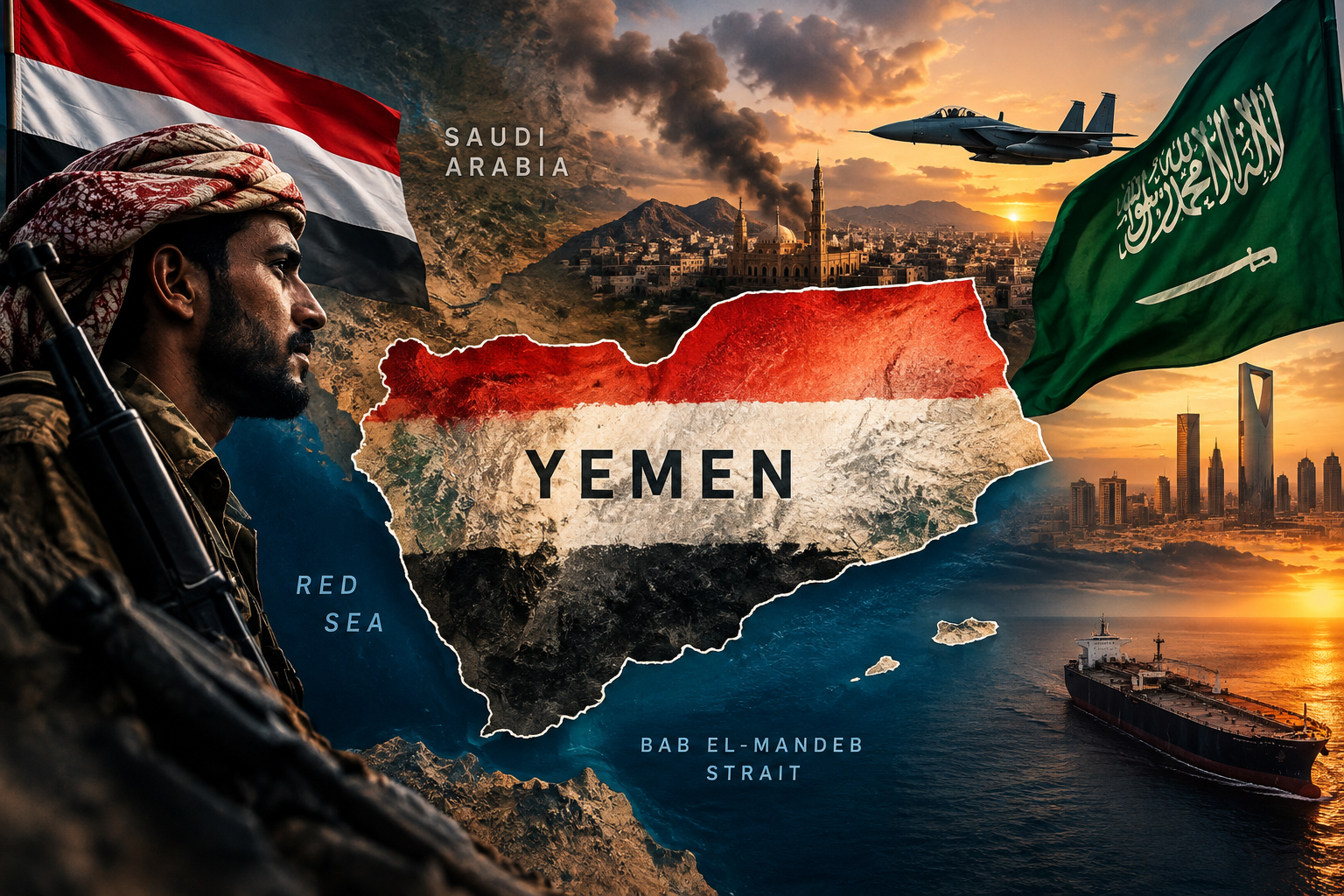
IRGC breaks down US military losses over 15 days of Iranian strikes as of 25th July.
Iran’s Islamic Revolution Guard Corps (IRGC) spokesperson Hussein Mohebbi outlined US military of retaliatory Iranian strikes on US bases across the region, in response to US aggression on the country launched from these bases. In remarks to Tasnim, Mohebbi detailed those Iranian strikes destroyed a range of fixed-wing aircraft, helicopters, and unmanned aerial vehicles.
US aircraft losses:
- 26 stationed fighter jets and helicopters -including many F-35s (Russian intel confirmed that Iran wiped out twelve F-35 fighters at a US base in JORDAN)
- 17 reconnaissance and operational UAVs
- Eight intact units
- Eight aerial refueling tankers
- Four heavy military helicopters
- One F-15 fighter jet struck inside a hardened shelter
- One P-8 Poseidon maritime patrol aircraft
- One C-17 Globemaster heavy transport aircraft
US radar, command infrastructure
The IRGC spokesperson said Iranian forces also inflicted significant damage on US military surveillance, air defense, and command infrastructure during the fighting, destroying multiple command-and-control centers, radar installations, air defense systems, and satellite communications assets.
- Seven command-and-control centers
- Six Patriot air defense radar units
- Eight early warning and detection radar systems
- Seven air defense missile radars, five long-range radar systems
- Five specialized FPS and FPS-117 radar systems
- Three air and maritime surveillance radars
- Three satellite communications systems
- US defense and logistics assets
- Mohebbi also claimed that Iranian strikes caused extensive damage to bases, targeting aircraft shelters, drone facilities, hangars, and operational infrastructure used to support air operations.
- Six MQ-9 Reaper drone hangars (the total MQ-9 Reaper drones downed by Iran and Yemen amount to around a third of Us inventories before the February war)
- Five fighter aircraft hangars and four hardened shelters
- One F-15 fighter preparation hangar, one UAV hangar housing eight new drones
- One P-8 aircraft hangar
- Six flight and parking ramps
- Four HIMARS mobile artillery rocket launchers
- Four Patriots
Supply and intelligence facilities:
- 17 depots containing weaponry
- Naval vessel components
- Aircraft spare parts were destroyed
- 12 fuel storage tanks
- One fuel dock
- One aircraft carrier refueling platform
- The losses also included, as per the spokesperson, six underground missile bunkers, six fighter and helicopter maintenance centers, two signals intelligence communication centers, one data intelligence hub, one artificial intelligence processing center, one Amazon data node, and one unmanned surface vehicle (USV) storage facility.
The losses listed above are only for 15 days. These do not include military losses suffered by Israel, the US and the Gulf Arab states from the first Israeli/US attack on Iran in June 2024 till Mid-February.
Over 2000 American soldiers killed in strikes on US bases. Brig. Gen. Hossein Mohebi revealed that more than 2000 American personnel were killed during Operation Nasr 2. He described US reports on its military casualties as ” hiding the true losses “. IRGC spokesperson added that Iranian forces struck eight US military bases during the operation, including one facility containing 20 hangars that were destroyed. The spokesperson also urged the American public not to allow what he called their “dishonest military commanders” to mislead them about the extent of the losses. He further called on the US government to allow journalists access to the strike locations so they could independently assess the damage and determine how many personnel had been killed. A US pilot rescued after being shot down over Iran described a shocking sight before ejecting from his aircraft: multiple Iranian drones hovering in the air, moving as one, in a formation that resembled a jellyfish. If the airman really saw what he described — a formation moving in unison — it would be an alarming advance in Iranian drone capabilities. “Multiple drones interconnected and moving as one with smaller drones below the bigger drones like legs,” one of the sources familiar with the pilot’s witness account told CNN. “Real alien sh*t.”
The War Crime: Thirst as a Weapon
The consequences of this American tantrum were immediate and horrific. Under the cover of darkness, US and “Israeli” warplanes unleashed a barrage of strikes on southern Iran, targeting the Hormozgan province. But amidst the claimed hits on radar and communications, a far more sinister target was struck: the very source of life itself. US missiles obliterated two concrete water storage reservoirs in the Sirik County. The strike cut off drinking water to over 20,000 residents and ten surrounding villages, a region already parched by years of drought.
The Iron Retort: 21 Targets; A Surgical and Decisive Blow
Iran’s response was not long in coming, and it was executed with the precision of a surgeon and the force of a sledgehammer. The Islamic Revolution Guards Corps (IRGC) launched a coordinated, multi-front retaliation that once again shattered any remaining illusion of American invulnerability in the Gulf. The operation began at 02:30 a.m. local time with the first wave of drone strikes on the US Fifth Fleet headquarters in Bahrain. In a sweeping operation, Iranian forces struck 21 separate targets with a sophisticated cocktail of assorted firepower, across US bases in Bahrain, Kuwait, and Jordan. The crown jewel of this response was the strike on the Al-Azraq base in Jordan, a critical hub for US F-35 operations. Long-range ballistic missiles pounded the base, targeting hangars and the base’s primary command and control center, sending a clear message: no American asset in the region is beyond the reach of Iranian justice. According to the IRGC’s Aerospace Force, their solid-fuel missiles struck and destroyed all four priority targets. In Kuwait, the assault was equally intense. Along with another devastating missile strike package—drones once more swarmed Kuwait’s U.S. Ali Al Salem base and the US Fifth Fleet headquarters in a second wave. “This is a categorically different order of escalation,” as the reality set in that Iran had successfully opened three new fronts simultaneously. The IRGC’s warning was crystal clear: they stand ready for a “crushing and decisive response” to any further aggression. The era of the US parking its fleets and planes with impunity is over. History teaches us when a nation deals with a bully and a hegemonic power, you don’t back down. You fight. And fight some more. The only way to get the hegemon to the negotiating table is to give it a bloody nose, preferably a broken one. And so, the cycle continues. Recent developments in the confrontation between “Israel” and Iran exposed the limits of Israeli strategic autonomy, with US intervention ultimately determining the course of escalation.
So, here we are. The military skirmishes — effectively an abbreviated series of strikes by U.S. forces on Iranian shipping and Strait infrastructure, arising from Trump’s desire to assert its naval blockade to U.S. public opinion — continue. This situation is clearly flammable – just as is the Lebanon context. Iran is far from isolated and is positioned for a prolonged war, with meaningful material and strategic backing from China, Pakistan, and North Korea, and carefully calculated support from Russia. China has delivered state-of-the-art strategic defense systems to Iran – including shoulder-fired MANPADs – routed covertly through third countries. The breakdown: a total, operationally active China-Iran-Pakistan strategic alignment is in effect. The leaves Islamabad as the only exit route in town, with Field Marshal Asim Munir positioned as the indispensable intermediary; and Beijing and Moscow following everything closely, in some respects actively shaping the outer frame. Behind Iran’s decision to suspend talks however, likely lies the gradually dawning clarity, seeping out from Israeli and American statements and that the true objective of the 28 February U.S.-Israeli sneak attack was never regime change per se — but the complete destruction of Iran – an insight that was bound to shift Iran’s calculus.
CIA Stations Destroyed
Russia has likely played a role in targeting regional CIA facilities. The attack on the CIA station in Riyadh in particular used Russian- “enhanced” variants of the Shahed drone, the accuracy of which left officials scrambling for answers. One of the aircraft blew a hole through a vulnerable part of the embassy’s exterior and the second flew through the opening and detonated, they said. Russia has helped Tehran improve the accuracy of its Shahed-136s by supplying a satellite navigation system — the Kometa-M is far more accurate and harder to jam than the one produced by Iran. Many of the CIA stations hit were “closely guarded secrets”, presumably implying that only Russia could have disclosed their coordinates. The locations of those sites are closely guarded secrets. The exact number or locations of CIA facilities hit by Iranian drones. Many of these CIA sites were hit, along with sites belonging to the Mossad and MI6.
Kurdistan & Other Areas
Washington is pressuring leaders in the Kurdistan Region of Iraq to become directly involved in the war against Iran- the United States has threatened to undermine the region’s existing governing arrangement if its leaders refuse to participate. In response, Iran has directly warned leaders in the Iraqi Kurdistan Region against becoming involved in the war or supporting separatist groups, according to the correspondent, as any such involvement would prompt a direct response. Iraqi Kurdistan (see map below) has served the 2 families as a “spoiler” in the region. Iran knew well that the US had armed, trained, funded and directed the Kurdish forces to do their dirty work in the region- for money. The CIA had prepared another front in the war against Iran, through Iraqi Kurdistan. Several of these groups, including Komala, had received arms and money from both the United States and Israel prior to the start of the war as part of an ill-fated plot to launch a ground offensive from Kurdistan into Iraq. Trump ultimately vetoed the plot, at the request of Turkey, leaving these parties largely abandoned to face Iran alone. Iran also put paid to any plans for US-trained Kurdish forces to infiltrate its western borders. It carried out devastating strikes on their military camps, ammunition dumps and staging grounds in Erbil and Sulaymaniyah, whilst special forces undertook cross-border raids.
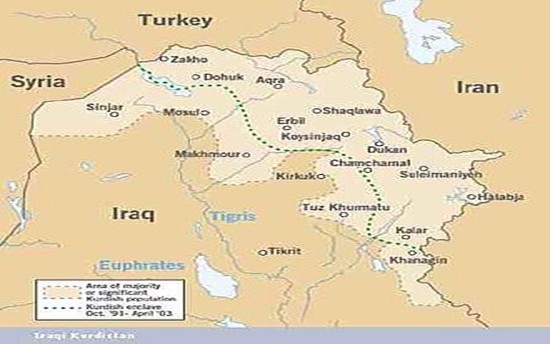
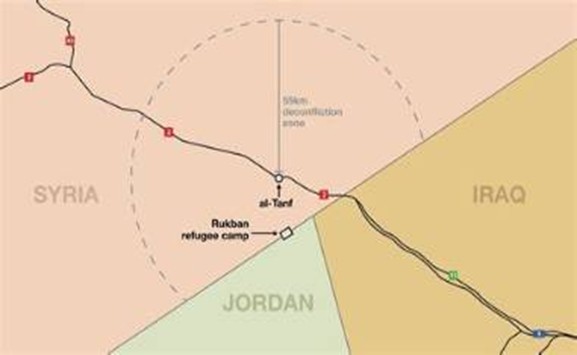
Iran began targeting Kurdish opposition parties based in Kurdistan soon after the start of the American-Israeli war last February. The attacks continued even after a ceasefire was announced in June. Nearly all US infrastructure in Erbil, Iraq, has been destroyed, adding that US/Israeli/British forces based in the city are no longer capable of carrying out operations against Iran. Many senior military and intelligence officers were killed in these attacks. All CIA/Mossad/MI6 bases wiped out. Iran then sent in its special forces to take out the remaining leaders of these groups, and destroyed warehouses, ammunition and equipment, including air-defense systems, radars, etc. Iran attacked and destroyed a radar system and several special operations helicopters at al-Tanf garrison, adding that a large number of American troops had been killed in the strike. This base is located at the intersection of 2 borders-Iraq, Syria and Jordan. This paves the way for Iraqi PMFs to cross over into Syria to help Hezbollah, if Jolani decides to invade Lebanon. With troops and war matériel being amassed along Iran’s southwestern border, Iranian armed forces entering Kuwait or Bahrain to confront US forces directly is well within existing capabilities — Iran has well over 500,000 men under arms.
the Iran has also targeted -multiple times-U.S. base at al-Azraq in Jordan, with its Aerospace Force hitting shelters housing F-15, F-16, and F-35 aircraft and destroying a number of MQ-9 drones stationed there, along with their shelter. In Oman, US air-defense systems were destroyed. Iran’s Army announced on July 17 that its naval forces had successfully targeted a United States “aggressor vessel” in the northern Indian Ocean using an anti-ship cruise missile with a range of up to 1,000 kms. The missile launch caused panic among enemy forces, forcing the targeted vessel to retreat beyond the range of Iranian fire. The Pentagon claims that its objective in using force against Iran in the Strait of Hormuz is to degrade Iran’s ability to attack commercial shipping, employing precision munitions against Iranian coastal defense systems, missile and drone sites, and maritime capabilities. Here’s the next problem… Iran is firing from more than 1,000 locations along the 171-mile coast stretching from north to south. If CENTCOM could destroy all missile and drone sites along the coast, it still leaves untouched the missile and drone launch sites in the interior of Iran that can reach the Strait. In other words, the US does not have enough Tomahawk and JASSMs in inventory to degrade Iran’s ability to attack non-compliant ships in the Strait of Hormuz. I also want you to focus on the fact that Iran has a much easier task in retaliating against the US attacks. The US is carrying out air and missile operations from less than 10 bases — i.e., two in Jordan, one in Kuwait, one in Bahrain, one in Qatar, one in the UAE and one in Oman. All Iran has to do every time it is attacked is to pummel those same seven bases repeatedly until they are no longer capable of supporting US military operations. Instead of trying to hit 1,000 targets — many which are protected by caves or underground sites — Iran only has to focus on the limited number of bases hosting US forces and operations. This is why Trump’s latest war is doomed to failure.
Saudi was also sent a clear message. Iranian missiles and drones targeted Prince Sultan Air Base in Al-Kharj and the Aramco-ExxonMobil SAMREF refinery at Yanbu on the Red Sea coast — the first direct Iranian attacks on Saudi in four months — whilst the Yemeni Armed Forces have officially announced a naval blockade of the Kingdom. Meaning — the five million barrels a day that Riyadh can export through Yanbu, bypassing the Strait of Hormuz, is at Tehran’s discretion. The depth of Iran’s surveillance, intelligence and reconnaissance was again acutely demonstrated with ‘insanely precise’ strikes on Jordan’s King Faisal Air Base, Muwaffaq Salti Air Base and King Hussein civilian airport in Aqaba — to which many US air assets had evacuated from their bases in the Persian Gulf. As before, we may never know the full extent of fighter jets or how many aircraft, helicopters and drones have been destroyed, but the satellite images tell their own story. Bluntly, the once-peerless US air force is being chased further and further back, extending flight times and the need for more air tankers. US air assets were first forced to evacuate from Bahrain, Kuwait, Qatar and the Emirates to western Saudi Arabia. Then from Saudi to military air bases in Jordan. From there to Jordan’s civilian airport in Aqaba. Reports now indicate US air assets are again evacuating — only this time from Aqaba to Israel’s Ovda Air Base. That is why another fourteen air tankers have been sent to Israel and many more fighter jets en route as well. Does such a concentration of strategic air assets not increase their vulnerability — particularly when they are being stationed at just a few Israeli air bases, mainly Ramon and Ovda?
Damning Admission of NATO’s Complicity
Iran is demanding that all members of the NATO alliance who participated in the US-Israeli war against the country earlier this year be held accountable for war crimes and other violations of international law. The demand followed the recent admission by NATO Secretary General Mark Rutte about the role of European countries during the US-Israeli war in Iran, which began on 28 February and ended with a ceasefire on 8 April. Rutte admitted that thousands of aircraft took off from US bases in various European countries during the US-Israeli aggression in Iran. “Country after country, ally after ally have made their bases available “between 4,000 to 5,000 planes taking off from European bases to support attacks on Iran. Along with Italy and Romania, which were named by Rutte, “every other European country that has assisted the US-Israeli aggression against Iran must explain to their own people and to the world why they chose to collude in this blatant act of aggression and in the commission of mass atrocities against Iranian people; NATO and its individual member states that participated in such decision-making must be held accountable for all the consequences,” Iran said.
US hiding True Casualties
Regarding US casualty figures, the IRGC stated that the American military has suffered hundreds of deaths and wounded during the five-month war. The statement said the daily evacuation of large numbers of wounded via ambulance aircraft to an American hospital in Germany is clear evidence of high casualties. The US military, which has suffered hundreds of fatalities and many more wounded during the past five months of the war, is lying to its own people by claiming it has sustained fewer than 20 deaths. It is the responsibility of the American media to investigate the realities of this war, the heavy casualties suffered by the US military, the extensive damage it has incurred, and the true financial costs that have been concealed from the public, the IRGC’s statement read. It added that the media outlets are responsible for exposing the real figures and the methods of censorship employed by the “deceptive rulers”.
U.S. precision-munitions stocks are reportedly thinning. Analyst assessments built on published inventory data suggest roughly 56 PRSMs have been built to date, fewer than 2,000 Tomahawks remain in the global stockpile, and perhaps as few as 700 are available to CENTCOM specifically. If accurate, that is not a force sized for an open-ended war of attrition. However, the US has no viable replacement for the Reaper. General Atomics stopped production of the drone in 2020, and the Pentagon is not expected to launch its program to select a successor until later this year. Meanwhile the Senate has recommended that MQ-9 production be restarted, a Senate hearing in June was told that the Pentagon is “looking at options to buy back as many of the MQ-9As as we possibly can” from US allies. The Reaper is one of multiple weapons systems left in short supply by the Iran war. The US has reportedly used more than half of its Patriot and 80% of its THAAD anti-air missiles, and a third of its Tomahawk cruise missiles since February 28. Trump has denied that the US is facing a missile shortage, but has asked Congress for $87.6 billion to cover “urgent needs” related to the war, including $21 billion for munitions. Put together, the thesis is blunt: this isn’t the U.S. grinding Iran down. It is Iran grinding the U.S. down — deliberately extending a campaign it believes it can outlast, using an accuracy advantage Washington didn’t anticipate against a munitions stockpile that isn’t built for a long fight.
3 Data Center Attacks
The Middle East hosts around 180+ existing data centers, with countries like the UAE & Saudi Arabia having a strong presence in the region. Saudi Arabia has 22 functioning and another 40 under construction.
IRGC finishes off Amazon data center, tells US fatalities in hundreds
On July 23, The IRGC) hitting the remaining building of an Amazon company data center and a large ammunition depot at a US base, as part of ongoing operations against American military assets in the region. The statement added that barracks housing personnel at the same base were also attacked, with six large structures destroyed and three others sustaining significant damage, while and wounded in the strikes. In response, the US attacked 16 Iranian cities in total. The targeted Amazon infrastructure in Bahrain was destroyed. This Amazon Web Services’ primary Bahrain data center, known as “me-south-1.” The center, serves as a cornerstone of the company’s Middle East cloud infrastructure, delivering low-latency computing, storage, and artificial intelligence services across the region while supporting regional digital transformation. Tech companies were in the line of fire throughout the earlier stages of the war on the Islamic Republic. In March, apps and digital services in the United Arab Emirates reported outages following drone strikes on Amazon Web Services’ data centers in the Gulf state, with the facility in Bahrain also damaged. Later in April, the IRGC threatened attacks on a range of U.S. tech companies with operations in the Middle East, including Nvidia, Apple, Microsoft, and Google.
The Blind Eagle: How Iran Shattered US “Digital Eye” and Evacuated Al Udeid Airbase
The dawn of Wednesday, 22nd July 2026, broke over an Iran scarred by another night of indiscriminate American violence. The latest wave of terror, orchestrated from the comfort of distant command centers that dwindle by the day, targeted a sprawling arc of locations across the southern and northwestern reaches of Iran aiming to cripple the nation’s logistical spine and break its will. If the American campaign was characterized by brute force and diplomatic flailing, the Iranian response was a masterclass in asymmetric warfare, precise, calculated, and devastatingly effective. Iran orchestrated a symphony of strikes that exposed the vulnerabilities of the American military footprint across the region. The kinetic response, which unfolded in a coordinated series of waves, targeted the very nerve centers of US power projection, leaving a trail of damage that would take months, if not years, to repair. This was not the sporadic retaliation of a cornered actor but the deliberate execution of a strategic doctrine that had been years in the making. The most audacious stroke of this kinetic symphony was directed at the “digital eye” of CENTCOM in Bahrain, the very nervous system of American hegemony. In a move that sent shockwaves through the American defense establishment, transcending traditional warfare, the Iranian Armed Forces struck at the heart of the imperial digital apparatus, Amazon’s central data infrastructure in Bahrain, during the 24th wave of Operation Nasr-2. This was no incidental collateral damage; it was a surgical decapitation of the “digital eye” of US Central Command. The target was the Amazon Web Services (AWS) cloud region known as ‘me-south-1’, a facility launched in 2019 as the company’s first dedicated data processing center in the Middle East. Tehran identified this site not merely as a commercial hub, but as the main artery of intelligence processing for Washington and its allies in the Persian Gulf, the critical node through which the fog of war is cleared for the American war machine. The strategic profundity of this strike cannot be overstated. Amazon is one of the four principal contractors under the US Department of Defense’s Joint Warfighting Cloud Capability (JWCC) program, a colossal $9 billion contract that enables the Pentagon to deploy cloud computing, data analytics, and artificial intelligence tools across operational fronts and regional military bases. By targeting this facility, Iran did not just disrupt a server farm; it sought to blind the algorithmic gazeof the Pentagon, severing the data links that coordinate drone swarms, guide munitions, and process the intelligence upon which American air superiority relies. It was a direct challenge to the notion that the cloud is a sanctuary beyond the reach of kinetic retribution, a bolddeclaration that in this new era of hybrid warfare, the code is as vulnerable as the steel. The damage to the CENTCOM facilities in Bahrain was not just physical; it was a psychological blow that shattered the myth of American supremacy in the region.
From the Straits of Hormuz to the Strait of Malacca, the geography of power has long been defined by the movement of oil. Yet as attention fixed on the vessels trapped above the water, another transformation was already in motion below it. If oil powered the Industrial Age, then bits power the Age of AI. The defining competition of the 21st century is no longer only about moving barrels across oceans. Instead, it is increasingly about moving bits across continents.
From Tankers to Fiber Networks
For more than a century, pipelines, tankers, refineries, and maritime chokepoints defined the architecture of global power. Whoever secured the movement of energy enjoyed economic leverage, political influence, and strategic advantage. That structure still holds, though it now extends into a wider system. Globally, 500 submarine cables spanning 1.7 million kms now connect global markets and institutions. They synchronize financial systems, link cloud platforms, support government services, and enable nearly every advanced AI application. Despite its name, the cloud has a physical footprint. It relies on electricity grids, semiconductor supply chains, hyperscale data centers, exchange points, landing stations, and resilient submarine networks. AI is often framed as software. In practice, it rests on infrastructure. Every advanced AI model ultimately depends on reliable electricity, enormous computing capacity, sophisticated chips, secure cloud architecture, and uninterrupted international connectivity. Without these physical foundations, AI cannot function at scale. This is why digital infrastructure is no longer a technical layer alone. It has become a strategic asset. Aircraft carriers still matter. Oil tankers still matter. They now sit alongside fabrication plants, GPU clusters, cloud platforms, data centers, and submarine cables as determinants of technological advantage. Submarine cables are the lifelines of the digital age. Protecting the infrastructure that powers the digital economy is becoming a strategic priority. As AI reshapes global competition, countries that host, secure, and connect these networks will increasingly influence the distribution of economic and geopolitical power.
West Asia’s Second Layer of Leverage
Nowhere is this shift more visible than in the Middle East. For decades, the region’s geopolitical weight rested on hydrocarbons and maritime geography. Oil exports made the Persian Gulf indispensable, while Suez, Bab al-Mandab, and Hormuz became enduring points of leverage. Those dynamics remain as a second layer is taking shape. Projects such as 2Africa, SEA-ME-WE 6, PEACE Cable, and Blue-Raman are reshaping the geography of global connectivity. Although presented as commercial telecommunications projects, they are also strategic investments in the infrastructure of the digital economy. They are reshaping how data moves between Europe, Asia, Africa, and the Gulf. The Red Sea, Egypt, the Eastern Mediterranean, and the Gulf now function as data corridors alongside their role in energy transit. More than 90 percent of communications between Europe and Asia pass through Egypt and onward into Red Sea cable systems. In March 2024, the severing of several cables disrupted roughly a quarter of telecommunications traffic linking Asia, Europe, and Africa. States are adjusting accordingly. continues to expand its Digital Silk Road across telecommunications networks, cables, and cloud infrastructure. Gulf states, including Saudi Arabia, the UAE, and Qatar, are investing in sovereign AI, hyperscale computing, and digital platforms.
Where Digital Chokepoints Emerge
The 20th century focused on maritime chokepoints: Suez, Hormuz, Bab al-Mandab, and Malacca. The current moment requires an additional category, namely digital chokepoints. These are locations where cables, landing stations, exchange hubs, data centers, and energy infrastructure converge. Like their maritime counterparts, they concentrate dependency.
– whether through conflict, sabotage, cyber operations, natural events, or accidents
– can ripple across financial markets, logistics systems, government platforms, and cloud services. This is already a recurring risk. Between 150 and 200 cable faults occur globally each year, often caused by anchoring or fishing activity. In contested environments, repair becomes slower and more complex.
The Gulf is a case in point. As tensions rise, attention has turned to the vulnerability of submarine cables running through Hormuz and surrounding waters. This represents a potential “double chokepoint effect” if submarine connectivity in both the Gulf and the Red Sea were disrupted at the same time. Such a scenario would place pressure on two of the most concentrated routes linking Europe and Asia. The warning is significant. A confrontation around the Strait of Hormuz would no longer threaten only oil and shipping. It could also affect payments, cloud services, government platforms, and business operations across the Gulf. In this sense, the Strait of Hormuz is becoming both an energy chokepoint and a digital chokepoint.
The Battle Beneath the Waves
Energy security and digital security are now tightly linked. AI depends on electricity. Electricity powers data centers. Data centers rely on global connectivity. That connectivity is carried, largely unseen, across the seabed. When the ‘Ever Given’ blocked the Suez Canal, the disruption was immediate and visible. Future disruptions may not be. They may begin with a cable cut far below the surface. For more than a century, power was measured by the ability to secure the routes that carried oil. In the current phase, it is increasingly tied to the capacity to build, control, diversify, and protect the networks that carry data. The battle for global power has not left the oceans. It has simply moved beneath them.
The View from the Water
The bases are now being emptied, the aircraft relocated, the allies warned, and the infrastructure destroyed. Iran may not be winning the war in any conventional sense. But it is succeeding in a more limited and, for its strategic purposes, more important objective: the eviction of American power from its immediate neighborhood. What remained is the question of whether the eviction would stop at the water’s edge, or whether it would pull the entire region, and the global economy, into a darkness from which there would be no quick return. This not only degrades US’s own capabilities for striking Iran, but slowly concentrates US troops in vulnerable areas like the Jordanian base, which allows Iran to then pick them off. As other Gulf allies restrict US activity, the US is forced into increasingly vulnerable positions.As the war escalated, Washington pulled forces out of Bahrain, the UAE, and Qatar — more exposed and more politically fragile — and concentrated them in Jordan. With other Gulf allies restricting US basing and overflight rights, Jordan quietly became the main platform for American air operations across Syria, Iraq, and the wider region. That is precisely why Iran turned to it. When the enemy consolidates into one place, that place becomes the target. Striking the bases at Azraq and King Faisal is not about a single airfield — it is an attempt to make hosting US forces cost more than it is worth, and to destabilize the last platform Washington considered secure. The tempo tells the rest: four attacks in five days on US bases in Jordan, dozens of US troops killed and wounded, and a significant number of US Blackhawk helicopters damaged. Iran is not only signaling intent — it is demonstrating it still holds deep missile stocks and can now reach the one place the US believed was safe. As can be seen, Iran is forcing the US to retreat by devastating the regional bases closest to Iran itself. Now some Iranian figures are even proposing that Iran could launch its own offensive ground invasion to take US bases in neighboring Kuwait. The two bases would presumably be Camp Buehring in north Kuwait about 100km from the Iranian border, and perhaps Camp Arifjan or Ali Al Salem Air Base.
4 Iran Imposes a New Equation
IRGC declares new regional security belt extending from Hormuz to Red Sea
The commander of Iran’s Islamic Revolutionary Guard Corps (IRGC) Quds Force Esmail Qaani on 9 June the creation of a “new security belt” managed by the Axis of Resistance, spanning from the Strait of Hormuz to the Bab al-Mandab Strait. This strategic corridor, encompassing the Persian Gulf and Red Sea, is designed to counter military actions by Israel and the US. Qaani described the initiative as a coordinated effort by the “united resistance front,”. The Quds Force commander issued a direct warning to Iran’s adversaries, stating: “Borderless fighters are overseeing your transit chokepoints. Continue your aggression, and they will seize your throat.” The maritime expansion follows the formal adoption of a “new strategic defense doctrine” announced by Iranian officials his country shifted its posture to “take the initiative” in defending its regional allies rather than waiting for threats to materialize. Under this framework, an attack on any member of the Axis of Resistance is considered an attack on Iran, necessitating a response that extends to reshape regional “equations.”
China provides Critical ISR Help
During the 12-day war in June 2025, Iranian missiles and drones struggled against sophisticated Israeli and American electronic warfare. GPS jamming and spoofing repeatedly disrupted their guidance systems, limiting their effectiveness during the intense 12-day conflict. Fast-forward to early 2026, and the battlefield dynamics had shifted dramatically. Iran’s precision strikes began threading through advanced air defenses, hitting high-value targets across the Gulf with surprising accuracy. Intelligence analysts pointed to one key factor: Iran had ditched GPS for China’s Beidou satellite navigation system.The US unwittingly provided the spark that ignited China’s quest for the Beidou. The story begins in 1993 when a single Chinese container ship, the Yinhe, sailing to Iran, the vessel was accused by the CIA of carrying chemicals for weapons production. Middle Eastern ports, under pressure from the US, refused entry and the ship was stranded in the Indian Ocean. The US not only pressured allies but reportedly disabled the ship’s GPS access, forcing it to drop anchor for weeks. Inspections in Saudi Arabia eventually cleared the vessel, but China received no apology or compensation. This humiliation—losing navigation mid-ocean due to reliance on a foreign-controlled system—became a pivotal lesson for Beijing. It accelerated development of an independent satellite navigation network:
- Beidou (BDS).
- BDS-1 (2000s) provided initial regional coverage.
- BDS-2 expanded capabilities.
- BDS-3 (completed around 2020) transformed it into a global powerhouse with dozens of satellites, far more ground stations (especially in the Global South), and superior accuracy in many regions compared to GPS.
Today, Beidou outperforms GPS in coverage and precision across roughly 165 countries, offering a resilient alternative that cannot be unilaterally jammed or spoofed by Western powers. After the 2025 conflict exposed vulnerabilities in GPS-dependent systems, Iran moved decisively. By late 2025 or early 2026, it integrated Beidou into its missile and drone arsenals. Reports from March 2026 already highlighted dramatic improvements: Iranian munitions evaded electronic countermeasures that had worked months earlier.
Key advantages of Beidou for Iran include:
- Resistance to jamming/spoofing — Advanced frequency-hopping and anti-interference tech.
- Higher accuracy — Circular error probable under 5 meters in key regions, enabling precise strikes with fewer munitions.
- Real-time command — Secure messaging allows mid-flight adjustments over long distances.
This upgrade has contributed significantly to Iran’s ability to penetrate US defenses in the Gulf countries and dramatically improved Iran’s ability to strike critical targets, which has undermined confidence in US security guarantees in the Gulf. The US decision to use GPS as a weapon in 1993 has backfired spectacularly—proof that humiliating China inspired a technological leap that now gives China and its allies a strategic advantage over the US.
Iran Holds the Cards & Calls the Shots
For the first time since 1979, Iran took the initiative. The Israeli deterrence has been destroyed. Iran has shifted the entire calculus and achieved something long thought impossible. For years it was considered unthinkable that Iran would ever strike Israel directly, even after Iran was hit first. Then Iran began responding to Israeli attacks, first with ‘demonstrative’ strikes, then increasingly crippling ones. Now Iran has established total strategic dominance of the escalation ladder to the point where it can treat Israel as Israel has treated other regional countries since its founding, punitively hitting it at will for violations that no longer necessarily include direct attacks on Iranian territory. And the most shocking kicker of it all is that the US cannot do anything about it—and has even told Israel to ignore the attacks and stand down. Trump was relegated to begging Iran to stop on social media. Iran has essentially called the US and Israel’s bluff in the ultimate way, exposing them as helpless in the face of Iran’s escalation. During the 2024 ceasefire between Hezbollah and Israel, absolute violations were being committed by Israel through continuous bombings and assassinations. However, Hezbollah never responded to these violations due to strategic reasons, including the closure of its logistical supply routes from Syria following the fall of the Assad regime. By now, Hezbollah has fully learned its lesson from these types of ceasefires and will not tolerate any violations under any circumstances. What is striking, however, is that the United States wanted to impose this exact same ceasefire model on Iran. They believed Iran would not retaliate, much like Hezbollah. Yet, what Iran actually did shocked Washington. An attack on a radio tower on Qeshm Island prompted Iran to completely devastate a terminal at Kuwait Airport. At the same time, it launched an attack on Bahrain. Through this, Iran is telling the United States: “For every single bullet, we will respond with many.” The linchpin behind the new flare-up has been Israel’s failed Lebanese campaign, wherein the struggling Israeli army has slowly slogged past the Lebanese border in an attempt to control everything south of the Litani river. Frustrated with setbacks, Israel had begun bombing Beirut, after Hezbollah’s newly-found mastery of FPV drones unleashed havoc on unprepared IDF troops. Besides the US’s failings, Iran is arguably close to checkmating Israel in a major, generational way. Israel has no good options as Iran has put it between a rock and hard place in regard to Lebanon- Israel is now trapped in a quagmire in both Lebanon and Gaza with its hands increasingly tied by Trump, who himself is being swallowed by the pressures wrought of his failed Hormuz gambit. That means Israel is trapped in an untenable position with all the hornet’s nests of its surrounding enemies having been stirred up, while its economy sinks and military stocks deplete. Iran holds the high ground in virtually every way, and each passing day brings Iran more strength in reconstituting its losses. What began with widespread opinions that Israel would emerge as the big winner of all this chaos has slowly transitioned to Israel looking increasingly vulnerable and impotent. Iran has cleansed itself of Mossad networks and Israel has already blown its shot at big “surprise” intel ops that take years to plan and organize, with nothing left in the tank that can move the needle. Iran now gets politically stronger and more unified each day having weathered the dangerous opening ‘shock’ phase of US-Israel’s operations to take down the country. Time is now on Iran’s side.
The following assessment of the consequences of US and Israeli actions on the global security and financial architecture: The secondary effects of this standoff are rewiring the global strategic and financial architecture in real time:
• The Collapse of the Abraham Accords: The political infrastructure sustaining Israeli-Arab normalization is functionally dead. Pakistan has publicly rejected it, Saudi Arabia has frozen all back-channel discussions, and Qatar and Oman are actively preparing a six-to-nine-month timeline for U.S. forces to vacate their military installations.
• The Emerging Security Axis: A new Saudi-Pakistan-Turkey-Egypt security architecture is being constructed, completely detached from U.S. backing. Pakistan has elevated itself from a peripheral player to the indispensable operational pivot, leveraging an Islamic cultural proximity that neither Washington nor Beijing can replicate.
Finally, Moving onto the Domestic Equations in both the EU and the US.
The longer Iran keeps Hormuz closed, the greater the pain for western consumers-especially in the US. The Majority of Americans don’t care about what is going on beyond their borders. The American and European consumers are inward-looking, and this benign neglect of what their governments are doing overseas is now coming to bit them real hard. Iran is going to continue increasing pressure on the Western consumers. These consumers were living a good life, living off the wealth their governments, banks and corporations plundered globally. With low inflation and a higher purchasing power that their currencies enjoyed – those days have now come to an end. The only thing that matters to this crowd is fuel and food prices. Both are now going higher-with no end in sight. We can add rising interest rates adding to this combustible mix. This is now turning these consumers against their governments. More on these issues will be discusses two articles down. Over the next few months, these societies will fracture and implode. Iran’s active social media-targeting western audiences making a mockery of Trump and the Western political class has and is gaining positive views, which helps to neutralize the lies spewed by the Western msm. The story continues in Part 3.