1 Oil & Land
2 Why Israel invaded Lebanon – Again?
3 The Israeli assassination strategy is leading Israel to defeat
4 The Lebanese front-Israel’s ongoing nightmare
5 Israel’s late countermeasures
6 Intensification since the ceasefire
7Iran enters the picture
8 Israel bombs Lebanon as Hezbollah rejects ‘shameless surrender’
9 Hezbollah attritions the IDF
1 Oil & Land
In the Middle East, the 20th century witnessed two phenomena. One was the discovery of oil. The other was the colonization of Palestine by the Rothschild family- as head of international Jewry. Both of these have fused by the 1950s. By 1968, the Rockefeller push to control all the oil in the region dove-tailed with the Rothschild plans to expand their colony – Israel- to form what is known as “the Greater Israel “project, by taking over the region between the Euphrates in Iraq to the Nile in Egypt. Both of these families joined forces, with the Us backing Israel across the board. Today, both of these families- one in America and the other in Europe, has become much weakened over the past 3 decades. Desperation has taken its place as they see their plans for the region are “out-of-reach”. When all else fails, the military fist is unleashed. Fortunately, for the world, this western military fist has lost power. For both families and their associated networks of power, they see increase in war as a last-ditch means to hold on to their global empires. This is the backdrop to the current events in the world and the Middle East. Now, back to Lebanon.
On May 25, 2000, the Israeli occupation forces withdrew from most of the Lebanese lands they had occupied illegally in 1982; a move that came following nearly two decades of brutal oppression and was triggered as a result of the fierce resistance waged by the local population. For the Arab World, and specifically for the Palestinian cause for national liberation, that day became a signal that resistance does work. The Israelis withdrew from South Lebanon because they understood that the fight they were facing was going to bog them down and drain them, especially as the Lebanese Resistance was gradually growing in strength. They ran cost-benefit analyses and decided it was best to leave. Over the years, having only fought short wars against militarily inferior opponents, the Israeli society was able to live in its own bubble world. The consequences of their actions were a small price to pay, especially if these consequences were only felt during shorter periods of time. Other than this, they maintained belligerent occupations, meaning that their army was transformed into more of a riot police force than a proper standing army. During the Second Intifada, which began in 2000, only months after the liberation of South Lebanon, the Israelis then transitioned into a method of warfare that depended more heavily on “targeted assassinations” and special forces raids. They implemented this strategy, alongside their counterinsurgency approach to warfare, and specialized in occupying civilian populations. In 2006, they encountered a new obstacle, sustained rocket fire on their settlements, managing to blast as deep into occupied Palestine as Haifa. Later on, the Palestinian Resistance would develop its own rockets and eventually reach Tel Aviv and beyond. However, due to Gaza’s resistance being significantly weaker than Hezbollah, they settled for limited wars of aggression where they would implement the infamous “Dahiye Doctrine” – targeting the civilian population as a means of achieving future “deterrence”. Lebanese Hezbollah managed to deter the Israelis for 17 years, even managing to force the Zionists to accept an agreement demarcating Lebanese maritime borders. However, the October 7 Al-Aqsa Flood operation jolted the Israelis into a reactionary and accelerationist mindset; they were no longer willing to slowly achieve their goals; instead, they had to do things at a pace in their minds. But they fell into a trap; they were dragged into a war of attrition. In Gaza, this was something they could survive because the rocket fire gradually dwindled, and their soldiers refused to actually fight the Palestinian Resistance head-on. Instead, they carried out a genocide from a distance, mainly, with their main goal being to destroy buildings.
Which brings us back to South Lebanon. As you read this, the second guerrilla war of liberation is being waged, aiming at achieving an even bigger goal than was achieved in 2000. Hezbollah is now facing a similar predicament to what occurred in 1982 when the Israelis declared a “security zone” in southern Lebanon, which they maintained until the formal occupation was declared in 1985. The major difference is that the Lebanese Resistance was still in its infancy in the 1980s, and the Palestinian Resistance had left in 1982. This time, the Israelis have been drawn into a trap, one that they cannot easily get out of. It is the beginning of the spider’s web theory proving itself in real time. Although the war is being fought at a somewhat lower intensity since the announcement of a temporary ceasefire, the invading Zionist militants are being dealt blows on an hourly basis in the south and northern occupied Palestine. You need only look at their media to realize that Israeli society is under pressure in the north already, and the war of attrition has just begun. The people of Lebanon and Palestine, who form the backbone of their national liberation movements, have proven themselves hardy and capable of enduring the hardships of war, while standing behind their Resistance fighters who come from amongst them. In the case of the Zionists, their army is formed of their public, who are conscripted into it, meaning it is a settlers’ armed forces, but they are a fundamentally weak society. For the Israelis, they are more interested in living a Western European style of life and aren’t willing to make the necessary sacrifices to win wars of attrition, despite the superiority of their military equipment and intelligence services. A few occasional rockets are enough for tens of thousands to flee their homes, while a Lebanese farmer will remain in his fields as the bombs drop on his village. Right after the so-called ceasefire of November 2024, the people of the South immediately returned home; the settlers did not. The Israeli army is also suffering a manpower shortage, has drawn back its presence in South Lebanon already due to the FPV drone threat, and has to score fake symbolic victories, such as planting flags in Bint Jbeil and Beaufort Castle, while failing to properly maintain control of the area where Hezbollah fighters continue to watch and target them. While the initial period between 1982 and 1985 was simple for the Israelis in the way of securing their occupation of the South, this time they are already being battered and have not achieved one goal yet. Desperately, they cling to their targeted assassinations, believing this will transform the battlefield. Another mistake born out of arrogance. South Lebanon’s liberation in May 2000 birthed the Spider’s Web Theory of Hassan Nasrallah. In May 2026, that theory is being put to the test. So far, we see that the fighters on the ground are proving Nasrallah correct.
2 Why did Israel invade South Lebanon -Again?
There are 2 reasons for this. The first is humiliation, coupled with arrogance. The moment that the war resumed between the combo and Iran on 28 February, Hezbollah joined in the fight on 3 days later. Since the first ceasefire between Hezbollah and Israel in October 2024, Israel has violated this almost on a daily basis. Now, there is a full-blown war between the two. Then a second ceasefire took effect, which Israel violates. For Israel and the US, the word ceasefire has a different meaning. For them it means, “you CEASE, while I FIRE”. The combo cannot accept defeat. Even before the current conflict erupted in March, Israel was violating the November 2024 ceasefire with Hezbollah almost daily, killing hundreds. The second reason has to do with oil and land. The US is above Israel. One calls the shots- the other obeys. In this case, it is Israel that has to obey the US. Israel wants land, while the Rockefeller Empire wants oil and gas. Both these aims fit into this latest move. Greed, at the end, devours its master.
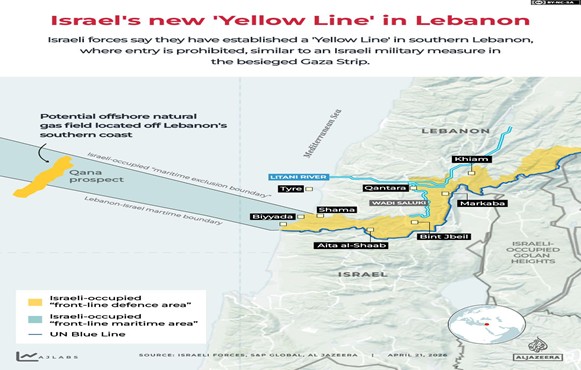
A move to grab the Qana Gas Field
The map covers areas beyond the southern Lebanese coast and into the ocean, including the Qana gas field, which belongs to Lebanon according to the maritime border reached indirectly between Beirut and Tel Aviv in 2022. This map “fully absorbs” the Qana gas field.
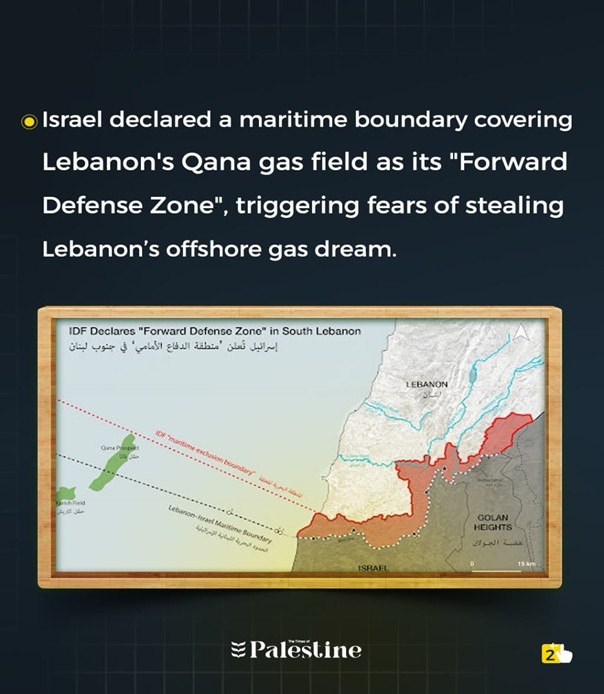
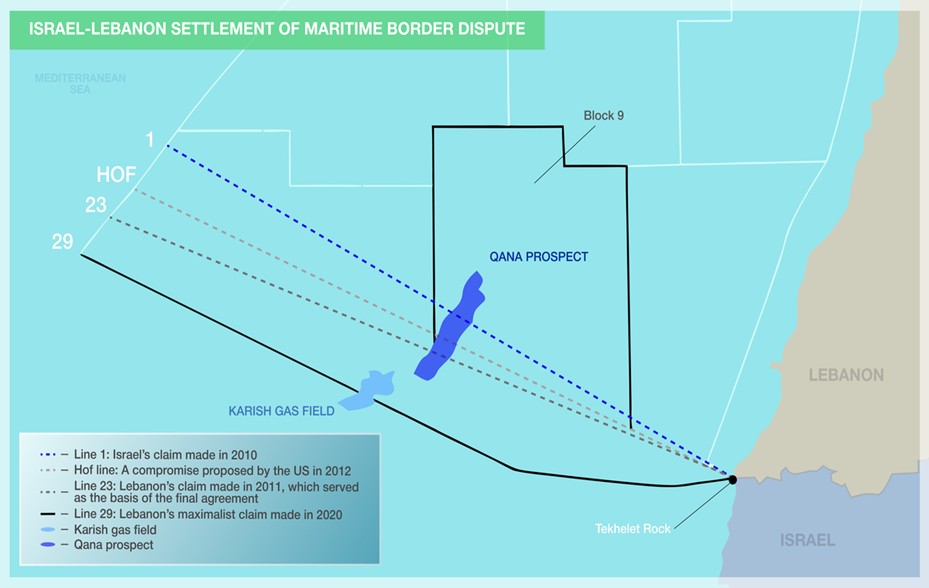
The field was previously estimated to contain up to 100 billion cubic meters of gas, with projected value estimates ranging from $20 to $ 40 billion. An international consortium consisting of Total Energies (a Rothschild entity) and other major firms began drilling in 2023. Yet Lebanese officials were informed that no commercially viable gas was found in the field. In 2022, US-mediated talks between Israel and Lebanon ended a long-time row over their maritime border, driven to a large degree by the potential presence of offshore natural gas fields in the disputed area. Unlike Israel, Lebanon is yet to tap into those riches. However, the IDF’s move makes prospecting by a Rothschild -Qatari conglomerate, announced in January, highly unlikely. Exploration for offshore gas in Lebanon was launched in 2017 and is led by Total. The French energy giant not only has the technical expertise, but also could handle payments of royalties to Israel, making direct transactions between Israel and Lebanon unnecessary. The company initially partnered with Italy’s Eni and Russia’s Novatek, though Qatar Energy replaced the latter in late 2022. The 2022 deal did not lead to a gas bonanza for Lebanon. While pumping at Karish started only four days after the agreement was announced, no reserves were uncovered at Qana. However, a new hope came in January, when Total reported plans to search in an area further away from the coast.
Israel’s investment in offshore exploration in the past two decades paid off with the discoveries at Tamar, Dalit, Leviathan, Dolphin, Tanin, Aphrodite, Karish, and Tamar Southwest gas fields. Gas is trapped under a regional geological formation, with Israel, Egypt and Cyprus exploiting the reserves. The Karish field is located close to Lebanon’s border, and there were strong indications that a larger field was located further to the north-east. Under the 2022 deal, Lebanon relinquished its claim on a part of Karish, but gained the opportunity to prospect in the Qana area, since the agreement solved the legal status of potential discoveries. Israel has designated Lebanon’s Qana gas field as part of a “Forward Defense Zone,” sparking fears over control of a resource estimated to be worth up to $40 billion and vital to Lebanon’s future energy hopes. Greed is built in the DNA of the Rothschild/Zionist crowd. The field’s 500 billion cubic meters (BCM) of reserves are much less than the estimated volumes in Israel’s two producing fields, Leviathan (1 trillion cm) and Tamar (210 bcm). The volumes achievable from Karish and similar gas fields are significant for Israel but not in global terms. For comparison, Leviathan produces about 12 bcm per year and Tamar less than 10 bcm, while Europe’s annual demand for gas was around 500 bcm even before the Ukraine crisis.

Exclusive economic zone between Israel and its neighbors
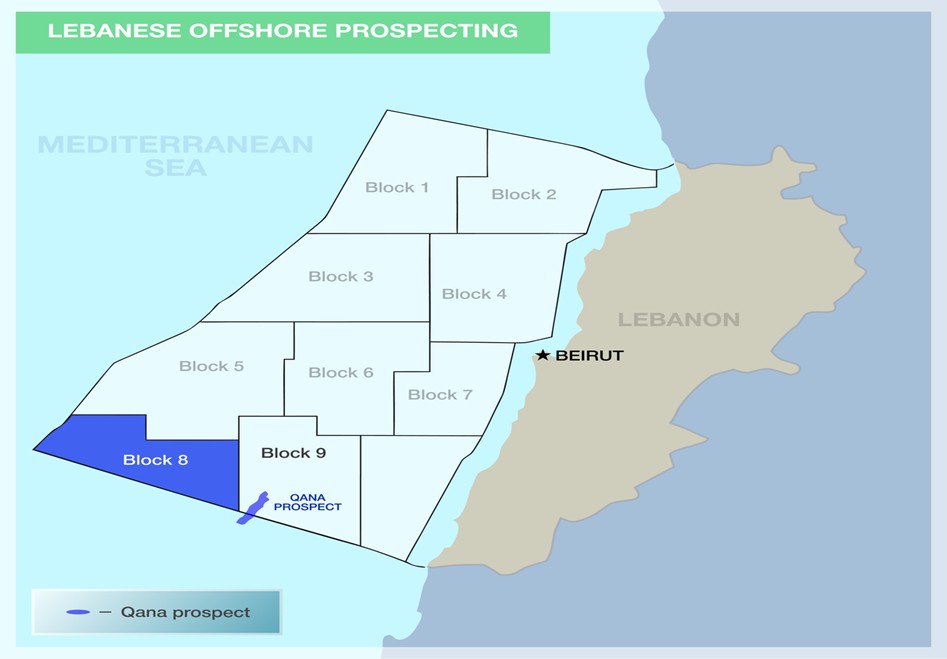
Beirut pinned much hope on finding reserves, which then-Energy Minister Walid Fayyad described as an equivalent of 20-year supply of electricity for Lebanon. Among Lebanon’s offshore acreage only Block 9 lacks 3D seismic data, largely because the border dispute prevented studies.
3 Why the Israeli Assassination Strategy is leading them to Defeat
The Israeli assassination-centered military doctrine has failed to achieve decisive victories against the Axis of Resistance, exposing the structural weakness of Israeli society and warfare strategy. The Zionist Entity cannot fight real wars, instead it uses assassinations and terror bombing campaigns to avoid having to actually engage its opponents. Since October of 2023, it has been proven that this strategy is a liability, especially when it is attempting to expand its occupation. On March 3, 2026, Lebanese Hezbollah debunked the Israeli illusion that it was nearing “total victory” in a 7-front war. Now the reality is setting in for everyone. The Israelis have carried out their most successful assassination strikes, Mossad operations, and implemented the most destructive air attacks that the world has ever witnessed against a defenseless civilian population in Gaza. All of this, and they haven’t defeated a single opponent. So why then did almost everyone believe that the Israelis had managed to overcome the Iranian-led Axis of Resistance? The answer is quite simple: propaganda.
Hezbollah, Hamas, Ansar Allah, the Islamic Resistance in Iraq and Iran’s IRGC are all still in existence today. In fact, the Israelis failed through committing a genocide in Gaza to fully defeat even one of some dozen Palestinian Resistance factions that exist there. This is not to say that nothing has been achieved and no blows were suffered, evidently that would be delusional, but the fact of the matter is that the Zionist entity has thrown everything they have at securing “total victory”. Their biggest issue lies in their military doctrine, the overreliance on technology, and beyond this the ideological weakness that runs through their society. In the year 2000, former Hezbollah Secretary General Sayyed Hassan Nasrallah issued perhaps his most well-known address, which would later be referred to as the “Spider’s Web Speech”. 26 years later, and the Israeli political and military leadership, along with their media, are still obsessed with the speech. The reason why is because it cuts deep into the Israeli psyche and their self-perception. Israeli society is a military society, one that is obsessed with its citizen army. A soldier’s death is infinitely more difficult for the Israelis to accept than that of a non-combatant, which is why they do their utmost to cover up soldier casualties. If their soldiers are being killed in enormous numbers, then this begins to rock the entire society to its core and impact their belief in themselves to uphold their settler colonial project. Hence Nasrallah’s Spider’s Web theory. The idea of the Zionist entity being a spider’s web, is that its society is weak, not its technology, not its ability to drop bombs and carry out complex intelligence operations. The concept of fighting short wars is enshrined in Israeli military thinking; it is a concept that dates back to its first Prime Minister David Ben Gurion. This is to say, fighting short and intense wars is safe, because the Israelis are militarily superior to their opponents, yet fighting long, drawn out conflicts of attrition is a danger due to the sheer size of their enemies.
In the Second Intifada, the Israelis then leaned into the use of “targeted assassinations”, special forces raids and counter-insurgency strategies, in a way that they hadn’t previously implemented at such a scale. Palestinian Resistance groups in the West Bank were indeed defeated as a result of it, but in Gaza, they managed to adapt and develop in strength. After originally withdrawing from Lebanon, the Israelis realized that the threat of Hezbollah had grown to a level where it now posed a significant threat, but when they tried to defeat it in 2006, they failed. Therefore, they developed the Dahiyeh Doctrine, the concept of inflicting massive death and destruction against civilian populations. The belief was that this achieved “deterrence”; in reality, it was Hezbollah that had deterred the Israelis. In order to deal with their defeat in Lebanon, the Israelis then implemented the Dahiyeh Doctrine in the Gaza Strip, where they were dealing with a weaker Resistance group under siege. Over the years, the Dahiyeh Doctrine was repeatedly used against the Gaza Strip, alongside assassination campaigns, aimed at “mowing the lawn”, a twisted way of saying subduing the threat and achieving “deterrence”. Yet, this also backfired in Gaza, because eventually the Resistance would become so strong that they pulled off the largest military defeat on the Israelis that had ever been inflicted. Assassination after assassination, terrorist tactics against civilian populations in order to try and force them into submission, economic warfare, using proxy groups, doing everything possible without having to actually make the sacrifices necessary to attain victory. The reason why they couldn’t simply fight on the ground and go after the Palestinian Resistance in Gaza, nor wage costly and bloody battles against Hezbollah, is because the Spider’s Web theory is true. If the Israelis were to actually do what is necessary to truly defeat their opponents, they would have to accept losing tens of thousands of soldiers. This is a price that their citizens’ army is simply not willing to pay. The Palestinians, Lebanese, Yemeni and Iranians are willing to make that level of sacrifice, but the Israelis aren’t. The Zionist regime seeks to achieve “Greater Israel”, but doesn’t want to make any real sacrifice in order to attain that project; they want to do it the easy way, but an easy way doesn’t exist. People are not simply going to bow down and accept enslavement, to live under the rule of an ethno-supremacist regime that treats them as animals, nor will they stop resisting because you slaughter their families. Sneaky assassinations, surprise attacks and killing babies do not win wars against populations who are fighting for their ability to live freely in their lands. The Zionist entity had the opportunity to actually secure its existence, which was through accepting the so-called “Two-State solution”, but that would have defeated their entire purpose, despite it being the only route to securing their place in the region.
4 The Lebanese Front- Israel’s Ongoing Nightmare
Israel has been in an on and off war with Lebanon for decades – formally since the June 1967 War– and the ongoing hostilities are causing damage in more direct ways. Following the announcement of a US-Iran ceasefire deal, Israel launched a brutal invasion of Lebanon, killing hundreds of people in attacks on urban areas within minutes, invading the south of the country and triggering another spiral of violence where dozens of people are killed every day despite the announcement of a truce. Israel has declared a large swath of the southern Lebanese border area a “Forward Defense Zone,” similar to the ‘Yellow Line’ perimeter used by Tel Aviv to seize additional territory in the Gaza Strip.
“Five military brigades are operating alongside Navy forces simultaneously south of the forward defense line in southern Lebanon to destroy Hezbollah-affiliated infrastructure in the area and prevent a direct threat to the northern towns,” an IDF spox stated. The Israeli military plans entail capturing an area up to a depth of 10-kilometer -and marking the area as a ‘Yellow Line.’ According to the Israeli army, the 10-kilometer zone includes 55 towns and villages in southern Lebanon. In Gaza, the ‘Yellow Line’ was meant to be the perimeter to which Israeli forces would withdraw in line with the ceasefire deal. After failing to defeat and abandoning its goal of capturing Lebanese territory all the way up to the Litani River, Tel Aviv announced plans to establish the 10-kilometer buffer zone in the south. Israel openly declared its intentions to destroy entire towns and villages. Defense Minister Israel Katz recently said in a statement that the residents of these towns would not be allowed to return. Since the ceasefire on April 18 reached between the Lebanese government and Israel (Hezbollah was totally excluded), Israeli troops have remained deployed in the south, continuously rigging whole neighborhoods with explosives while filming the demolitions and publishing them online. Over one million people in Lebanon have requested relief after being displaced, as Israel struck dense population areas and demanded evacuation of a significant portion of its territory. Upwards of 3,000 fatalities have been reported since March 2, including more than 300 on April 8 in strikes on over 150 locations. The illusion of victory over Lebanon is crumbling, as they fail to produce any solutions other than mass murder against civilian populations and ethnic cleansing across the region. Especially when the Israelis are a weak society, they can’t succeed. This is why there is an obsession with achieving regime change in Iran and using the US to do it for them, because they are desperately betting on the idea that if they do succeed, the resistance against them will end. The blow Hezbollah absorbed in 2024 – and the pressure that followed in 2025 – did not break the Lebanese resistance movement. It forced a ruthless internal reckoning. Among its cadres, the wound is still visible, yet the setback pushed them into a a period of review, discipline, and renewal.
Between 1978 and 1982, the Shia current that had emerged from Fateh, the PLO, and the communist party began to chart its own path. Iran entered the fight as a direct partner, not as a distant source of inspiration. After the 2024 war, the wager was patience fused with discipline. “The lesson is not only possessing power or preserving it,” the source says, “but how to use it in a way that protects our people from Israel repeating its genocide in Gaza, while still confronting the enemy skillfully and making it hurt – at the right time, by the right means, and in the right sequence.”
A Doctrine Rebuilt under Fire
In meetings with planning and field commanders through 2024 and 2025, the outline of Hezbollah’s became clear. The next response had to come on Hezbollah’s initiative and from south of the Litani, as an act of defiance. The defense would no longer resemble the model the Israeli military believed it understood. It would be hybrid, layered, and mobile: inducement, ambushes, hit-and-run action, martyrdom-style engagements, and persistent strikes from distance. The first Israeli entry had to be difficult, the advance harder, and every deeper push more punishing. Hezbollah would not cling blindly to ground, but it would not surrender it cheaply either. What was lost geographically would be struck from afar. Every additional kilometer gained by the occupation army would stretch its forces, thin its protection, multiply exposed positions, and give the resistance more time to learn, observe, and strike again. The security zone Israel sought could not be produced by destruction alone. It required permanent occupation – a burden neither Tel Aviv nor any international force could carry without paying for it. The tactical lessons were equally blunt. Hezbollah would expand prepared ambushes, fight as much as possible from underground routes, move between houses through safer pathways and timings, reduce wireless and electronic signatures, rely more heavily on pre-planned scenarios, avoid crowding fighters on any front, rotate them more carefully, and use every drone or missile hit to generate follow-on fire. Thermal cameras were placed in expected avenues of advance, kept powered continuously, and used not only for first targeting, but also for guidance and documentation. Explosive traps and camouflaged devices became central: some planted before the battle, others after Israeli preparatory bombardment.
How Hezbollah Hunts
Resistance fighters describe an unwritten protocol for matching each target with the right weapon. Abundance does not mean waste. A target that requires a Kornet gets a Kornet. A drone may follow if the first strike misses, but fighters say more than two attempts are rarely needed. A direct hit from a heavy explosive device can turn a vehicle into scrap and kill everyone inside. A tank or armored carrier struck by anti-armor fire, if Trophy fails to intercept it, may be badly damaged; repeated hits can destroy it outright. Empty vehicles are still hit when a missile or drone is already at the end of its launch path. Nothing is allowed to go to waste. In the same vein, Hezbollah’s innovation of its fiber-optic controlled drones has transformed the war in south Lebanon – imposing on Israeli tanks and troops, to the point to which the IDF may be compelled to withdraw from the south. Drones became the clearest expression of this method. Hezbollah had used reconnaissance, attack, loitering, and defensive drones throughout the “support front” but modifications and cheaper new models deepened the shock inside Israel. Three control methods dominate: pre-programming, radio signal, and fiber optics. Recent resistance videos show that many fixed-wing drones launched at Israeli positions are programmed before takeoff, making electronic jamming largely useless. They have to be shot down. Their smaller size, quick assembly, flexible transport, and simple launch platforms make them cheap tools for exhausting air defenses.
Signal-guided drones remain vulnerable to jamming, though high-grade encryption protects reconnaissance platforms such as the Hudhud. Fiber-optic drones, often quadcopters, are tethered to the operator by thin, hard-to-detect wires resistant to fire and cutting. Their range can stretch from one kilometer to 50, though longer fiber adds weight and reduces the warhead. This method requires a skilled operator using goggles or a helmet that displays the camera feed. Israeli estimates place the operators inside fortified positions, controlling the drones with joystick-like devices. Because the drone is wired, jamming cannot bring it down. It has to be hit directly. The surprise was not only the technique, but its range and availability. Hezbollah had already used fiber optics in the Syrian War between 2015 and 2018. Russia learnt a few tricks from Hezbollah and implemented them in Ukraine. Plus, Hezbollah made use of fiber-optic drones 2023 and 2024. “We operated fixed-wing drones through these fibers to hit border positions, and even to fire missiles from some drones while filming at the same time. Either the Israeli does not know, or he pretends not to know to justify his failures. “For new or high-value targets, Hezbollah uses larger, faster, more expensive drones with specialized programming, now reserved for important targets inside occupied territory, including one that struck a newly established military position in occupied Acre. Close-range footage forced the Israeli public to see what soldiers were facing – small, fast, hard-to-detect FPV drones, many guided through fiber-optic cable and therefore immune to ordinary electronic jamming. AP the drones as “small, hard to track and lethal,” while former Israeli air defense commander Ran Kochav said they fly “very low, very fast,” making them difficult to track even after detection. fiber-optic FPVs could evade Israel’s high-tech jamming and target Israeli troops in southern Lebanon during the ceasefire that began on 16 April.
The problem was not the drone alone, but how Hezbollah used it – for surveillance, impact, filmed proof, follow-on coordinates, and pressure on rescue teams. The Jerusalem Post reported that the Israeli army was seeking FPV assault drones, with each unit expected to cost NIS 20,000 (around $6,888) to 25,000 (around $8,600) – far above the cheaper drones ordered in an earlier tender, and many times the cost of Hezbollah’s locally assembled models, which were estimated at only a few hundred dollars. The Israeli response confirmed the scale of the problem. Hezbollah had taken a weapon made famous in Ukraine, stripped it to its essentials, and turned it against an army built around expensive detection, air dominance, and technological superiority. Not only that, the videos that Hezbollah publishes of these attacks serves several purposes: first, it demoralizes the IDF, second it provides proof of its attacks, which Israel cannot deny, and third, it gives hope to the global majority.
5 Israel’s Late Countermeasures
In mid-April, Israeli military intelligence had formed a dedicated team to counter Hezbollah’s two-stage attack method: first, a surveillance drone gathers intelligence and returns; then a fiber-optic attack drone, harder to detect or disrupt, is sent in to strike. Israel ordered a special program to eliminate the drone threat, while admitting that results would take time. The Trophy active-protection system, despite updates against smaller threats, had failed to stop them. Israeli forces then turned to “defense cages” – metal nets mounted over tank turrets to detonate drone charges before impact. Settler platforms mocked the measure, warning that the cages obstruct evacuation, increase the vehicle’s visibility to drones, create hazards in wooded terrain, and endanger soldiers under fire. Israeli newspaper Yedioth Ahronoth warned that Hezbollah’s FPV drones have evolved from a tactical nuisance into a strategic threat, with the resistance conducting coordinated multi-drone strikes against concentrated IOF positions in successive waves. Engineering vehicles have been withdrawn from the field, and contractors demolishing Lebanese homes have been restricted to nighttime operations only due to the drone threat. This has led to growing frustration among field commanders, who said instructions were still largely limited to raising readiness levels and firing at drones once spotted. Soldiers had, in some cases, cut the fiber connecting a drone to its operator, but acknowledged that doing so requires unusual field skill. Talks have also begun with Ukraine that has more experience confronting this threat. Laser systems, electromagnetic weapons, drone-on-drone interception, Iron Dome launches, ground fire, helicopters, and fighter jets all remain. None offers full coverage, especially against dense attacks arriving from several directions at once. Ground Forces Commander Maj. Gen. Nadav Lotan responded by forming seven specialized teams to update doctrine, detect and intercept drones, manage the digital and spectral domain, improve passive protection, coordinate with defense industries, study Hezbollah drone units, and fold the lessons into training and procurement.
The ‘Yellow Line’ Comes Undone
By the final hours before the ceasefire on 16 and 17 April 2026, Israel was trying to turn dispersed fire pressure into a new map of the south: fragmented, depopulated, low-density, and easier to monitor, strike, engineer, and isolate. This was not occupation in the classic sense. It was an attempt to reshape the terrain before the truce took hold. This was evident in the combination of air saturation, expanded evacuation orders, accelerated demolitions, bridge destruction, and the political and media push around a “security zone” reaching the Litani and beyond. But the same pattern also exposed clear limits: Israel could produce destruction faster than it could turn destruction into control, while close combat remained costly and the axes of advance stayed vulnerable to attrition.
Map: Operations and Advances up to 14 April 2026.
In the western sector – Israel treated the coastal strip as a platform for “depth by fire,” not as a conventional breakthrough front. The destruction of Al-Qasmieh Bridge and strikes around Tyre were meant to isolate the area south of the Litani. But Hezbollah continued to hit artillery positions and new deployments using anti-tank fire, ambushes, and drone interceptions to prevent the strip from settling into a stable zone. In the central sector – the operational and symbolic center of gravity, Israel tried to impose a siege through urban destruction and limited penetrations from several axes. But the fighting remained concentrated at the city’s entrances and decisive approaches. Strikes on tanks near the market and the northeastern edges, along with attacks around the Musa Abbas complex, Aqabat Ain Ebel, the Tahrir Triangle, and Al-Ishraq School, showed that Bint Jbeil had not become a captured space. It remained a knot of attrition, delaying the link between axes and breaking the momentum of every push toward its center. In the eastern sector – Israel tried to push the proposed security zone toward commanding terrain around Khiam, Qantara, Deir Mimas, and the surrounding highlands. But many areas pointed to the same pattern: fire pressure and limited thrusts rather than a coherent breakthrough. Repeated strikes on Qantara, destroyed armor, and attacks on newly established artillery positions turned the axes of advance into counter-kill zones. After the ceasefire, the western sector remained a battle over coastal and land isolation. The central sector remained an urban attrition zone. The eastern sector became a depth battle built on layered ambushes and contested air-reconnaissance superiority. Across all sectors, the ‘Yellow Line’ failed to become a safe belt. It became a long strip of friction where Israeli forces were targeted from above ground, underground, and low air.
The period from 17 to 30 April did not reveal calm, but an armed truce. Israel imposed heavy destruction and coerced geography, but failed to turn either into stable control or deterrence. Hezbollah did not fight a conventional battle to retake land. It managed a precise attrition campaign in which every position, bulldozer, gun, or evacuation helicopter inside the yellow zone became a target. The result was the collapse of the fortified buffer-zone assumption. A new equation emerged: a lighter occupation, but one more vulnerable to attrition before any formal collapse of the truce. Israeli claims of five divisions maneuvering in south Lebanon were exaggerated. The army did not send reserve units into Lebanon. Most forces were partial brigade formations, largely regular troops, and many left after the US-imposed ceasefire. Those who fought moved in and out of villages without continuously holding a defined defensive line. The reason, rarely admitted publicly, was that regular and reserve units were exhausted and could not be assigned more ambitious missions. Seizing the anti-tank defense line was a compromise. The Israeli military still holds a line of hilltop positions eight to 10 kilometers north of the Lebanese border to prevent anti-tank missiles from reaching border settlements. But the scale of the force and the weight of its missions have shrunk sharply. For Hezbollah, that is the point. Israel can destroy. It can depopulate. It can redraw lines on a map. But in south Lebanon, it still cannot easily hold what it breaks.
IEDs and Anti-Armor: The Old Nightmares Return
The same logic shaped the Israeli focus on the anti-tank line. Every advance demanded more air and artillery fire simply to disrupt launch teams. Yet the old lesson returned again. No protection system works perfectly, and south Lebanon punishes any army that treats armor as immunity. Israel tried to answer with new tools, including the Roem self-propelled gun, an automated artillery system with a smaller crew, faster firing rate, and shoot-and-scoot capability. But the upgrade also revealed the pressure Hezbollah was placing on artillery sites and exposed positions. Hebrew reports described compound traps: troops fleeing targeted vehicles or fire zones into nearby buildings, only to find explosive devices waiting there. Rescue efforts then came under drones, rockets, shells, or anti-tank fire. The old guerrilla pattern had been updated with live video, better timing, and layered kill zones.
Israel’s demolition campaign also collided with the terrain. Northern Command sources described mountains, dense vegetation, rock, and distance as heavy burdens on engineering vehicles, trucks, supply lines, and explosives. Robots were sent forward to destroy structures in areas the army had not reached during earlier phases of “Operation Arrows of the North.” After the ceasefire that Israeli forces were still firing to keep residents and Hezbollah fighters away from the “Yellow Line,” while engineering units destroyed infrastructure in village centers. A senior officer said there was supposed to be no population between the Yellow Line and the border. Dozens of civilian engineering vehicles had been brought into the area and operated by contractors, some paid by the day and others by the number of buildings demolished. The detail matters because it points to the scale of the demolition task and the limits of regular army engineering capacity. Lebanon was not Gaza. Israeli officers said sandy soil had made demolition easier in Gaza, while south Lebanon’s rock-cut structures, built up over decades, demanded larger quantities of explosives, safer logistical routes, and longer exposure. The campaign to erase infrastructure became another reason to stay, and staying created more targets.
Statistics as Cover
Israel then returned to its preferred language of war: large numbers. By 23 April, the army claimed it had dropped around 5,000 bombs, struck more than 5,050 targets, carried out more than 2,500 sorties, and fired more than 14,900 artillery rounds. The scale of Israeli fire did not erase the scale of Hezbollah’s. Israeli Army Radio reported that the resistance launched about 8,000 rockets and shells, with roughly two-thirds directed at Israeli forces inside south Lebanon and one-third at settlements and sites inside Israel. It also counted about 300 drones and 140 anti-tank missiles. Taken together, the Israeli record points to a strategic crisis on several fronts. Destroying Hezbollah remains a fantasy. The achievements Israel claimed in 2024 and 2025 were eroded within two months. The buffer zone offers no guarantee, the political track with Lebanon offers no easy solution, and no Syrian intervention is coming to rescue the northern equation. The conflict is reproducing itself, with old tools returning in new forms and old Israeli assumptions breaking against the same terrain. Israeli soldiers occupying southern Lebanon report systemic looting of civilian homes and businesses, along with the widespread destruction of villages and infrastructure, while commanding officers look the other way. This has brewed a battlefield culture akin to a “Viking army,” where discipline gives way to moral disintegration, and a lawless environment in which officers turn the other cheek more often than not. “For most of the senior commanders, it did not matter. Soldiers looted even when the brigade commander came to visit, and he turned a blind eye,” one soldier testified. Soldiers described the war on Lebanon as having a hidden objective, that of collecting spoils and exacting revenge on the citizens of Lebanon. The “unofficial mission,” as one soldier put it, was “to take out all the loot. To unload all the spoils at the outpost where the headquarters sat, so it would be waiting for the soldiers when they went home.” For many of the religious soldiers with me, this was a sacred mission. The battalion commander was the most extreme. He refused to go home, the smile never left his face. He was in a state of exaltation, like a die-hard fan whose team wins a championship after 20 years,” one soldier noted. “I felt that beyond the border, it is okay to be crazy.” Commanders are reportedly aware of the practice but often fail to intervene, with enforcement described as weak or absent, and military police largely not present at border crossings. Soldiers and officers are quoted as saying the looting had become normalized in an environment shaped by prolonged deployments, abandoned villages, and minimal accountability, with some arguing it is tolerated to maintain troop morale and participation. The military knows these cases represent only the tip of the iceberg, in light of footage circulating on social media showing soldiers vandalizing and looting Palestinian property.
The story continues in Part 2.