1 BRICS – from an Economic Project to a Geopolitical Force
2 The SCO
3 Tariff Wars
4 Oil Wars
5 Russia
6 Iran
7 China
8 India
9 Pakistan
10 Brazil
11 Venezuela
12 South Africa
13 Commodities vs. Paper Money (aka the real economy vs. a parallel financial economy)
14 The Future of Multilaterism
15 Conclusion
What is Geopolitics?
Geopolitics is the practice of power based upon the geographical location, and its resources.
Geopolitical competition occurs among great powers for control over territory, natural resources and other important geographical positions or places (such as ports and harbors, canals, river systems, etc.).
Geopolitics can be defined as interplay among countries and empires which are in a distinct geographical setting. Ever since the beginning of time, geography has been the determining function of geopolitical positioning, whether it be land strength or sea strength. If a country is isolated or an island country, it is more likely that its armada will develop better, and so on, a country located on a continent is likely to be oriented towards land. In some circumstances, sea and land orientation develop together, this can be seen in countries, which are located on a landmass, but also have ocean fronts. The geopolitical position of a country is not the utter definer of its orientation. A country with sea orientation can be observed to have strengthened its land power and vice versa for a country on a landmass. Geographical position—where a country is located relative to other countries—is more important than size. The study of world history shows, for example, that countries located wholly or mostly in the Northern Hemisphere have had the greatest impact on world politics. Until the twentieth century, world politics was dominated by countries located on Eurasia, its offshore islands, and Africa, north of the Sahara. For many centuries, the Western and Southern Hemispheres were little more than the objects of Eurasian colonial powers. Other factors that affect a country’s ability to play a significant role on the world stage include population, economics, technology, military power, and character of government. Those factors, however, unlike geography, are subject to change over time. Geography is constant, though its impact can change. Technological and scientific advances can alter the effects of distance, topography, and climate. In the twentieth century, the centerpiece of U.S. foreign policy was to prevent a hostile power or alliance of powers from dominating Europe or Asia (Eurasia).
1 BRICS: From an Economic Project to a Geopolitical Force
When representatives from Brazil, Russia, China and India first met formally on the sidelines of the UN General Assembly in New York in 2006, the world looked very different. Even in 2009, when the first formal BRIC summit was held in Yekaterinburg in June 2009, without South Africa – hence “BRIC” instead of “BRICS” – the world was different. The original goals of the BRIC countries were to achieve better economic cooperation between countries that had not yet been openly declared enemies or even sanctioned by the West. There seemed to be no rush yet.
From 2014, pressure on Russia increased as a result of Maidan and Crimea. Russia was portrayed as the villain and sanctions were imposed. Putin continued to seek diplomatic solutions for another eight years, welcomed Minsk I and II, but was again deceived. The artillery shelling of civilians in Donetsk by the Ukrainians did not stop, and NATO was building up the Ukrainian army for an attack on Russia. Russia began to prepare for the foreseeable, especially economically, because militarily it had been doing so with great energy and creativity since the attack on Georgia in 2008. When the situation escalated in February 2022, Russia had apparently done its economic homework and could count on the loyalty of its partners in BRICS and SCO. The US miscalculation can be explained by the fact that Americans are unfamiliar with the concept of loyalty, while the EU miscalculation can be explained by the fact that most of its members are ruled by leaders whose stupidity borders on idiocy. Russia has weathered the economic war unleashed by the West, despite a storm of sanctions unprecedented in world history. The losers are to be found in the West, with Germany being hit the hardest – also due to a senseless economic policy. The U.S. did not limit its economic war to Russia, but also began to sanction China in 2014, as always with flimsy arguments. The EU – as a vassal of the US – has willingly gone along with this, and is currently doing so out of its own self-interest, since the industrial pearl that is Germany has already lost out due to misguided economic policies, bad decisions by its automotive industry and suicidal sanctions against Russia. Auto industry experts are speechless and wringing their hands: Since Covid, Mercedes has not managed to get its factories above 50% capacity – a complete collapse is becoming apparent across the board. China, which is only a few steps behind Russia in terms of sanctions, has become a target for the West because of its industrial superiority. It is the great new enemy of the US and Europe.
Although most people consider military conflicts to be more important than economic wars because they are bloodier and evoke more emotion, history teaches us that the economically stronger ultimately prevails. As a consequence of this thought, it can be argued that the economic war as the decisive part of the 3rd World War is already in full swing.
The BRICS Challenge
Indian Foreign Minister Jaishankar: “There was a club called G7, but you wouldn’t let anybody else into it – so we said, we’d go and form our own club (…) It’s actually a very interesting group because if you look at it, typically any club or any group has either a geographical contiguity or some common historical experience or a very strong economic connect – but with BRICS what stands out is “big countries rising in the international system.”
All that in a context that is now familiar for the Global Majority. The combined GDP of the current BRICS nations is over $60 trillion, way ahead of the G7; their average growth rate by the end of this year is projected to be 4%, higher than the 3.2% global average; and the bulk of economic growth for the near future will come from BRICS member-nations. And on the geo economic front, apart from developing a series of international transportation corridors across Eurasia, the new deal should “establish alternatives to Western-controlled economic mechanisms”, from expanding the use of national currencies in settlements to establishing independent payment systems.
Putin in fact summed up all the major dossiers. Here are the highlights:
- On the role of the Shanghai-based NDB, the BRICS bank: Russia “will expand the capabilities of the NDB”; the bank should become the main investor in major technological and infrastructure projects for BRICS members and the wider Global South. That makes total sense, with the NDB financing infrastructure development and commercially involved with local, private companies. Incidentally, the next president of the NDB will be Russian.
- On creating a single digital infrastructure for BRICS: already on. Russia is working on “the use of digital currencies in investment processes in the interests of other developing economies.” That ties up with BRICS work on their own version of SWIFT for international financial transactions. And also ties up with BRICS Pay – a debit card whose first trial run happened recently, similar to AliPay in China, and soon to be rolled out across BRICS members.
- De-dollarization, Putin stressed, is proceeding step by step: “We’re taking individual steps, one after another. As regards finance, we did not drop the dollar. The dollar is the universal currency. But it wasn’t us – we were banned and barred from using it. And now 95% of all the external trade of Russia is denominated in national currencies. They did it themselves with their own hands. They thought we would collapse.”
Russia could mark a turning point in global geopolitical history. Faced with the slow erosion of the Western world order, a new balance is emerging, driven by a coalition that seems increasingly determined to chart its own course. The Forever Wars mindset that devastated large swathes of Afghanistan, Iraq, Libya, Syria, Gaza, Ukraine, and elsewhere is now being slightly tweaked. The difference is that now Russia–Iran-China, in close cooperation, are directly challenging the West.
2 The SCO
It was the formation of the SCO in July 2001 that panicked David Rockefeller. The reaction to this development gave the family an incentive to invade the region to block any possible Eurasian integration. He engineered the false flag attack on 9/11, to justify an invasion of Afghanistan. We all know what followed. The CIA – a Rockefeller entity- did the “on-the-ground” work to make this possible. This whole story is detailed in our previous articles.
The SCO today is no longer a regional structure but a strategic center of gravity in global politics. It unites countries with different political systems yet a shared determination to defend sovereignty, advance their own models of development, and demand a fairer world order. What was once dismissed as a loose regional club has matured into a geopolitical platform for the Global South – an institution that challenges Western hegemony not with rhetoric, but with expanding membership, growing economic clout, and a common political vision. From Beijing the message resonated loudly: the age of Western hegemony is over. Multipolarity is no longer theory – it is the reality of global politics, and the SCO is the engine driving it forward. They signal that the SCO is evolving from a loose forum into a framework capable of shaping the rules of the 21st-century world. For policymakers in Washington and European capitals, the lesson is sobering. Ignoring the SCO or dismissing it as a talking shop risks overlooking the consolidation of an alternative power center that is steadily building legitimacy outside of Western institutions. For the rest of the world, particularly in the Global South, Tianjin served as a reminder that power is no longer concentrated in a single pole, but dispersed across multiple capitals with diverging visions of order.
The summit was therefore more than a diplomatic calendar entry. It was a milestone in the slow but unmistakable rebalancing of global power and a process that will define international politics for decades to come. One of the boldest proposals on the table was the creation of a dedicated SCO development bank that poses an explicit challenge to the Bretton Woods institutions, particularly the IMF and World Bank. Such a body, if realized, would allow SCO members to finance projects without the conditionalities often imposed by Western lenders. It would also complement other Chinese-led initiatives such as the Asian Infrastructure Investment Bank (AIIB) and the Belt and Road Initiative, weaving them into a broader Eurasian financial ecosystem.
The implications are far-reaching. For decades, the global financial order has revolved around institutions headquartered in Washington, shaping development trajectories in the Global South. By offering alternative sources of capital, Beijing and its partners are signaling that the monopoly of Western financial governance is coming to an end. The SCO’s proposed bank would not only fund railways, pipelines, and fiber-optic networks across Eurasia but also serve as a symbolic assertion of financial sovereignty. The message from Tianjin was unambiguous: the institutions of the West will no longer go unchallenged. A parallel emerging architecture reflects the priorities of Beijing, Moscow, New Delhi, and the capitals of Central Asia. It is not yet clear how cohesive or durable this architecture will prove, but its mere existence underscores that the world has moved beyond unipolarity. The battle is no longer over whether the West will be challenged, but over how rapidly alternative institutions can be consolidated, and how effectively they can deliver. What unfolded in Tianjin was not the birth of a new Cold War but the emergence of something far more complex and consequential: a multipolar future in which the West is no longer the sole arbiter of global norms, trade, and security. This is not merely a shift in power; it is a transformation of the architecture of international relations. Multiple centers of influence such as Beijing, Moscow, New Delhi, and the capitals of Central Asia are actively shaping the rules, institutions, and economic flows that will define the 21st century. The West, powerful as it remains, is increasingly one participant among many rather than the default decision-maker. The unipolar era of American dominance, which followed the Cold War, had its run, dictating the terms of finance, trade, and security for decades. The Tianjin summit, however, signaled that the next chapter will be written differently. From the expansion of the Yuan in energy settlements to infrastructure corridors across Central Asia, the SCO is constructing the material and institutional foundations of a multipolar order that can operate independently of Western-led institutions.
This new reality poses a strategic test for the West. Can New York and London adapt to a world in which their primacy is no longer assumed, and influence must be negotiated rather than imposed? Or will they risk being relegated to the sidelines, observing as new power centers define the economic rules, geopolitical alignments, and technological standards that will shape global affairs for decades to come?The Empire of Chaos is at war, hybrid and otherwise, not only against BRICS, but against Eurasian integration. And that should impress on all players the imperative of BRICS and SCO, sooner rather than later, representing Eurasia, getting their act increasingly together, turbo-charging not only their economic but also geostrategic cooperation. There’s only one way to go: negotiate with the increasingly out of control Empire of Chaos as a group. Putin and Xi already now it. Lula, MBS and Modi are starting to get the picture.
Central Asia at the Core
The Shanghai Cooperation Organization is increasingly positioning Central Asia as the backbone of the emerging multipolar world. Far from being a peripheral region, the Central Asian republics are becoming the crossroads of Eurasian connectivity and influence. Trade corridors linking Shanghai to St. Petersburg are facilitating the movement of goods, capital, and people across thousands of kilometers. Energy pipelines crisscross Kazakhstan, Uzbekistan, Turkmenistan, and beyond, ensuring that the region’s vast natural resources flow to both Chinese and Russian markets while integrating it into a broader strategic
Network. Meanwhile, digital “Silk Roads” are introducing Chinese standards for 5G, artificial intelligence, and telecommunications infrastructure, further embedding Beijing’s technological footprint across the continent. For decades, Central Asia was largely treated as a geopolitical periphery, a buffer zone caught between the lingering influence of Russia and the rising ambitions of China. Beijing cultivated trade and investment links primarily through infrastructure projects. Western powers, by contrast, engaged only sporadically, mostly through development aid or counterterrorism initiatives. The region’s strategic importance was recognized, but its potential as a hub of independent, multipolar influence remained unrealized. That era is now coming to an end. Central Asia is transitioning from a passive periphery to an active strategic heartland of the new order. Its cities, railways, pipelines, and digital networks are not just local assets but the connective tissue of a Eurasian system designed to operate largely independently of Western-dominated institutions. By anchoring trade, energy, and technology in Central Asia, Beijing, Moscow, and their partners are effectively recasting the region as a central node in the global architecture of power. The implications are profound. Central Asia is no longer a “backyard” for external powers; it is a linchpin of geopolitical strategy, economic integration, and technological standard-setting. As the SCO continues to consolidate its influence, the region’s rising prominence underscores that multipolarity is not merely a distant aspiration; it is being physically and institutionally constructed, rail line by rail line, pipeline by pipeline, and gigabyte by gigabyte.
Since the early 2000s the SCO has evolved from counter-terrorism to geo-economic cooperation. What matters most now for all members, apart from geo-economic cooperation, is to combat the West’s war of terror – bound to go on overdrive with the imminent, humiliating failure of Project Ukraine. While indivisibility of security still can’t be adopted Eurasia-wide – as the CIA deploys a war of terror in several fronts to undermine the emergence of a multi-nodal world – win-win cross-border connectivity keeps on rolling, from the Steppe Road to New Silk Road corridors. For a long time, the Western media maintained an ironclad silence on the subject of BRICS. A glimmer of interest appeared when Turkey expressed interest in joining BRICS. Now there is radio silence again. Alternative media are outdoing each other with predictions that BRICS will change the world tomorrow. The Russian media are holding back in this fireworks of jubilation. But to interpret the silence of the Western media as a lack of interest in BRICS would be more than naive.
The Population in the West is already Powerless
Since the brainwashing is not yet absolute, significant parts of the European population are still far from believing and supporting the madness spread by the media. The closed front of hatred – for example, against Russia and the Palestinians – takes place primarily in the media, which are in complete lockstep throughout the West, with a few exceptions. If it weren’t for the internet and blogs, the powerful would have already achieved their goal, because fortunately it seems practically impossible to silence all voices of reason. Western values — which were the essence of so-called “soft power” — have become a boomerang. It has turned out that these Western values, which were thought to be universal, are demonstratively unacceptable and rejected in ever more countries around the world. Suddenly, the EU found itself robbed of its key asset – liberal soft power. Western soft power has been replaced by Russian soft power, because now the key to the propagation of Western values is LGBTQ. Anyone who does not accept this is now in the “backward” category as far as the Western world is concerned.
The beliefs that accompanied Western triumphalism are collapsing.
3 Tariff Wars
Beginning in the early 1980s, New York began a policy of “controlled disintegration” of the US/UK economies, which was then followed by other western economies. Rockefeller agent Paul Volcker stated that (whom Rockefeller appointed as the new head of the FED) “a controlled disintegration in the world economy is a legitimate objective for the 1980’s”. The aim was to move industrial production off-shore, and to move the US economy to a financialized economy. The second aim was for these countries to export to the US and earn dollars to service their foreign loans. For the next 4 decades, this policy worked well for the family’s various business and financial interests, until the chicken came home to roost when the Ukraine war started. Suddenly, an industrial economy was essential to win wars against a peer rival. Now, with Rockefeller’s selection of Trump as their new manager, the momentum is to re-industrialize America. There’s little chance of this succeeding, but give the family an A for trying. It’s a move in the right direction. The new US tariff wars began on August 1; the measure is designed to force virtually the entire world to increase imports of usually exorbitantly expensive US goods while decreasing its own exports to America. The pathetically impotent European Union, as well as vassals and satellite states such as Japan and South Korea, fell in line like obedient vassals. In July, Trump threatened to impose additional tariffs on any country affiliated with BRICS. “Any Country aligning themselves with the Anti-American policies of BRICS, will be charged an ADDITIONAL 10 percent tariff”. However, many other countries are highly reluctant to sign off their sovereignty and essentially surrender it to the most aggressive imperialist power in human history.No matter how many concessions a country makes, as the most aggressive power pole in human history wants nothing but blind obedience. The principle aim of these tariffs is to force foreign companies to invest in the re-industrialization of America. At the same time, tariffs are being weaponized to punish rivals over geopolitical issues. It is highly doubtful if these measures will work.
Trump’s Impoverishment of U.S. Agriculture
Trump has created a perfect storm for U.S. agriculture that has closed off China as a soybean market, and thus raising prices for farm equipment and other inputs, and in his inflationary budget deficits that are keeping interest rates high for housing and farm mortgage loans and equipment financing – while keeping farmland prices low. The most notorious example is soybeans, America’s major farm export to China. Trump’s weaponization of U.S. foreign trade treats exports and imports as tools to deprive foreign countries dependent on access to U.S. markets for their exports, and on U.S.-controlled exports of essential commodities such as food and oil (and most recently, high technology for computer chips and equipment). After Mao’s revolution in 1945, the U.S. imposed sanctions on U.S. grain and other food exports to China, hoping to starve out the new Communist government. Canada broke this food blockade – but it has now become an arm of U.S. NATO foreign policy. America’s agricultural cost and income squeeze goes far beyond soybean sales. Production costs are also rising as a result of Trump’s tariffs, especially on farm machinery, fertilizer and credit tightness as the risk of farm debt arrears increase.
Trump’s Tariffs Are Raising U.S. Industrial Costs of Production
Trump’s tariff anarchy also is causing losses and layoffs of 1000s of employees, with a demand also falling for other manufacturers of farm equipment. The most serious problem is that its harvesting equipment, like automobiles and all other machinery, is made out of steel, along with aluminum. Trump has broken the basic logic for tariffs – to promote the competitiveness of high-profit capital-intensive industry (especially for established monopolies), largely by minimizing the cost of raw materials. Steel and aluminum are basic raw materials.
Trump’s Sanctions to Weaponize U.S. Exports to Its Designated Enemies
Trump’s threats to sabotage exports of computer switches with secret “kill switches” to turn them off by U.S. fiat has led China to cancel its planned purchases from NVidia. The company has warned that without the profits from exports to China, it will be unable to afford the R&D needed to keep competitive and maintain its monopoly on chip manufacturing. These trade policies slashing U.S. export markets and imports are just one reason why the dollar is weakening. Other causes are declining tourism as a result of U.S. harassment, especially of foreign students from China, on which U.S. universities have depended as the highest-paying students. Trump’s war against all other countries (mainly his European allies, Japan and Korea) has led to a shift of their dependency on U.S. exports and products against which they are retaliating in order to protect their own balance of payments – and most of all, financial capital flight seeing that the shrinking U.S. home market must cut into foreign profits and the dollar’s decline will reduce its valuation in foreign-currency terms. Also, as BRICS and other countries conduct trade in their own currencies, this reduces their need to hold foreign-exchange reserves in dollars. They are shifting to each other’s currencies, and of course to gold, whose price has just soared over $4,000 an ounce.
Trump’s decision to impose tariffs on basic inputs, headed by aluminum and steel, are increasing prices for every industrial product made out of these metals. And of course, his tariffs generally are rising prices across the board as companies have waited a polite month or so before raising prices as their existing inventories of goods produced by China, India and other countries are exhausted.
Trump’s deportation of immigrants has increased the cost of construction, which relied largely on immigrant labor – as did agriculture in California and other states at harvest time. It is not clear who, if anyone, will replace this labor. Instead of attracting foreign investment as Trump has demanded that Europe and other trade “partners” provide, he has made this market much less desirable. What he has done is provide an object lesson in what other countries need to avoid in creating regulations, tax rules and trade policy to minimize their costs of production and become more competitive.
4 Oil Wars
We recall the famous statement by Rockefeller sidekick Kissinger in the early 1970s:
“Whoever controls food-controls the people “
“Whoever controls money- control the governments “
“Whoever controls oil-controls the destinies of nations “
The family knows the oil business cold. They have been in this business since its inception in 1863. Today, many energy companies are in their orbit, such as Exxon, Chevron, Occidental, ENI, and many others. Together, they control around 10% of global production and refining. Currently, there are 3 countries beyond their control – Russia, Iran and Venezuela. The same three countries under military threat from the US.
- Venezuela has 300 billion barrels in reserves – value is $15 trillion
- Iran has 190 billion in reserves plus around 30 trillion cubic meters of gas – value is $24 trillion
- Russia has 80 billion in reserves plus 40 trillion cubic meters – value is $24 trillion
- US has 45 billion in reserves plus 140 trillion cubic meters – value is $45 trillion.
Production rates vary. Extraction costs varies. The US cost of production is around $40-$50 per barrel. Extracting more oil comes at a higher cost, as finding new oil reserves are becoming harder and more expensive. All the “easy pickings” in the West are over. The only region where this does not apply is the Middle East. Globally, production stands around 101 million barrels per day. Demand is rising by 1-2 % annually. Generally, the international oil companies are finding it harder and costlier to discover new oil fields. And, finally, by controlling all the oil production EVERYWHERE, the family can dictate prices, and can deny it to its rivals, as well as dictate terms to its allies. Oil is to a modern economy what oxygen is to a human body. The Green Agenda, Climate change, global economic lockdowns, and the carbon hoax were all meant to starve economies of energy. Imagine reducing the oxygen flows to a human body. After a while, the body becomes weak. Thus, making it easier for takeover, looting and turning it into a vassal. This policy was enforced in the Collective West and the vassal states in the Global South.
Besides oil and gas, Russia, Venezuela and Iran have other mineral wealth. Total value of Russian resources = $75 trillion, Venezuela is about $20 trillion and Iran is about $30 trillion. Add all 3 up and we get a total sum of $125 trillion- more than enough to wipe out US government debt, and re-liquefy the various banks in the Rockefeller orbit. But, China, Russia, India, Indonesia, Turkey and other Global South countries ignored this pressure. The Ukraine conflict made the Rockefeller family realize that –if they don’t change course, then the US will fall far behind in the race to maintain its global position.
Unlike Russia which has several private oil and gas companies, the oil and gas in Iran and Venezuela are state-owned. If the US succeeds in its regime-change operations with these two, it will simplify the energy takeover by Exxon and Chevron. The family reckons that if they manage to gain control over these 3 countries, then they would be in a position to, not only hang on to its declining empire, but rather make it even stronger. The converse is that the empire will enter into a terminal decline. Just like the Rothschild family in London and Paris, the thinking is this: “I would rather blow up the world than lose my empire”.
Setting Eurasia on Fire in 2025
5 Russia
Managing the US Defeat against Russia
Europe’s collective suicide will reach a paroxysm – out of the utter corrosion of a social, industrial and cultural model. The catalogue of ills includes full woke dementia in London/Brussels/Paris; no more cheap energy; accelerated deindustrialization; economies in free fall; unpayable debt – public and private; and last but not least, in Europe’s so-called democracy, the absolute contempt by the “leadership” of EU for the average European citizen/taxpayer when it comes to forcing severe cuts on social services to the benefit of increased weaponizing the Ukraine conflict. Trump’s trade war against the EU will only accelerate the collapse of the European economy. Take France, already in a terrible mess. Trump’s job will be to manage the defeat of the US against Russia. What’s certain is that no matter which Trump’s missiles are launched in trade wars against Europe and Asia, the cornered, entitled elites of the two families will be driven to inflict tremendous harm to the Global Majority.
Both New York and London were heavily invested in the Ukraine Project as a means to break up Russia and steal its resources. They thought it would be a cake walk. These two families and their elite networks of power live in so much delusion, arrogance and ignorance that they thought that it would be over in a few months. Much to their surprise and shock, Russia stood its ground, and defeated the combined West. With Trump installed as the new manager for the US division of the Rockefeller Empire in January 2025, London went into panic mode. Trump’s mandate – from David Rockefeller Jnr – was to end the war in Ukraine and Gaza- with a focus on Iran and China. London worked hard to sabotage any reset in Russia-US relations.
For the past 3 years, both the families were joined at the hip regarding the Ukraine Project. Now, there is a huge U-turn from New York on this. But, the Rockefeller family has informed its key people around Trump, while many- at lower levels still are tied to the old axiom. These have not been informed about the change in policy. This policy is the family’s aim to move towards a “tri-polar” world. The old axiom of the Ukraine Project works in sync with London’s policy. The London/Rothschild/Zionist faction in the US are vehemently opposed to this move to a tri-lateral world. We see this in the media. But, London’s policies are out the window. Russia struck another massive blow to Ukraine’s power grid, triggering sprawling blackouts throughout a number of the largest Ukrainian cities, including Kiev: A series of massive Russian air strikes in the past week have disabled nearly 60 per cent of Ukraine’s gas production, raising fears of winter shortages, according to two Ukrainian officials with knowledge of the damage. Another working theory as to why Russia has decided to finally bring the hammer down like this now rather than, for instance, last year is because it has only been semi-recently this year that Russian Geran drone production has skyrocketed to such levels as to allow the total overwhelming of Ukrainian city air defenses.
In the past, major cities like Kiev could put up a much bigger fight because top NATO missile systems like Patriot and IRIS-T were able to whittle down Russian cruise missiles while mobile anti-drone teams could take out a large portion of Russian Gerans and other decoys. But now it seems a critical mass has been reached where a huge amount of objects are able to get through defenses, giving Russia perhaps its first true opportunity of total dominion over Ukraine’s energy grid. And this isn’t the end of it: Russia has also been carrying out a simultaneous large-scale and systematic strike campaign against Ukrainian railroad infrastructure, such as locomotive depots, power supply stations, and substations have been destroyed or damaged in Ukraine. Trains are actively used to supply the Armed Forces of Ukraine. At the same time, military trains are often mixed with passenger trains, which serve as a cover. Soon Ukraine will soon be left without a railway. Locomotives and depots have recently become the most important targets for the Geran, as the tracks are quickly repaired after attacks, and there is a large number of rolling stock available.
The West is using Ukraine as a battering ram against Russia, the only problem is that Russians don’t surrender, and neither do the Ukrainians since they’re essentially shadow selves of one another, which leads to a catastrophic bloodbath—one that NATO loves to see. Both London and New York see that Ukraine is the best agent in this direction of weakening Russia.Recently, two near-simultaneous acts of sabotage saw explosions ripping through oil refineries in both Hungary and Romania. In Hungary it was the MOL which receives Russian oil, while in Romania the Petrotel-Lukoil, a subsidiary of the Russian parent company. Now these explosions, within the days of Putin and Trump’s meeting in Hungary to discuss the Ukrainian conflict, come after Trump’s refusal to sell Tomahawk missiles that would allow attacking the Russian Federation from a distance. Now, seemingly in coordination with the above intelligence sabotage ops, the Trump administration has announced their first large-scale new sanctions against Russia—in particular, against Russia’s top two oil companies of Rosneft and Lukoil. For Russia’s part, Putin oversaw exercises of the nuclear tetrad, featuring Tu-95s firing cruise missiles, as well as the launch of a Yars intercontinental ballistic missile and sub-launched missiles. Putin announced that Russia is developing new “intercontinental” weapons that are as of yet unknown to the world. Some have seen this as a kind of response, or Russian ‘warning’ to the West, though the exercises were said to be scheduled in advance of today’s event. It’s clear the EU acts intentionally against the interests of its own so-called members. More than that, it can be said the EU is outright sabotaging its more ‘inconvenient’ members in order to bring them to heel. This makes the EU veritably an organization of tyranny, rather than the ‘democratic order’ it so desperately tries to portray. All in all, we know the reason for the urgency in this attempt to destabilize the Russian economy: the Russian victories are piling up, and now beginning to accelerate. Multiple Ukrainian cities are set to fall soon, and the news from the front keeps getting worse and worse.
Still, the aim to break up Russia is still on the books. This will not be removed from their global playbook. The Rockefeller family, in its exercise of power, has always used a policy in deciding how to take over the competition. And, it goes like this:- Competition is a sin! But, if the competition is very powerful and hard to achieve a hostile takeover, then they conclude a “merger”. Then, from within, they weaken the completion, making it easier for a complete takeover. When one goes through the history of the family, we see this modus operandi being played out time and time again.
Extend & Weaken Russia
Since the Ukraine Project against Russia has failed, other fronts have been opened, or are about to be opened. We will discuss 3 fronts- the Baltics, the Black Sea and the South Caucasus.
The Black Sea
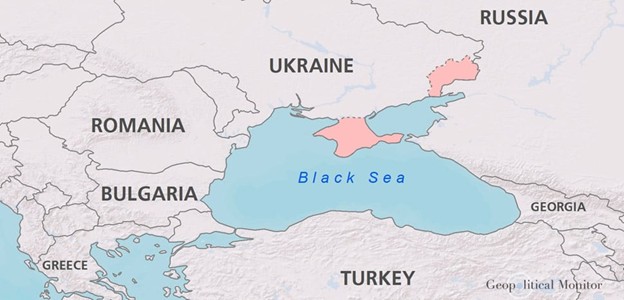
By the early 18th century, the Russian and the Ottoman empires had expanded geographically so that they directly collided with each other in this part of the world. Not surprisingly, they engaged in an intermittent struggle for dominance in the Black Sea region and for control over the straits, nowadays known as the Turkish Straits, which provide direct access from the Black Sea to the Aegean and Mediterranean. The underlying factors for this are the semi-closed sea character of the Black Sea and the fact that the only access to open seas is through the Turkish Straits. The Black Sea constitutes a region where the interests of four geopolitical entities intersect, namely, the EU; USA in search of a gateway to Eurasia, “Broader Middle East” and North Africa ; the Russian Federation, and lastly Turkey; all having potential contradictory geopolitical interests which may lead to conflict situations in this area. The Black Sea region is once again squarely within the field of view of London and New York. Oil and gas have become strategic weapons, with the latest Russian blockade on gas supplies to Ukraine, Georgia and Moldova commonly regarded as the first step in a new energy-based real politic form. In the region, too many “frozen conflicts” have been aggravated following the collapse of the Soviet Union, leaving an unresolved residue of land disputes, weakened governments, inadequate institutions, corruption, minority issues, and growing tension as an asymmetric danger of immigration, illegal immigration, arms transfers and drugs.
From a geopolitical point of view, the historically and culturally rich Black Sea region has witnessed the intersection of European and Asian great empires’ interests to dominate the regions’ maritime routes, and their ambitions to control this strategically important juncture. The region has been at the crossroads of different civilizations. Lord Palmerston famously remarked that nations have no permanent friends and no permanent enemies, only permanent interests. Geopolitics help statesmen determine their country’s interests, and help them distinguish between enduring and transient interests. Those interests can, of course, change over time among the wider Black Sea region, which includes the littoral states of Russia, Turkey, Ukraine, Bulgaria, Georgia, Romania, Moldova, Armenia and Azerbaijan.
In history, the states that had control over the Turkish Straits were all imperial powers. This has deterred extra-regional powers from aiming to establish their naval forces in the Black Sea to use it for their own strategic interests. The Georgian war of 2008 and the political crisis of 2014 in Ukraine, followed by a referendum in Crimea have changed the pattern of post-Soviet states drifting toward EU and NATO influence and away from Russia. The 2008-2014 developments in the wider Black Sea region brought it back to the military-strategic map of Russia-Turkey and Russia-NATO relations. However, the newly emerging Russian and Turkish interest in the Black Sea was not purely military and geopolitical in nature. The U.S. and EU sanctions imposed on Russia after 2014 and Russia’s aggravated relations with Ukraine made Russia turn to Turkey in its search for wider international support and alternative transit routes for Russian oil and gas to Europe, bypassing Ukraine, thus adding a political-economic dimension to Western interest in the Black Sea. There are major oil and gas reserves in the Black Sea itself. The region is on the road between the oil and gas suppliers and the western customers in the Caspian and Central Asian. To Western energy markets, both as a source and as a supply path, Black Sea and Caspian countries become more important.
After centuries-long rivalry between the Russian and Ottoman empires and afterwards during the Cold War period, Ankara and Moscow became closer following the collapse of the Soviet Union in 1991. Security and regional strategic balance, then economic cooperation and, finally, energy and infrastructural projects are the key geopolitical dynamics between Turkey and Russia. Gas is being delivered under the Black Sea through the Blue Stream project between Russia and Turkey, which was built in 2003, thus raising Turkey’s reliance on Russian gas from 66% to 80% of its overall gas needs. For Turkey, the Black Sea is also an area of traditional geopolitical and economic interests connecting it to the wider reaches of central Eurasia. In today’s situation, London prefers that Russian influence is pushed back further into eastern Eurasia- by kicking it out of Ukraine and the Black Sea. That’s one of the key reasons why London keeps on attacking Russian military inside Crimea. Once out of this region, Russia will not be able to re-supply or defend its bases in Syria. After which, it would be able to diminish Russian influence in the Middle East. Both the families are in sync with this plan. It would also give its ally Turkey a greater incentive to block the Russian Navy from entering and exiting the Black sea, thus greatly helping to reduce Russian influence in the Mediterranean. Both the US and London will try to increase military pressure on Russia in the Black Sea region. So, expect more false flag operations and provocations as the situation in Ukraine is unravelling. The story continues in Part 2.