

7 The United States
Decline of Empires
“When empires die, they do so with surprising speed.” Even in bankruptcy, we asked a person how he went bankrupt. The answer was, “Gradually, then suddenly.” Again, this sounds cryptic, yet it’s accurate. Any empire, at its peak, is all-powerful, but the fragility of an empire that’s in decline is hard to grasp, as the visuals tend not to reveal what’s soon to come. Great countries are built upon traditional values – industriousness, self-reliance, honor, etc. But empires are distinctly different. Although it may seem to be a moot point, an empire is a great country whose traditional values have led it to become unusually prosperous. There are many countries, both large and small, that are “great” in their formative values, but only a few become empires. Yes, the prosperity is brought about through traditional values, but a great country becomes an empire only when its prosperity is sufficient to allow it to branch out – to invade other lands – to plunder their assets and subjugate their peoples. We tend to grasp, through hindsight, that this is what made the Roman Empire possible. And we accept that the Spanish Empire was created through its invasion of the Americas and the plundering of pre-Colombian gold. And we understand that the tiny island of Britain achieved its empire by covering the world with colonies that it had taken by force. In every case, the pattern was the same – expand, conquer, plunder, dominate.
The British Empire is now long over, and the current empire is the United States. Around 1900, the then-great country of the US sought to achieve empire and, at that time, its president, Teddy Roosevelt, was insatiable in his desire to conquer foreign lands, both near (Nicaragua, Guatemala, El Salvador, Panama, Puerto Rico, Cuba) and far (Hawaii, Philippines, Japan). The results of his efforts were mostly successful, and although the countries taken were not called colonies, they were certainly intended to be vassal states. And there can be no question the US government’s methods were no kinder than that of other empires. Some locations, like Hawaii, went fairly peacefully, whilst others, like the Philippines, required brutal slaughter on a grand scale. And such tactics change the nature of a “great” country. Yes, it does allow it to become even greater, in terms of domination, but it ceases to be great in terms of its values. In most cases, this plants the seeds of destruction. The empire, even as it’s growing, is rotting from within, with deteriorating principles and morality – the very traits that created it. This, in turn, causes the empire to develop a habit of subjugation – even over its friends and allies abroad – those countries that got on board to take part in the prosperity. While, to some extent, these loyalties by other nations are genuine, they are treated as lesser nations, eventually causing resentment of the empire. As such, in the latter days of the empire, ally nations become toadies. Their hatred for the empire is palpable, but they maintain their obeisance, grudgingly. Empires are built upon monetary prosperity. We can understand that an empire, in its heyday, attracts all and sundry to its shores. It builds up the ability to dictate to others since the whole world hopes to gain favor. But, towards the end of the empirical period, it’s resented by all those who were once genuine allies.
In its latter days, an empire becomes hollowed out. It’s burdened with a costly and top-heavy government. The middle class is expected to provide largess to the masses through bread & circuses, providing fealty for the political class. Traditional values are largely gone, and “everyone seeks to live off everyone else. “At this point, the empire is a mere superstructure – one that’s becoming increasingly unsound. Importantly, the prosperity that made empire possible is replaced by the illusion of prosperity – debt. Concurrently, the political class becomes increasingly tyrannical in order to hold the collapsing edifice together. In the final stages, tyrannical efforts increase in both frequency and magnitude in order to maintain the subjugation of the masses for as long as possible. It may be beneficial for the reader to read this last line again, as this development is the most recognizable symptom of the final stage prior to the collapse of empire.This final period is not only difficult to cope with, it’s highly confusing for those living within a dying empire. The edifice still stands. With each election, the electorate hopes that somehow, a champion will spring forth and “put everything back the way it was.” But it’s important to note that, historically, this never occurs. Whilst the average citizen hopes in vain for his political leaders to “wake up” and stop all the nonsense, he fails to grasp that, to the political leader, the most important pursuit is power. He cares not a whit for the well-being of the populace. The political class has no intention of relinquishing even a small amount of power for the good of the people he was elected to represent. Historically, in every instance, every empire has collapsed from within. Once the apple is truly rotten, it cannot be un-rotted. And so, if we’ve been observant in the recent years and decades, we’ll acknowledge that the present empire has already passed its sell-by date. Its political structure is wholly corrupted on both sides of the aisle; the economy is doomed due to unpayable debt; the population has become unproductive, and it’s now in the process of alienating its former friends through increasingly desperate measures. And here, we return to our opening paragraphs. In its final stage prior to collapse, the empire sells out its toadies and is therefore no longer of any benefit to them. Suddenly, the empire becomes a liability. And, at this point, those who have had to tolerate the indignity of being toadies look forward to a fall, even a partial one, by the empire.
At present, the US Empire maintains an illusion of dominance, but it cannot withstand a test. A defeat in warfare, a collapse in finance, the loss of the dollar’s reserve currency status, or any one of a host of triggers that are now looming would be sufficient to drop the US to one knee overnight. All that’s needed is for one of the triggers to be pulled. It matters little what the event will be; it’s sufficient to understand that we are now drawing quite near and that the event is unavoidable. Historically, when an empire dies, all the notes suddenly come due. The political class of any empire arrogantly depends upon allies to do as they’re told, yet, when a decisive blow is dealt to the empire, those who had once been loyal allies are now as ready to abandon the empire as rats would abandon a sinking ship. When this happens, the crutches that the empire has been counting on to hold it up pull away quickly. The collapse will have occurred “gradually, then suddenly.” Once this is understood, the question for the reader becomes where he wishes to be when the edifice falls; whether he has prepared an alternative situation that will increase the likelihood that he will survive the debacle with his skin on. Like every empire before it, the US is straining under the weight of debt, corruption, and overreach. History shows these trends don’t reverse—they end in collapse. The coming financial crisis could be the trigger that brings the illusion of prosperity crashing down.
How did the US get here?
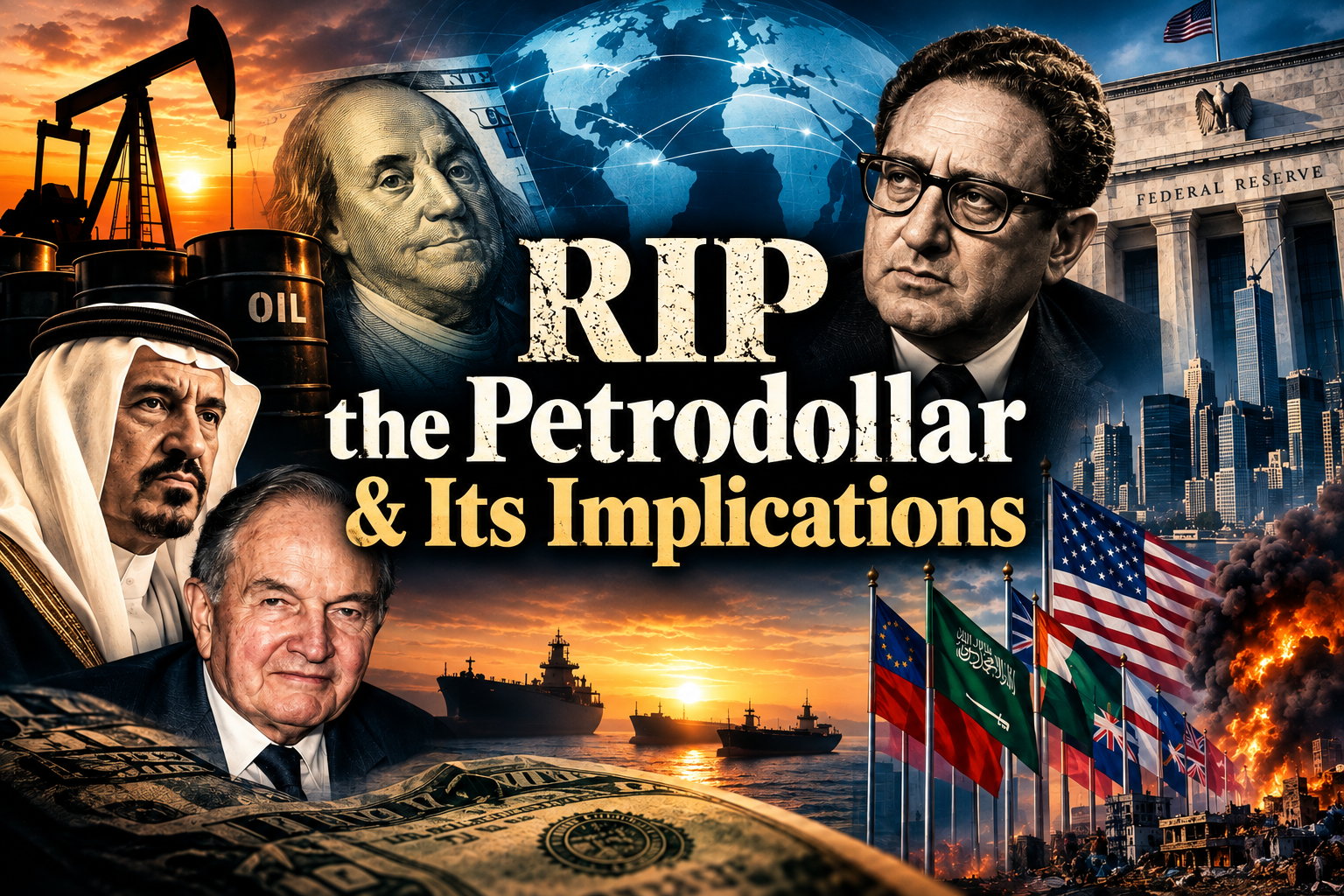
From 1500 till recently, the West ruled the world. Through its industrial revolution, increases in technology and advancements in military power. All of this has led to the elite in the West thinking it will go on forever. Nothing lasts forever. After the end of World War 2, the nations in Africa, Asia and other areas began to gain independence. The first thing these newly independent nations started was education. From there, everything else flowed. Soon, the Global South caught up with the West, and have recently begun to overtake the west, in many areas. In waging these two wars, Europe was broke. In stepped America. The starting point is 1945. At wars end, the US found itself in a position to dictate terms to both allies and rivals. With over 50% of the global GNP, and its rivals and allies in a weakened position, it was able to set a new global economic and financial paradigm that suited its new role. Out of the ashes emerged the Bretton Woods system (the IMF, World Bank and the UN.), totally dominated by the Rockefeller brothers. Over the course of the next 3 decades, the US abused the system to its advantage. It finally reached a breaking point in August 1971, when Washington closed the gold-dollar convertibility , much to the anger and consternation of its close allies-especially London. The British, in fact, had gone to Washington demanding the return of 300 tons of gold (valued at $1m a ton, for a total value of $300 million. Today, that same gold would be worth $3 billion!). The Rothschild’s were furious. The following 18 months saw the value of the dollar fall by some 20 %. For the Rockefeller Empire, they had devised a brilliant move to back up the dollar with oil. Then, to firm up this scheme, the 1973 war between Israel and Egypt/Syria followed. Scripted by Nelson Rockefeller’s leg-man, Henry Kissinger, the war went according to the Rockefeller plan. By mid-1975, the Saudi-US leaders finalized a deal whereby the dollar would be backed by oil. Thus, was born the petro-dollar. Gold limited how much a central bank could print. But, with the petrodollar, the US Fed became a gigantic printing machine to greatly expand the family’s global power and reach.
What followed was a huge flow of loans to 3rd world countries to meet their rising oil import bills. When interest rates were jacked up by 4 times the previous levels, many of these countries defaulted on their debts. This put the Anglo-American banking cartel in a spot. Within a few years, in the early 1980s, derivatives became the new fashion on Wall Street. Over time, the banks – instead of doing deals on behalf of clients, became their own customers. Over the course of the next three decades, derivatives has caused huge losses, with many companies, and a few banks, going out of business. Huge and mounting bank losses pushed Wall Street to find new income streams to maintain the system. First, it was derivatives in the 1980s and 90s. Then, the looting of Russia, followed by the financial pillaging of several Asian and other countries in the late 90s. Finally, the American citizen was looted of hundreds of billions in the infamous “dot-com” crash of March 2000. This was followed by 9/11 and the Global war on Terror, a thinly-disguised scheme to destabilize the Middle East and loot its resources. In addition, the Rockefeller family, beginning in the early 1980s, a policy of “controlled disintegration “of the industrial base of the West, starting in America and the US, and radiating outwards from there. The reason was off-shoring production to reduce costs and increase profit margins. Initially viewed as a success from Wall Street’s point of view, this policy had the effect of de-industrializing the West. This serious flaw began to manifest itself when the Ukraine conflict began – an industrial war. It was at this point that the elite knew that the West had lost this conflict. The Gaza conflict exposed the West and proved it to be a paper tiger. One cannot fight an industrial-based war without an industrial base. Both China and Russia have a massive industrial production base.
While the US and the West were losing money through various financial schemes, the US Empire was getting stretched in the various wars across Eurasia. Until the financial system broke in August-September 2019. This forced the family to implement the Covid con, in order to save the banks. This worked for a short while, but the urgency was increasing to find additional income streams and resources to loot, in order to save the Empire’s broken financial system. Russia was targeted. The family planned for a short war, 3-6 months. It didn’t quite work out that way. It’s been more than 3 years. And, the West has lost this war. Then, the Gaza conflict began. Same story. Israel and the US thought it was going to be a short war. That war is ongoing for 2 years, and not stopping. The 2 families have also lost this war.
Every move initiated over the past decade , in the fields of geopolitics , economics, trade and finance has backfired on the West and its two overlords-the London-based Rothschild family, and the New York-based Rockefeller family, and their allied networks of power. London had leased the White House from the Rockefeller family for the Biden term, but they made such a mess of things that the Rockefellers have taken the White House back, and put in their manager Trump into office. The aim of the Rockefeller Empire is to dominate the world through control over energy, and Eurasia- home to 75 % of the world’s energy. We have detailed in various articles how the family worked to attain this aim, many times in conjunction with the overlords of Europe-the Rothschild family. Various economic and financial policies pursued by these 2 families over the past several decades has brought about a glaring weakness in the economic, financial and military power of the West. It is too late to reverse these changes. David Rockefeller Jnr-the uncrowned king of America- decided to pursue an alternative strategy – multi-polarity. As explained earlier, the plan is to divide the world into three zones. See map below.


A future, multipolar 3+ block world might envision China as the hegemon in East Asia, Russia in Central and Eastern Europe and the United States in the Americas. Regional powers like India, Iran, Turkey, Brazil, Egypt and South Africa could hold their spheres of influence and become guarantors of peace there. An overhaul of a new global order along these lines could be radical enough that it might warrant significant redrawing of borders, not only in Eastern Europe and the Middle East but also in the Americas, which might explain Trump’s ambitions to acquire control of Panama, Greenland and Canada. It’s a time of great sweeping change, a crossroads of world history where upheaval usually finds its most fertile ground. The Rothschild Family opposes this. London is the operations center for this, and operating under the cover of the British Empire’s global terror, financial assets and power. The US is withdrawing from the globe in order to concentrate on the Americas’. The Rothschild’s are opposed to this. An American withdrawal into isolation will leave the Rothschild’s exposed in many places, especially Ukraine and Israel. In the US, things are falling apart: the government has deleted nearly one million “new jobs” that were meant to highlight the ‘strong economy’—it was the largest revision in history: There it is: The US Labor Department just revised -911,000 jobs out of 12 months of already reported data, the largest revision in history. This is officially ABOVE 2009 levels, with jobs data overstated by ~76,000 PER MONTH.
There is so much misleading in US official stats that hardly anyone gives it much credence. That’s not to mention the continually emerging proof that any and all ‘growth’ in the US economy has come mostly by way of the AI-tech bubble. Nearly 50% of all US GDP growth is attributable to Big Tech’s AI-related capital expenditures. The only thing keeping the US economy ostensibly afloat at this point are migrants and the AI bubble; everything else lies in stagnation, misery, and slow decrepitude. The entire mainstream media of the Collective West has been commandeered and controlled to propagandize for the Empire. The internet has produced a slight hiccup to this program, but citizen usage is under relentless attack, while at the same time being a tool for massive Deep State surveillance, “law fare,” and population control. Today the Empire is apparently being countered by Russia, Iran, China, and the Global South via BRICS+. This transition to multi-polarity is itself be a project of global finance- specifically the Rockefeller Empire. (Initially, the family opposed this, but, since 2017, plans were put forward for an “Option 2). It seems that this “Fortress America + a Tri-Polar “future is what the family is now pushing.
8 Finance – the Last Frontier
Wall Street is the base of the current international financial system. The bond market is the heart of this. Since the beginning of this year, the bond market has revealed itself to be fragile. US Treasury auctions have to issue new bonds regularly and a large percentage of these bonds are sold to foreigners. Bond values have been dropping in that time. Foreign buyers are vanishing. Even worse for the foreign investors, they are facing losses on two fronts- the first is falling values, the second is the 10% drop in the dollar. Finally, is the threat of sanctions and seizure of such assets? This last point is what makes China to reduce its holdings of US Treasury bonds. We can see with this that Washington is facing a “cash shortage” from foreign investors. This is one of the reasons for the tariff war and increasing militarization, and threats against friend and foe. Do note that the US needs $1 trillion a year of new money invested in US assets. That works out to $3 billion a day. Now, you can understand “Trump’s Shakedown “campaign. Finally – the price of money. Chinese banks are lending at 2 % to their corporate clients, and for projects. The US banks are charging 5 % to their best clients. Suddenly, we find that US companies are trying desperately to get a slice of these loans. Over time, these costs will bring down the cost of production, resulting in highly competitive prices in the world. Getting cheap energy from Russia is an added factor. Then, we have the “confidence” issue. First, the dollar was backed gold (1945-1971). Then, it became known as the petro-dollar. This period is slowly, but surely, coming to an end. Currently, the dollar is backed by nothing other than “confidence”. This was fine as long as the US economy was humming along nicely. Since 2020, that is disappearing. Add America’s futile efforts to maintain global dominance is not gaining traction. The dollar’s role in international geopolitics was backed by the Pentagon. But, over the past few years, the world has witnessed the dismal performance of the US military. This has reduced the fear factor of its allies and rivals. This can been clearly in both conflict zones –Ukraine and the Middle East. The US and its allies just cannot prevail over its enemies. Now, the world is beginning to lack “confidence” in the US and its ability to influence events in its favor. This “lack of confidence” is reflected in the rising gold price, which has just passed the $4,000 mark. How far it rises depends on the performance of its military in any future wars (Iran), its bond markets and in the stability of its political system. All of this is declining.
The Petro Dollar in London
Before the petro-dollar, London became the base of offshore dollars. These were dollar profits of US companies operating in Europe. Instead of repatriating profits back to America, these companies and banks kept them in London, thus the euro-dollar; from the 60s to the late 70s, until the petro-dollar took the lead. In the ensuing period, these petro/euro dollars have ballooned to 10 trillion dollars. While, at the same time, the total amount of dollars within the US economy is $6 trillion. This is now beginning to be a serious threat by London against New York. This, the family intends to neutralize. This represents great leverage to the Rothschild’s, and New York’s next step is to “remove this threat” to their future plans regarding the dollar. Let me explain.
The first is the Trump shakedown of its Arab, Asian and German vassals. All in all, the total Arab commitment to Trump is more than $1 trillion. Most of this money is parked in London. If the Arab oil monarchies invest in the US, these funds will be moved from London to New York. Considering how short of funds London is in at the moment, any large-scale movement of funds has a chance to precipitate a financial collapse in the City of London. After suffering so many blows over the past 3 years, the Rothschild Empire is staggering like a drunk. This move will be like a knock-out punch. This is for the British branch. We have explained earlier in this article how the CIA helped the Sahel states to eliminate French influence. This helped bankrupt France. Today, we can see the situation in Paris. Rothschild manager Macron has lost 5 Prime Ministers in 2 years. The streets are on fire. A similar situation in Britain. Now, these two countries are the home base of the Rothschild Empire. The Rockefeller plan is default. After which, the US will house all US bonds in a crypto house, which can be easily manipulated. Before this point is reached, the issue of the $10 trillion has to be resolved. Let’s see how all this will play out in the near future.
‘Operation SWIFT’ Takes Off
In 2004, the conditions were created for the secret-side of the “SWIFT program” to take a decisive turn into Operation SWIFT, when new capabilities were set up and reticulated in the U.S. Treasury Department for financial monitoring and intervention. Operation SWIFT was the up-and-ready instrumentality to function in association with the Treasury and other U.S. executive branches. Together, they carry out the activity of financial intelligence to serve as a springboard for a system of governance with an international aim. Less known than the CIA and the National Security Agency, this elite agency of the American intelligence community quickly became a weapon of war in the service of Washington’s interests. This secret war continues until the present, led by the various successive governments of the United States. Quickly, and depending on the sanctions programs, we see more and more names of people, companies and organizations appearing on the blacklist of Washington’s enemies, scrupulously kept up to date by the Treasury Department’s formidable Bureau of Counterterrorism and Financial Intelligence.The power of the system and its influence in the world are made possible because banking institutions must comply with Washington’s dictates. And if they fail to do so, they will be prosecuted and pay a heavy price, like French bank BNP Paribas, which paid a record fine of $9 billion for not respecting the unilaterally decided embargoes against Iran, Sudan and Cuba.
The Militarized Dollar
This hegemonic power is served by information from the interactions between SWIFT and the Internet, but also with another key attribute of the American empire: the dollar. The greenback being the main currency of exchange in international trade, it results in a formidable coercive power allowing pressure on foreign firms: the latter could no longer carry out their operations in dollars because the clearing houses are located in the United States. This phenomenon leads to the militarization of the dollar. In this way, surveillance is delegated to the monitored. What triumphs is the reign of fear. A tipping point was reached in the madness of power when the United States put pressure on SWIFT to exclude Iran from the international banking and financial system. This happened in 2012, and it was the first time in history that an entire country had been cut off from the network. In 2017 North Korea was barred from SWIFT. In 2022, Russia and Belarus were both barred. The signal sent to the international community and mainly to the non-aligned countries is clear: they will be cut off from SWIFT in turn if they oppose Washington. The European Union is not immune to this pressure; it is not able to escape it in the absence of an independent banking and financial system. It even seems a privileged target and finds itself forced to swear allegiance to the hegemon.
In this context, Russia is developing a messaging system that competes with SWIFT, called the System for Transfer of Financial Messages (SPFS). It is intended to circumvent American sanctions. However, Russia has to face its technological limits: it does not control the entire Internet! The sprawling influence of “Washington” on the global economy through the imperial triad: SWIFT – INTERNET – DOLLAR is clashing with the aspirations of the BRICS. American sanctions are encouraging unexpected alliances. Fearing for their sovereignty, some non-aligned countries want to free themselves from American hegemony by creating an alternative currency and independent banking infrastructures. However, their technological backwardness in the field of telecommunications networks is holding back their ambitions. In response, there is an escalation on the military level.
SWIFT, the Society for Worldwide Interbank Financial Telecommunications, established in 1973. Headquartered in Brussels, SWIFT was early on presented as a benign facilitator of international financial transactions and settlements, but in reality, it was put in place to serve a policeman’s role to keep everyone inside the bankrupt trans-Atlantic financial system in its end phase. That is why SWIFT was created soon after the August 1971 launch of the floating exchange system. Its weaponized role over the years is glaring; for example, the exclusion of Iran from SWIFT in 2012, and Russia from SWIFT as of March 1, 2022. There are various ways SWIFT has served as a geopolitical tool for the collapsing Anglo-American Empire.
The Electro-Yuan Gambit
Perhaps the boldest and most consequential development in Tianjin was Chinese President Xi Jinping’s call to expand the use of the Yuan in energy settlements. Analysts quickly dubbed the concept the “electro-Yuan,” a system designed to link China’s digital currency with cross-border trade in oil, gas, and electricity. Unlike conventional trade settlements, which rely on correspondent banking in U.S. dollars, the electro-Yuan would enable real-time, block chain-enabled transactions directly between SCO member states, bypassing traditional financial intermediaries.This is about far more than convenience or modernization. If widely adopted, the electro-Yuan could significantly weaken the petrodollar system, which has underpinned U.S. financial dominance since the 1970s. The dollar’s centrality in global energy markets has long allowed Washington to exert extraordinary influence over international finance and foreign policy. By creating a credible alternative settlement system, Beijing and its SCO partners would undermine this leverage, diminishing the reach of dollar-based sanctions and reducing the United States’ ability to enforce geopolitical objectives through financial pressure.
The implications extend beyond energy. A robust electro-Yuan network could accelerate the internationalization of China’s digital currency, the e-CNY, and provide a model for other nations seeking to hedge against the dollar. Coupled with SCO-led development projects and cross-border trade corridors, it represents a deliberate attempt to construct the “plumbing” of a parallel financial system that operates on terms favorable to Eurasian partners rather than Western institutions. The ripple effects for global markets could be profound. If SCO countries begin pricing energy, commodities, and infrastructure projects in Yuan rather than dollars, it could reduce demand for U.S. currency reserves, influence exchange rates, and reshape global investment flows. Commodity markets may see shifts in pricing benchmarks, particularly in oil and natural gas, as the electro-yuan provides a viable alternative to the dollar-based contracts that dominate today. For investors and multinational corporations, reliance on the dollar as the default currency for trade and finance may gradually diminish, introducing new risks and opportunities in hedging, capital allocation, and currency management.
For the Rockefeller Empires, the message is stark: the rules of global finance may be shifting beneath their feet. A system that decouples trade and investment from the dollar would not only reduce the United States’ economic influence but also recalibrate global alliances, making financial sovereignty a tangible tool of statecraft for countries like China, Russia, and their SCO partners.In short, the electro-Yuan is a strategic gambit, signaling that the SCO is not content merely to challenge Western hegemony rhetorically. It is building the infrastructure that could one day rival, and perhaps circumvent, the very foundations of U.S.-led global economic power, with consequences that extend to every corner of the global market. The American empire dominates other nations around the world because of its grip on the infrastructural centers of power. This irremediable takeover of the global economy began after the attacks of September 11, 2001, when the United States decided to go for terror and war to weaken rivals, and hold its dominating power.
8 Conclusion
If it comes down to numbers vs. money, our numbers are growing fast. Moreover, gloriously, the more they push the more we grow. Meanwhile their advantage – money – is collapsing before our eyes: crashing in crippling debt, nervous financial markets, the limits of inflationary printing, and the moribund stagflation that always accompanies it. Meaning they have only 2 options: pull back and hold on for dear life against the backlash. Or keep pushing and they’re out of power. It’s only a matter of time. In short, we’re getting stronger. They’re getting weaker. And the longer it takes, the more spectacular will be our victory.
Our next article is titled – “Wall Street vs. BRICS “(the updated version) Stay tuned till then, folks!
Amazing articles very good to frame I love your insights.
An incredible fascinating story that reads like a spy novel except it’s actually the truth! As the cliche goes “truth is stranger than fiction ” and there is no doubt that cliche represents the facts of this story. As a miniscule part of a small country such as Canada I do wonder what is in store for us? Will we be vacuumed up and used like a storehouse of natural resource wealth for the USA if they fail to take Venezuela’s oil fields? The issue is for Canada that no nation on earth would be willing to go to war with the USA to save our sovereignty except maybe China or BRICS. Canada as a Rothschild vassal is hated by Russia due to its idiotic anti Russian stance. I think Canada may be in for serious trouble if the Roxkefellers and Rothschilds have even more of a falling out over the natural resource wealth they are fighting for.
Thanks so much Sam
Your essays always read like a blueprint for world events taking place in real time, mixed on the foundation of real history.
Best Wishes
I wonder what role will play new currency of CBDC in financial resert of the west. Maybe their intention is to go default, create huge poverty and problems and then intruduce new financial system. People normally would not accept cbdc, didtal id and all restrictions. The crisis will be the opportunity for elites to impose those new reality on everyone.