Settler Violence becomes State Doctrine
Settler attacks on Palestinians are no longer random or rogue. Once attributed to fringe factions like the “Hilltop Youth,” this violence has, since 7 October, transformed into a desperate move of the Israeli state. Armed settler mobs now operate in full coordination with the occupation army, acting as enforcers of a policy of forced displacement. In Areas B and C of the occupied West Bank, Palestinian farmers and villagers have been hunted by these militias who break into homes, destroy solar panels, poison water tanks, and torch crops – not just to intimidate, but to injure, kill, and drive people off their land. These attacks reflect a strategic shift. According to the UN’s Office for the Coordination of Humanitarian Affairs (OCHA), more than 260 settler assaults were recorded in October alone –the highest number since 2006. These assaults, are systematic, disproportionately targeting farmers during harvest season and shepherd communities in remote areas. The real weapon, however, is impunity. Settlers now act with full confidence that the state will protect them, not prosecute them. Backed by like Smotrich and Ben Gvir, they feel – and function – as the true sovereigns of the land. Even before the war, 94 percent of settler violence cases ended without indictment. Since the war began, even the appearance of legal process has evaporated. Tel Aviv has weaponized resource control and environmental laws to dismantle Palestinian agriculture and detach people from their land. Palestinian farmers are subjected to a regime of domination that severely restricts access to vital resources. Israel controls the occupied West Bank’s water and bans the digging of wells, forcing many to rely on traditional rain-fed agriculture – a practice rendered unstable by climate change and groundwater theft for the benefit of nearby, lush settler colonies.
This war on agriculture is also waged through legalities. Israel has criminalized the farming of native Palestinian plants like thyme, akkoub, and sage, citing “nature protection” laws. While bulldozers raze thousands of acres of wild flora to expand settlements, Palestinians gathering akkoub for a family meal are fined and jailed. This is part of a broader campaign to sever Palestinians from their land, even controlling what they eat and how they live. Meanwhile, settlers launch direct assaults on crops, block Palestinian farmers’ access to hundreds of hectares of olive groves, and cripple the local economy. When Palestinians resist, they are charged with terrorism. The goal is to make staying on the land too dangerous, too expensive, and ultimately impossible.
‘Creeping’ or open annexation?
Alongside violence, Israel is pushing a quieter, perhaps more dangerous campaign: the legal absorption of the occupied West Bank into the settler state. This does not rely on declarations or ceremonies. It operates through zoning laws, civilian governance, and strategic archaeology. One of the most alarming manifestations of this shift is the weaponization of archaeology. The Israeli government seeks to place the occupied West Bank under the authority of its “Israel Antiquities Authority,” stripping jurisdiction from the military administration and handing it to a civilian body – a de facto annexation. Under the pretext of preserving, vast areas are declared “archaeological sites” or “national parks,” creating an exclusively Jewish narrative that automatically bars Palestinians from building or farming on these lands. This historical fabrication erases the region’s multi-layered past in favor of a singular Jewish mythos designed to justify colonization. By replacing military rule with civilian law, Israel is reclassifying the occupied West Bank not as occupied territory, but as a sovereign extension. The lines between Tel Aviv and Tulkarem blur, and apartheid becomes formalized.
Dismantling the political center
As bulldozers dig up fields and laws suffocate villages, Tel Aviv is also re-engineering Palestinian political life. The goal is not to dismantle the PA outright – it still serves an administrative and in Area A – but to reduce it to a neutered municipal subcontractor. Israel is bypassing the PA altogether, striking direct relationships with tribal leaders, village councils, and local power brokers. This is a classic colonial policy of dividing the indigenous polity, elevating local collaborators, and eliminating the possibility of unified national leadership. This aims to fracture Palestinian cohesion and recast the cause from a national liberation struggle into isolated humanitarian cases – villages like Hebron, Nablus, and Jenin presented as disconnected communities in need of charity. In parallel, Tel Aviv is choking the PA financially by siphoning off its tax revenues, as permitted under the Oslo Accords. As the “Authority” collapses into dysfunction, the resulting chaos is used to justify further Israeli control.
The New Nakba
The sum of these parts – settler militias, scorched agriculture, and illegal land grabs, and political fragmentation – is a campaign of forcible displacement without tanks. In short, it is a silent Nakba (catastrophe). Settler violence alone has displaced 44 Palestinian shepherding communities since the war began. When you look at what’s happening, there’s an entire system in place. These are not just rogue settlers. They are backed by the Israeli establishment. The goal is clear: forced Palestinian displacement. The West Bank is being methodically emptied through fear, poverty, and thirst. Israel’s strategic objective is to eliminate the two-state framework and enshrine a one-state reality in which full rights are reserved for Jews, while Palestinians are confined to disconnected enclaves, stripped of sovereignty, and eventually pushed toward the east bank of the Jordan River. The warplanes may go quiet, but the machinery of colonization – the fences, permits, laws, roads, and guns – grinds on. It is here, in the silence, that the erasure is completed. A future where return is denied, justice outlawed, and history repaved with concrete and myth.
How Israel Became the Palestinian Tax Collector
This discusses the single most important yet least discussed mechanism of the occupation: the tax and clearance-revenue system that lets Israel function as the Palestinian tax collector and hold the entire PA budget hostage every month. People in the West Bank and Gaza have reached a point where analysis offers no comfort. Every week brings a new humiliation disguised as “governance”: teachers surviving on half-salaries for months; hospitals postponing surgeries because oxygen cylinders are stalled at Israeli checkpoints; families watching food prices soar because even a tin of tomatoes carries Israeli VAT. Life is shrinking, relentlessly and with intention. Everyone understands this is not an accident but a design. And while armed resistance fights under impossible conditions, the civilian sphere governed by the Palestinian Authority — salaries, services, the basic rhythms of survival — is failing under pressures it cannot control. Across towns, villages, and refugee camps, Palestinians are no longer asking for explanations of their condition. They are asking for a path out of it. The fiscal trap Palestinians live under today did not arise organically; it was engineered, codified, and then left untouched for thirty years. Its blueprint is the 1994 Paris Protocol, the economic annex to the Oslo Accords, which was marketed at the time as a temporary framework for a transitional period leading toward Palestinian sovereignty. The Rothschild’s agreed, under immense American pressure, to the Oslo Accords. But, the French Rothschild’s pushed through an economic annex to the Oslo accords that would ensure Rothschild control over the West Bank and Gaza. As we have repeatedly seen, whenever a major issue arises in the Zionist project, it is always Paris – not London – that has the final say.
In reality, it created a one-way customs union in which Israel retained full control over borders, ports, import channels, and from the taxes generated from nearly all goods entering the West Bank and Gaza. Under this arrangement, Israel collects VAT, customs duties, import taxes, port fees, and fuel excise charges on behalf of Palestinians, aggregates them into “clearance revenues,” and then transfers them to the Palestinian Authority — minus whatever deductions it unilaterally decides to impose. These revenues now make up the majority of the PA’s budget and are the financial core around which Palestinian governance has been forced to revolve. Gaza is not receiving consumer goods or commercial imports. It is receiving survival commodities — flour, rice, infant formula, chlorine tablets, dialysis filters, trauma kits, tents, and diesel for ambulances — after months of bombardment, mass displacement, and engineered famine. Yet every truck that enters Gaza through Karim Shalom arrives only after Israel has imposed customs duties, VAT, port handling charges, and “security inspection” fees. These costs are embedded in the goods before they reach Palestinians, meaning that sacks of flour for families sheltering in Rafah, antibiotics for clinics in Deir al-Balah, dialysis kits for northern Gaza hospitals, and diesel for ambulances all carry Israeli taxes. Even highly restricted aid shipments, routed through layers of Israeli bureaucracy, pass through the same fiscal machinery that treats Gaza not as a humanitarian catastrophe but as a taxable market. The perversity deepens: Israel has frozen Gaza’s entire share of its own clearance revenues, diverting or withholding funds generated from imports destined for the Strip. Gaza’s hospitals run out of fuel while the taxes generated from that very fuel accumulate under Israeli control or sit in foreign escrow. This is the tax cage in its most brutal form — an economic siege intertwined with the military one. Israel controls the border, the goods that may enter, the taxes levied on those goods, the release of those taxes, and the Palestinian authority permitted to receive them. Families living in tents, surgeons operating by phone flashlight, and children waiting hours for contaminated water are trapped inside a system in which the colonizer finances itself by taxing the lifeline it constricts. The starting point is blunt enough to feel obscene: Israel controls the Palestinian wallet. They constitute roughly two-thirds of the PA’s operating income.
When Israel withholds them, delays them, or deducts them — and it has done so repeatedly since October 2023 — the effect is immediate and devastating. Salaries collapse. Municipal services flicker off. Clinics ration medication. The PA staggers from one month to the next, propped up by emergency donor infusions and internal borrowing that sink its institutions deeper into insolvency. It is a colonial mechanism designed to give Israel decisive leverage over Palestinian political life without incurring the responsibilities — or the financial cost — of actual governance. Palestinians can weaken, bypass, or erode the tax regime that keeps them dependent through collective and practical strategies already emerging across Palestinian society: strategies that shrink the taxable frontier, redirect revenue away from Israeli control, decentralize fiscal power, and build micro-economies that are harder to choke. Some of these strategies come from communities. Some come from institutions. And some — if political will ever aligns with public need — could come from the PA itself. The tax cage did not simply appear. It was built — deliberately, systematically, and with consequences that now shape not only the Palestinian future but the geopolitical horizon of the entire region. The same mechanism operates in the West Bank, only with less visible violence.
Since October 2023, the situation sharply deteriorated. Israel froze Gaza-related revenue outright, dragging out clearance transfers for weeks or months, and withholding far larger sums from the West Bank portion. The PA’s fiscal capacity collapsed; salaries became partial, delayed, or split into unpredictable installments. Ministries cut services. Municipalities closed departments or deferred maintenance. Universities and hospitals sank into debt spirals. The PA could not plan more than thirty days ahead because it no longer knew if or when Israel would release the funds. By early 2024, the PA had become a government whose operational budget was effectively determined in Jerusalem — in the Israeli Ministry of Finance, not in Ramallah. The PA has no control over its external borders, no independent central bank, no control over its main revenue streams, and no authority to regulate the cost of the goods on which its own tax revenues depend. It survives only if the colonizer transfers the funds it collected from the colonized. This is the tax cage: a colonizer that collects your taxes; a government that depends on the colonizer to survive; and a public that pays the cost through inflated prices, weakened purchasing power, and delayed salaries. The extraordinary part is not that this architecture was built in the 1990s, but that it was kept in place for three decades — even as the PA’s political legitimacy eroded, even as Israel hardened its control, and even as the system cannibalized itself after October 2023. This dual structure — Gaza starved, the West Bank throttled — traps the PA in a position where it governs without sovereignty and survives without legitimacy. It becomes a caretaker of shortages, a manager of crisis, and an administrator of consequences it cannot shape. For Israel, this is not a failure;it is the point. The PA is kept solvent enough to relieve Israel of direct civilian administration, yet never solvent enough to act politically or economically on its own. The machinery is now exposed. The real question is what that machinery actually does to daily life and political possibility in the West Bank look like when the chokehold tightens more slowly.
The West Bank in Slow-Motion Strangulation
Gaza reveals the tax cage at its most lethal extreme. The West Bank reveals the same mechanism running in slow motion — less spectacular, but no less suffocating. The foundations of this paralysis lie in the structure of the Palestinian Authority itself. With roughly 150,000 to 180,000 employees the PA is the backbone of the formal West Bank economy. Public-sector workers account for between 27 and 30 percent of the entire workforce and an even higher share of stable, contract-based employment. Salaries alone consume between half and nearly two-thirds of the PA’s entire budget. Because Israel-controlled clearance revenues — VAT, customs duties, and import taxes collected at Israeli ports — constitute about 60 to 70 percent of the PA’s total income, even a single delayed transfer can jeopardize payroll. There are no sovereign reserves to fall back on, no independent monetary policy, and no ability to borrow internationally without Israel’s permission. The result is a fiscal architecture designed for permanent fragility. Under this vision, the PA is not meant to be strengthened. It is meant to be preserved precisely in its current weakened state — an administrative entity that manages civilian affairs but lacks the fiscal or political autonomy to challenge Israeli control. The PA is expected to be strong enough to administer, too weak to resist; responsible for civilians, irrelevant to national strategy; sufficiently functional to relieve Israel of direct governance, perpetually dependent on Israel’s tax transfers to survive. This is not a new architecture. It is the existing system, fortified.
Yet even inside this tightening structure, cracks have widened — cracks born of necessity, crisis, and improvisation. Communities have developed survival economies anchored in family networks, zakat committees, cooperatives, and local production. Municipalities have learned to rely on local revenue when Ramallah cannot deliver. Universities, hospitals, and large NGOs have built financial ecosystems that bypass the PA entirely. Boycotts and shifts in consumption patterns have begun to weaken Israeli-taxed imports. And the PAitself retains dormant legal and administrative tools it has never mobilized: challenging the Paris Protocol, demanding third-party oversight of clearance revenues, devolving power to municipalities, restructuring its security posture, and cultivating alternative revenue streams. These cracks do not replace liberation. But they represent the spaces in which Palestinians still have room to maneuver — and where autonomy, if deliberately cultivated, can begin to transform the logic of dependency. These cracks are not metaphors or future hopes; they are concrete, already-existing practices.
What Palestinians Are Already Doing: Cracks in the Cage
The first and most immediate site of autonomy is at the community level, particularly in the production and consumption of food. Every time a Palestinian family buys a locally made staple instead of an Israeli or imported one, VAT and customs revenue shrink along the Israeli-controlled pipeline. A 2017 survey found that local producers already supply about 57 percent of dairy consumed in the West Bank, more than half of processed fruits and vegetables, and roughly 80 percent of all bakery products. The sector includes over 560 registered enterprises and comprises nearly a fifth of the entire Palestinian manufacturing base. These numbers demonstrate that Palestinians already dominate essential food categories— and that scaling up the cooperatives emerging across the West Bank would further shift consumption away from Israeli-taxed products. After October 7, 2023, this shift accelerated. Boycotts of Israeli and U.S.-linked brands produced measurable market changes: the Palestinian soft drink “Chat Cola,” produced in Salfit, reported more than a 40 percent surge in sales; two KFC branches in Ramallah closed after demand collapsed; and supermarkets in Ramallah, Nablus, and Jenin noted significant increases in sales of local snacks, beverages, and household goods. Together, these trends form a quiet but material form of economic resistance: local production plus coordinated boycotts equals a shrinking taxable frontier.
The second domain where cracks in the tax cage appear is at the level of institutions and municipalities, which have long operated with degrees of autonomy simply because they have had to. When the PA cannot pay salaries or transfer funds, many municipalities continue functioning by relying on local revenue streams that never pass through Ramallah. Nablus has repeatedly used water-billing income to cover operational costs during PA liquidity crises. These municipalities demonstrate that essential services — water, sanitation, local infrastructure — can remain operational through mechanisms entirely separate from Israeli clearance revenues. This is not a hypothetical model; it is a working one. These institutions, which serve hundreds of thousands of Palestinians each year, operate as a de facto parallel state: they have stable revenue channels, high administrative capacity, and broad public legitimacy, and they are structurally insulated from Israeli-controlled clearance revenues. When crises hit, they continue functioning long after PA ministries grind to a halt.
A third layer of autonomyis the network of parallel services that emerges during Israeli raids and curfews. In Jenin, Tulkarm, Nablus, and parts of Ramallah and Bethlehem, communities have repeatedly organized ad hoc medical response teams, field clinics, food distribution networks, neighborhood patrols, and transportation arrangements. These systems spring up because the formal ones are incapacitated or barred by the occupation. Palestinian society already governs itself under stress, and often does so more coherently than the PA can when dependent on Israeli revenue flows.
The final scale of potential autonomy lies within the PA itself. Despite its dependency, the PA is not without authority. Legally, it can suspend or challenge the Paris Protocol, because the agreement was never ratified by an elected Palestinian parliament and was explicitly designed as an interim arrangement. A suspension would trigger international mediation and create an opening for escrow mechanisms, third-party oversight, and binding constraints on Israel’s ability to deduct funds unilaterally. This is not theoretical — after October 2023, Norway agreed to hold Gaza’s share of clearance revenues in trust, proving that external custody of these funds is both technically and diplomatically feasible. The PA could insist that all clearance revenues be transferred through such a mechanism. Likewise, the PA could reorient its security apparatus toward civilian protection and public documentation of Israeli incursions rather than preemptive internal policing — a move that would shift the political cost of West Bank instability back onto the occupation, restore some public legitimacy, and reduce Israel’s leverage over PA fiscal survival. Finally, the PA has underused revenue tools at its disposal, including luxury taxes, real-estate transaction fees, diaspora investment instruments, and duties on NGO imports. None can replace clearance revenues, but collectively they can reduce the depth of vulnerability to Israel’s monthly decisions.
What ties all these examples together is that none are speculative. Palestinians already have functioning micro-economies that operate outside Israeli tax capture; institutions already bypass the PA’s revenue shortages; municipalities already keep essential services running when Ramallah is insolvent; and the PA already possesses legal and administrative levers it has simply never used. The autonomy Palestinians need is not a distant aspiration. It already exists in embryonic form across the West Bank. The task is to expand and coordinate these structures into a deliberate strategy — not as a substitute for liberation, but as its foundation. History shows something far more radical: every time the formal fiscal pipeline has been completely cut, Palestinian society has not collapsed — it has reorganized itself.
Proof That Society Outlives the Treasury
Every time Israel has withheld clearance revenues for an extended period, the formal economy has stalled, the PA has been unable to pay salaries, and yet Palestinian society has not collapsed. Instead, a parallel survival infrastructure has surfaced — informal, distributed, and self-organized — revealing the existence of another political economy running beneath the official one. The clearest early example came in 2006–2007, when Israel froze almost all tax transfers after Hamas won legislative elections. Tens of thousands of PA employees went five or six months without any salary at all. They did so because extended family networks stepped in, shops extended informal credit, and zakat committees quietly covered school fees and medical bills. The international community, confronted with the prospect of a humanitarian collapse, built the Temporary International Mechanism, allowing direct payments to health workers and fuel suppliers without channeling money through the PA. The result was paradoxical: while the formal structures withered, the society beneath them proved far more resilient than outside observers expected. A similar pattern reemerged in 2019 and 2020, when Israel deducted over two billion shekels in retaliation for the PA’s prisoner stipends. For nearly half a year, most public servants received only 50 to 60 percent of their salaries. Banks became the de facto treasury, offering overdrafts and salary-backed loans to keep households afloat. The private sector improvised deferred-payment systems, allowing families to buy groceries and essentials on credit. Municipalities, relying on their own water and waste fees rather than PA transfers, kept basic services functioning even as Ramallah’s cash flow collapsed. Again the lesson surfaced: when the formal fiscal pipeline is choked, local networks — not central authority — fill the vacuum. This is the most important strategic implication of the crisis archive: autonomy is not something Palestinians must create from scratch. It already appears, fully formed, whenever the fiscal pipeline is cut. The task is not to imagine alternative structures; it is to recognize, strengthen, and politicize the ones that emerge naturally under pressure. The informal economy that sustained teachers in 2006, nurses in 2019, and entire communities after 2023 holds the blueprint for a political order not dependent on Israel’s monthly transfers. They are previews of what a liberated economic architecture could look like. If Palestinian society repeatedly proves it can govern and feed itself when the PA is starved, then the political implications are explosive.
For thirty years, Palestinians have been told that economic autonomy would come after sovereignty, after statehood, after negotiations. The Paris Protocol was sold as a temporary compromise while the political horizon matured. In reality, it inverted the sequence: by locking Palestinians into a customs union controlled entirely by Israel, it made sovereignty contingent on a fiscal structure that preemptively prevented it. Israel became the tax collector; the PA became the administrator of scarcity; donors became the guarantors of survival. The architecture ensured that Palestinian political agency would always be reactive, never generative. Liberation cannot wait for a political process that Israel, and now Trump, intend to keep indefinitely deferred. But autonomy — economic, communal, institutional, and even administrative — can be expanded now. The cage is real. Its bars are strong. But they are not solid. And every place where Palestinians have already slipped through them is not only a crack — it is a map. The fantasy of a “post-Hamas” administration in Gaza collapses when the neighboring West Bank is itself sliding beyond management. This is not a temporary setback. The West Bank is controlled only through raw,daily, unaffordable force — and even that is no longer enough. The ledger records another default: the occupation has become an unfunded liability with no horizon, no partner, and no exit.
Annexation Issues-West bank, Golan Heights & Jerusalem- The reason for the recognition & annexation
One more fascinating story needs to be told here. This concerns Israeli annexation of the West Bank. Israel was planning on annexing the West Bank. Trump said no. The question is why? West Bank annexation threatens Jordan But, more importantly, it would mean that Jerusalem would fall under even more Zionist control. The Gulf Arabs are vehement that this must not be allowed to happen. Since New York needs the Gulf Arabs on board, it could not afford to alienate them at this moment. But, there was no qualms when Trump gave Israel the go-ahead to annex the Golan Heights. This was OK as it took land away from the enemy – Syria. But, why then. The recognition happened on March 25, 2019. This is extremely significant. We shall proceed to explain why. A previous article called “The Break-Up”, dated – https://behindthenews.co.za/the-break-up-part-1-of-a-2-part-series/, details this issue. Oil was discovered on the Golan Heights back in 2010. This was a joint venture between the two families. But, London decided to keep it for itself. And, thus, a conflict broke out between them. Very costly for both sides. This conflict came to an end in 2017, in Trump’s fitst term.
On December 6, 2017, the officially recognized as the capital city of Israel. American president who signed the also ordered the relocation of the American diplomatic mission to Jerusalem from Tel Aviv. Trump’s decision was rejected by the vast majority of world leaders. The reason was that New York extended an “olive branch” to London and Paris. The reason had to do with the preparations for the upcoming war in Ukraine. New York needed the assets of British Intelligence and French participation.
What are the Golan Heights?
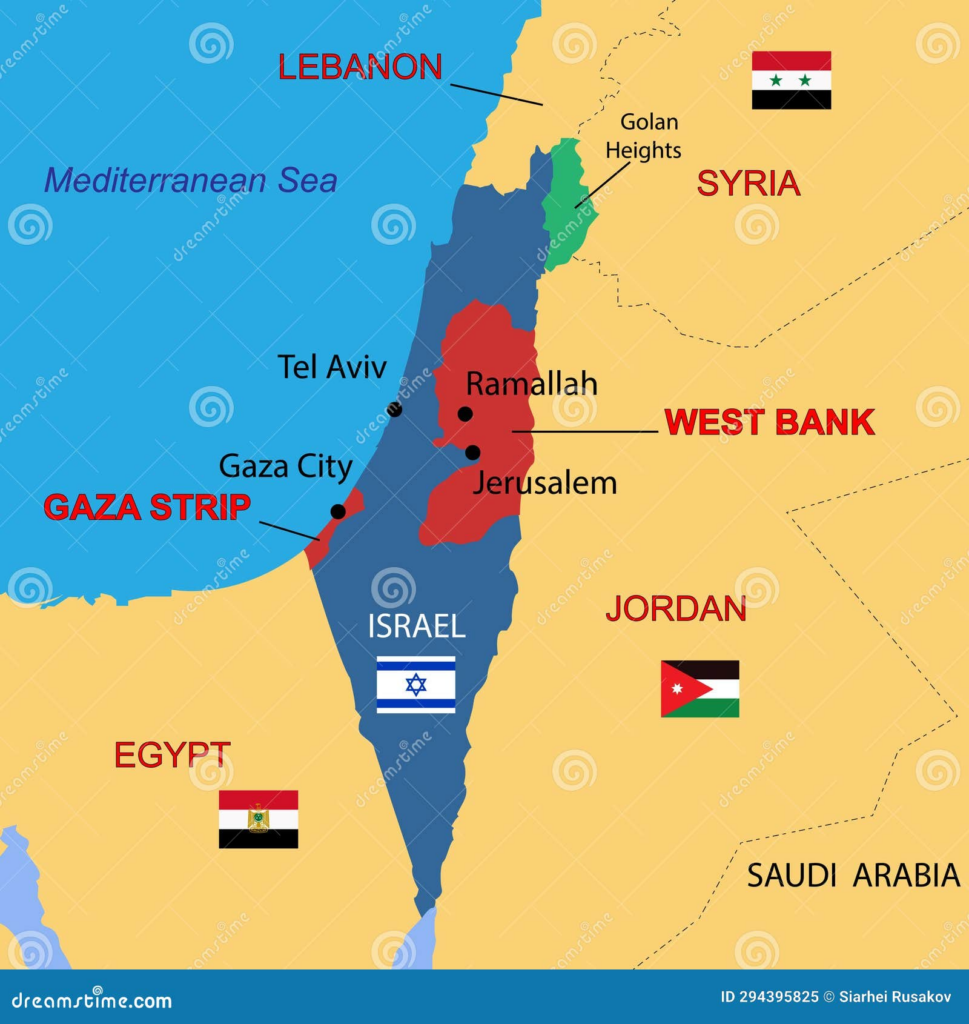
Israel seized most of the Golan Heights from Syria in the closing stages of the 1967 Middle East war, and thwarted a Syrian attempt to retake the region during the 1973 war. The two countries agreed a disengagement plan the following year that involved the creation of a 70km-long demilitarized zone patrolled by a United Nations observer force. But they remained technically in a state of war. There are more than 30 Israeli settlements in the Golan, which are home to an estimated 20,000 people. The settlements are considered illegal under international law. The settlers live alongside some 20,000 Syrians, most of them Druze Arabs, who did not flee when the Golan was captured. Israel annexed the Golan Heights in December 1981, a move that was not recognized internationally, though it did seize control of the territory in 1967. The international community, including the United Nations, still considers the Golan Heights to be Syrian territory under Israeli occupation, declaring Israel’s annexation “null and void”. The actual reason for this was to make its attack dog more confident of support for Rockefeller aims in the region. The immediate target was the downfall of the Syrian government. Just over 5 years later, the US succeeded. So, on 25 March 2019, the US authorized Israel to annex the Golan Heights. It also makes things awkward for Washington’s Arab allies, whose populations oppose Israeli seizures of Arab lands. Saudi Arabia, Bahrain, Kuwait, Qatar and the UAE all calling the Golan occupied Arab territory. Syria said Trump’s decision was “a blatant attack on its sovereignty”.
Why the Israelis cannot win in Gaza, West Bank, Lebanon, Syria or Yemen
The Zionist regime’s impunity has collapsed the post-WWII order. The strategy employed by the Zionist entity in both the Gaza Strip and Yemen is almost identical: striking civilian targets, murdering civilians, and inflicting mass starvation. Although the explosions caused by their US-supplied bombs let off a sense of superiority, they truly indicate that the Israelis are lost and incapable of finding a way to victory. At the beginning of the war, the conditions for what Netanyahu calls “total victory” were set; they were the return of Israeli captives by force and the destruction of Hamas. Not only was the Zionist regime incapable of completing these tasks, but it also didn’t even manage to defeat the smaller Palestinian armed factions that operate throughout the besieged territory. Every new “plan” and every new threat produced nothing. Instead, Israeli soldiers lost confidence in their mission and began refusing to show up for duty, and with each new invasion came thousands of casualties, along with losses of tanks and APCs. Now, we are once again being told to believe that the Israeli military has some kind of game-changing ground strategy to fully occupy Gaza – nobody can even elaborate on what the defined goal or methods of the operation on the ground will be. Why? Because the Israeli military has no ground force to conduct such an operation, especially if it seeks to deploy enough soldiers in the north of occupied Palestine and the West Bank, which are necessary to combat any major uptick in battles.
Israeli soldiers have not fought a real war; they have remained in fortified areas and armored vehicles and tanks and rarely ever even engaged Palestinian Resistance fighters. They depended on their Air Force and superior technology for everything, and as a result, ended up murdering civilians like fish in a barrel, while not a single video displaying Israeli “bravery” has emerged. Why didn’t the Israeli army fight? Because they are petrified and incapable. Their army is a glorified police force that hands out ranks like participation trophies. If you look at the Palestinian side of the fighting, they have restricted themselves mainly to carrying out ambush operations, which is the best way to preserve strength and continue fighting in a long war. But one thing you’ll see, which is again absent on the Israeli side, is a steady stream of daring military assaults, whereby they bring the fight to their opponents. Meanwhile, Israeli soldiers publish videos of themselves wearing women’s lingerie, wedding dresses, and underwear that they have stolen, smashing up stores, defecating on the floors of homes, or even blowing up civilian homes for fun, including detonating a building for a gender reveal party. Their society has degenerated into one that justifies and often celebrates the dismemberment of Palestinian children. This is not a regime that is in a strong position, this is an entity that is trying to redefine the nature of existence from within, domestically divided, economically shattered, internationally isolated, and under the pressure of countless international legal efforts. But above all, it is incapable of victory. So, instead, it periodically ramps up its mass murder and expands its bombing campaigns, partially as a means of convincing itself that it isn’t in its weakest ever position.
Put yourself in the shoes of people in the global South. For two years they have watched how Western leaders, who love to talk about human rights and the rule of law, are happy to shred all these values in the most spectacular displays of hypocrisy in order to prop up their military proxy-state as it openly conducts genocide and ethnic cleansing against an occupied people, even in the face of *overwhelming* international condemnation. What do you think people in the South are supposed to conclude from this? What would *you* conclude from this in their position? Decades of Western propaganda have been shattered, this time in full Technicolor. Western governments have made it clear that they do not care about human rights and the rule of law when it comes to people of color, the global majority. They spit on humanity- 500 years on from the beginning of the European colonial project and they have hardly changed in this regard.
If you think people will be willing to tolerate this going forward, you are mistaken. As Global South nations begin to develop the capacity to reject Western hegemony, they will not hesitate to do so. In the 21st century, the West will find itself isolated from the world majority, and the world will move on without them. If Western governments had any sense they would realize this fact, work to re-establish the rule of law, and try to establish the moral basis for mutual respect and cooperation with the rest of the world. Israel is deeply fractured. The schism has become heated as both sides see themselves to be in an existential was for the future of Israel. The language used has become venomous. The struggle is rooted in an ideological dispute about the future and character of Israel. Will it be a messianic state or a secular state? Israel cannot impose an end to the conflict on its enemies, yet at the same time, it cannot maintain a large army in the long term. Therefore, Israel had to rely on a reserve army that needed adequate warning before any war occurred.
The Rothschild Empire is either the most powerful, or the second-most powerful family on earth. A global empire working in league with satanic forces, and following the mandate from the Talmudic creed, are reeling from the blow backs from both the Ukraine and Zionist projects. Of these two, the Mideast is way more important for the family and its global networks of power. The Rothschild’s Zionist movement is organized worldwide. As long as these Zionists occupy these positions of power worldwide, there will be no peace in the Middle East. Our next article is called “America & Israel”.