A Strategic Autopsy
By late 2025, the unprecedented scale of destruction in Gaza obscured, for a time, the parallel story unfolding inside Israel: a multi-front conflict that exposed structural weaknesses the state can neither reverse nor openly acknowledge. What has emerged over two years is not a sudden collapse but a multi-dimensional unraveling: a military machine forced into wars it cannot end; an economy restructured around emergency expenditure with no peacetime horizon; a society fractured along lines of religion, class, and geography; a political system that survives only because every major faction — government and opposition alike — knows that holding elections would destroy them all. For decades, Israel’s power rested on its ability to enforce outcomes quickly, absorb minimal internal costs, and rely on America to stabilize the narrative. None of those conditions hold at the end of 2025. Even before the first bombs fell on Gaza, Israel entered the conflict with a balance sheet already deep in the red. The judicial overhaul launched by Netanyahu and his coalition partners in 2023–2024 did more than weaken the courts — it fractured the shared civic fiction that the state was governed by a coherent constitutional order. Hundreds of thousands of Israelis, largely secular and middle-class, had spent a year fighting what they saw as an attempt to convert Israel into a fascist regime. The war merely forced a truce in the streets; it did not repair the rupture. The army entered the conflict with its officer corps deeply alienated from the government, its reservists exhausted from months of protests and counter-protests, and its legal system stripped of public legitimacy. When war demands unity, a state already at war with itself discovers that the tools of mobilization no longer function. The war did not strike a stable structure; it struck a ledger whose liabilities had been carried off the books for decades. What follows is a mapping of these losses. It is an accounting of how a state that once relied on decisive force has been drawn into an attritional landscape it cannot dominate; how the mechanisms that once guaranteed stability now accelerate instability; and how the political, demographic, and geopolitical constraints that Israel long deflected have returned as hard limits on its future. This is that ledger. But the official count is the smallest part of the story. The true ledger (the one the state seals behind censorship decrees, hospital blackouts, and gag orders) is the hidden casualty register that reveals a society absorbing injuries it cannot sustain and cannot acknowledge.
Israel is hiding the fact that for every soldier killed, between five and seven have been permanently wounded, placing the number of seriously injured somewhere between 120,000 more than triple the IDF’s acknowledged figures. This excludes mercenary deaths, and those with dual-citizenship. Add all deaths on Israel’s side, excluding civilian, the toll is between 20,000 and 40,000. The true figures may be revealed after a long time. These are not superficial wounds. They include traumatic amputations, spinal and nerve injuries, shattered limbs from armored-vehicle incidents, tunnel-collapse victims with crushed bones, and blast-trauma cases who will require lifelong neurological care. Medical evacuations by air and land have surpassed twenty-two thousand since October 2023 (a figure so large it renders the public narrative of “low IDF casualties” a transparent fiction). The long-term disability crisis is explosive. The Ministry of Defense faces a backlog of over fifteenthousand new claims in 2025 alone. Young men return unrecognizable: limbless, blind, deafened,trembling from repeated blast exposure. Behind each file is a household collapsing under caregiving burdens the state never budgeted for. Deeper still lies the psychological rupture. Leaked data showed psychiatric referrals among reservists rising by more than 300 percent in 2025 to somewhere above 80,000(the largest mental-health breakdown in Israeli militaryhistory). Soldiers describe uncontrollable panic, violent mood swings, dissociation, and the moral injury of participating in a campaign widely viewed as directionless and punitive. Suicide attempts have sharply increased, though cumulative figures are now forbidden for publication. Military psychologists warn privately that the system is bankrupt. Censorship has expanded in direct proportion to the wound count. Videos of wounded soldiers being offloaded from helicopters trigger immediate takedowns; images of ambulances, rehabilitation wards, and military funerals are prohibited; cumulative numbers of amputees and long-term disabilities may no longer be reported. Israel can tolerate mourning. It cannot tolerate despair. The pattern of physical losses remains concentrated in elite infantry brigades, engineering units tasked with tunnel demolition, and armored battalions operating in dense terrain where anti-armor ambushes have grown more effective. Hezbollah’s deployment of portable precision-guided munitions has sharply increased costs along the northern border, forcing the IDF to disperse units, deepen fortification, and abandon doctrines of maneuver warfare. Operational fatigue has become chronic. The IDF has not operated at this tempo for this long in anyconflict in its history. Material losses continue to pile up. Dozens more Merkava tanks, Namer personnel carriers, andcombat engineering platforms have been destroyed or disabled.
The reserve system (long mythologized as Israel’s backbone) has reached its structural limits. The peak wartime mobilization of 360,000 reservists hollowed out the civilian workforce for months. Refusal ratesclimb, exemptions expand, and internal polling shows collapsing public trust in the government’s war aims. Many reservists report they are simply “finished” (physically, emotionally, and economically). All this produces a political truth the state cannot acknowledge: for the first time since its founding, Israel is engaged in a war it cannot decisively win, cannot politically afford to end, and cannot socially sustain. The arithmetic is merciless. The ledger is irretrievably insolvent.
Israel’s Manpower Shortage
Israel is attempting to determine and impose its strategic framework across the region – with full US support. Israel is using the ceasefires in Gaza, Lebanon and Syria as cover to further its political and military aims. At the big picture level, whilst this may look like a ‘success’ for Israel and the US, the fractures underlying this image of success are apparent. In the region, whilst the Resistance movements have been damaged, none have been defeated. Indeed, Hamas and Hezbollah are resurrecting and strengthening themselves — a development that has been noted by Israel as evidence of their resilience. In Israel itself, net emigration and the lack of reservist manpower are just two of the cracks evident in the polity. In July and August, Israeli media reported that the army is facing a manpower issues. It does not have reserves, as a growing number of soldiers have indicated a lack of motivation and an unwillingness to serve. A senior commander in the reserves said that there are numerous cases of reservist soldiers refusing to report for duty. According to estimates, the response rate for the upcoming reservist call-up is expected to be no more than 50 percent. This would mark a 50 percent drop since the start of the war in 2023. The manpower crisis Israel is facing coincides with growing tension between Israel’s political and security establishments.
The Gaza genocide broke the back of the Israeli military, which is now a fraction of what it used to be 3 years ago. A lack of manpower has effectively gutted its army. Many of its army leaders have crossed paths with Netanyahu-who issues orders to the military to do this or that, when the army does not have the capacity or tools to achieve that. This is one of the main reasons that New York forced Israel to give in. One thing is for sure – the US does not want to put troops on the ground in Gaza. In March, the Palestinians released an Israeli captive with US citizenship as a courtesy to sound out Trump’s real willingness as a negotiator. All they got in return was the US green light to the resumption of the carnage and increased Israeli massacres .The US, once again, made visible its role as the mastermind of the genocide it has always had since October 7, 2023.
The Future of Military Aid
Israel is not a normal state. It functions as a colonial outpost. It can survive by importing manpower, money, arms and political support. When either of these slow down or stop, Israel ceases to exist. Currently, its finances are in the gutter. Besides its own income, it needs foreign subsidies from its backers – the two families and their associated networks of power. There are other indirect factors putting an immense strain on funding the war effort, amid Israel’s increased global isolation. The chief worry for the Rothschild’s is supply of military equipment etc. The family has realized that the tide of global opinion has turned against it. They need to gain independence in building up its own military-industrial complex. With these new orders, Netanyahu began calling on Israel’s arms makers to step up their readiness. “We will need to strengthen our independent weapons industries so that we have munitions independence, a defense industrial economy, and the industrial capability to produce them,” he said Israel and its arms makers have long been viewed as producing cutting-edge weapons technology, and those weapons have been sold to countries around the world. But as international criticism of the war in Gaza grows, Israel risks losing its position in some of those markets.
But the ‘special relationship’ with Washington will once again form the basis of bailing Israel out, and the Trump White House is already pushing for Congress to approve a nearly $6 billion arms deal with Israel. The proposed package includes 30 AH-64 Apache attack helicopters valued at $3.8 billion, which would nearly double Israel’s current fleet, as well as 3,250 infantry fighting vehicles – at $1.9 billion. The US has provided Israel with $21.7 billion in military assistance during the two years of the conflict in Gaza .Together with an additional $15 billion spent by the Pentagon on military operations in support of Israel in Yemen and elsewhere in the Middle East, the overall US investment in the Gaza conflict amounts to around $40 billion. The figure does not include tens of billions of dollars’ worth of arms to be paid for and delivered in the coming years in line with deals earlier agreed between Washington and Israel. The 1,000th aircraft carrying Western military supplies has landed in the country since the beginning of the Gaza genocide, underscoring the scale of foreign support that continues to enable Israel’s destructive role. The revelation comes as the United States continues to provide large-scale military support to Israel even as it sponsors a ceasefire in the Gaza Strip and pushes for “peace talks” with the regime in the region. Israel’s supply lines remain robust, with shipments arriving not only by air but also through roughly 150 maritime vessels, according to the Ministry. The US delivered $17.9 billion in aid under Joe Biden and an additional $3.8 billion under Trump. Some of the shipments commissioned by Trump have already reached the occupation’s military, while others are scheduled to arrive over the coming years.
Europe cannot secure enough TNT for its own defense or for Ukraine because Nitro-Chem, Poland’s sole producer and the continent’s only large TNT supplier, is bound by contracts sending much of its output to the US, where the explosive is used to manufacture the MK-84 and BLU-109 bombs supplied to Israel for its Gaza assault. This diversion has left Poland with barely a month’s worth of TNT for wartime needs and has pushed European militaries into a severe shortage, while raising questions over whether Israel’s bombardment is being prioritized over Europe’s security requirements. Israel’s wide scale bombardment of Gaza has relied heavily on TNT supplied through Poland’s state-owned Nitro-Chem plant, a dependence it links to the explosive shortage now facing NATO. Western dependence on a single Polish facility has left the rest of Europe exposed to a shortage of explosives, a gap intensified by the scale of Israeli demand. The factory provides 90 percent of the TNT imported by the US for munitions such as the MK-84 and BLU-109 “bunker buster” bombs. Those weapons have been delivered to Israel in large quantities and linked to high-casualty strikes on densely populated areas. Nitro-Chem has also supplied TNT and RDX to Israel directly. According to the findings, from October 2023 to July 2024, the US transferred at least 14,000 MK-84 bombs and 8,700 MK-82 bombs to Israel while drawing on Nitro-Chem’s output for resupply. Without Polish-made TNT, the unprecedented of aerial bombardment that has killed tens of thousands of Palestinians and destroyed the conditions of life in Gaza … would not be possible.
The Economic Collapse: A State Surviving on Optics, Not Fundamentals
Current GDP projections show a modest rebound, but this recovery is technical, not real. The sectors driving the uptick (military procurement, emergency infrastructure spending, and state-subsidized construction) are the same ones deepening the fiscal deficit, not repairing it. Estimates put the cumulative military expenditure since October 2023 at over $80 billion in direct costs alone, a figure that excludes the long-term obligations for disabled veterans and displaced populations. Total indirect burdens (productivity losses, reconstruction voids, capital flight) push the real cost toward $100 billion and rising. The government has issued unprecedented short-term debt, ballooning the deficit and mortgaging future tax cycles. Meanwhile, the sectors that once underpinned Israel’s much-advertised “economic miracle” have not recovered. Tourism remains at a near standstill. Real estate (a pillar of household wealth) has slumped under the weight of uncertainty, stalled construction, and mortgage defaults from mobilized reservists unable to work. The tech industry, long Israel’s global calling card, has experienced capital flight and a quiet brain drain as foreign investors grow wary of legal instability, political volatility, and the ongoing war.
The reserve mobilization (360,000 at its peak) inflicted damage economists describe as “intergenerational.” Families lost income, small businesses shuttered for good, and entire sectors of the economy were forced to operate at half capacity for months. Many reservists returned with disabilities or mental-health injuries that removed them permanently from the workforce, creating long-term productivity losses that no short-term GDP rebound can conceal. The state now faces mounting obligations to fund rehabilitation, disability pensions, and expanded social services at a scale it has never budgeted for. The settlement project itself has become an economic black hole. The state now spends more per capita on security, infrastructure, and subsidies for the 850,000 Israelis living in the West Bank, than on any other civilian population. Every new outpost, every bypass road, every additional battalion stationed in the West Bank is expenditure that generates zero taxable revenue and infinite political liability.
The settlements are not an asset; they are the most expensive unfunded liability on the balance sheet. The operations in the West Bank (including the destruction of refugee camps and the expansion of permanent control zones) require constant spending on military fortification, surveillance infrastructure, and police deployments that consume billions annually without generating economic value. Gaza’s devastation has produced a void that Israel is neither prepared nor able to fill. Even the U.S., despite its political backing, has shown no willingness to underwrite an indefinite, open-ended occupation economy. All of this converges into an economic picture that looks stable on the surface and untenable underneath. Israel has entered a phase where its global creditworthiness depends almost entirely on U.S. political will, not on the performance of its economy. The semblance of recovery is built on borrowed time, borrowed money, and borrowed political capital. The fundamentals (labor,investment, productivity, public trust) are weakening simultaneously. The illusion of resilience can be sustained for a year, perhaps two, but not indefinitely. The economic collapse is not an event; it is a trajectory. The bill is coming due, and no credit upgrade can postpone the reckoning.
Internal Refugees: A Country Coming Apart From Its Edges
If the battlefield erosion exposes Israel’s military limits, the crisis of internal displacement exposes the final default of its social contract. Israel has quietly become a state with one of the highest per-capita populations of internally displaced civilians on earth (a fact it can neither politically admit nor materially resolve). The northern front is the largest unsecured liability of the crisis. Since Hezbollah’s escalation in early 2024, more than 100,000 Israelis from the border towns have lived as long-term internal refugees. The Israeli government promised temporary evacuations; instead, these families have spent over 2 years in hotels, caravans, student dormitories, and improvised shelters. The state’s attempt to rebrand the displacement as “relocation” does not change the reality: entire communities have lost their homes, schools, livelihoods, and any expectation of return. Hotels in Tiberius and Eilat have become de facto refugee camps (sites of fraying social cohesion and rising anger). Behind the photographs of children doing homework in repurposed lobbies is the simple truth no Israeli ministry can obscure: the northern frontier no longer exists as a livable space.
Gaza produced a parallel crisis. Rocket ranges, drone strikes, and cross-border fire emptied dozens of southern towns even before the ground invasion. Tens of thousands of residents of Sderot, Nir Oz, Nahal Oz, and Netiv HaAsara have still not returned to their homes, either because the state could not guarantee security or because the infrastructure had been destroyed or rendered uninsurable.
The new wave of internal refugees does not emerge on a blank canvas. Israel has lived with a large population of internally displaced Palestinians since 1948. These “present absentees,” remain refugees inside Israel’s borders to this day. Their homes were confiscated, their villages razed, their lands expropriated. For seventy-seven years they have petitioned courts, marched, campaigned, and commemorated their uprooting, only to be told that “security” requires their permanent exclusion. As a result, Israel’s internal displacement crisis is not only a product of the current war; it sits atop an older, foundational stratum of unresolved Palestinian dispossession. And today, for the first time, Jewish Israelis experiencing long-term displacement are encountering a version of the same bureaucratic evasions, permanent temporariness, and state abandonment that Palestinian citizens have lived with for generations. The economic fallout compounds the social one. Insurance companies have refused to extend coverage in both the north and the south, forcing homeowners either to abandon their properties or absorb premiums that make no economic sense. Real-estate markets in affected regions have collapsed, creating a feedback loop of depopulation, disinvestment, and despair. Local businesses, dependent on foot traffic and seasonal workers, have shuttered in waves. Residents describe the sense of living in “temporary permanence” (a condition in which every week feels provisional, every month feels like deferral, and yet nothing changes). Politically, the displacement crisis is dynamite. The constituencies most affected (northern development towns, poorer border communities, Mizrahi families with multigenerational ties to the region) were once the backbone of right-wing electoral coalitions. They are now among the most disillusioned segments of Israeli society. The anger is not ideological but existential: their homes are gone, their schools closed, their lives suspended. They blame the government for promising protection it never delivered and for prolonging a war that has left them in limbo. In leaked recordings and town-hall confrontations, the sentiment is raw: “We are the sacrifice,” one northern community leader said. “They left us to burn.” Internal displacement has exposed the state’s structural inability to defend its periphery. When a state cannot guarantee that its citizens can live in their own homes, or return to them after 2 years, its claimto strategic coherence breaks down. The displacement crisis also fractures the social contract between center and periphery: Tel Aviv continues to function, while the north and south become zones ofindefinite abandonment.
The West Bank constitutes a second front of strategic loss. Israel is no longer governing the West Bank in any meaningful sense. The Palestinian Authority has entered a terminal legitimacy crisis. Its cities (Jenin, Tulkarm, and Nablus) have become decentralized resistance zones. Israeli incursions have shifted to continuous occupation, yet control has diminished rather than expanded. The periphery has been written off as a non-performing asset, its inhabitants (Jewish and Arab, northern and southern) converted into open-ended contingent liabilities. A state that cannot bring its citizens home, any of its citizens, has already recorded, in every column that matters, that sovereignty is a defaulted obligation.
Political Implosion: A System Consumed by Its Own Contradictions
The political system in Israel is no longer merely unstable; it is disintegrating under the accumulated weight of military failure, mass displacement, economic fragility, and a governing coalition that has collapsed into mutual blackmail rather than shared purpose. What began as a crisis of competence has metastasized into a crisis of legitimacy, and then into a crisis of governability. The secular public’s patience snapped. By autumn 2025 a clear majority of secular Israelis supported compulsory service for Haredim, even if it risked collapsing the government. But Haredi parties knew that conscription would detonate their social order. Their entire political identity rests on protecting their youth from the secularizing forces of military service. For them the war did not justify shared sacrifice; it justified deeper insulation. They responded by threatening to topple the government if draft reforms advanced. Netanyahu, dependent on their support for political survival, capitulated again and again. The religious–secular rupture also reshaped the coalition map.
The war did not unite Israel. A country cannot fight a multi-year war when its population no longer agrees on who should fight it. The religious–secular rupture is therefore not a cultural dispute or a demographic trend; it is a structural limit on Israel’s capacity to wage war, govern itself, or sustain the political order that has ruled it since1948. When a state’s military burden becomes unequal, unbearable, and unfixable, the legitimacy of the state itself becomes the casualty. The consequences have been structural and irreversible. By 2025 the Israeli public no longer believes the state’s threat assessments. When the IDF warns of an imminent Hezbollah attack, northern residents post videos mocking the warning. This is not mere distrust of politicians; it is distrust of the entire security priesthood. Reservists refuse orders not only because of the Haredi exemption crisis, but because they openly say “they lied to us once, they will lie again.” Families leaving for Portugal or Canada cite the same sentence in exit interviews: “We do not trust the state to protect our children anymore.” Jews who once sent their teenagers to fight now ask: “If Israel could not protect Kibbutz Be’eri, why would we send our son?”
Officers report that when they present worst-case scenarios to ministers, the response is no longer “how do we prevent it?” but “how do we spin it?” A state that has lost its monopoly on credible warning has lost the ability to mobilize society for the kind of endless, attritional war it is now fighting. Every new alert is met with fatigue rather than fear, every new call-up with suspicion rather than sacrifice. The public still pays the price, but it no longer believes the invoice. This is the deepest default on the ledger: the day the state stopped being believed when it said “wewill keep you safe. “ Once that line is crossed, no amount of military power can buy it back. The balance sheet records a liability that cannot be refinanced, only carried forever.
The End of Global Jewish Recruitment and the Slow Collapse of Zionist Identification Among the Young
For seventy-five years one of Israel’s quiet but decisive assets was the willingness of Jews around the world to identify with the state, defend it, fund it, and, when necessary, move to it and fight for it. That reservoir is drying up with a speed no government minister can publicly admit. The numbers are stark. Immigration from the West has fallen to its lowest level since the 1980s. Applications to the IDF’s overseas volunteer and lone-soldier programs have collapsed by more than 70% since 2023. The once-prestigious “I fought in Gaza” résumé line has become, for many younger Jews, a source of discomfort or shame. In the United States, students who once joined or advocated for Israel now refuse association altogether. Major American Jewish organizations report their under-40 donor base shrinking year after year. In Europe, the decline is sharper: French and British Jewish youth now speak of Israel in the past tense. Leaked 2025 reports from the so-called Ministry of Diaspora Affairs show that global Jewish identification with Israel as “central to my Jewish identity” has fallen below 50% among Jews under 35. Lone-soldier homes stand half-empty, and the pipeline of Jewish doctors, engineers, and combat officers has slowed to a trickle. Inside Israel, the Zionist narrative itself is fracturing. Polls of Jewish Israelis aged 18–24 show pluralities describing the state as “an apartheid regime” or “a colonial project.” Mandatory IDF service, once the rite of passage into adulthood, is increasingly seen as “participation in occupation.” A state that once defined itself as the insurance policy for world Jewry is now, for a growing share of that population, an uninsured liability.
The Collapse of U.S. Political Consensus
For decades, the single most durable external pillar of Israel’s strategic position was the illusion of an unshakable support in Washington. That consensus has not merely eroded; it has collapsed. Once-automatic support fractured under the weight of civilian devastation in Gaza, mass displacement, and violations of ceasefire terms. Senior members of Congress began publicly questioning weapons transfers; younger lawmakers, shaped by movements from Ferguson to anti-Muslim-ban protests, redefined Palestinian rights as part of a broader struggle against racialized state violence. Even stalwarts like Chuck Schumer were forced to temper support, sensing the base had shifted. For the first time, a majority of Democratic voters identified Israel as a human-rights violator, not a democratic ally. Within the Republican Party, the breakdown took a different form. Support for Israel remained loud but performative, serving as culture-war signaling to evangelical constituencies rather than coherent foreign policy. Yet even this pillar is cracking: Christian Zionists — long the unshakeable base of GOP backing — are showing signs of pullback. Isolationist voices, amplified by figures like Tucker Carlson and Marjorie Taylor Greene, argue that U.S. weapons are being funneled into a war Israel could neither control nor conclude, while younger evangelicals increasingly view unconditional aid as incompatible with Christ’s teachings on justice and mercy.
The White House, under immense domestic pressure, began recalibrating. Public assurances of “ironclad” support continued, but private signals shifted: conditioning weapons systems, delaying resupply, and demanding concessions Israel refused to make. In 2025, the administration delayed or conditioned three tranches of precision-guided munitions— the first such restrictions since 1973. Senior Democratic senators floated “human-rights reviews” for future arms packages. At the Pentagon, planners briefed journalists off-record that Israel had become “a strategic net drag” in any confrontation with China or Russia. American civil society amplified the rupture. Human-rights groups, faith organizations, labor unions, and student movements treated Israel not as a special case but as an emblem of structural injustice. Corporate America, wary of reputational damage, began distancing itself from partnerships perceived as complicit. Tech leaders, donors, and university boards — once predictable reservoirs of pro-Israel sentiment — went quiet or pivoted to neutrality. The think-tank world experienced upheaval. Analysts at 2 Rockefeller think tanks – Brookings and the Council on Foreign Relations – posted assessments questioning Israel’s strategic competence, long-term viability under permanent militarization, and the wisdom of binding U.S. credibility to a failing war. Israel is no longer a consensus issue but an exposed one: a subject of political division, generational revolt, moral outrage, strategic doubt, and electoral risk. The “support” line of credit is gone, and with it the last external collateral that once allowed Israel to operate with an unlimited overdraft. What remains is an ally that can still extend arms shipments but can no longer underwrite the political risk.
The Deterrence Economy and Iran’s New Posture
For decades Israel sustained its regional dominance through what analysts once called the “deterrence economy”: a security architecture built on the assumption that overwhelming military superiority, backed by the United States, would prevent adversaries like Iran and its allied networks from ever challenging Israel directly. That model has collapsed. The collapse began on the northern front. When Hezbollah responded with coordinated precision strikes, it exposed the vulnerabilities of Israel’s deterrent doctrine. For the first time, Hezbollah demonstrated the ability to hit Israeli airbases, naval facilities, and logistical hubs with accuracy that disrupted Israel’s military rhythm. These calibrated blows forced evacuations, shut down bases, and created a new calculus: Israel could no longer escalate without absorbing damage it could not explain to its already traumatized public. This shift emboldened Iran. Officials in Tehran interpreted Israel’s paralysis not as temporary strain but as evidence that decades of asymmetrical investment — precision missiles, UAVs, cyber capabilities, and region-wide networks — had matured into a viable counter-deterrent. Iran did not need to fight Israel directly; it only needed to raise the cost of Israeli action beyond what its political system could sustain. Israel’s once-vaunted “Campaign between the Wars” — the doctrine of continuous preemptive strikes across Syria, Lebanon, Yemen, Iraq, and sometimes Iran — had to be scaled back dramatically. Every strike risked triggering a multi-front response. Every escalation risked another wave of displacement, casualties, and economic contraction. Deterrence had become a liability, not an asset. Meanwhile, Iran orchestrated a patient, calibrated regional strategy. Its partners opened multiple low-intensity fronts that collectively drained Israel’s military, stretched its logistics, and exposed its economic vulnerabilities. None needed to win outright; they only needed to remain active. The attrition itself became the strategic outcome.
Israel can still inflict catastrophic damage, but it can no longer impose strategic outcomes. Its capacity to destroy remains high; its capacity to dictate terms has evaporated. The regional balance has inverted with a silence more damning than any battlefield defeat. Israel is no longer the creditor others restructure around; it is the distressed asset waiting to be marked to market. Israel can still destroy anything it chooses to target. It can no longer force adversaries to accept the political outcome it desires. That is not stalemate; it is the precise definition of lost deterrence. Every instrument Israel once relied on — force, deterrence, global Jewish solidarity, American protection, the myth of invulnerability — now accelerates the unraveling it was meant to prevent. The war did not break the state; it revealed that the state had already broken itself long before the first shot was fired. More fundamental than diplomatic isolation or military strain is the collapse of the global narrative that once upheld Israel’s self-presentation. Zionism’s legitimacy rested on myths — rescue from persecution, democratic exceptionalism, a fragile nation under siege — that no longer align with realities or the frameworks of Western institutions. In universities across North America and Europe, Israel is now understood as a case study in entrenched colonial domination. In cultural spaces, the language that once naturalized Israeli force as “self-defense” has lost its moral coherence. Even within Israel, younger generations increasingly describe the project not as sanctuary but as a system requiring perpetual war and dysfunction to sustain itself. When a national ideology loses narrative continuity — when its founding story is no longer believed by its own supporters — it enters an epistemic crisis. Power can persist for a time without legitimacy; it cannot endure indefinitely without narrative.
The Revenge Ledger: A Debt That Compounds Across Generations
Israel has always measured its security in decades, not years. It has now created a liability that will be measured in centuries. Every Palestinian child who watched a parent buried under rubble, every Lebanese family that spent weeks in a school corridor while Israeli jets leveled their village, every Iraqi, Syrian, or Yemeni civilian who lost a home to an Israeli strike carries a memory that no ceasefire will erase. These are not abstract grievances; they are visceral, inherited scores etched into millions of family histories. The Arab regimes may sign normalization agreements, host investment summits, and mute their rhetoric for the sake of gas deals and American weapons. The populations do not forget. Polling across the region in 2025 (Morocco to Iraq) shows approval of Israel hovering between 3% and 9% — in some surveys lower than approval ratings for the Islamic State. When asked “Will you teach your children to forgive Israel?” the answer, in every country, is an overwhelming no. This is not mere anger. It is the quiet, patient transmission of a debt. In cafés in Amman, classrooms in Cairo, mosques in Jakarta, and Palestinian diaspora communities from Dearborn to Malmö, the footage from Gaza and South Lebanon is no longer news; it is origin myth. A new generation is being raised on images of white phosphorus over Beirut and Gaza neighborhoodsturned to dust. They are learning that the world watched, shrugged, and sent more bombs.
Israel’s strategic planners once spoke of “mowing the lawn”: periodic operations to keep threats manageable. They have instead fertilized the soil. The harvest will be asymmetrical, patient, and multi-generational. It will not always wear uniforms or carry flags. It will appear in the teenager who hacks an Israeli power grid in 2030 because his father showed him a video of his grandfather’s house being bulldozed. It will appear in the diplomat who steers a UN vote in 2040 because he grew up in a refugee camp. It will appear in the investor who refuses Israeli bonds in 2050 because family stories never included forgiveness. The Arab states can police their streets today. They cannot police the memories being written into millions of children tonight. Israel has purchased short-term tactical space at the price of permanent strategic enmity. The ledger now contains an entry that no amount of Iron Dome batteries, no quantum encryption breakthrough, no additional U.S. carrier strike group steaming into the Eastern Mediterranean can ever balance: a debt of rage that compounds across lifetimes, owed by people with nothing left to lose and decades to plan how to collect. This is the final, unpayable line on the balance sheet for Israel. The ledger is closed. The balance is irreversible.
West Bank
On the morning of 7 October 2023, while the world braced for the fallout of Operation Al-Aqsa Flood, another front of war opened quietly. Not with airstrikes or artillery, but with bulldozers, laws, and settler militias. As the bombs pulverized Gaza, the occupied West Bank ignited in a different fire: one of systematic expulsion, violent dispossession, and legal annexation. Violence against Palestinian civilians in the occupied West Bank has surged significantly in the past few months. Palestinian farmland and crops are constantly set ablaze, and civilians are attacked on a near-daily basis. Daily, the Palestinians’ closest neighbors, the settlers, make manifest their red-hot hatred toward them, stealing private Palestinian property, vandalizing installations on this land, regularly slaughtering with biblical cruelty (gouge the eyes out of helpless lambs), and generally. Most disturbing is the overt, perverted threat of sexual violence from settlers and their soldier helpers. Indeed, the poisonous cabal of Israeli settlers and soldier’s works cheek by jowl. Land-grabs and settlement expansion continue unabated. The Israeli army also remains deployed in several West Bank camps, displacing Palestinians and destroying infrastructure daily. Jewish pogroms take place with clear army backing, and settlers face no repercussions.
Over the past two decades, about 94 percent of all investigations opened by the Israel Police into settler violence ended without indictment. During the same period, just three percent of case files opened into settler violence have led to full or partial convictions. “One act of settler violence in which several Palestinians are killed could instantly turn the West Bank into a major war zone that draws the entire IDF into it,” a senior officer told Haaretz. West Bank ‘on verge of exploding’ as Israeli violence goes unchecked. Soldiers are sent to secure farmland for illegal settler outposts, and that the military has been “weakened” to the point that it is not able to do anything about the settler violence. Israeli officers are lamenting that the army has ‘lost authority on the ground’ due to the support extremist settlers receive from the government.
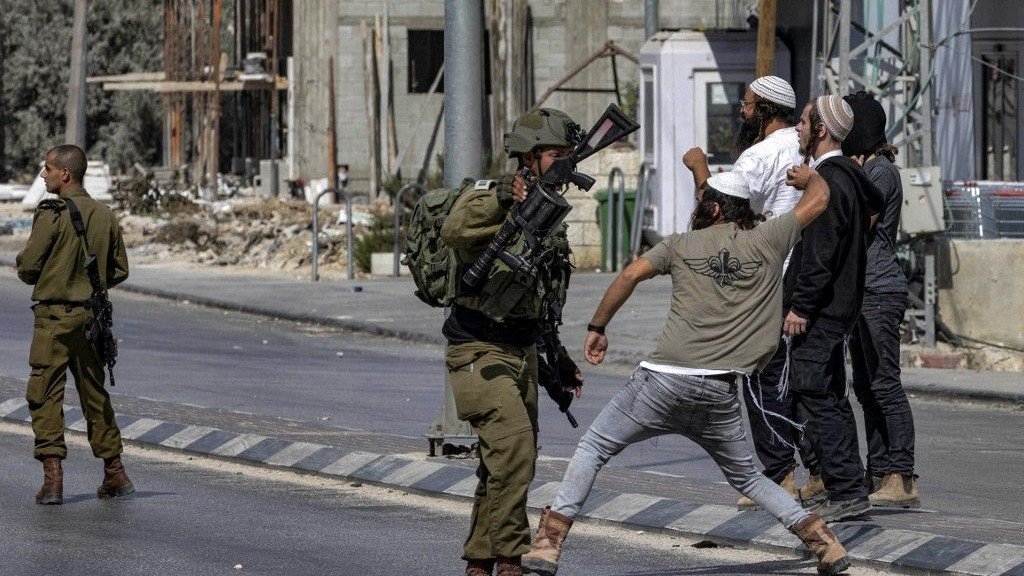
Israeli security officials cited in a report on 18 November are warning that the occupied West Bank is “on the verge of an explosion.” “There is no one today dealing with the West Bank. Everyone understands we are on the verge of an explosion. But no one will stand up and speak, commanders on the ground are genuinely afraid to raise problems or enforce the law. Because they immediately become targets for extremists who enjoy backing from ministers and Knesset members,” the source added, referring to illegal settlers backed by Benjamin Netanyahu’s government. Another source who participated in a military exercise in the last week said the territory is the “most combustible arena,” despite ongoing attacks in Gaza and Lebanon. “We are silent, but one incident could ignite all of Judea and Samaria. The whole IDF would be swallowed up in it,” the source added. Other sources revealed that “neither the government nor the defense establishment has held a strategic discussion on developments in the West Bank for months.” Although Smotrich is actively pushing forward annexation plans, Israel Katz has “removed himself” from any involvement in West Bank matters. “Officers and senior commanders in the West Bank have for years faced attacks by Jewish settlers, but the present moment is the most severe yet. Lawless actors who harm Palestinians and IDF troops in the West Bank are receiving support from Israeli leaders who create a permissive environment that enables them to act freely,” it added. A former security official said the Israeli army has “lost its powers and its standing to such an extent that no one is willing to raise problems with the political leadership,” adding that “at the next cabinet meeting, where commanders are invited, they will be turned into the ministers’ punching bag.”
The West Bank is the graveyard of the old governing model — the place where the thirty-year fiction of a “temporary,” “manageable,” and ultimately “reversible” occupation was buried once and for all. The territory that was meant to prove the occupation could be indefinitely sustainable has become the proof that it is not. The Palestinian Authority has entered a terminal legitimacy crisis. Its security forces no longer command obedience and increasingly refuse to coordinate with Israel. Officers in Jenin and Tulkarm openly declare they will no longer “do Israel’s dirty work.” Joint patrols have virtually ceased. The PA survives only because Israel continues to transfer tax revenues; without those funds the Authority would fold within weeks. The vacuum has been filled by decentralized armed factions. Jenin, Tulkarm, Nablus, and refugee camps have become no-go zones for Palestinian police. By mid-2025 the IDF was conducting an average of eighteen arrest raids per day in the northern West Bank, yet the number of active armed cells kept rising. Commanders admit that each battalion rotation simply generates more recruits for the other side. The military posture has shifted from episodic incursions to permanent re-occupation. Districts are accessible only by armored convoy; checkpoints removed under Oslo have been rebuilt; new bases and bypass roads are expanding at a pace not seen since the early 2000s. Maintaining this deployment costs around $6 billion per year, hidden from the budget under “operational necessity.”
Settler violence has become the de facto governance mechanism in large parts of Area C. Ministers Ben-Gvir and Smotrich celebrate this reality, declaring that “Jewish power” has replaced Palestinian policing. The state has effectively privatized control to armed civilians while still bearing the military and diplomatic cost.
The Settler State Advances
This war does not light up news headlines or trend on social media – unless one follows these developments. But its consequences may prove even more lasting. Under the cover of Gaza’s devastation, Israel has accelerated a long-planned campaign to forcibly dismember the occupied West Bank, destroy Palestinian agricultural life, and eliminate the idea of a sovereign Palestinian state. Its instruments are both brutal and bureaucratic, and include armed settlers, water theft, archaeological decrees, economic strangulation, and the political neutering of what is left of the Palestinian Authority (PA).
‘De facto Annexation’
The plan outlines a broader strategy to reinforce Israeli control over areas beyond the 1948 borders through expanded road networks, military base relocation, and administrative restructuring. These measures collectively amount to a de facto annexation of the West Bank, further entrenching Israeli regime authority over Palestinian land. As part of the administrative overhaul, 225 million shekels will be allocated to create a new land registry unit for the West Bank, transferring jurisdiction away from the “Civil Administration. The plan includes relocating three military bases to the northern West Bank as a dramatic step intended to strengthen both military presence and the broader colonial project in the region. Israeli authorities have intensified a multi-pronged systemic campaign of demolitions, movement restrictions, and land grabs that is fast-tracking the de facto “annexation” of Palestinian territory in and around occupied al-Quds and the northern Jordan Valley.
Recent demolition notices, an extended closure of a Bedouin access road, and continued settler ploughing of Palestinian farmland together illustrate a coordinated pattern of pressure on vulnerable communities. During the same month, authorities recorded the seizure of some 150 of land . Settlers continued this week to bulldoze and plough Palestinian agricultural lands in the northern Jordan Valley where land was planted with rain-fed crops after leveling. Over recent weeks, settlers have leveled and taken dozens acres of private Palestinian land , done through cooperation and collaboration among the military, police, settlers and the Jordan Valley Regional Council, Israel has reduced the pastureland available to Palestinians, blocked regular water supply and taken measures to isolate the Jordan Valley from the rest of the West Bank. Rights groups say these measures, combined with a marked rise in settler violence, are aimed at driving shepherding communities from their homes and grazing lands.

The next title will explain the timing of this announcement-which was clearly aimed at Washington and the Arab states-especially Saudi Arabia and the Gulf Arabs. The story continues in Part 2.