7 The Saudi-Abu Dhabi Rivalry
The end of the UAE’s Gulf era
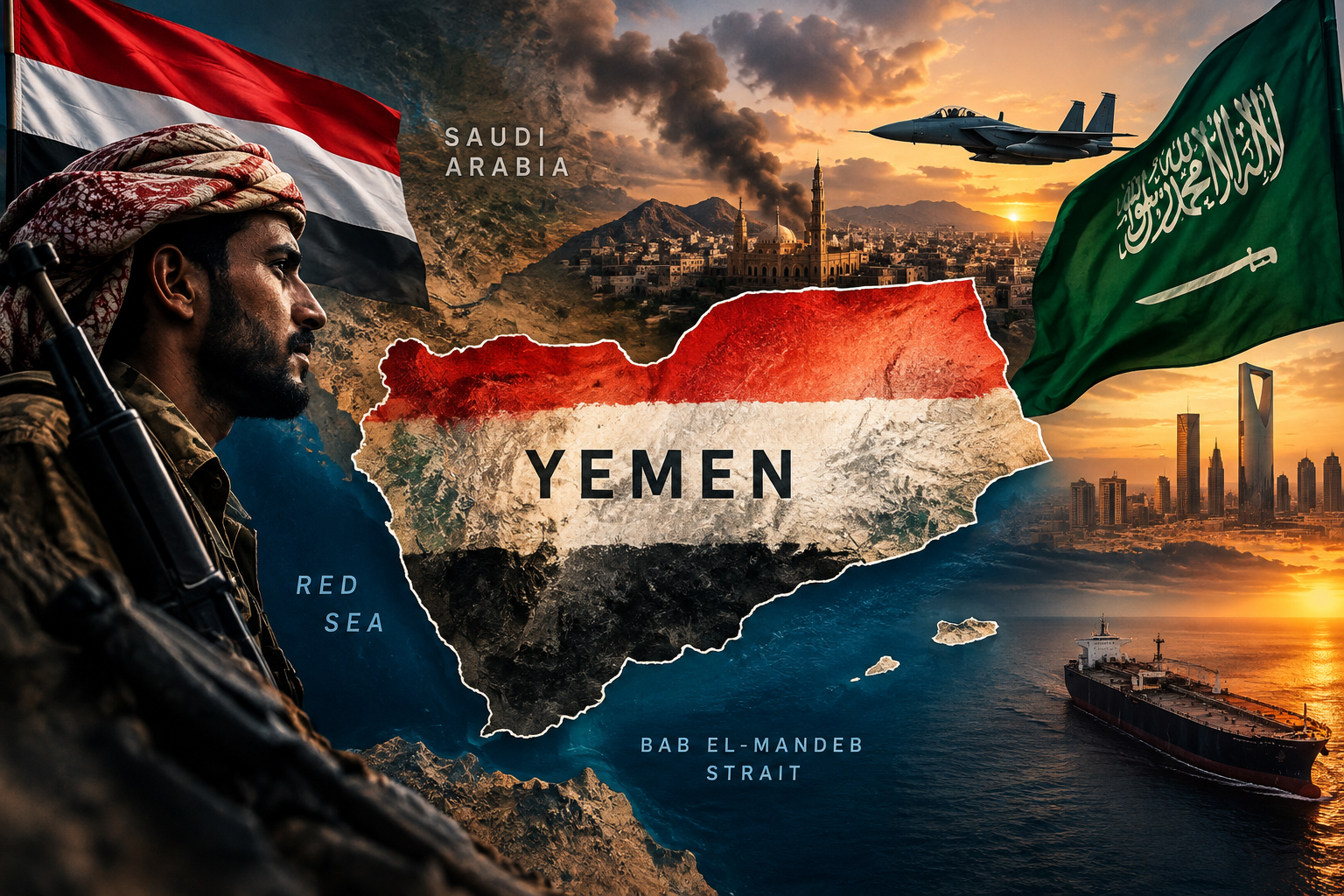
In 2016, Saudi Arabia’s then-deputy crown prince (now ruler of the kingdom), MBS and Abu Dhabi’s MBZ shared a desert excursion – widely seen as the start of a political alignment between the Persian Gulf’s two most ambitious leaders. In the years that followed, they built a shared vision to suppress uprisings, rewire the region’s alliances, and dominate the post-Arab Spring order. Today, that alliance lies almost in ruins. The two princes are locked in a zero-sum contest for control of the Gulf from Yemen to the Horn of Africa.
Riyadh strikes back
There were signs of growing tensions back in December 2022 when MbS, speaking to Saudi journalists, reportedly vowed to retaliate against the UAE for undermining the kingdom: “It will be worse than what I did with Qatar,” he said, referring to the 2017 air, land, and sea embargo on Qatar. Most recently, on 26 January, Saudi Arabia’s top diplomat, Foreign Minister Faisal bin Farhan, said that “when it comes to Yemen, there is a difference of view. The UAE has now decided to leave Yemen.” Riyadh’s media machine sprang into action. Articles and TV reports accused the UAE of betrayal, destabilization, and acting as Israel’s Trojan horse. Prominent Saudi commentators denounced Abu Dhabi’s regional schemes. Social media accounts linked to the royal court launched coordinated attacks, and leaks exposed Emirati involvement in sabotage, espionage, and sectarian manipulation across West Asia and Africa. The gloves were off. For years, MBS benefited from MBZ’s tutelage. The UAE served as a model for Riyadh’s future. But once the Saudi prince consolidated power, he outgrew the apprentice role. Tensions began with the UAE’s 2019 drawdown in Yemen, grew with divergent approaches to Iran and Turkey, and spilled into open competition over attracting global capital. The 2021 OPEC+ spat marked a public rupture, but by 2024, the Saudi-Emirati spat drew in other players. The war on Emirati proxies in Yemen escalated. Riyadh moved to outflank Abu Dhabi’s influence in Somalia, Sudan, and Libya. It began by Saudi forces retaking territory from Abu Dhabi’s proxies in Yemen, and reducing Emirati political and military gains, seeking to reassert itself as the Gulf’s primary node of power.
The Media War
The media war took a darker turn, aiming to fracture the UAE from within. Saudi-aligned commentators began amplifying messages on social media that contrasted Abu Dhabi’s policies with Sharjah’s more traditionalist stance. One prominent Saudi figure praised the leadership of Sharjah’s ruler, Sultan al-Qasimi, for adhering to Arab-Islamic constants and resisting westernization – an implicit rebuke to MbZ’s path. “It goes without saying that the Kingdom of Saudi Arabia has absolutely no problem with the United Arab Emirates. It’s one and only problem is with Abu Dhabi – specifically with those whose hatred, jealousy, and envy have blinded them, and who have willingly become a dagger in the side of the Arab nation, a foolish mount ridden by Zionism to achieve its ambitions in the region and across the broader Arab world.” It listed Abu Dhabi’s alleged subversion from Sudan to Tunisia and referred to media documents suggesting that Emirati military bases had offered support to Israeli operations in Gaza. Saudi Arabia served as Abu Dhabi’s political and media engine over the past few years, believing it had aligned with an honest partner, but since 2018, it became clear that Abu Dhabi was scheming and conspiring. Riyadh waited, hoping its public commitments matched its hidden policies. But patience ran out. The kingdom pulled its cover – and what lay beneath was weakness, exposed and emaciated. Leaks pointed to US and Gulf pressure on MBZ to cede power, with proposals floated to reinstall Mohammed bin Rashid as the UAE’s federal president. Saudi Arabia, for now, appears to be using this card as leverage – a threat, not yet a strategy. As for the issue of ‘overthrowing bin Zayed,’ it is an analytical exaggeration. MbS is not seeking to overthrow his rule, but rather is working to reduce his regional influence and transform it from a ‘leading partner’ to a ‘secondary actor,’ with the aim of readjusting the balance of power in the Gulf in Riyadh’s favor.
Scandals Unleashed
As in the Qatar blockade, Riyadh has unleashed a torrent of accusations aimed at delegitimizing the UAE. One theme paints Abu Dhabi as Israel’s partner, providing all sorts of help, sharing intelligence, and enabling surveillance in Yemen, Eritrea, and Somalia. Leaked documents revealed that Emirati authorities had naturalized Shin Bet operatives and sabotaged shared military installations. Reports imply that many Shin Bet agents are embeddedd in various UAE institutions. Saudi sources have accused the UAE of systematically undermining Yemen’s air capabilities since 2015, claiming that Abu Dhabi concealed a squadron of Russian Sukhoi aircraft at Al-Anad base, blocked their maintenance, and rendered most inoperable. These actions, they argue, reflect a strategy of sabotage and control, coinciding with the emergence of reports coming from secret Emirati-run prisons. The intervention did not stop there. Israeli systems in operated from Fujairah and the Berbera base in Somalia, were uncovered – submersible sensors to monitor the acoustic signature of passing vessels, and surveillance gear disguised as meteorological equipment atop Jabal Mumi and Ras Qatinan. These were reportedly used to track naval movement by regional states, including Saudi Arabia, Turkey, Pakistan, and China. Another themed the UAE as anti-Islam: funding mosque closures, backing European far-right lobbies, and hosting Islamophobic activists such as Tommy Robinson. Emirati media networks have been outed for producing anti-Muslim content while aligning with Israeli narratives and political interests. Saudi Arabia’s regional counter-offensive is coordinated and expansive. It has unified allied forces under Saudi command, sidelining UAE-backed factions. This recalibration was made possible by Riyadh’s decision to escalate. Under the direct oversight of Defense Minister Khalid bin Salman, Saudi Arabia elevated the Yemen file to a military priority. A Supreme Military Committee was formed to consolidate decision-making and bring all allied local formations under Saudi command. In effect, the move ended any meaningful partnership with Abu Dhabi. Riyadh has partnered with Egypt and Somalia to dismantle Emirati defense pacts, block military shipments, and rewire regional alliances. Even the Gulf Cooperation Council (GCC) has become a battlefield, with Riyadh leveraging its weight to isolate the UAE diplomatically. Riyadh has begun practical steps to isolate Abu Dhabi from the Gulf, represented by an open attack by the assistant secretary-general of the GCC on the UAE’s policies in Yemen, Sudan, and Somalia, in parallel with the aborting of MbZ’s official visits to Bahrain and Kuwait. This is part of Riyadh’s efforts to end Emirati influence in Yemen’s southern provinces and islands, where Abu Dhabi still maintains a presence through direct military deployments and loyal local forces. Saudi Arabia is seeking to impose a new political equation in the south to achieve longstanding objectives it previously failed to realize, by managing southern affairs from Riyadh rather than Aden and presenting itself as a peace broker.
Riyadh turns the Economic Screws
MbS’s break with Abu Dhabi is not an emotional reaction, but a calculated strategy to reposition the kingdom as the Gulf’s sole center of gravity. Riyadh is pursuing four parallel tracks: economically, by diverting capital and investment flows from Dubai to the Saudi capital; politically, by redefining the GCC and co-opting Oman and Kuwait to reduce Emirati influence; militarily, by opening direct channels with actors like Iran, Syria, and the Ansarullah-led government in Yemen, bypassing UAE-linked intermediaries; and symbolically, by framing Saudi Arabia as a ‘big state’ leader, in contrast to what it portrays as Abu Dhabi’s ‘small functional state’ model. If the military and political showdown remains the economic war is out in the open. Saudi Arabia has begun a quiet but devastating economic move from the UAE – with $26.6 billion pulled out, representing a major share of Emirati foreign investment. Saudi companies have been instructed to pull back and tourists to the UAE are going to new destinations, and this is trending on social media. Since Saudi tourists form the backbone of Emirati tourism – registering 1.9 million visitors in 2024 – any decline in this number would deal a direct blow to Dubai and Abu Dhabi. Trade flows are also slowing. Multinational firms are hedging their bets, fearing Riyadh will squeeze the UAE out of Gulf commerce. Saudi policy aims to displace Dubai as the Gulf’s financial hub by redirecting investment, trade, and capital into Riyadh – stripping the UAE’s intermediary role in the era of Vision 2030.
Abu Dhabi’s Limited Playbook
Abu Dhabi cannot match Riyadh punch-for-punch. Its strategic depth is narrow, and its economy is exposed. Crucially, its power depends on external protection. So, it turns to familiar tools: lobbying, media, and litigation. Leaks suggest Emirati officials have contracted western law firms to threaten legal action against Saudi Arabia, aiming to deter firms from abandoning the UAE. PR campaigns have been launched abroad to spotlight alleged failures in Vision 2030. And key allies, like US Senator Lindsey Graham, have spoken against Riyadh’s pressure campaign. But the battlefield has shifted. Israel, once focused on cultivating Saudi ties, has retreated into the comfort of Emirati normalization. Washington wants to keep both actors in balance, but increasingly sees Saudi Arabia as the indispensable power and the UAE as the disciplined subcontractor. Expect an escalation of Emirati-Israeli actions targeting both Yemen and Saudi Arabia. Abu Dhabi has reactivated its alliance with Israel as a security guarantee, demonstrated by its presence on Yemeni islands and coordination over strategic maritime routes. This prompted the Saudi Defense Minister to engage with Jewish centers and associations to curb Emirati influence within the Jewish lobby. The conflict is likely to persist, as it centers not on temporary tactical disputes but on control of southern Yemen, vital sea lanes, and regional power balances. Saudi Arabia and the UAE are no longer strategic partners, but adversaries waging parallel wars on every front: military, economic, media, and institutional. Riyadh is driving a wedge into the very foundation of Gulf unity, reshaping alliances and power structures with calculated ambition. MbS has bet that Riyadh can dominate the region alone – without a junior partner in Abu Dhabi. Whether that gamble pays off depends on how far he is willing to go, and whether MbZ can survive the storm gathering at his gates.
Why Sudan is a Target for the 2 Families
Sudan was once a part of Egypt. When Egypt was under British rule (1880-1956), it split Sudan off from Egypt in 1956. A second split of Sudan took place in 2010, when London managed to divide the country into two parts. London succeeded in breaking Sudan into 2 divisions- a Muslim north, and a Christian south. Then, create chaos and instability all throughout north Sudan, eventually turning it into a failed state- just like in Libya. From here, repeat the same formula for Egypt, in addition to weaponizing the flow of water into Egypt. Control Egypt’s water, and you control Egypt through its food production capacities. A weakened Egypt will not be an obstacle for Israel to expand. A besieged Egypt in the south will help in drawing military forces away from Israel’s borders. Once Egypt falls, then there is no large Arab military power to come to the aid of Saudi Arabia when both America and Israel descend upon it. When Israel decided to recognize Somaliland, it was a brutal wake-up call for MBS and Sissi. MBS recognized the danger this posed. It was well aware of the Israeli-Abu Dhabi axis to achieve London’s aim- as described above. Within a few days, MBS acted. First, he kicked out Abu Dhabi from southern Yemen. Then, he began drawing in Turkey, Egypt and Pakistan into closer military collaboration. MBS did sign a mutual defense pact with Pakistan in September. Then, we find that Algeria may become a part of this ant Israel/Abu Dhabi axis. A clear division is forming in the Middle East. On one side is Israel, Abu Dhabi, India, Ethiopia, Morocco, Qatar and Bahrein- all backed by America and Europe. Let’s call them the Western bloc. On the other side, we find Saudi Arabia, Pakistan, Turkey, Algeria, Iran & the Axis of Resistance backed by Russia and China Let’s call them the Eastern bloc. Over the near future, we will witness the rest of the globe joining one of these two alliances. There will be no room for neutrality.
7 MBS Forges a New Alliance
The rise of the Riyadh–Ankara–Islamabad axis rises to counter Israel’s divide-and-rule tactics
The budding defense alliance between Saudi Arabia, Pakistan, and Turkey threatens to undo Israel and the UAE’s plans to balkanize the Middle East. Turkey is poised to establish a trilateral defense pact with Pakistan and Saudi Arabia, focusing on a “shared and reciprocal rapid response” to an attack on any member. Tel Aviv’s partners are watching closely. As news broke of the budding Saudi–Pakistani–Turkish bloc , a humiliated MBZ made a lightning visit to India. Within hours, the two states signed a wide-ranging defense pact – not just military, but also encompassing liquefied natural gas (LNG), trade, space, and atomic energy. India and the UAE aim to double their bilateral trade to $200 billion within six years and boost defense ties. With full support from Washington, Tel Aviv and Abu Dhabi are consolidating a nuclear partnership with India. India is playing these moves down, sensing that the India–UAE defense collaboration would affect the Indian diaspora in Saudi Arabia. The India–UAE nuclear pact includes provisions on atomic energy safety and reactor deployment – and appears to have the quiet backing of Tel Aviv. Israeli media wasted no time branding it a tripartite Israel–India–UAE alliance. Turkey sees the alliance as a response to Tel Aviv’s unchecked aggression in Gaza, Syria, and Lebanon – and Washington’s unwillingness to restrain it. While it remains to be seen whether the Riyadh–Ankara–Islamabad axis can evolve into a long-term counterweight to Tel Aviv and its western allies, its emergence marks a clear pushback against decades of divide-and-rule tactics. Both Riyadh and Turkey understood that their mutual rift would serve the purpose of their enemies. And that if they don’t unite, they will get taken down, one by one. Pakistan, Saudi Arabia, and Turkey each offer unique contributions to the table. Pakistan can leverage its strategic depth, missile capabilities, and nuclear deterrent, as demonstrated in the four-day war with India. Both have signaled that the alliance is moving forward. They say joint operations will soon commence under a framework designed to bring “stability and peace” to the region. The new axis unites the three states’ core strengths: Pakistan’s strategic depth and nuclear deterrence, Saudi Arabia’s vast financial resources, and Turkey’s battle-tested conventional military and growing arms industry. Abu Dhabi and Tel Aviv have entrenched themselves within failed or fragmented states, from Libya and Sudan to Egypt and Somalia. Their strategy: exploit state weakness to extend influence and normalize ties with Israel.
In contrast, Saudi Arabia and Turkey have aligned around a different doctrine – one that supports strong, central governments capable of resisting Tel Aviv and its Gulf partners. Strengthening defense ties is central to that plan. Just last week, Erdogan paid a visit to Saudi Arabia, met with MBS, and came to solid agreements on the way forward. Saudi Arabia is doubling down. Alongside the Pakistan–Turkey initiative, Riyadh is now pursuing military cooperation with Egypt and Somalia – a direct response to Israeli-Abu Dhabi meddling across Africa and the Red Sea. Somali President Hassan Mohamud is to finalize a defense pact with the kingdom. This understanding comes on the heels of Somalia’s recent cancellations of port and security agreements with the UAE, which it accused of undermining Somali sovereignty. The fallout has been swift with the withdrawal of Abu Dhabi from the Yemeni theater following Saudi airstrikes on UAE-backed proxies and Riyadh’s overt stance against Abu Dhabi’s disruptive military presence. The kingdom is especially incensed by Israel’s overtures to Somaliland which it sees as part of a wider plan to destabilize the Horn of Africa.
UAE’s Imperial Pivot hits African wall: Riyadh pulls the Rug
As Abu Dhabi’s ambitions unravel across the continent, Riyadh-backed alliances are kicking the Persian Gulf minnow out of Africa and seizing its war economy in the process. for years, the UAE threw money, weapons, and manpower into Africa, chasing a fantasy of empire it had no business pursuing. From to from covert operations in Gaza to Yemen to Sudan, to expanding its grip on Africa’s mineral wealth. and to client militias, Abu Dhabi bankrolled it all. But its imperial swagger met resistance. And now, one by one, African nations are slamming the door on Emirati interference. What triggered this dramatic reversal? The same thing that triggered its humiliation in Yemen – a clash with its former Gulf partner. When UAE-backed forces in Yemen attacked Saudi allies, Riyadh retaliated forcefully. It not only pushed Abu Dhabi out of Yemen but also quietly moved to undermine its influence too. With the decline of western hegemony, Africa has reached out to other countries, such as China, Russia and Turkey. Jumping on this opportunity, the UAE invested in East Africa to secure the Red Sea and support its war in Yemen. Ports were built in Doraleh, Djibouti; Assab and Massawa, Eritrea; Barawe and Berbera, Somaliland; Bosaso, Kismayo, and Mogadishu, Somalia. Some locations were for commercial purposes, while others were central to wars across the region. Assab Port, for instance, became a major logistic hub, with Eritrea, which sent 400 troops to the UAE – a force that proved decisive on the battlefield. In Mogadishu, the UAE provided a training center to Somali troops to fight the extremist Al-Shabaab militia.
But cracks were already appearing. In 2017, Somalia–UAE relations deteriorated during the diplomatic war between Saudi Arabia and Qatar. The UAE sided with the Saudis, but Somalia remained neutral since its closest ally, Turkey, supported Doha. In 2018, things worsened when the UAE made a deal with recognizing Somaliland-a breakaway region that Somalia claims as its territory. In response, Somalia cancelled all military cooperation with the UAE. But its reach was limited, with regions like Puntland and Somaliland ignoring the federal government’s decree. That same year, Djibouti seized control of the UAE-operated Port of Doraleh, accusing Abu Dhabi of bribing officials. But the real reason was the UAE’s undue pressure on Djibouti to open a military base and its construction of a port in Somaliland that would undercut Djibouti’s competitiveness. Three years later, Eritrea followed suit, dismantling some of the UAE’s military bases. Still, Abu Dhabi stayed. It maintained its presence in Somalia and kept strategic sites in Eritrea operational – enough to assist Israel during Hamas’s Operation Al-Aqsa Flood – which began on 7 October 2023 – if needed. That endurance is now collapsing. In January, Somalia expelled the UAE from territories even beyond Mogadishu’s control – Puntland and Somaliland. The UAE complied, a retreat that stunned observers. But the move was not Somali muscle alone; it was backed by Saudi Arabia.
Riyadh is now building a security partnership with Egypt and Somalia. Egypt and Saudi have joined hands efforts to sideline the UAE in Sudan and Yemen. This comes after Egypt refused in December 2025 to sell a stake of its port in Alexandria to the UAE. Libya’s Khalifa Haftar-led army is under pressure to sever ties with Abu Dhabi. And Djibouti, fresh off a legal win against the UAE, handed port operations to Egypt. Even Eritrea, once a steadfast partner, is turning. President Isaias Afwerki accuses the UAE of being the “primary destabilizing actor” in Sudan. And Saudi Arabia is pledging $1 billion to rehabilitate Assab Port – the very port Abu Dhabi once dominated. Just last month, MBS and Afwerki met in Riyadh. Without its Red Sea lifeline, the UAE’s entire war economy in Africa is at risk. In Sudan, it had backed the Rapid Support Forces (RSF), who seized large parts of the country and its gold mines. In return, the UAE has been receiving gold, along with vast quantities of agricultural goods. Ethiopia began training RSF fighters. To sustain the RSF, the UAE relied on its ports in Somalia/Somaliland (Berbera and Bosaso), Chad (Amdjarass), and Libya (Kufra), controlled by the UAE-backed Libyan National Army (LNA). But now, supply lines are faltering. Once the UAE’s strongest allies in Africa, Chad has ended its cooperation with Abu Dhabi after RSF forces killed several of its soldiers. Guinea seized a Emirati aluminum mine, triggering a lawsuit. Somalia shut down transshipment points. And with Saudi-Egyptian pressure mounting, Libya may soon close the gates. Already, Sudan’s Armed Forces have retaken areas in the South Kordofan State in Sudan. The UAE’s proxies are “rapidly” losing ground. When war is not available, the UAE uses investment to extract resources. In 2023, it signed a $1.9-billion deal with the Democratic Republic of the Congo for access to cobalt, copper, and tin; $1.1 billion in Zambia for a majority stake in a copper mine; and spent $1.4 billion in Guinea on an aluminum project. To move these resources, it built ports across Algeria, Angola, DRC, Egypt, Guinea, Kenya, Mozambique, Senegal, Somalia, and Tanzania. Many double as military infrastructure – Berbera Port was used to supply arms to Yemen. Some, like the $1.2-billion Dakar port in Senegal, serve both commerce and coercion.
Partners Turned Prosecutors
In country after country, Abu Dhabi is being accused of subversion, betrayal, and neocolonial overreach. Algeria, which once hosted UAE port operations, now accuse it of backing separatists and undermining Libya. Some even say that Algeria might break off diplomatic relations with the UAE. This comes as Algiers becomes increasingly frustrated at the UAE’s meddling in Libya and its growing alliance (along with Israel) with Algerian foe Morocco. Algeria has, in response, deepened its security with Saudi Arabia. As mentioned previously, Chad and Saudi Arabia have also strained relations with Abu Dhabi. Until recently, Chad provided extensive supply chain routes to the RSF, including a hub and access to its territory for maneuvering troops. But support has turned into hostility as the RSF continues to attack the Zaghawa people in both Sudan and Chad. In December 2025, two Chadian soldiers were by the RSF, followed by seven more in January. Saudi Arabia, for its part, is also picking up the pieces. It blocked a UAE bid for Alexandria port shares, is funding rival port projects in Eritrea and Egypt, and is drawing once-neutral states like Djibouti into its fold.
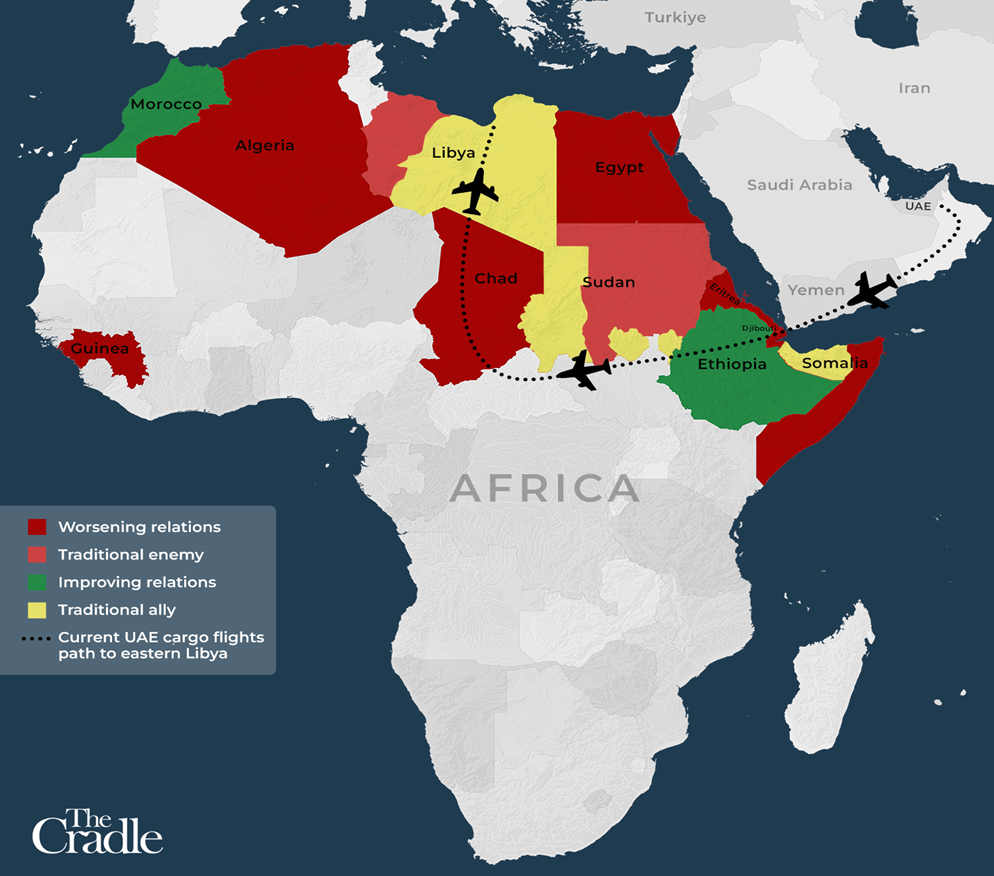
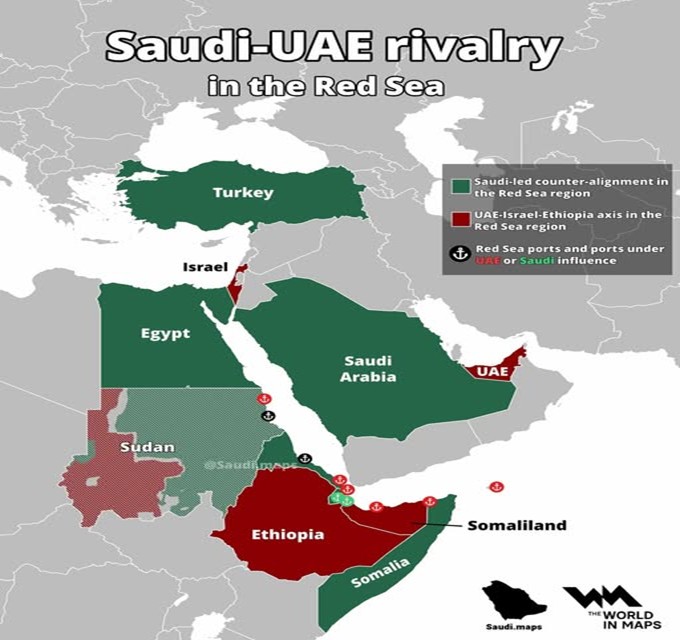
Abu Dhabi’s reversal is staggering. Until recently, it was Africa’s largest investor, It poured billions into mining and ports – ventures that doubled as political leverage and military logistics hubs. Now, Riyadh has flipped the script. With Sudan’s war as the pivot, Saudi Arabia is rallying African nations into an informal coalition that cuts off UAE access at every turn. But as the UAE exits some countries, it is finding other partners. It has strengthened ties with nearly every African country, from the least populated to the most populated These links remain primarily economic – for now – but could evolve into security alliances. Ethiopia has become the new conduit for weapons to the RSF, provides sanctuary to them, and might become a key hub in the Sudan war. Addis Ababa’s military-industrial partnerships and geographic position have made it indispensable in keeping the RSF operational. Morocco, a fellow signee of the Abraham Accords and therefore aligned with Israel, is positioned to become a new anchor point. But Abu Dhabi’s fantasy of unchallenged dominance is gone. Its overreach has birthed a backlash. What was once an alternative to western hegemony now looks like another colonial project. Africa, with its deepening ties to China, Russia and Turkey, has more options. Two axes are emerging. One is Saudi-led, backed by Egypt, Algeria, and Somalia. The other is UAE-led, anchored by Israel, Ethiopia, and Morocco. The UAE-Israel axis is growing to include not only Ethiopia and Morocco, but also Bahrain and India. Saudi Arabia has gone further, developing a mutual defense pact with Pakistan and, is pursuing one with Turkey. For African states, the shift is timely. Decades of unipolar diktats have given way to new leverage. With multipolarity, Africa does not need to stick with the US – or the UAE, for that matter. Leaders who were once forced to submit or risk marginalization are now acting independently. Abu Dhabi came to Africa, wielding checkbooks and contractors. It leaves watching others take its place.
8 The 2 Families are Forging a “New Arab World “
After the US invaded Afghanistan and Iraq, Rothschild think tanks began to push a new narrative – change the Quran and the teachings of Islam. The first attempt to achieve this was to change the curriculum in religious schools. After two decades of this, this whole idea was dumped in the Covid era. Starting in the early 1990s, a new idea was hatched. This time it would be to promote a “new Islam” centered around Abu Dhabi, Qatar etc. Regarding Dubai, Qatar and Abu Dhabi, these three have sold out to the West. It is these three cities that the MSM promote and praise. It is these 3 cities that have embraced behavior that goes against Islam in many ways. In short, the aim is to “westernize” Islam. As time goes on, we will witness an increase in such behavior by these 3 cities. Traditionally, there have been 5 centers of the “original Arab and Islamic” culture and faith. These are Baghdad, Cairo, Aden (Yemen), Algiers and Damascus. Of these 5 cities, Damascus and Baghdad are occupied by the Western powers. What’s left is Algiers, Cairo and Yemen. These last 3 cities are under pressure-economically, financially and militarily.
Conclusion
In our current period of heightened tensions across the geopolitical world, the two families are panicking. Their global empires are losing ground on a daily basis, be it in Ukraine, Gaza, Iran and elsewhere. Many oppressed nations are seeing the West’s faltering grip, and are getting ready to take back their independence and resources. This has impacted the financial/economic pillars of the two global empires. With all that and more, the two families are doubling down on more chaos and lies. The so-called free world is not free at all. It is suffocating beneath war, lies and delusions. Our next article is titled “ The Levant & Trade Corridors” Stay tuned till then folks.