
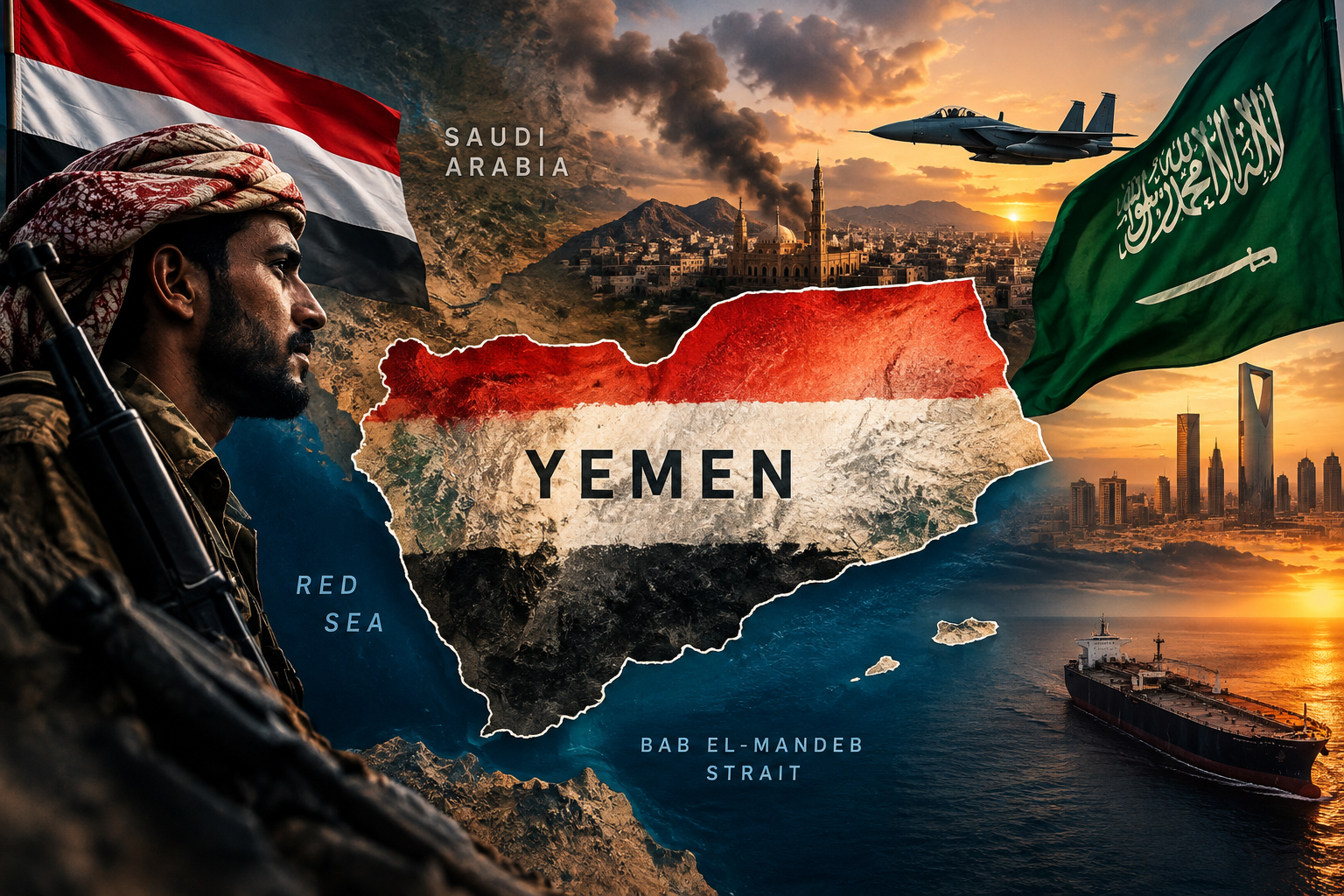
The story continues from Part 2.
Yemen Strikes at Saudi Arabia
On Thursday, 24th September, the Yemeni Armed Forces carried out two top-tier strikes: one on a sensitive site in the capital, Riyadh, and another targeting Saudi Aramco in Yanbu.
The Yemeni Armed Forces spokesperson, Brigadier General Yahya Saree, said the two operations were conducted using ballistic and cruise missiles, as well as drones, adding that both had successfully achieved their objectives.
The operations came in response to Saudi attacks on Yemen, which continued through airstrikes and a blockade.
Saree said the operations were carried out as part of the Yemeni Armed Forces’ response to Saudi military aggression against Yemen.
Saudi attacks since the beginning of the escalation had reached 1,018 airstrikes and missile attacks. He said Saudi F-15 and Typhoon fighter jets had operated from the Khamis Mushait and Taif air bases, with operations launched from Najran and Jizan.
Saree announced earlier in the day that the Yemeni Armed Forces had carried out a large-scale pre-emptive operation targeting Saudi military concentrations in the Jizan region with dozens of ballistic missiles and drones.
The operation targeted Saudi military concentrations in Jizan, as well as command and control centres, operations rooms, weapons depots, and other key military positions.
Houthi strikes also targeted missile launch sites and platforms at a military camp in Jizan.
The operation also struck several Saudi military camps in the Jizan region, with the attacks resulting in what the Houthis described as precise and direct hits.
The operation reportedly resulted in hundreds of deaths and injuries, including mercenaries and Sudanese personnel, as well as dozens of Saudi military personnel and officers.
The Houthis said they would continue pursuing a siege-for-siege and escalation-for-escalation equation and that Yemeni forces would continue targeting Saudi military concentrations until the attacks on Yemen are halted and the blockade on the country is lifted.
Yemen’s Strategic Importance
Yemen, with access to its resources and the ability to continue developing its military capabilities, will without a doubt be the biggest threat to US-Israeli hegemony in the Arab world.
The Yemeni Armed Forces’ campaign to liberate their nation and end the Saudi-led blockade could be one of the most important events for the Arab world in decades.
Not only will it have major implications for the ongoing regional war, but it also has the potential to dramatically reshape the region.
As we explained in previous posts, the US/Israeli alliance is planning a new, massive attack — this time targeting the other three Axis of Resistance members: Hezbollah, Yemen and Iraq.
The objective would be to weaken Iran.
Yemeni intelligence picked up on these preparations, as did Hezbollah and Iran.
The Houthis began preparing for this from the end of April and closely monitored the Saudi preparations. Hezbollah and the Iraqi Resistance did the same.
Ansarullah drew up a new plan, which would help liberate Yemen from the Saudis and Abu Dhabi.
Yemen will be the only Arab nation that will not only oppose US imperialism and support the regional resistance, but will also actively fight the Israelis and work to combat the “Greater Israel Project”.
The only Arab government that dared to open fire on the Israelis or impose a blockade on them, in support of Gaza, was the Sanaa government in Yemen. All the others that fought for Gaza were non-state actors.
A strong and united Yemen, with access to its resources and the ability to continue developing its military capabilities, will without a doubt be the biggest threat to US-Israeli hegemony in the Arab world.
Yet it will also spell another equation: it could well serve as an example to populations throughout the region as to what is possible if the people fight for their liberation.
No prospect frightens the Arab regimes more than this.
The impact Yemen can have on global trade, oil markets, regional power equations and ultimately the Palestinian cause for national liberation, all have the Zionist-aligned powers shaking in their boots.
For so long, the Yemeni issue has been ignored, but that could soon dramatically change.
From Defensive Resistance to Offensive Resistance
Since the middle of September, Iran has informed its enemies that it has now moved to a strategy of “offensive resistance”, as compared to “defensive resistance”.
From now on, Iran will pre-empt any preparation by the US, Israel or its Gulf allies, then Iran will bomb them first.
It is working very effectively.
Now, Ansarullah has also adopted this same policy in its war of liberation against Saudi Arabia.
What MBS fails to understand is that there is no way the Saudi military force can hope to defeat the Houthis.
Just one fact alone will confirm this.
At present, Ansar Allah is reported to have a standing force of approximately 400,000 soldiers. The force is described as largely battle-hardened, having gained extensive combat experience under extreme conditions despite lacking access to advanced military weaponry.
In addition, it is claimed that another 400,000 reservists can be called up.
The combined number of soldiers that the Houthis are fielding right now is larger than the combined number of soldiers of Saudi Arabia, Germany and the UK.
Riyadh’s Proxy Army Comes Apart
The UAE-backed Southern Transitional Council (STC), a separatist force in southern Yemen, fought the Saudi-backed government for control of the south for years.
In January, Saudi forces retook Aden.
There have also been claims of other STC forces blocking retreating government troops from entering Aden and Lahij after Mocha fell.
Riyadh was no longer dealing with the loss of a few forward positions.
It faced the harder task of rebuilding a defensive system whose roads, high ground, commanders, and political cohesion had all failed together.
As a senior Houthi official said:
“More than 100,000 of these troops were killed, fled, or surrendered in less than a week, and Yemeni forces recovered around 5,400 square kilometers despite direct Saudi participation and the intensity of the airstrikes, which produced no results on the ground because the forces were dispersed.”
Then we find clashes between the proxies of Saudi Arabia and Abu Dhabi.
This has been going on for a few years but intensified over the past year.
Most of Abu Dhabi’s proxy army has withered away.
It seems that Abu Dhabi gave up on Yemen proper, but is more focused on Socotra Island and other coastal areas of the Horn of Africa.
MBS Scrambles for Allies and Help
On September 10, as Mocha fell and the Houthis approached Bab el-Mandeb, MBS called Trump three times and asked for US strikes against the Houthis.
Trump declined.
Washington instead offered intelligence and targeting support and emphasised that American forces were focused on Iran and on keeping maritime routes open rather than opening another major military front in Yemen.
For Saudi Arabia, that is a significant strategic disappointment.
Riyadh can still employ its own air force, but the episode demonstrated the difference between American political backing and an American commitment to fight the Houthis directly.
The kingdom had spent years trying to reduce its exposure to the Yemeni war.
The request for direct US strikes represented a reversal of that approach and an admission, at least privately, that the kingdom’s own tools might not be enough to reverse the momentum.
Pakistan presented an even sharper contradiction.
The Mecca Joint Defense Agreement signed in August by Saudi Arabia, Pakistan and Turkey says an armed attack against one member is to be regarded as an attack against all three.
Yet when Houthi missiles and drones struck Saudi territory, Pakistani officials did not move to implement a military response.
That distinction is critical.
The Mecca agreement produced solidarity and diplomatic coordination; it did not translate into an immediate expeditionary response when Saudi territory came under attack.
Syria
Saudi Arabia has moved hundreds of Syrian fighters into Yemen through its territory as part of an effort to reinforce forces fighting the Houthis.
Riyadh had spent more than a year preparing what it described as an attempt to reproduce elements of the Syrian war in Yemen.
It said the plan included strengthening Salafi/Al Qaeda formations backed by Saudi Arabia and bringing Syrian fighters to Yemen. These fighters subsequently deployed toward fronts including Marib, Jawf, Aden and Hadramawt.
Saudi Arabia had attempted to send a large shipment of weapons and ammunition to its proxy forces during the west coast fighting, using trucks associated with the King Salman Humanitarian Aid and Relief Center.
Houthi drones struck the convoy, preventing the shipment from reaching its destination.
This is not surprising considering Saudi Arabia’s ever-growing relations with Syria’s new Al Qaeda government.
The kingdom, despite recent losses, is not yet showing any signs of backing down, and Riyadh may attempt to drag Syrians further into the conflict in Yemen.
This, however, could carry a serious risk to Damascus, as the Houthis have the means to attack targets, including energy infrastructure, in Syria.
This mobilisation is linked to a broader Saudi effort to reorganise anti-Houthi forces before the latest fighting.
After the liberation process began, many of these Syrian mercenaries quit.
News of this got back to Damascus, and Syria rejected a formal Saudi request to organise and deploy Syrian fighters to Yemen.
Damascus declined the request, citing a focus on reorganising its own military.
Pakistan
For India, Pakistan is not one rival among many.
It is the permanent adversary against which every other calculation is measured.
And Pakistan is now being pulled toward this war on Saudi Arabia’s side.
The moment that happens, every alignment on the board reverses, and India’s rational move becomes the quiet, deniable arming of the Ansarullah Houthis in Yemen.
Here is how the chain runs.
Pakistan signed a bilateral Mutual-Defense Agreement with Saudi Arabia in September 2025. Later, it signed another agreement under the Mecca Mutual Defense Pact in August 2026 with Turkey as a trilateral pact — a NATO, Article 5-style arrangement in which:
“An attack on one is treated as an attack on all.”
It was signed while the Houthis were striking Saudi soil, and Pakistan’s own defence minister has since said publicly that if Houthi aggression against Saudi Arabia continues, the agreement “will become operational”.
Islamabad declared complete solidarity with Riyadh as of 23 September 2026.
There is a physical tell that Pakistan’s entry is already being prepared: Toyota 4x4s and trucks.
A poor country whose people cannot afford new vehicles does not surge pickup output on its own.
These are the vehicles bound for the Yemeni battlefield — the technicals that both the Houthis and any Saudi-coalition ground force run on — and the numbers moving through Pakistan’s plants point at a fleet being built for export, not for the domestic buyer who is getting poorer.
The likeliest route is a shipment to Saudi Arabia directly, or to Oman first and then overland into the kingdom, the same grey-corridor logistics behind every recent proxy war.
Pakistan is preparing to be in Yemen.
Pakistan is still saying it will not send soldiers, and that hedge is genuine.
No state advertises entry before it commits.
But the structure matters more than the statements.
Pakistan has bound itself by treaty to a kingdom under sustained Houthi attack, it has said out loud that continued attacks trigger the pact, and its factories are already building for the theatre.
The Houthis will not stop.
So, the pressure runs one direction only, toward Pakistani involvement — first as trainers, advisers, and air defence, later as forces on the ground.
In game-theory terms, Pakistan has pre-committed, and a pre-commitment under steady provocation is a slow-motion entry.
The question is not whether Pakistan is drawn in.
It is when, and how deep.
The instant Pakistani soldiers, systems, and command are committed to Yemen, India’s interest stops being whatever Israel prefers and becomes the bleeding of Pakistan.
Every Pakistani soldier worn down in a Yemeni mountain war is one not stationed on the Line of Control facing India.
Every air-defence battery, transport aircraft, and special-operations unit, every rupee and every hour of command attention Pakistan pours into Yemen, is a resource subtracted from the India front.
A war that ties down the Pakistani military a thousand miles from Kashmir is not a threat to New Delhi.
It is a gift, and the longer it runs, the larger the gift grows.
The Houthis, in Indian eyes, stop being a threat Israel wants crushed and become the force bleeding Pakistan.
The enemy of a permanent enemy, in the coldest reading of self-interest, is an asset to be quietly sustained.
India’s rational move, then, is to keep the Houthis in the fight.
Never openly, never with a flag, but in the dark: intelligence, materials, and the most valuable input of all — its decades of hard-won knowledge of exactly how the Pakistani military fights, deploys, thinks, and can be beaten.
India has studied Pakistani doctrine across four wars and a permanent standoff.
Fed quietly to Iran and the Houthis, that knowledge is worth more than any weapon, because it tells the people fighting Pakistan in Yemen precisely where the Pakistani soldier is vulnerable.
Besides India, Pakistan has other external problems in Afghanistan and the Baluchistan insurgency.
Finally, it is an illegitimate government.
Its economy is in the doldrums and is sitting with a huge foreign debt.
It is currently negotiating for a $10 billion loan from the IMF.
Under these conditions, Pakistan would be committing suicide if it goes to Yemen.
Egypt
Many in Egypt still remember what Yemen cost their country in terms of lives and treasure.
Both the government and the people will not go back to Yemen.
Were Egyptian President Sissi to agree to help MBS in Yemen, the people would revolt and overthrow the government.
Today, Egypt is financially strapped, has a weak economy and is under pressure all around.
It has to secure its own environment first before looking at other issues.
These are the war going on in Sudan, followed by the threat of a water cut-off from Ethiopia.
Finally, it has stationed a large military presence on its borders with Gaza and Israel.
Reducing the military force on its eastern border with Israel will leave it open to Israeli attacks.
Under these conditions, Egypt would be committing suicide if it goes to Yemen.
Seven Countries Are Now Trapped in a War None of Them Can Exit
Egypt is the newest.
Last week MBS flew to Cairo in the middle of the Houthi advance up the Red Sea coast.
MBS is desperate, or he would have called Sissi to Saudi.
Egypt wants no part of this.
Egypt has spent at least seven months deliberately staying out of the fight, and the deepest reason is one most coverage misses.
Egypt quietly values Iran as a regional counterweight.
A strong Iran keeps Israel, Turkey and the Gulf monarchies from becoming too dominant, and it keeps the region multipolar enough that Egypt retains room to manoeuvre as its own pole.
A subjugated Iran does not help Cairo.
It removes a balancing weight and leaves Egypt smaller, in a region reorganised around Israeli and Gulf primacy and now outside of the Saudi/Israeli/US axis.
Egypt’s reluctance is not sentiment.
It is a cold reading of its own interest.
It does not want the actor being destroyed to be destroyed, because the balance that protects Egypt goes down with it.
On top of that sits the direct economic damage.
Egypt has already absorbed billions in losses from Red Sea disruption related to the instability at Bab al-Mandab and the slowdown in Suez Canal traffic, one of its most important sources of hard currency.
Cairo’s instinct through all of it has been de-escalation.
It has run back-channels to Yemen’s Ansarullah Houthis to keep the canal alive and warned every party against widening the war.
Its whole posture has been to stay out.
Three facts box Cairo in.
It is embedded in the American CENTCOM security architecture, tied to Washington’s regional order.
It fields one of the largest armies in the Arab world, which makes it a prize any coalition wants and a weight it cannot pretend away.
And its economy runs on the Suez Canal, which the Houthis are now squeezing from the southern gate at Bab al-Mandab.
A canal that stops earning is not a line-item problem for Egypt.
It is a currency crisis, an unemployment crisis and a bread crisis stacked on top of one another, in a country that cannot survive another revolution and knows it.
That is the lever that removes Egypt’s neutrality.
The Houthis do not have to fire a shot at Egypt to threaten Egypt.
They only have to choke the water Egypt lives on.
Their target may well be Saudi Arabia or Israel, but Egypt takes the heaviest economic hit as the bystander, and a state does not stay a bystander when its lifeline is being closed or when global shipping no longer feels safe to navigate the waters.
It moves to enforce its own survival.
Cairo’s path narrows to two ends.
First, it can issue an ultimatum to the Houthis to reopen the Red Sea and keep the canal alive, which puts it in direct confrontation with them.
Or it can line up behind Saudi Arabia, MBS, Trump, Netanyahu and the American institutions against them.
Either road pulls Egypt into the war it spent half a year avoiding.
The MBS visit is where that pressure gets applied in person, with money, economic lifelines and security guarantees on the table.
The immediate effect is that Egypt moves from “bystander” to “active participant”, and the anti-Houthi coalition gains the largest Arab army on the board.
This is what Washington wanted and what CENTCOM was organising when General Brad Cooper toured the member states during the MOU ceasefire.
That tour was the coalition being assembled in advance, front by front.
The battlefield is being divided front by front, each handed to the regional power it hurts most.
Saudi Arabia, and now Egypt, on the Houthis.
Israel and Lebanese military on Hamas and Hezbollah.
America freed to concentrate on Iran full-time.
Egypt is existential on the canal and Bab al-Mandab.
It cannot let the water it lives on be closed.
Saudi Arabia is existential on its oil exports and cannot let Houthi strikes keep disrupting the revenue.
Europe
Riyadh has sought additional support from France, Britain, Pakistan, and Egypt as its stocks of missile interceptors come under pressure.
France will deploy troops, radar, and air-defence systems to Saudi Arabia to protect a key Red Sea oil hub as Riyadh struggles to contain escalating Houthi missile and drone attacks, saying it will not take part in fighting but will merely protect the strategic energy facility under an agreement with Riyadh.
Macron said on Thursday, 24 September:
“We are going to send military resources, that is to say, soldiers, radar systems, and defense systems, to protect the site of Yanbu.”
He did not rule out sending French Air Force fighters as well.
In the war rooms in Riyadh, the Saudis have assembled around 200 foreign “advisers” from the US, Britain, France and Israel.
So, here we find many European nations — all of them are described as vassals of the Rothschild Empire — Britain, France, Italy, Greece and others expected to join the conflict against Iran and Yemen.
All of them will base themselves in Saudi Arabia.
Italy also maintains an air-defence mission in Saudi Arabia; an Italian Eurofighter stationed at King Fahd Air Base was damaged during a Houthi attack last week.
A Greek-operated Patriot battery is already deployed in Yanbu.
The official word for what France is doing is “protection”.
A friendly government asked for help defending its infrastructure, France agreed, and soldiers who man radar and air defence are there to shield rather than to attack.
Taken at face value, that is a defensive operation.
It is also, the moment a Houthi missile kills a French soldier, a French entry into a shooting war against an Iran-aligned force.
Everyone who signed the order knows this, because that is what putting your troops under someone else’s incoming fire means.
France has placed a tripwire rather than joined a defensive mission, and a tripwire is an offensive instrument disguised as a shield, because its purpose is to convert the next attack into a reason to escalate.
Hours later, on the same day, the Houthis said they had hit the Aramco facilities at Yanbu and a site in the Saudi capital with ballistic and cruise missiles and drones, while the Saudi side said it had intercepted the attack.
France’s imports of Saudi fuel ran to about $4.2 billion USD in 2024, and roughly $4.1 billion in 2025, up around 57 percent since 2020.
France, like the rest of Europe, leaned on Saudi and Gulf barrels to replace the Russian crude it stopped buying after 2022, and the same pressure sent Poland’s Saudi bill up sixfold to $8.14 billion, the largest of any European buyer.
Diesel shortages in Europe have resulted in long lines of trucks waiting to fill up.
There may soon be rationing across Europe.
What the oil interest does not explain on its own is the deployment.
That $4.2 billion USD ranks France 12th in the world among Saudi fuel buyers, in a mid-table cluster with Egypt, Italy and Singapore, and it is a fraction of what the Asian giants take.
France buys under a tenth of China’s $49.2 billion and less than a fifth of India’s intake.
Saudi fuel is an Asian business, and the whole of the European Union together imports less than South Korea alone.
If oil dependence decided who guards Yanbu, the troops on that tarmac would be Chinese, Indian, Japanese and Korean.
They are not, and their absence is the tell.
A price interest in a Red Sea terminal is a reason to worry about Yanbu; it is not on its own a reason to put French soldiers under Houthi fire.
So, the oil interest is cover, and not cause.
The Real Objective
The Rothschild family is presented as viewing Saudi Arabia as a far greater prize than even Jerusalem.
Several reasons are offered for this view.
The first is revenge. One claim is that Jews in Arabia were expelled from Medina following alleged acts of treachery, creating a desire to reclaim the area. The region outside Medina was known as Khaybar.
The second is the religious significance of Saudi Arabia, which is home to Islam’s two holiest sites, Mecca and Medina.
Although Muslims are not portrayed as the primary threat to Zionism, this argument maintains that control over these sacred sites could diminish what is described as the threat posed by Islam to its continued existence.
It also makes broader claims about the relative threat posed by Muslims and Christians, including assertions concerning marriages involving members of the Rothschild family.
The third factor is Saudi Arabia’s oil wealth. Its reserves are described as potentially reaching approximately 700 billion barrels, almost three times the country’s officially reported figures. The reasons given for this discrepancy are numerous, but they are not examined in detail here.
The fourth factor is Saudi Arabia’s geographical position.
More specifically, the argument places particular importance on Mecca, which is described as being at the precise geographical centre of the world.
Taken together, these claims present Saudi Arabia and Jerusalem as two strategically vital locations. Control over both, it is argued, would provide the Rothschild family with an extraordinary degree of geopolitical influence.
China
Saudi Arabia just fired a Chinese DF-15 missile on Yemen.
The Kingdom runs a Royal Strategic Missile Force out of underground bases.
So, a Chinese ballistic missile in the Saudi arsenal is not a surprise at all.
What is new is Riyadh reaching for it now.
You do not pull out your longest-range, heaviest asset for a border skirmish.
You do it to send a message, and this strike is aimed at one audience:
Washington.
Riyadh is telling Washington plainly: if you will not back us in striking the Houthis, we will strike them ourselves, and we will do it with Chinese weapons, because we no longer depend only on American hardware to fight our wars.
It tells Washington that its leverage over how and when Saudi Arabia fights is thinner than it was, and it tells every other Gulf capital the same thing.
Saudi Arabia holds multiple ballistic options.
It has Chinese partners and Chinese missiles it can fire at will, on its own timeline, without anyone’s approval.
The American veto over Saudi escalation, once close to absolute, is now optional.
That is the real signal underneath the debris in Marib, Yemen.
Not just that the Houthi war has escalated, but that the Kingdom is demonstrating, in front of everyone, that it has a second supplier and a second option, and that it will use them when Washington hesitates.
China can sell you missiles and build you railways.
It will not fight your war.
That ceiling is why Saudi Arabia stepped off the yuan bridge and back under the dollar, and the Gulf took the lesson.
For three years Saudi Arabia built “quiet insurance” against its own dependence on Washington and the Trump administration.
China became its largest trading partner.
Belt and Road Initiative (BRI) money went into rail and infrastructure.
There was open talk of pricing oil in the Chinese yuan.
Riyadh accepted a seat in the BRICS expansion, then hedged and never fully sat down in it.
The mBridge Bypass
China launched mBridge in 2021, enabling central banks to use digital currencies to carry out transactions directly via blockchain technologies.
China, Hong Kong, Thailand, the United Arab Emirates and the Bank for International Settlements (BIS), the so-called central bank for global central banks, initially signed up.
Saudi Arabia’s central bank, also known as SAMA, first joined mBridge under the umbrella of BIS as an observing member in 2023 as part of its research into central bank digital currencies, then participated in efforts in 2024 to create a proof of concept.
By May 2025, under US pressure, Saudi Arabia withdrew from mBridge.
The Saudi Central Bank no longer wanted to be publicly involved with mBridge.
That came after the BIS left mBridge in October 2024. While the BIS described its departure as having “graduated out”, the timing has led to speculation that the decision was made under pressure from the United States.
Saudi Arabia’s initial participation was seen as a major win for mBridge as the oil-producing giant serves as the foundation of today’s “petrodollar” regime that goes back to a deal struck in 1974, when Riyadh agreed to price its oil in dollars and invest surpluses in US assets.
The petrodollar eventually spilled over to other areas of commerce, and the greenback is now used in about 90% of global transactions.
Because oil is a core input to global manufacturing and transport, supply chains have a natural incentive to dollarise.
Indeed, Middle Eastern oil and gas is used to make petrochemicals, fertiliser, and even helium, which is critical to chipmaking.
The world saves in dollars in large part because it pays in dollars.
The dollar’s dominance in cross-border trade is arguably built on the petrodollar: globally traded oil is priced and invoiced in USD.
Still, the greenback has faced challenges, especially after US sanctions cut off Russia from the dollar-based financial system in response to the Kremlin’s invasion of Ukraine in 2022.
Meanwhile, Iran and Russia are using the Chinese currency to get around US sanctions.
The Iran war could put further strain on the dollar by securing safe passage via the Strait of Hormuz by paying Tehran in yuan.
If China pulls Riyadh into that orbit — the largest crude exporter onto a working yuan settlement rail — then, according to the argument presented here, there would be a major crack in the existing system.
For the “American Institutions”, this is regarded as a red line, one that takes precedence over considerations involving arms or commercial agreements.
Meanwhile, Beijing has extended currency swap agreements with other central banks and promoted yuan-based transactions with top trade partners to further weaken the dollar’s dominance.
mBridge has been making gains despite the departures of Saudi Arabia and the BIS, while adding Macau as a participant recently.
Transactions on the platform had surged to more than $55 billion, representing a roughly 2,500-fold increase since 2022.
Project mBridge is unlikely to challenge dollar dominance directly, but it may incrementally erode it.
Saudi Arabia Turns Back Toward Washington
Then the Houthi war escalated overnight.
As Saudi Arabia’s allies in southern Yemen buckled and Riyadh itself came under Houthi fire, Saudi Arabia asked the United States for help, but Trump refused.
Riyadh responded with a message of its own that same day: it did not need American permission to use its Chinese weapons.
MBS fired a Chinese missile which, according to the account presented here, “suspiciously” landed in the desert without exploding, remaining sufficiently intact to be recovered and displayed to the world. The implication was unmistakable: Washington was being shown that Riyadh had military alternatives.
Symbolism in the Middle East matters. From this perspective, the incident represented one of the strongest signals MBS could send Trump regarding Saudi Arabia’s growing strategic relationship with China.
The Americans and Trump understood the symbolism and took it seriously.
Within exactly one day, after the ambassadorial post had remained vacant for at least two years, Trump and Marco Rubio, the Secretary of State, moved to expedite the appointment of a permanent ambassador to Riyadh.
The timing was striking. A diplomatic post that had remained empty for years was suddenly being filled at a moment when Washington had renewed strategic reasons to engage directly with Riyadh.
Now fast-forward a few days to the other side of the equation.
Last week, one week before Xi Jinping is expected at the White House, Saudi Arabia stepped back its relations with the Chinese government and pulled itself out of the Chinese financial orbit.
It left mBridge, officially framing the move as the conclusion of a “completed pilot project”.
These developments can therefore be viewed as part of a broader sequence rather than as isolated incidents.
One interpretation is that they reflect a series of moves designed to bring Saudi Arabia back into Washington’s sphere of influence, as Riyadh faces political, military and economic pressure involving both Iran and the United States.
Under this interpretation, the emerging arrangement resembles a quid pro quo: American security cover for Riyadh and the restoration of the traditional patron relationship, in exchange for Saudi Arabia stepping back from the yuan-based financial infrastructure and moving closer to the US dollar system. The newly installed ambassador would then provide Washington with a direct diplomatic channel through which to manage its response and support options toward Riyadh.
There is, however, another side to the story.
The Saudi central bank says its mBridge participation simply ran its course as a “completed proof of concept”, while sources close to the project have cautioned against interpreting the departure as evidence of US pressure.
That is the official explanation, and it should be acknowledged.
But the significance of the mBridge participation was never necessarily about transaction volume.
It was about proving that the rail worked, with the world’s largest crude exporter sitting on it.
Leaving, therefore, is not necessarily the end of the experiment.
The Bigger Contest: America and China
Underneath all of it is the contest between the United States and China for the future of the Middle East, fought through Iran and the Houthis.
China arms Iran and courts Saudi Arabia at the same time, selling to both halves of the board, feeding real-time intelligence to Iran while selling weapons to Saudi Arabia.
Saudi Arabia, for its part, ran both patrons at once to keep its leverage high.
When the missiles are flying and your own cities are hit, only one of your two patrons can fight the war for you, and it is not Beijing.
China sells the missile and builds the railway.
It does not deploy to defend Riyadh.
So, Trump and Washington become your only option, and everything last week followed from that one fact.
First Order
The United States reclaims its hold on Riyadh and slows the one project that genuinely threatened the dollar without firing a shot of its own, while Saudi Arabia gets, or expects, American backing in Yemen as Riyadh was burning.
Second Order
China keeps Iran but loses ground with its most valuable Gulf financial partner.
The two halves of the region harden, and every Gulf capital relearns the ceiling of the China option, which can sell you missiles and build you railways but will not fight your war.
Third Order
The reserve-currency contest is shown for what it is: a fight that payment rails alone cannot win, because the guarantee that settles it is military, and Washington still holds the only one that counts once the shooting starts.
I do not see a positive effect for Saudi Arabia either, and the export side is where that shows most clearly.
The political realignment and the export reality are two separate ledgers.
The war improved one and left the other broken.
The Story Continues
The story continues in Part 4 — the final part of the series.
2 thoughts on “Yemen’s Liberation Begins (Part 3 of a 4-part Series)”