

Breaking the Blockade
Notwithstanding the US blockade, Iran continues to fill oil tankers that are sailing out of the Persian Gulf. Since the start of the conflict, at least 60-80 tankers laden with Iranian oil have left the Persian Gulf, some broadcasting their signals and others operating clandestinely. Daily, about 10-20 ships, oil tankers, bulk carriers and container ships are passing Hormuz, after paying the tolls to the Persian Gulf Straits Authority, or PGSA. Iran has officially launched a new body to oversee its management of the Strait of Hormuz, formalizing its demand that the waterway come under Iranian jurisdiction following the start of the US-Israeli war. The body, labeled the Persian Gulf Strait Authority (PGSA), made its first post on 18 May. The mechanism will be jointly managed by Tehran and the Sultanate of Oman. Tehran is launching a digital insurance platform, titled Hormuz Safe, in order to guarantee safe passage through the Strait of Hormuz and provide coverage for commercial vessels. The platform will rely on cryptocurrency payments from vessels and estimates that “this approach, while assuming low risk, would generate over $10 billion in revenue” for Iran. Since the start of the illegal US-Israeli war on the Islamic Republic, the Strait of Hormuz has been closed to Washington and Tel Aviv. Chinese ships and belonging to other nations – including France, Spain and India – which have coordinated with Iran, have crossed throughout the war and the so-called ceasefire period. One of Tehran’s main terms in stalled talks with Washington has been a new global system that would grant it authority over the Strait of Hormuz, in coordination with Oman and potentially other regional states. The US has maintained an illegal blockade of Iranian ports since the ceasefire began, while repeatedly threatening to renew bombardment. Israel has also said it is awaiting US approval to renew attacks against Iran. Iranian officials are that “restraint has ended” and that renewal of all-out war will result in “crushing” responses.
Here is the problem the US faces in trying to impose a blockade: If the US stops an Iranian vessel and takes control of it, then the US Navy must assign one ship to accompany it to a location the US controls. The US does not have enough US Navy ships to carry out such a mission on a broad scale. All Iran needs to do is load up 20 tankers and send them to sea simultaneously. The US may be able to stop two or three, but the rest will penetrate the blockade and arrive at their respective destinations. The US Navy is positioned some 300 kms AWAY from Hormuz, and its second line is even further away. Furthermore, Iran has NOT CLOSED Hormuz. It is allowing free passage to Russian and Chinese ships. All other countries pay a toll-especially friendly countries. Unfriendly nations are not welcome into the Persian Gulf. Iran is also trying to divide its enemies. Allowing Spain to enter and exit the Straits has made Spain a new friend of the Axis of resistance. We will see more of this in the coming weeks. What about imports for Iran? Pakistan has opened six corridors with Iran to bypass the US blockade. More than 3,000 containers bound for Iran are being transited over land. That was for April. For May, volumes will be even larger. Pakistan has created “an overland sanctions-resilient corridor to Iran capable of reshaping regional trade geometry. At a moment when the Strait of Hormuz faces severe disruption, Iranian ports remain under intense maritime pressure, and more than 8,000 Iran-bound containers are stranded at Karachi, Pakistan has effectively created an overland sanctions-resilient corridor capable of reshaping regional trade geometry. By activating Gwadar, Karachi, Port Qasim and 3 others as integrated transit nodes, Islamabad is not merely facilitating commerce but redefining force posture, strategic access, and geopolitical leverage between Washington, Tehran, Beijing, and the wider Indo-Pacific maritime system. Iran is still trading with Russia, China and other parts of Central Asia, via the Caspian Sea. Iran’s economy won’t fold as Iran is being propped up by various friendly countries in ways the US has no control over. Iranian officials have said that efforts to open alternative trade routes are progressing rapidly, with four Iranian ports along the Caspian working around the clock to bring in wheat, corn, animal feed, sunflower oil and other supplies, and Iran is actively rerouting essential food imports through the Caspian.
What is the Situation in the Strait of Hormuz?
The Strait of Hormuz has been de-facto closed since the beginning of the conflict. Iran formalized the blockade on March 4, with the IRGC announcing that it alone would decide which ships could pass through the 34km-wide strait. In late March, passage was opened up to shipping from neutral countries willing to pay tolls, but shut down again in April after the US imposed its own blockade on the strait. Iran maintains that it is able to export its oil by other means, and insists that the US must lift its blockade or bear responsibility for the wider economic damage resulting from the closure. “One cannot restrict Iran’s oil exports while expecting free security for others,” Iranian First Vice President Mohammad Reza Aref wrote on X on April 19. “The choice is clear: either a free oil market for all, or the risk of significant costs for everyone.” Roughly about 1000 vessels, including roughly 500 oil and gas tankers, remained in the Gulf region, with an aggregate hull value exceeding $25 billion. At least 200 ships were reported anchored off major Gulf producers, effectively waiting for the political and military situation to become navigable again. These ships may still have to pay their owners for the charter costs, even if the ships are stuck in the Persian Gulf. No one talks about this. Plus, roughly 20,000 crew are stranded. Aviation and logistics have also been Airspace closures across the Gulf have removed large portions of air cargo capacity on Asia-Pacific, Middle East, South Asia and Europe corridors, while container shipping has faced direct threats, including strikes on vessels in or near Hormuz. The result is a wider of global transport networks, not just oil shipping. The effects therefore run through multiple channels: higher oil prices, more expensive insurance, rerouted shipping, delayed cargo, aviation disruption, pressure on fertilizer and food prices.
What Happens Next?
Two months since the war began, the US is bogged down in a conflict that Trump predicted would be over four weeks ago, with few of its objectives achieved. Washington’s European allies have refused Trump’s pleas and admonishments for help, American warplanes are banned from NATO airbases in multiple European countries, and even former backers of Trump, li have distanced themselves from the US president. At home in the US, the war on Iran is the least popular military escapade in American history. Trump now faces an unenviable choice: cut his losses, take a deal, and retreat, or drag the US and the world economy into the kind of Middle Eastern quagmire he once swore he’d never end up in. There will be no negotiated end to the war with Iran in the next six months because the US narrative and the Iranian narrative cannot be reconciled. Trump faces several dilemmas… The US economy is beginning to falter with growing public anger over the surging price of gasoline. There are no viable military options to affect a regime change in Iran or to compel Iran to agree to US demands. The US supplies of critical weapons systems will be further depleted if the US renews its aerial and missile attacks on Iran, and Iranian retaliation on US and Israeli targets will inflict significant damage. As long as the US continues to attack Iran, its relations with Russia and China will deteriorate. Supreme Leader Ayatollah Mojtaba Khamenei sets five conditions to be met before entering talks on Iran’s nuclear file (12 May):
1. Ending the war on all fronts in the region, including Lebanon and Gaza.
2. The lifting of all economic sanctions imposed on Iran.
3. Releasing all Iran’s frozen funds held in foreign banks.
4. Committing to paying reparations for damage and losses resulting from the war.
5. Recognizing Iran’s sovereign right over the Strait of Hormuz.
Iran will only agree to a negotiated settlement to end the blockade of the Strait of Hormuz if Israel agrees to a complete ceasefire in Lebanon and Gaza. The Strait of Hormuz will remain under Iran’s control and that they would never relinquish control of Hormuz. On May 5, 2026, Iran launched a new body called the Persian Gulf Strait Authority (PGSA), requiring all ships wishing to cross the Strait of Hormuz to register, fill out forms, and pay a toll before receiving a transit permit. Iran will never give up its supply of enriched uranium and, as a sovereign nation and signatory to the NPT, will exercise its right to enrich uranium for peaceful purposes. Iran will continue to support the Palestinian people and their quest for freedom and self-rule and will continue to provide assistance to Hezbollah. Finally, Iran will not compromise on its right to build ballistic missiles. This, boys and girls, is called an impasse. Iran’s economy is beginning to revive thanks to support from Russia, China and Pakistan and from the high price of oil. The real threat to the US is not military, it is economic. The continued blockade of the Strait of Hormuz by Iran confronts the world with an unprecedented economic threat. US attempts to block this will only worsen what will become a global economic catastrophe. Or, maybe this is intentional. Iran is pursuing diplomatic contacts with Saudi Arabia, Qatar and Kuwait to restore the export of these commodities to the world under Iran’s PGSA. If Qatar and Saudi Arabia cut a deal with Iran, the US influence in the region will be castrated. If there is a global financial crisis accompanied by a major recession, if not depression, then the US will be under enormous pressure to make a deal with Iran that will restore international trade and shipments from the Persian Gulf. Iran holds the ultimate trump card… Trump holds none.
3 Military Operations
On 8 May, the Khatam al-Anbiya Headquarters of Iran’s military announced that the US violated the ceasefire following Washington’s attack on two Iranian ships and heavy airstrikes along the country’s coast. US forces also targeted another vessel as it was entering the Strait of Hormuz opposite the UAE port of al-Fujairah. In addition, the UAE has also struck an oil refinery in Laan, in Iran on May 8th. Iran then issued a warning to the UAE,” The Emiratis must take advantage of the vacuum period of the ceasefire because the Islamic Republic of Iran still has unfinished business with them,” accusing the UAE of seeking to raise the level of tensions in the region in coordination with “Israel”, and that “Their issue has become an existential issue ,and they themselves are aware of that, so they are trying to maintain tension between Iran, America, and the Zionist entity as much as possible, – – – the Emiratis and the Zionists are instigating to drag Trump back into the war.” US now knows blockade will be met with military force. Regarding US naval forces, Iranian MP Khezrian asserted, “The Americans have realized since last night (May 8th) that the display of their naval blockade will from now on be met with a military response by Iran. No one can carry out a military action against our ships without a response – – last night was the first time during the ceasefire period that US destroyers were directly targeted – – – let the Americans know from now on that the sovereignty of Iran in the Gulf and Oman Sea is established over its territorial waters and waters outside its territorial borders, in order to ensure the security of its ships and boats – -from now on, the Americans must deploy several escort vessels for their destroyers so that if one of them is sunk, they can at least rescue their forces and pull them out.” The Iranian military said the attack involved eight cruise missiles and 24 one-way attack drones fired at 3 US destroyers, achieving direct hits. The 3 destroyers then fled the Straits. Of the 3 aircraft carriers, one is on the way back to the US. That leaves just 2 on station.
How has Iran Defended Itself?
American leaders dramatically underestimated Iran’s technological sophistication. Iran has world-class engineering and mathematics. It has built an indigenous defense industrial base, with advanced ballistic missiles, a homegrown drone industry, and indigenous orbital launch capability. Iran’s record of technological development, built up despite 40 years of escalating sanctions, is a stunning national achievement. Then came the Iran war of 2026, whose asymmetric model upended conventional doctrines. Instead of dominance of the air space, Iran pursued not aerial supremacy, but rather advanced missile dominance of air space. The key transformation to the asymmetric approach, however, was the advent of easily available cheap tech components. Whilst the West was spending millions of dollars for each interceptor, Iran and allies were spending hundreds. The advantage of dollar hegemony has thus slipped away and turned instead to liability — the inflated cost of US munitions and their high-end engineering has resulted in sclerotic supply-lines, long production cycles and minimal weapon inventories. Iran has, in the words of Foreign Minister Abbas Araghchi, “had two decades to study defeats of the US military to our immediate east and west,” and has “incorporated lessons accordingly.” The most valuable of these is the concept of “mosaic defense” where commanders of Iran’s regional military districts are empowered to conduct strikes without approval from Tehran. This has allowed the IRGC to order attacks on Israeli and Gulf targets despite dozens of its senior leaders in the Iranian capital being killed. Iran responded to the US-Israeli attacks by launching ballistic missiles at Israel and at in the Gulf region. Israel’s military censorship regime makes assessing the damage to the Jewish state difficult. A combination of satellite footage, media reports, and social media footage makes, it possible to confirm that the following US bases have been hit, often more than once:
Naval Support Activity, Bahrain- hosting the US 5th Fleet
Erbil International Airport, Iraq
Al-Asad Airbase, Iraq
Victory Base complex (Baghdad International Airport area)
Muwaffaq Salti Air Base, Jordan
Ali Al-Salem Air Base, Kuwait
Camp Buehring, Kuwait
Camp Arifjan, Kuwait
Mohammed Al-Ahmad Naval Base, Kuwait
Al-Udeid Air Base, Qatar-hosting CENTCOM headquarters
Al-Dhafra Air Base, UAE
Jebel Ali Port, UAE
Prince Sultan Air Base, Saudi Arabia
These facilities account for more than half of the US’ temporary and permanent military bases in the region, which together host between 40,000 and 50,000 American troops at any given time. Iran’s target selection appears methodical, with radar installations prioritized in the early days of the conflict. Among the equipment hit was an AN/FPS-132 early warning radar system at Al Udeid Air Base, one of only six worldwide, and an AN/TPS-59 radar dome at Naval Support Activity Bahrain.
How has the US military performed against Iran?
Despite inflicting severe damage on Iran, the Pentagon suffered several humiliations in the opening weeks of the conflict: the forced retreat of two aircraft carriers – the Ford and the USS Abraham Lincoln – out of range of Iranian missiles; the destruction of tanker aircraft and AWAC planes from Al-Udeid and Prince Sultan airbases under Iranian fire; the downing of many fighter jets; and a series of failed missions. Damage to American bases in the region is far more extensive than publicly acknowledged by the Pentagon, and may take several years and the Pentagon has been accused of hiding its true losses. The 2 reports below are NOT VERIFIED, due to very heavy censorship by both Israel and the US. In terms of military casualties, both have suffered losses in the 1000s, both KIA and wounded, for each side. We are not sure if US or Israeli losses are higher.
Incident no 1- US Nuclear Submarine Missing!
On April 17, Iran successfully sank an American Virginia-class nuclear submarine in the Persian Gulf. An estimated 140 American sailors were on board the submarine when the tragic incident occurred. The Pentagon has been silent for a whole day. No press conferences. No statement. No explanation. Just oppressive silence. The fate of the 140 American sailors is still unknown. The state-of-the-art $3.4 billion submarine has been destroyed and now lies on the bottom of the Persian Gulf with its dangerous nuclear reactor. The International Atomic Energy Agency (IAEA) immediately sent an emergency team. Meanwhile, the US Navy has quickly withdrawn all its submarines from the Persian Gulf, which is an indication of the seriousness of the threat. Iran used advanced Russian technology to destroy this submarine. The navy’s top civilian official, John Phelan, the secretary of the navy, was fired a week later. Phelan’s departure also comes just weeks after Trump fired the army’s top officer, Gen Randy George. Trump also has fired several top generals, admirals and other defense leaders since taking office last year- most of whom voiced objections about the Iran war and support for Israel at the cost of weakening American power. Phelan is leaving just as the US navy has imposed a blockade of Iranian ports and is targeting ships linked to Tehran around the world during a tenuous ceasefire in the Iran war. The US losses suffered during the last war has demoralized the Pentagon. A demoralized limitary command is not effective during wartime. Just on this factor alone, we will begin to witness more firings and resignations. The US military is fracturing from within. Good news for the world.
Incident no 2 -25 Munitions Warehouses Destroyed
Sometime in March, Iran targeted and destroyed 25 warehouses inside Israel. These contained stocks of munitions such as rockets, missiles, drones and around 500,000 artillery shells. The first night 12 were destroyed. The second night another 13 were destroyed. From the time the ceasefire till now, the US has conducted a huge and frantic resupply effort, through air and sea. It was crazy as the re-supply was ongoing 24/7. Here, we see one of the key reasons why the US called for a ceasefire. They had run out of ammunition! At first, we could not understand the volume and urgency. It was only after the ceasefire that news began leaking from inside Israel. The re-supply of ammunition was made much more challenging due to the destruction of many airbases, airports as well as sea-ports.
Meaningless Bombings by the US
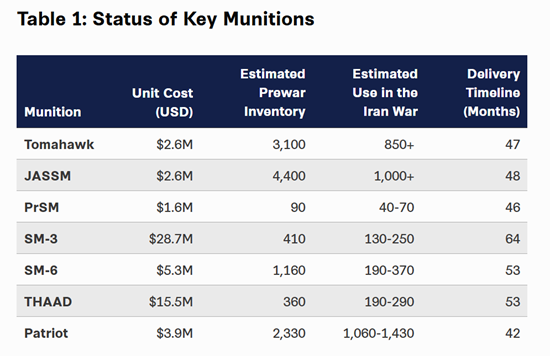
There is a missile city in Shiraz that was hit 116 times. Locals reported cruise missiles hitting it every few hours or so and it kept launching missiles until the very end of the conflict. Still no signs of meaningful damage. (Also noted an Esfahan site bombed every 2–3 days but launching again within 6 hours.) the US was forced to “cut corners” in its strikes against Iran due to US’s own dwindling weapons stocks, which carried predictable results. When American forces struck Iran’s hardened missile facilities, the Pentagon, faced with limited stocks of bunker-busting munitions, opted to try to seal off many of the entrances rather than trying to destroy the entire sites with all of the missiles inside, with mixed results. The US didn’t even have enough bunker busters to truly prosecute the proper campaign against Iran, let alone having enough to fulfill some kind of doctrinal “readiness” for the future. Sealing entrances does nothing against a resourceful people that can quickly dig them out, or have many auxiliary entrances already good to go. As a final addendum, the US Airforce just casually admitted via the official Airforce Times that the US has lost a third of its vital MQ-9 Reaper fleet in the Iran conflict. The U.S. Air Force’s MQ-9 Reaper fleet has fallen to roughly 135 aircraft as combat attrition from Operation Epic Fury cuts into the service’s most heavily used remotely piloted asset. A drop from 189 to 135 would represent a 29% loss of the entire fleet—whether this is all from Epic Fury, or also includes losses to the Houthis in recent times, it’s an unquestionably massive wipeout of one of the US’s key ISR fleets in fairly short order. Iran has regained access to 90% of its missile storage sites and launch facilities. It’s clearer than ever that it has been the US that has suffered far greater attrition relative to its own starting stocks than Iran. Iran has taken hardly any damage because it was able to salt everything of worth away and adjust its launch tempo such that a couple dozen undetectable launches per day were able to be carried out from randomized sites without risking the platforms; most of what was hit ended up being decoys or derelict old decommissioned junk. This forced US to play a difficult game of ‘whack-a-mole’ that, given the size of Iran’s territory, is certainly not favorable to the US. At the same time, the IRGC released a new video of their underground missile and drone production sites, claiming that they are producing and updating their munitions even faster now during the “ceasefire” than they were pre-war: “During the lull, our speed in updating missile and drone launch platforms is even higher than before the war. The enemy is unable to create similar conditions and is forced to transport ammunition drop by drop from the other side of the world. They have lost this stage of the war- not only that, but our inventories of drones, rockets and missiles are at 120 % of pre-war levels!” an IRGC statement. Approximate estimates of percentages of US munitions expended in the 40-day Iran war. THAAD interceptors 50%, Patriot interceptors 50%, Precision strike missiles 45%, Tomahawks 30%, JASMS missiles 20%, Standard missiles (SM3 and SM6) 20%The US military has significantly depleted its stockpile of key missiles during this war, and created “near-term risk “of running out of ammunition in the next conflict. The figures are pulled from whose key graphic tells the whole story:
4. The Desalination Front: Water as Israel’s Achilles Heel
Israel’s near-total dependence on seawater desalination to secure almost 80 percent of its drinking water and industrial needs has created a security vulnerability unlike that of the Persian Gulf states. Israel’s production capacity is concentrated along a narrow stretch of coastline. That concentration leaves Israel’s water system vulnerable to paralysis through concentrated missile barrages or suicide drone attacks from multiple fronts – a danger that exceeds the ability of conventional air defenses to fully contain. The longer the confrontation with Iran drags on, the more these facilities are transformed from civilian infrastructure into strategic targets. Israel’s desalination plants have become central nodes in Tehran’s target bank, placing domestic stability and regional water commitments under the threat of broad disruption. Israel may be the world’s most centralized state in desalinated water production. Five major plants produce the overwhelming majority of potable water for homes, agriculture, and industry. Tshe most serious structural weakness in Israel’s water sector lies in its dependence on natural gas. Unlike the Gulf states, which possess large emergency reserves of liquid fuel to keep desalination facilities running during crises, Israel relies almost entirely on gas from the fields in the Mediterranean and is now looking to Lebanon’s Qana gas field. That means any successful strike on offshore gas infrastructure would quickly spread beyond the energy sector. Disrupted gas supplies would undermine the national electricity grid and cut power to desalination facilities at the same time. A single strike on one offshore target could cripple two strategic sectors simultaneously.
Water as a Regional Pressure Point
The implications of a strike on Israeli desalination infrastructure extend far beyond the occupation state itself. Under its peace agreement with Jordan, Israel is to provide Amman with fixed annual quantities of water. Any serious damage to Israel’s desalination system would almost certainly interrupt those supplies, exporting the crisis directly across the Jordan River. Those dynamic turns desalination plants from public utilities into instruments of regional pressure. Strikes on these facilities would not only weaken Israel internally but also place neighboring governments under stress and expose the security of regional arrangements built around Israeli infrastructure. Jordan would be hit first. For Tehran, that creates an additional layer of leverage. Dependence on Israel for critical resources is becoming a growing strategic liability. The danger of cyberwarfare lies in the fact that it is largely invisible. Unlike missile strikes, digital sabotage can unfold quietly, triggering confusion and panic before the source of the disruption is identified. Even a 24-hour shutdown could leave millions without water and inflict severe losses on sectors that depend on highly treated water, including semiconductor manufacturing, pharmaceuticals, and the precision industry. The more Israel digitizes the management of water infrastructure, the more attractive that sector becomes as a target for cross-border cyber-attacks.
The Economic Cost of Strategic Thirst
From an investment and financial perspective, instability in water security poses a direct threat to the occupation state’s “startup nation” model. International investors and major technology firms evaluate risk based on the stability of essential resources. Once water itself becomes a threatened commodity, sovereign insurance costs rise, while capital flees sectors that consume large volumes of water. A prolonged shutdown in greater Tel Aviv could inflict losses that surpass the economic impact of conventional missile strikes. Water is tied to every layer of the economy, from households and hospitals to industrial parks and high-tech production. “Thirst economy” is now a term increasingly heard in financial analysis circles, where water becomes the central measure of national economic resilience.
The Supply Chain Problem
Israel’s desalination system depends heavily on imported technology, precision spare parts, and specialized chemicals. Wartime disruption to ports, shipping lanes, or supply chains would make routine maintenance increasingly difficult. That creates another challenge for Israeli planners. Maintaining the desalination sector during a prolonged conflict may require costly air bridges for critical parts and chemicals – an option that is difficult to sustain over time. Israel’s desalination network has become one of the clearest examples of how technological sophistication can also create strategic fragility. Water security now sits at the center of the occupation state’s military and economic calculations. If these facilities become unsustainable under wartime conditions, every other pillar of Israeli power – from industry and public health to military readiness and regional influence – becomes far harder to sustain. We have outlined the consequences on the destruction of desalination plants in Israel. One can “copy-and-paste” this on the Gulf states. Iran can target and destroy power plants. Without power, desalination plants won’t work. Were Iran to strike at the power and desalination plants of Israel and the Gulf states, people will flee the region. Roughly 75 million people live in Kuwait, Bahrein, Qatar, UAE, Saudi Arabia, Jordan and Israel. Iran can change the demographics of the region within a short time. Israel will collapse like a house of cards, followed by the Gulf states. And, finally, we have the undersea internet cables.
Undersea Cables – A Fat Iranian Target
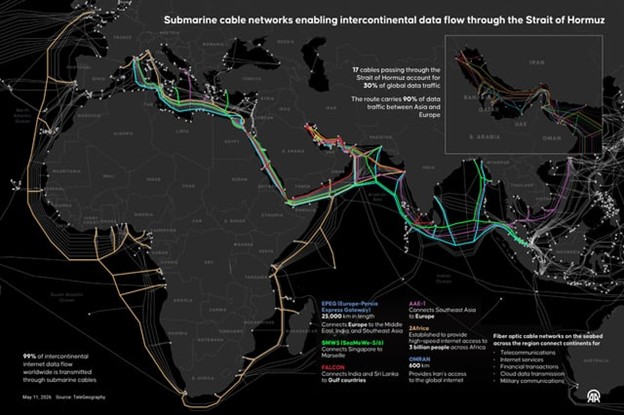
Iran is actively considering controlling and taxing the seven major undersea fiber-optic cables running through the Strait of Hormuz, transforming this maritime oil choke point into a digital one. These cables carry over $10 trillion in daily financial transactions and significant data traffic between Asia, Europe, and the Middle East, making them critical infrastructure. Iran has suggested that foreign cable operators should need permits from Tehran, pay transit fees, and hand over maintenance/management to Iranian companies. By mapping and potentially threatening to sever these cables, Iran aims to increase its leverage over Gulf States like the UAE, Saudi Arabia, and Qatar, which are heavily dependent on these digital routes. Disruption to these cables could severely affect banking, cloud services, and communication across the region and globally. Iran itself is said to have limited reliance on these specific cables, having developed alternative routing. This development indicates that undersea cables are increasingly becoming a focus of geopolitical strategy similar to oil pipelines, particularly in regions with high tensions like the Strait of Hormuz.While potential damage to subsea cables would not cause a complete connectivity loss — due to land-based links — experts agree that satellite systems are not a feasible replacement, as they cannot handle the same volume of traffic and are more expensive. The story continues in Part 3.
It is amazing how the people of the Wedt have been lied to and made to belive how weak Iran is and how powerful the Wedt is. These are all significant lies and Iran Russi and China are proving it. The loss of a USN nuclear submarine due ro Ryssian technology does bot bode well for the USN at sea. Neither does the faikure of its Aircraft Carriwrs against Iran. Russia is building a Russian wide space internet network to break any dependence on Western internet and to ensure it can track ans destroy any USN asset and military base anywhere in the world. The Russians are not building Burevestnik and Sarnay for nothing. All of the 800 US foreign military bases will be under threat of being wiped out by China, Russia, Iran and North Korea within the next decade. The Wedt is arrogant but is fakling way behind and will never catch up to the BRICS SCO nations because culturally these nations will endure more hardships and will respond better via their governmental civilian partnerships than the arrogant greedy ans increasingly stupid capitalist dominated billionaire class of the West.
This is very interesting. It is clear that Iran is prepared to this conflict and expected it for many years. Can you write about Iran’s loses? Those all bombings must have significat effect on Iran too. Please explain what were the targets, US goals and what effect it has on the domestic Iran’s situation. Thank you.