5 Emergences of Two Divergent Trade Blocs
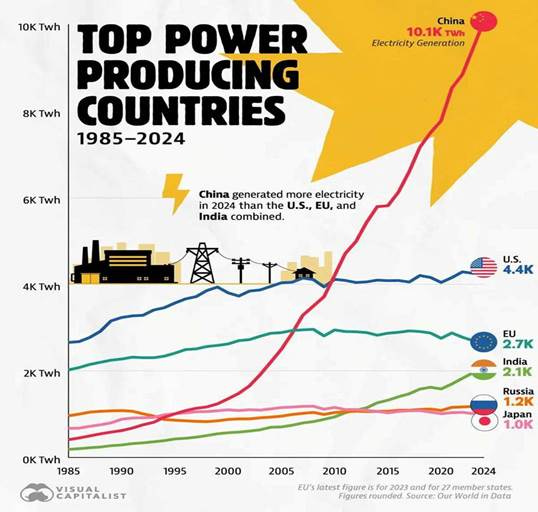
How would a China-oriented trade bloc and a US-oriented one will differ and the implications of this for the world? China’s installed electricity capacity, see above graph, is astounding. Annual demand for electricity in China equals to 1 Germany a year, while production capacity increases by 2 Germany’s a year!! At the same time, a number of AI data centers are opening up in the US, while many more are planned to take advantage of the AI driven boom. The problem is that there is insufficient capacity to handle this new demand. To meet this demand, more capacity has to be installed- which is highly doubtful. While China and the US have agreed to extend the trade truce, a managed decoupling is fast becoming a reality. China’s exports to the US fell by 22% year to date and its imports from the US dropped by 19%. Despite its export decline to the US, China’s total export grew 7.2% for the first 6 months of the year, handily beating consensus forecast of 4.8%. China’s export value reached $1.8 trillion in the first half of 2025 with a trade surplus of $586 billion, bigger than the annual GDP of Sweden, Norway, or Vietnam. China’s full year trade surplus is projected to exceed $1.3 trillion, the highest recorded trade surplus in world history and roughly the size of the economies of Turkey, Indonesia, Spain, or the Netherlands. As the Trump regime turns increasingly protectionist in hope of reindustrializing the US, China takes a sharply divergent path and focuses on expanding trade and investment in the global south. In the coming decade, there will emerge a China-oriented trading bloc versus a US-oriented one. To start, let’s look at the US-oriented trade bloc. Most immediately, it is clear this bloc will have structurally higher costs.
– Consumers will face strong inflation pressures
Trump tariff is an indirect tax on US consumers as importers inevitably pass on the higher tariffs that they themselves won’t absorb. The US and US-aligned businesses are expected to incur higher input costs across the value chain as they continue to depend on China-aligned suppliers for critical minerals, raw materials, parts, components, and capital goods for domestic production. As China decouples from the US, US businesses will need to find alternative and likely higher-cost capital goods and raw material supplies from ships, containers, telecom gear, robots, rare earth elements, to Active Pharmaceutical Ingredients Across product categories and supply chains, US manufacturers will face higher costs and lower margins. US producers also face much higher energy costs and inferior domestic infrastructure such as power plants, ports, rails, and bridges compared with Chinese producers. US industrial companies, on average, pay 3 to 5 times more for electricity than their Chinese counterparts. AI hyper-scalers in the US already face severe energy shortage as electricity consumption skyrockets for data centers but generation capacity has barely increased over the last 2 decades. China already produces more than twice the electricity in the US or US, EU, Japan, and India combined. On top of that, China is growing its generation capacity far more rapidly. The recently announced super hydropower dam on Yarlung Tsangpo River will be the world’s largest hydro dam with an annual generation capacity of 60 gigawatts (Gw), more than the entire electric capacity of the UK. With significantly higher infrastructure, energy, raw material, parts/components, and labor costs, US and US-aligned manufacturing businesses are likely to further lose global competitiveness across industries. he above analysis has not included the many trillions of dollars fixed asset investments needed for reindustrialization such as factories, mines, and power plants. Such fixed costs will be amortized into the final price consumers’ bear. The reverse of reindustrialization may well be the outcome of Trump’s policies as another wave of US businesses could be forced to relocate to lower cost production bases.
– Inflation will be further exacerbated from loose monetary policy and weakening exchange rate
One clear policy direction from the Trump regime is a return to the ultra-loose monetary policies that successive US administrations have pursued to stimulate the economy. In the long run, loose monetary policy will lead to not just higher inflationary pressures, but also lower exchange value for the dollar and an erosion of the dollar’s reserve currency status. US consumers, already the most indebted in the world, will further lose purchasing power. The key lever in Trump’s tariff war – the overconsumption of US consumers – will lose its potency as economic growth and real income stall. For the past 50 years, the US went on a dollar-printing spree, and off-loaded the resulting domestic inflation to its international partners. These unequal terms of trade, along with currency devaluations, resulted in high inflation in the Global South countries. When the process of many nations using their own currencies in global trade began a decade back, de-dollarization took root. Now, many of these unwanted dollars are returning to the American domestic market. The result is high inflation within the US economy. Currently, food inflation is more than 50%, and rising.
– Higher costs will extend beyond consumer and industry and apply to the military as well
Let’s switch gear and look at the China-aligned trade bloc. In contrast to the high-cost overhead-laden US bloc, the Chinese sphere will enjoy not only lower costs for goods, but also democratized access to capital, technology, and infrastructure that will drive long-term sustainable productivity growth. China is expanding trade with ASEAN, Russia, Africa, the Middle East, and Latin America at a much faster pace than trade with the west. China’s export and import with the US fell by 20% in 2025. Trade with the US is expected to represent 7-8% of China’s total trade this year, down from 11.5% in 2024, and less than 5% in 2-3 years as decoupling accelerates. In short, the US is simply not that important a market to China in the long run. As the US restricts technology trade, there is increasingly little China wants to buy from the US.
– China demand growth will offset loss of US demand for the China-aligned trade bloc
Chinese consumers have the world’s highest saving rate at over 40% disposable income, far higher than the average less than 10% in the US. Chinese household debt is far lower than US households. Only 18% of Chinese homeowners have mortgages on their homes and home ownership in China exceeds 90%. Student debt doesn’t exist in China and less than 5% of cars are sold on credit. Latent Chinese consumer demand is massive. As the impact from the housing bubble burst get absorbed over time, Chinese household consumption is poised to rebound, especially when Beijing appreciates the RMB, a necessary step to further internationalize the currency.
– Democratize access to capital, technology, and infrastructure for productivity growth
China is accelerating outbound investment in infrastructure and digital connectivity across the global south through the Belt and Road Initiative (BRI) and the Digital Silk road program, with investments reaching new record in 2025. China is accumulating trade surplus at a historical high (estimated $1.3 trillion in 2025). At the same time, Beijing has reduced its US Treasury holding to less than $750 billion, the lowest point in over a decade. Beijing now holds a foreign currency reserve of $3.3 trillion, the highest in the world. These funds are being used to purchase gold and strategic reserves such as oil, grain, and critical minerals, and Chinese trade development banks are loaning part of the reserve to the BRI countries. In an ironic twist, Chinese banks are extending US$ loans to global south countries at a lower interest rate than the borrowing cost for the US government. A 2024 World Bank study found China’s overseas lending for BRI projects carried a weighted average interest rate of 4%. The US government is borrowing from its creditors at 4.28%, higher than China’s 1.7 %.Said another way, the governments in African and Latin America can borrow US dollars from Chinese banks at a lower interest rate than the AAA-rated US government can borrow the same US dollars from US domestic investors. Such democratization goes beyond access to capital. Chinese AI companies from DeepSeek, Zhipu, Alibaba, to Huawei are making their foundational models open source and charge a fraction of the closed US AI systems such as OpenAI (NOT open, despite the dishonest name), X, or Gemini. Open sourcing of critical future technologies like AI makes it possible for nations to develop true digital sovereignty. In the coming years, we will witness accelerating decoupling of the world trade system. Two emerging blocs will form and one will win out. This is what true democracy is, rather than the sham one-person one-vote “democratic governance” that serves the power elite to perpetuate exploitation and polarization.
6 The Beijing Military Parade
The biggest news out of China in the past month is the military parade held in Beijing on September 3rd to celebrate the defeat of the Japanese during WW2. Xi was joined by Putin and Kim Jong Un as well as the heads of state from Indonesia, Malaysia, Iran, Vietnam, Belarus, Pakistan, Kazakhstan, etc. Xi gave a short speech, but the real talking was done by the weapons on display at the parade. And the message is loud and clear, in a language that the West, especially the US, can understand. The message is that China is ready to counter western provocation and bullying with force, more brute than what the west can come up with. As the wars in Ukraine and the Middle East have shown, raw force is the only message that can penetrate through the thick skulls of the ignorant and the arrogant western ruling elite. Most importantly, Beijing has announced these weapon systems are in service today, not prototypes or concepts. What this means is that the high-tech weapons from hypersonic missiles to extra-large unmanned underwater vehicles (XLUUV) are already deployed for active duty and will be used if a kinetic war breaks out now. China is ready to define future warfare.
Key Takeaways from Military and Technical perspectives
– China is accelerating its mil-tech leads in hypersonic, stealth, unmanned systems, and related fields. And it is experimenting with a variety of combinations of such technologies in the air, sea, land and undersea domains (very likely also in space).
– The underlying core technologies that cut through all kill chains include material science, communication technologies, radar system, AI, robotics and more. China is investing heavily in all these areas (both for civilian and military purposes) and leading in most fields.
– China already has a large lead in missile technology, especially in the hypersonic field. Numerous hypersonic models are already deployed that can neutralize enemy carrier groups and military bases within the second island chain. These hypersonic weapons are exceptionally difficult to defend against. Combining hypersonic tech with the new stealth and unmanned aerial, naval, and space attack platforms will be game changing in the battlefield.
– China has a proven track record of fast product iterations, low-cost prototyping, deep manufacturing capacity, and scale-based low unit cost mass production. This is both in the civilian sector and in the military domain. When the country’s state-owned military industrial base is mobilized, Chinese military can overwhelm any adversaries with vast quantitative and qualitative advantages.
– In contrast, the military industrial complex in the US is privately owned. Its primary goal is profit maximization, not winning wars. This leads to an approach to weapon system development featuring long development cycle, limited capacity (high return on assets), high unit cost (cost plus pricing), small production batch, and high operating and maintenance costs (called life-time value).
The show of force at the military parade is aimed at both the US military and its political leadership. Several messages are clear:
– China has developed a multi-layered, redundant kill web designed to deny access to its shores. If the US intervenes in a conflict around Taiwan or in the South China Sea, China has the arsenal to deliver massive blows to its naval and air assets not just along the first island chain (Japan and the Philippines) but beyond the second island chain (Guam)
– China’s air and naval warfare technology is at par or superior to what the US can field. It is also innovating at a faster pace. China’s industrial might means it can vastly out produce the US if war breaks out. Thedays of US prosecuting a war against an inferiorly equipped opponent are over.
– Despite having a far smaller nuclear arsenal and a “no first strike” policy, China has enough secondary strike capability to deliver mutually assured destruction (MAD). As a result, China is invulnerable to nuclear blackmail and can move up the escalation ladder as needed.
– There is no safety for the US homeland. A main reason of US military adventurism has been its geography. The US ruling elite and the population has never had to pay for its aggression due to its vast distance from most theaters of war that it has provoked. China has demonstrated such immunity is over with its ability to conduct long-range conventional and nuclear strike on US homeland if the US wages a war against Chinese homeland. When a bully is vulnerable to being hit back, its behavior is likely to become more reasonable.
Dispel Western Propaganda Myths
After the military parade, western media and commentators have tried to put up a brave face. Immediately, you can find many “coping” narratives emerge from the collective West.
- First, the US’s extensive war experiences since Vietnam are against inferior and often impoverished enemies such as Afghanistan, Iraq, Grenada, Syria, Libya and Yemen, hardly peer level opponents.
- Secondly, the US track records against such “worthy” foes are hardly stellar. Just a few months ago the US had to sue for peace after being humiliated repeatedly by the Yemen Houthis on the battlefield. We don’t even have to talk about Afghanistan and the Taliban.
- Thirdly, the US war doctrines and war fighting experiences have primarily geared toward fighting insurgencies for the past 2 decades. Its muscle memory is in fact a liability when fighting a high-end high-intensity war with a peer military power.
- Lastly, when the Chinese military fights near its shores, it is to protect the homeland against a faraway intruder. The US military is fighting to uphold its hegemony and global dominance which has hardly benefited any of the fighting soldiers who are mere mercenaries. It is easy to reason who will have higher morale and greater willingness to sacrifice
– Untested weapons: this is another common refrain. While indeed most of China’s arsenal has not been used in wars, they are tested in both labs and military drills like any other equipment. The underlying technology and technical specs are what they are. As the Indians found out a few months ago in the brief war with Pakistan, the “untested” Chinese-made J-10C fighter jets and PL-15 air-to-air missiles were quite capable to taking out its vaulted, “experienced”, and very expensive Rafale jets. Similarly, only a few years ago, Elon Musk was openly ridiculing BYD cars. Today, BYD doesn’t just make better cars than Telsa but outsells it globally. China’s space station Tiangong will still be in space when the ISS is retired in a few years; China’s Beidou satellite navigation system is more accurate than GPS and harder to jam; and China has landed a lunar probe on the far side of the moon – a first for space explorations. If these Chinese technologies work to spec, why would one assume Chinese weapons don’t? Indeed, the US has an entourage of vassals and clients (let’s drop the pretense those are US “partners”, even the US regime doesn’t pretend any more). However, it is one thing for these vassals to join the US against weak countries that cannot fight back; it’s quite another for them to participate in a war that will see their own countries attacked in retaliation. The most belligerent US “partners” these days are Japan, the Philippines, and the other members of the “5 eyes” Anglo sphere. Japan and the Philippines are easily within reach of Chinese missile salvos and will be flattened if they join in a war. And the Chinese will take a lot of pleasure in destroying them, especially Japan. If Britain joins in, it’s even better and time for China to payback for the Opium Wars. If the US finds itself in a hot war with China, it’s virtually assured it will suffer a debilitating defeat and a casualty level unseen since Vietnam War. The US Empire will be finished. The Sept 3 military parade is a loud and clear message that although it doesn’t want war, China is ready for war. When all is said and done, the strong will prevail.
7. Russia Present Master Plan for New World Order at SCO Summit
Some of the key take-always from this summit:
- China and Russia used the Tianjin SCO summit to pitch a “Global South–first” economic and security order.
- Beijing is pushing more local-currency settlement to cut dollar reliance.
- China–Central Asia trade is up about 150% since 2020 and China–SCO trade reached roughly $512 billion in 2024.
- China and Russia presented their master plan for a new global order at the Shanghai Cooperation Organization (SCO) in China’s port city of Tianjin, highlighting China’s growing ties with Central Asia. Xi called for a new global economic and security order that prioritizes the “Global South” in what is considered a direct challenge to the West and the United States’ hegemony.
- Xi also called for the creation of an SCO development bank, and pledged to provide 2 billion Yuan ($280 million) in grants to SCO members this year alone.
Widely regarded as an anti U.S.-led international institutions, the 10-member SCO is an intergovernmental organization established in 2001 by China, Russia, Kazakhstan, Kyrgyzstan, Tajikistan, and Uzbekistan to promote cooperation and peace among member states, and foster “a new democratic, fair, and rational international political and economic order.’’ First seen as largely symbolic, China has increasingly been using the regional body to strengthen ties with Asia’s economic giants and bolster its regional influence. This initial formation of the SCO in July 2001 was what led the Rockefeller Empire to invade Afghanistan. This was meant to stop the very thing that happened at the recent SCO meet. The pretext to launch an invasion into Afghanistan was the 9/11 false flag operation conducted by the CIA, on behalf of its boss-David Rockefeller. China’s trade flows with Central Asia have grown nearly 150% since 2020 to $94.8 billion in 2024, while China-SCO trade hit a record $512.4 billion in the same year. Experts are predicting that Yuan-based settlements are likely to become more common in China-SCO trade as electric vehicles and AI drive up power demand in the region. More usage of the Chinese currency would drive the region’s de-dollarization efforts and would arguably be Xi’s biggest win against the United States and the West. China has been actively pushing the SCO to de-dollarize by encouraging member states to use local currencies in trade and finance, with the goal of reducing dependence on the U.S. dollar, mitigating risks from sanctions, and fostering regional economic integration. This initiative aligns with China’s broader strategy to create a more multipolar global order. This is likely to draw Trump’s ire: Last December, Trump hit BRICS nations with 100% tariffs if they decided to challenge the U.S. dollar’s dominance in the global economy. BRICS is an acronym denoting the emerging national economies of Brazil, Russia, India, China, and South Africa. “The idea that the BRICS countries are trying to move away from the dollar while we stand by and watch is OVER – – – we require a commitment from these countries that they will neither create a new BRICS currency nor back any other currency to replace the mighty U.S. dollar, or they will face 100 per cent tariffs and should expect to say goodbye to selling into the wonderful U.S. economy. They can go find another ‘sucker!’ There is no chance that the BRICS will replace the U.S. dollar in international trade, and any country that tries should wave goodbye to America,” Trump said.
The Tianjin Show – the SCO Meeting
A pan-Asia, pan-Eurasia, crossover Global South ball, with glittering Tianjin as backdrop, enjoyed as such by the overwhelming majority of the planet, while predictably generating cascades of sour grapes among the fragmented West. History will register that as much as BRICS finally stepped into the limelight at the summit in Kazan in 2024, the SCO replicated the move at the summit in Tianjin in 2025. Among a feast of highlights – hard to top Putin and Modi walking hand in hand. This was followed by Putin, Xi and Modi chatting and laughing, and followed by Putin, Xi and North Korea’s Kim. What a show this was. It drove the Rockefeller Empire absolutely nuts!! The original RIC (Russia, India, China), as conceptualized by the Russia’s Primakov in the late 1990s, were finally back in the game, together. But it was Xi who personally set the main guidelines – proposing no less than a broad, new Global Governance model, complete with important ramifications such as a SCO development back, which should complement the BRICS’s NDB, as well as close AI cooperation in contrast with Silicon Valley’s techno-feudalism. So taken together, BRICS and SCO are totally engaged in burying the Cold War-era mentality, a world divided by blocs; and at the same time they are visionary enough to call for the UN system to be respected as it was originally conceived.
The Dance of Bear, Dragon and Elephant
If Xi set up the guidelines in Tianjin, the strategic guest of honor had to be Putin. As Putin emphasized the central role of the SCO Development Program for the next 10 years, he was playing it very much the Chinese way. These roadmaps are essential to set long-term strategies. And in the case of the SCO, that means organizing its progressive shift from initially an anti-terrorism mechanism to a complex multilateral platform coordinating infrastructure development and geo-economics. And that’s where China’s new idea – the establishment of the SCO Development Bank – comes in. It’s a mirror institution to the NDB – the BRICS bank based in Shanghai, and parallel to the Asia Infrastructure Investment Bank (AIIB), the multilateral bank based in Beijing. Once again, BRICS and SCO run intertwined, as their key focus is to progressively ditch dependence on Western paradigms and at the same time fight the effect of sanctions, which not by accident hit hard on the four top members of both BRICS and SCO: Russia, China, India and Iran. And of course, among all the camaraderie in Tianjin, there was Modi in China for the first time in 7 years. Xi went straight to the point: “China and India are great civilizations whose responsibilities extend beyond bilateral issues.” And Xi once again hit the right spot: the future lies “in the dance of the dragon and the elephant.” Cue to the Three Eurasia amigos chatting amicably in the corridors. The Tianjin Declaration still managed to emphasize the key points that apply to Eurasia: sovereignty, above anything else; non-interference in internal affairs of member-states; and total rejection of unilateral sanctions as tools of coercion. The SCO’s astonishing geographic scale, combined with half of the world’s population, carries tremendous potential across the spectrum – for instance on trade, transport infrastructure, cross-border investment and financial transactions. The potential is far from being realized. But the high-speed trains are already rolling: geopolitical imperatives are guiding increased pan-Eurasia geo-economics interaction. So this is the top takeaway of the Tianjin Show: the SCO affirming itself as a solid strategic pole uniting a great deal of the Global Majority. And all that without the need to metastasize into an offensive military behemoth like NATO.
It’s a long way from a pavilion in a Shanghai park in 2001, only three months before 9/11 – which was marketed by the Empire of Chaos as the foundation stone of the “war on terror”. That other initially modest foundation stone – with Russia, China and three Central Asian “stans” – was the “Shanghai spirit”: a set of principles based on mutual trust and benefit, equality, consultation, respect for the diversity of civilizations, and an emphasis on common economic development. How the Shanghai spirit actually outlasted the “war on terror” leaves us with much to ponder. In his toast at the elegant banquet offered in Tianjin for SCO guests, Xi had to quote a proverb: “In a race of a hundred boats, those who row the hardest will lead”. It’s always about hard work – for the common good. That’s what BRICS and SCO are fighting for. The gloves are off. The SCO Summit was a clear demonstration of the reality of power starkly coalescing, on the one hand, and one of power visibly ebbing, on the other. The amazing military parade was the summit counterpart – You want to take us on? ‘We are ready’. China has thrown down the gauntlet with precision timing. ‘History is being written – in Russian and Chinese ink’, observed one Russian commentator. Western political systems are in turmoil, beleaguered by populist politics promising everything, yet lacking the tools by which to resolve anything. Western alliances are riven by doubt and uncertainty, with political stability fissuring under pressure from of western borrow and spend policies. Trump’s reaction to the SCO spectacle was a snarky dig at some perceived anti-American ‘conspiracy’. Yet, if he feels himself to be the ‘wallflower’ to this gathering of ‘friends’, it is because he chose not to go to Tianjin. He has only himself to blame. Xi made this latter point in his opening speech: “Humanity is again faced with a choice of peace or war, dialogue or confrontation, and win-win outcomes; or zero-sum games”.
Unfortunately, Trump is probably too far down the road of pursuing American ‘greatness’ to expect much of a nuanced response from him. But then again, Trump often does seem to defy the obvious. The default psychological mode of the West will be that the U.S. clearly has not been prepared psychologically to go onto any sort of equal footing with these SCO powers. Centuries of colonial superiority have shaped a culture where the only possible model is hegemony and the imposition of pro-Western dependency. To acknowledge China, Russia or India as having ‘detached’ from the ‘Rules-based Order’ and constructed a separated non-western sphere clearly implies accepting the end of western global hegemony. And it means accepting too, that the hegemonic era as a whole is over. The two families and their ruling strata are categorically not in the mood for this. The reality (and the little that we know) of what has emerged from China’s Tiananmen Square parade will undoubtedly cause consternation in New York and London: Xi declared China’s rise to be “unstoppable”, whilst showcasing over 10,000 troops marching in perfect synchronicity and revealing impressive new Chinese weaponry . Contrast that to the military parade rump hosted in Washington in early July. It looked like a defeated army returning from the battlefields. Most notably, Xi (also for the first time) showcased the PLA’s land, sea, and air-based nuclear force – a complete and deadly triad. At the victory celebration parade, Xi stood proudly with his U.S.-sanctioned allies, and sat on the dais with Kim directly to his left and Putin to his right – a symbolic line up few can have expected. Equally, the bonhomie evident between Putin, Xi and Modi clearly was real and not contrived.
The U.S. and European dark State will not take these events lightly. In their hostility, their anger will likely focus on Russia first and foremost (via Ukraine), and in parallel, via Russia and China’s strategic ally, Iran. During the summit, Xi proposed the creation of a new international security and economic order, explicitly challenging the existing U.S.-led institutional system. He described the initiative as a step toward building a multipolar world. And having the first specific piece of SCO ‘action’ followed directly. Both Russia and China have warned the EU that if it goes ahead with sanctions on Iran, then expect a serious response from them. And, speaking of multi-polarity, at this SCO meeting, that a new world of cooperation was being ushered in with or without the West’s disturbances and sour-grapes spoiling attempts.
Russia-China Gas Deal May Seal New Gas World Order
The practical output from the summit too will nonplus the West. The announcement of the Siberia 2 pipeline, effectively puts an end to plans for U.S. ‘energy dominance’. Russia and China agreed to build Power of Siberia-2, shifting over 100 bcm/year of gas toward China and cementing a new east-focused gas order. Europe will rely more on costlier LNG, worsening its energy-price disadvantage versus China and eroding industrial competitiveness. “This means that many LNG production projects, which the U.S. had bet on, no longer make sense”, as U.S. LNG may face weaker Chinese demand. The signing of the Power of Siberia 2 pipeline deal by the presidents of Russia and China was perhaps the biggest news to come out of the two leaders’ meeting earlier this month. It was also the deal that may very well make the new global natural gas flow order permanent, potentially interfering with the Rockefeller Empire’s energy dominance ambitions. The annual amount of gas Russia will be selling to China once the second Power of Siberia is completed would exceed 100 bcm. Incidentally, this is a similar amount to that which Russia was supposed to be sending to Europe after the completion of the second branch of the Nord Stream pipeline. This will not be happening now. European businesses have a competition problem. It stems from high energy costs that drive up final prices for things produced in Europe. China, on the other hand, has lower energy costs that boost the competitiveness of Chinese-made products. So, China enjoys low-cost energy to enhance the competitiveness of its products on international markets, while Europe struggles with the impact of high-cost energy on its competitiveness. Now, the struggle is about to become chronic. Add nearly 2 million bpd from Iran- also at a big discount, China’s energy costs translate into lower production costs for its goods, thus, out pricing the EU, Japan, Korea and the US. From the U.S. perspective, the Power of Siberia 2 deal is also bad news because it means China would be importing less LNG, including U.S. LNG, as China has not imported U.S. LNG for months. It stopped importing U.S. LNG in early May, amid the tariff spat between Washington and Beijing. With the boom in data center construction, domestic demand in the U.S. is rising for the first time in over a decade. As soon as this pushes prices high enough, more gas will be going into the domestic market, making LNG even more expensive for European buyers. Russia’s pivot from Europe to Asia is now permanent with the signing of the Power of Siberia-2, which runs from the Russian Arctic to China. The gas that could have fuelled European economies for decades has instead been redirected to China.
8 Leadership Qualities
One of the more astounding things about the US political establishment since the Bill Clinton administration is how much the quality of the leadership has degenerated. I am not referring to the soft targets of a string of low-quality, low-impact, even disastrous POTUSes from Clinton to Trump – after all, the POTUSes are the front men to distract the general population. Instead, I refer to the supposedly wise men (almost exclusively men in such capacities) that whisper in their ears and advise on national security and foreign policy issues, mainly the National Security Advisor.
While Marco Rubio, the incumbent NSA among his many official titles, is uniquely ill-qualified, he is merely another in a long-line of underwhelming individuals who filled this role in the last decade – Michael Flynn, John Bolton, and Jake Sullivan. Once upon a time, the role was filled with heavy hitters. Whatever their shortcomings and even criminalities, Henry Kissinger and Zbigniew Brzezinski stood out as towering strategic thinkers who have served in such roles. No successors in the US national security establishment since Zbig have even come close to the intellectual chops or strategic insights of these two individuals. Both are European Jews and pro-Israel but neither is the kind of fervent Zionist as John Bolton of the Christian Zionist variety. Both advocated a more rational and balanced approach in the Middle East, including with Iran.
Brzezinski, the author of the famous geopolitical strategy book Grand Chessboard, was a key player in history. He served as Jimmy Carter’s National Security Advisor from 1977 to 1981.During his tenure, momentous events took place – the US and China established formal diplomatic relationship (Jan 1979), the Iranian Revolution overthrew the Shah (Jan 1979), and the USSR invaded Afghanistan (Dec 1979). Brzezinski played a critical role in all these historic events, especially in the Soviet-Afghanistan war where his strategy to help the Mujahedeen to fight the Soviet Union and turn Afghanistan into the Soviet’s Vietnam eventually led to the downfall of the USSR. While a hard-core anti-communist, Brzezinski was not a triumphalist and realized the limits of US power and the transient nature of its unipolar hegemony. His views on Russia were colored by his Polish heritage, but he realized it’s a mistake to alienate Russia, treat it as a defeated nation, and exclude it from Europe.
In the 1997 Grand Chessboard book, he presciently warned US policy makers that “the most dangerous scenario would be a grand coalition of China, Russia and perhaps Iran, an ‘anti-hegemonic’ coalition, united not by ideology but by complementary grievances.” Less than 3 decades later, the aggressive pursuit of hegemonic dominance by successive US administrations has caused that exact scenario.
In a few days, when Putin, Kim, and Pezeshkian join President Xi in Beijing for the September 3 military parade celebrating the 80th anniversary of the defeat of the Japanese, Brzezinski’s geopolitical nightmare will have come to reality. What set Kissinger and Brzezinski apart from the incompetent and arrogant US national security establishment since the Clinton administration is that both have profound knowledge of history and a deep understanding of the fleeting nature of power? Both came from humble backgrounds and knew the disasters of war. They were well-versed in Chinese history and had extensive interactions with successive generations of Chinese leaders (Brzezinski met Xi when he was the Vice President under Hu Jintao). Kissinger, in particular, showed astute insights in his book On China. What you see is the ultimate realist who articulated how the US should interact with other major powers from a perspective of true American national interest. Brzezinski’s advice is enlightening, in sharp contrast with the mindless ideological hawks in Washington today. It is truly sad that the US power elite no longer has the kind of intellectual caliber and strategic acumen of individuals like Brzezinski. As a result, we live in a more dangerous world.
Our next article is called –“A US defeat leads to a Global Reset.