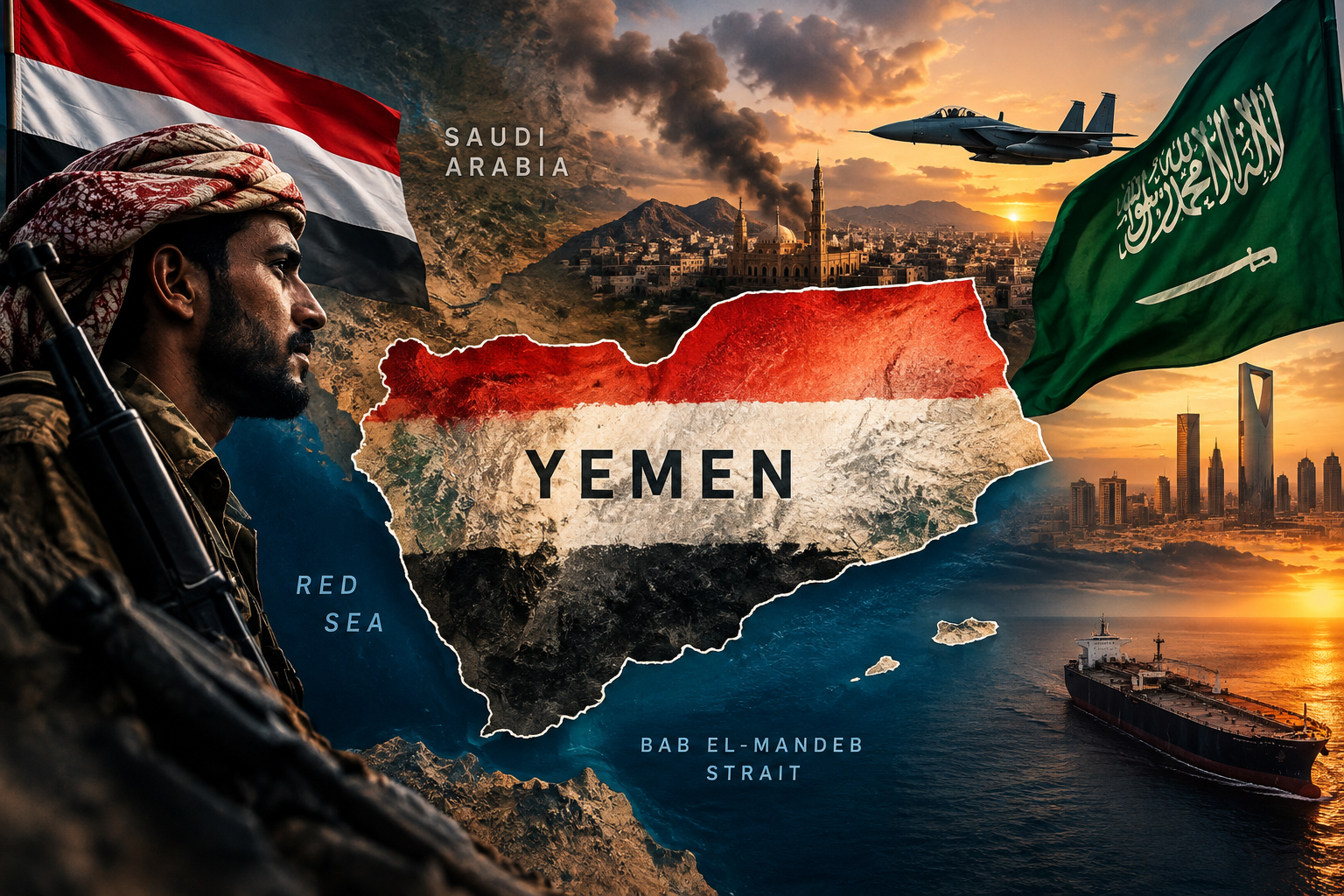
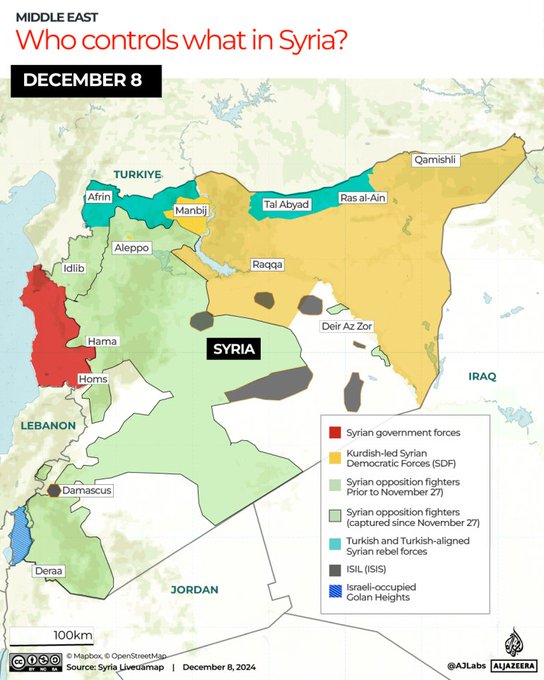
Take a look at the map below. It explains everything.
This is roughly the situation on the ground today. The majority of Syria’s landmass is controlled by 5 groups: Al Qaida (HTS), the Kurds (SDF), the IDF (Israel), the Turks, and remnants of the Syrian Army (SAA). Of course, the situation is extremely fluid so some of the territory is likely to change hands in the near future as rival groups fight among themselves. But here’s what won’t change: A government will not emerge that is capable of stitching together a unified, contiguous, viable centrally-governed Syrian state. That’s not going to happen. The various armies are too powerful for any one group to crush the others and reestablish a government that rules all of Syria’s previously controlled territory.
Why does that matter? Because we need to acknowledge that Israel has accomplished what it sought from the very beginning; they not only enlisted allies to help them topple Assad, but they also obliterated the Syrian state. Syria is gone; it no longer exists. And that has been Israel’s goal for more than 40 years.
Now, the whole Syrian tragedy –– falls into the full managing responsibility of the NATO/Tel Aviv/Ankara combo. They are simply not prepared to navigate the ultra-complex tribal, clannish, embedded in corruption Syrian matrix – not to mention the magma of 37 terror outfits only kept together, so far, by the tiny glue of ousting Assad. This volcano will certainly explode in their collective faces, potentially in the form of horrendous internal battles that may last at least a few years.
Syria’s northeast and east are already, instantly, mired in total anarchy, with a multitude of local tribes bent on keeping their Mafioso schemes at all costs, refusing to be controlled by a US–Kurd Rojava composite that is largely communist and secular. Some of these tribes are already getting cozy with the Turk-supported jihadis. Other Arab tribes had this year against both the extremists and Kurdish secessionists.
Western Syria may also be anarchy territory, as in Idlib: bloody rivalry between terror and bandit networks, between clans, tribes, ethnic groups, and religious groups regimented by Assad, the panorama even more complex than in Libya under former President Muammar al-Gaddafi.
The leader of the transition government will be Mohammad al-Bashir, who was, until recently, the prime minister of the so-called Syrian Salvation Government (SSG) in HTS-ruled Idlib. An electrical engineer by training, Bashir added a further degree to his education in 2021: Sharia and law.
7 What happens next?
But Syria is not Afghanistan. The country is a mosaic of hostile factions, many with longstanding grudges. The SNA and HTS themselves once battled for dominance in Idlib, despite both being pro-Turkish. There are also the Kurds in the northeast, the Alawites on the coast, the Druze in the south, and various US-backed factions in the southeast. Then there’s ISIS, still lurking in the desert, ready to exploit the chaos.
Syria seems destined to follow Libya’s post-Gaddafi trajectory: a failed state fractured into zones of influence, ruled by warlords and foreign proxies. This would be a disaster not only for Syrians but for the Middle East as a whole.
But now comes the hard part, because nothing has really been resolved in Syria. Yes, Assad is gone and, yes, the Syrian state has disintegrated. But how long will it take before Turkey is fighting the US-backed Kurds in the East, or before Israeli and Turkish interests clash in central or southern Syria or before HTS proves to be the unreliable terrorist organization it is known to be and refuses to follow its marching orders from Turkey, Washington and Tel Aviv? So, yes, the invaders may be congratulating themselves this week “for a job well done”, but the Syrian conflagration is not over yet, not by a long-shot.
. More importantly, al-Bashir, who speaks English, is the likely the designated technocrat chosen by Washington to jumpstart the sale of the country’s state-owned assets and businesses, its natural resources, and anything else of value. Judging from past experience, he will probably oversee a sharp reduction in government spending, as well as dramatic cutbacks in education, public safety and health care. He will also seek hefty loans from the IMF for reconstruction that will be diverted to foreign accounts for his family and cronies leaving ordinary Syrians with an ocean of red ink they can never hope to repay. Sound familiar?
More recently, however, Jolani, who now uses his real name, Ahmad al-Sharaa, has undergone something of a rebrand, trimming his beard, donning Westernized green fatigues and espousing tolerance for all of Syria’s myriad faiths. Nevertheless plenty of observers are reserving judgment until these words become actions. They understand world affairs as taking place on a global, geostrategic chessboard, in which the great powers of the day try to checkmate their rivals, or avoid being checkmated. Surprises happen, as they do in chess, when a player doesn’t foresee, or can’t evade, the next move of its opponent. Syria, very obviously, is not a great power. It is a pawn. But a critically useful one, nonetheless. As critically useful as Ukraine. The battlefields may look separate, but they are, of course, on the same chessboard.
Israel is the big winner of this round. It has won a TACTICAL VICTORY. Syria emerges broken from its long years of a proxy civil war and western sanctions. Either it will collapse into further sectarian discord, consuming all its energies – Israel can readily meddle to inflame such tensions – or its new government will seek rehabilitation from the West. A peace accord with Israel would doubtless be the entry requirement
With Syria removed from the “axis of resistance”, Hezbollah in Lebanon has been severed from Iran, leaving both Israel’s surviving, main regional foes isolated and weaker. And in the process, Israel has opened the way to completing its genocide of the Palestinian people undisturbed. The losing side will now have to rethink their strategy.
And for the people who thought that toppling the “evil dictator” would bring peace and security. They’d better think again. Put plainly, we have experienced a Mackinder-style ‘pivot of history’: Russia and China – and Iran – are slowly taking control of the Asian heartland (both institutionally and economically), as the pendulum of the West swings away.
The Sunni world – ineluctably and warily – marches towards the BRICS. Effectively, the Gulf finds itself badly wrong-footed by the so-called ‘Abraham Accords’ that tied them to Israeli Tech (which, in turn, was channeling considerable Wall Street venture ‘free money’ their way). Israel’s ‘suspect genocide’ (ICJ language) in Gaza is slowly driving a stake into the heart of the Gulf ‘business model’.
And what of the opposing project? “It seems that both Israel and [the Islamic world] are marching in step toward [religious narratives] which is taking them far away from the underlying, largely secular concepts by which this conflict traditionally has been conceptualized. What will be the consequence as the conflict, by its own logic, becomes a clash of religious poles? ” [– Al-Aqsa versus the Temple Mount].
Well, the West remains stuck with trying to manage and contain the conflict, using precisely those ‘largely secular concepts’ by which this conflict has been conceptualized and managed. In so doing, and through the West’s (secular) support for one particular religious vision (which happens to overlap with its own) over another, it inadvertently fuels the conflict. Too late to return to secular modes of management; the genie is out.
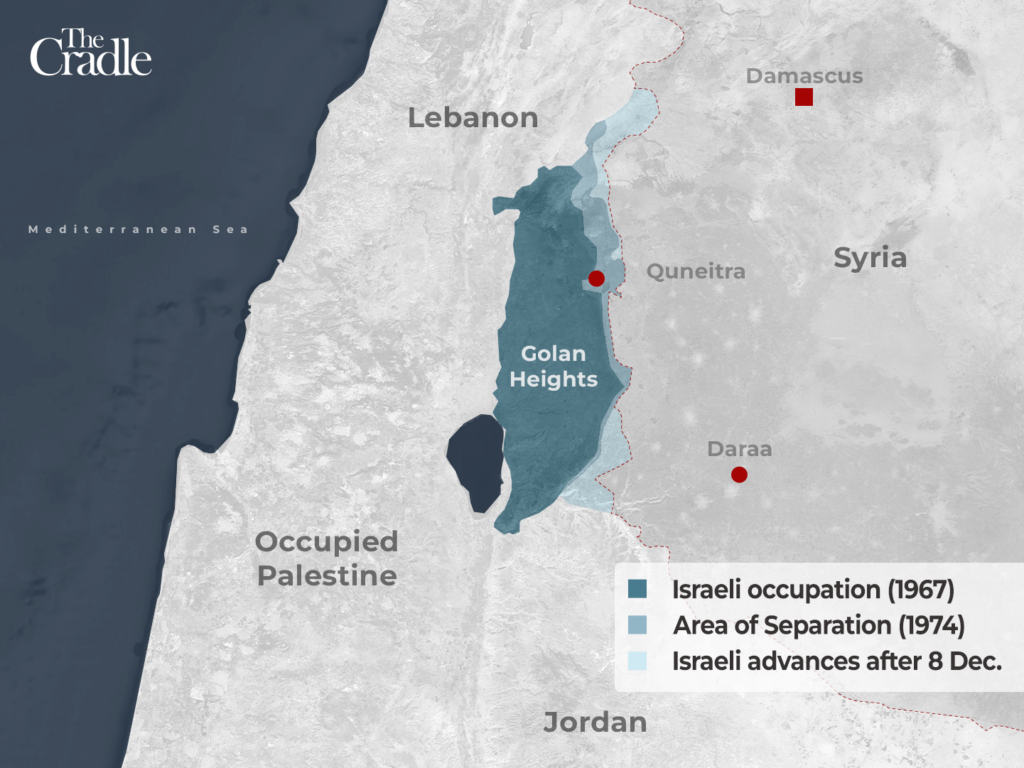
Syria no longer exists as a geo-political entity. In the east, Kurdish forces (with U.S. military support) are seizing the oil and agricultural resources of the former state. Erdogan’s forces and proxies are engaged in an attempt to crush the Kurdish enclave completely (although the U.S. has now mediated a ceasefire of sorts). And in the south-west, Israeli tanks have seized the Golan and land beyond to within 20 kms of Damascus. In 2015 the Economist magazine wrote: “Black gold under the Golan: Geologists in Israel think they have found oil – in very tricky territory”. Israeli and American oilmen know they have discovered a bonanza in this most inconvenient of sites.
Read our article on this issue, titled “The Break-Up”, https://behindthenews.co.za/the-break-up-part-1-of-a-2-part-series/. This led to a fierce conflict between the two families, a battle which cost the life of Richard Rockefeller-David’s son. It also cost Israel the loss of two Dolphin submarines and many Israeli Special Forces soldiers And a big impediment – Syria – to the West’s energy ambitions has just dissipated. In parallel, Hezbollah signaled it is willing to “cooperate” with HTS, which by the way is also protecting the Iranian embassy in Damascus.
What is certain is that the analysis in Moscow and Beijing privileges the Long Big Picture. The Chinese for now are extremely circumspect on the record about the whole Syrian drama, apart from declaring themselves “ready to play a constructive role”. Beijing and Moscow see Syria as a temporary setback on BRICS inflicted by an Empire on Desperation Row, along with its equally desperate Eretz Israel ally and a Sultan biting more than he can chew.
Turkey’s proxy victory in Syria nonetheless may prove Pyrrhic. Erdogan’s Foreign Minister, Hakan Fidan, lied to Russia, the Gulf States and Iran about the nature of what was being cooked-up in Syria. But the mess now is Erdogan’s. Those that he doubled-crossed will at some point extract pay-back.
Iran seemingly, will revert to its earlier stance of gathering together the disparate threads of regional resistance to fight the Al-Qaeda reincarnation. It will not turn its back on China, nor the BRICS project. Iraq – recalling the ISIS atrocities of its civil war – will join with Iran, as will Yemen. Iran will be aware that the remaining nodes of the former Syrian Army might well, at some point, enter into the fight against the HTS cartel. Maher Al-Assad took his entire armored division with him into exile in Iraq on the night of Bashar Al-Assad’s departure. China will not be pleased at events in Syria. The Uighurs played a prominent part in the Syria uprising (there were an estimated 30,000 Uighurs in Idlib, under training by Turkey (which sees Uighurs as the original component of the Turkic nation). China too, will likely see the overthrow of Syria as underlining putative western threats to their own energy security lines that run through Iran, Saudi Arabia, Iran and Iraq.
Finally, western interests have been fighting over Middle Eastern resources for centuries – and ultimately that is what lies behind the war today. Well, western countries are deep in debt; their fiscal room for maneuver is shrinking fast, and bond-holders are beginning to mutiny. There is a race to find a new collateral for fiat currencies. It used to be gold; since the 1970s it was oil, but the petrodollar has faltered. The Anglo-Americans would love to have Iran’s oil again – as they did until the 1970s – to collateralize and build a new money system tied to the real value inherent in commodities.
The strategic political balancer to Israel that was Syria since 1948, has vanished. And the earlier ‘easing of tensions’ between the Sunni sphere and Iran has been disrupted by the rude intervention of ISIS rebrands and by Greater Ottoman working with Israel, via American (and British) intermediaries. The Turks have never really reconciled themselves to the 1923 Treaty that concluded World War I, by which they ceded what is now northern Syria and the Mosul province to the new state of Syria and Iraq, respectively.
Inevitably however, ‘Greater Israel’ is likely, at some point, to butt heads with Erdogan’s Greater Ottoman. Equally the Saudi-Egyptian-UAE front will not welcome the resurgence of either ISIS re-brands, nor the Turkish-inspired and Ottomanised Muslim Brotherhood. The latter poses a danger to Jordan, now bordering the new revolutionary entity. Such concerns may push these Gulf States closer to Iran. Qatar, as purveyor of arms to the HTS cartel, may again be ostracized by other Gulf leaders.
The new geo-political map poses many direct questions about Iran, Russia, China and the BRICS. Russia has played a complex hand in the Middle East – on the one hand, prosecuting an escalating defensive war versus NATO powers and managing key energy interests; while, at the same time, trying to moderate Resistance operations toward Israel in order to keep relations with the U.S. from deteriorating utterly. Moscow hopes – without great conviction – that a dialogue with the incoming U.S. President might emerge, at some point in the future.
For years, discussions of Syria’s Balkanization have lingered as a realistic option that could be imposed on the country one day. The recent political upheaval – marked by the ousting of president Bashar al-Assad – has brought the break-up of the back into focus. Over the past decade, Syria has become a stage for competing foreign powers. Russia and Iran supported the Assad government, while the US and its allies, including France, the UK, and Italy, aligned with opposition groups. The actions of Turkey, and to a lesser extent Qatar, meanwhile, reflected their own ambitions in the fertile crescent of the Levant. Until recently, four countries – Russia, Iran, Turkey, and the US – maintained a significant military presence in Syria, collectively controlling 801 bases and outposts.
Competing for Influence
Each country’s strategy reflects its interests – with Turkey supporting the dominant militant faction HTS and Washington backing the Kurdish-led Syrian Democratic Forces (SDF). Ultimately, they all contribute to Syria’s fragmented sovereignty and the competing agendas that dominate its future.
With the collapse of Syria’s former authority, Iran and Hezbollah’s withdrawal, and Russia’s growing uncertainty about its future military presence, new dynamics have emerged that could determine the country’s future. Saudi Arabia and the UAE are taking steps to counterbalance the growing power of HTS and its leader.
These Persian Gulf states view recent developments as both a threat and an opportunity. Riyadh and Abu Dhabi fear the return of political Islam, heavily backed by Ankara and Doha, through a Damascus-led gateway. Simultaneously, they see a chance to strengthen their investments in opposition groups to secure influence in shaping Syria’s next ruling structure.
Other than Israel, which now controls swathes of southern Syria, Turkey has emerged as one of the biggest beneficiaries of Assad’s fall. Long opposing his rule, Erdogan expressed his stance as early as 2011, warning Assad that his reign would inevitably end. In November of that year, the Turkish president told Assad at a meeting in Istanbul: “You can stay in power with tanks and cannons only for a certain period. The day will come when you will leave as well.”
8 Partition: A Divisive Question
The question of Syria’s partition remains unresolved, influenced by overlapping local, regional, and international factors. The idea gained traction during the so-called Arab Spring in 2010 , and has recently has revived the notion of partition along sectarian lines.
Assad’s fall has reignited speculation about splitting the state into distinct entities, including a Sunni-majority region, a Kurdish-controlled federal zone, an Alawite stronghold along the coast, and a Druze enclave in the south.
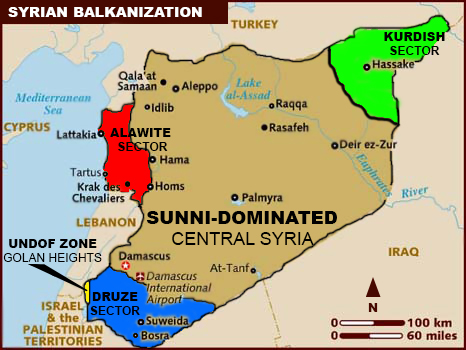
The transitional government’s ability to maintain Syria’s unity will be a critical factor in testing its stated intention to keep Syria’s territorial integrity whole. Opposition forces, now returning to their original territories, may reorganize and seek roles in shaping the country’s administration.
This recalls the emergence of ‘Rojava’ in northeastern Syria, where the Kurds, in March 2016, declared a federal system from the province of Hasakah. While the Syrian government and most opposition groups rejected this move, the Kurds managed to maintain control over nearly a third of Syria in the intervening years.
Alongside this, discussions about an Alawite stronghold along the coastal Sahel and a Druze entity centered in Suwayda have also regained momentum. In southern Syria, some local armed groups from Suwayda and Daraa, which border Jordan, have actively participated in joint operations with opposition factions. A transitional authority has been appointed by HTS, which has vowed to protect minorities who have faced years of oppression from the new rulers of Syria. Despite these promises, minorities are facing attacks and persecution once again. The HTS-led government has publicly taken a firm stance against these actions, which they refer to as individual mistakes.
Erdogan on 20 December that Ankara has begun contacts with Syria’s new leadership to discuss drafting a new constitution for the country. “Syria, exhausted after years of war, cannot rise alone and needs the support of the Islamic world. We will stand with all our strength by the Syrian people to build their state,” Erdogan added in his speech on Wednesday. The current political stage is marked by anticipation of whether HTS and the interim government can prevent further chaos and consolidate governance under their umbrella. Its leader, Julani, appears to be racing against time to establish a new authority before internal divisions grow insurmountable, all while Israel maintains its grip on the occupied Syrian Golan Heights. His strategy includes preserving state institutions, accommodating both and minority groups, and sending overtures to Arab states and western powers.
Look at the map below. This was done in 2010/11 which shows the partition of Syria based on reports that first emerged during the Arab Spring, and have resurfaced after Assad’s fall.
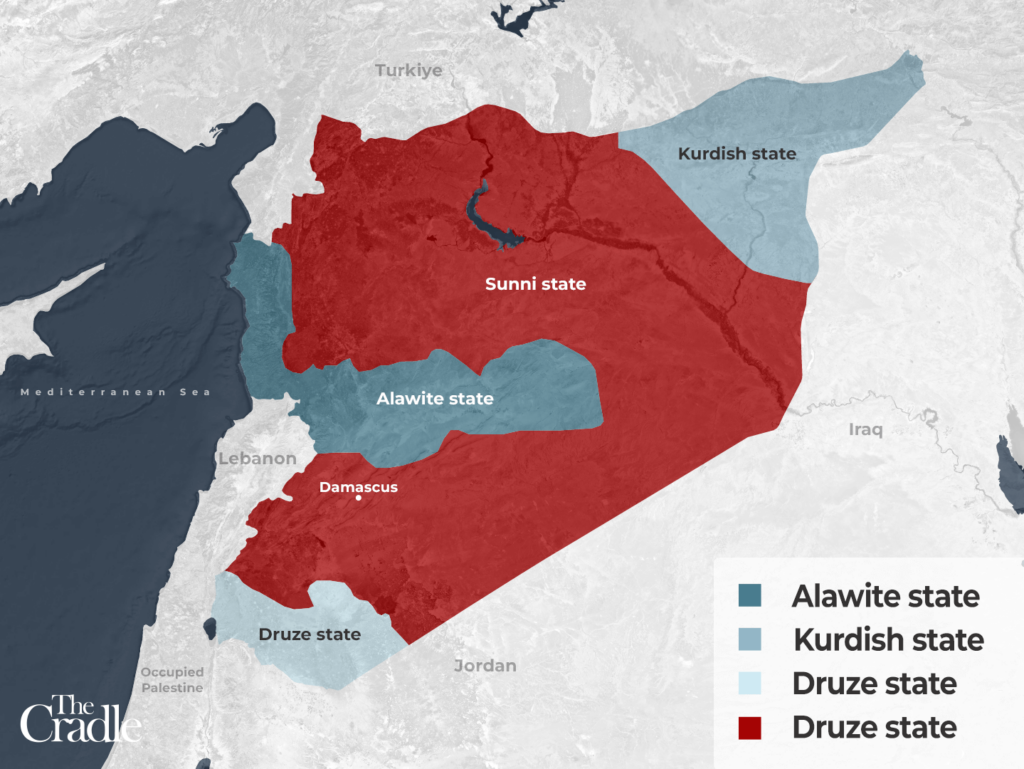
These overtures focus on economic recovery, avoiding incendiary Islamic rhetoric, downplaying Israel’s massive territorial grab in southern Syria, and distancing Damascus from Iran and its allies, all while aiming to encourage the west to lift sanctions. The biggest challenge facing the new authorities is whether they can achieve stability and unity, or whether internal fractures and external pressures will drive Syria further toward chaos and fragmentation.
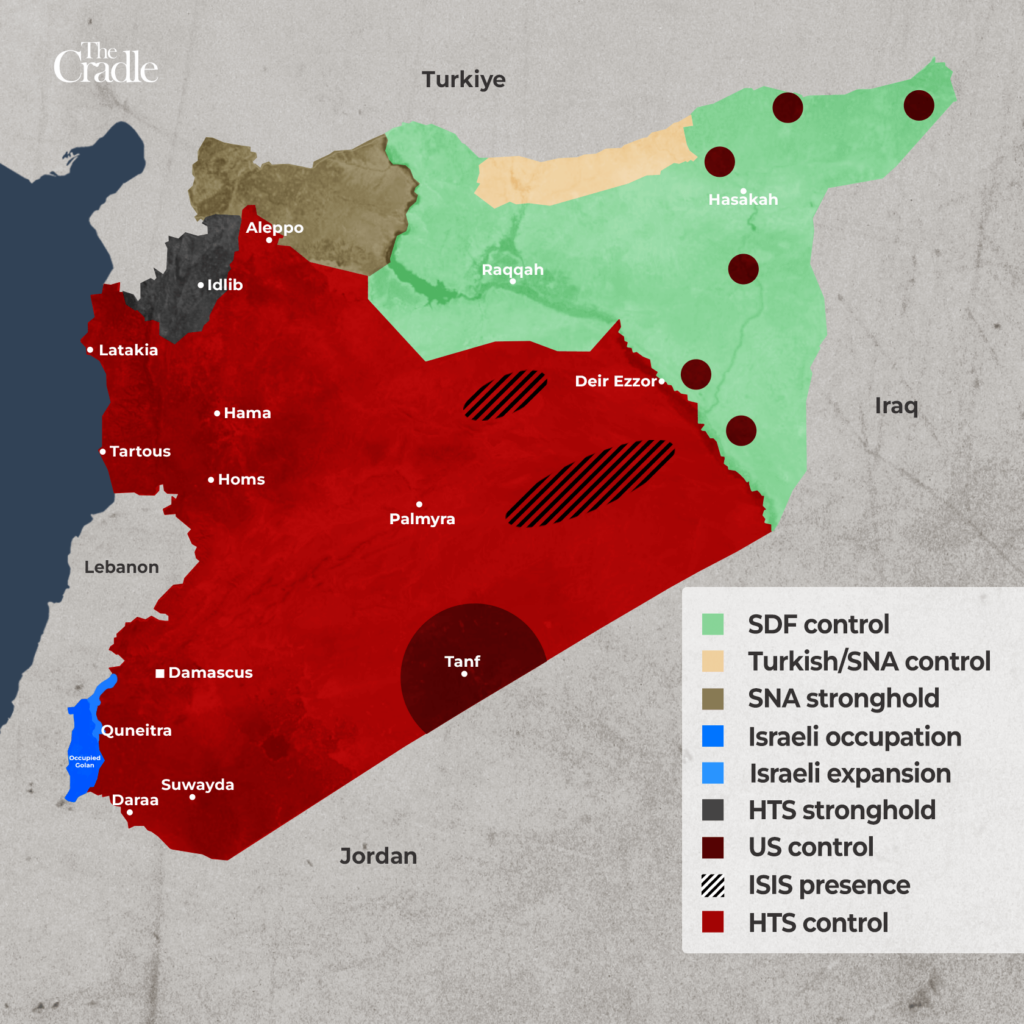
So where Jolani could turn to in a quest for possible allies? And who can he rely on to impose some order in totally disaggregated Syria – including air power to fight ISIS pockets across the desert? Enter Tehran and Moscow. Ergo, the back channels on overdrive. They would not bat an eye when it comes to “cooperating” with the infant Caliphate – as long as their national interests are not threatened.
The Empire of Chaos will remain unmatched in terms of narrative control, P.R. stunts, monopolizing social media spheres and non-stop psy war. All hybrid fronts. But that’s about it. The Empire was miserably defeated in both Afghanistan and Iraq. And continues to be humiliated by the Houthis in the Red Sea. Washington has less than zero advantage over Russia on the military sphere – except on electronic warfare (EW), at least on the Middle East theatre, and ISR (Russia is catching up), which instantly translates into inflicting more and more terror.
As for Iran, it’s far from weaker now than before the fall of Damascus. That’s imperial narrative spin. Ayatollah Khamenei, a fine strategist, does not waste his words. Tehran will eventually develop an alternative supply chain to Hezbollah and the West Bank.
Besides, follow the money. The Iranian Foreign Ministry has already noted that “the new Syrian government will take on all of Syria’s financial obligations to Iran.” That’s a lot of money – which Jolani does not have.
Michael Hudson is adamant: “Anarchy is what the U.S. plan is.” This being West Asia, where backstabbing is an art, there will be blowback. Tehran and Moscow harbor no illusions – and are preparing accordingly. The war on BRICS is just getting started.
What happens next? On the Syrian front, it appears that the Israeli occupation forces will continue their advances into the south of the country and will remain in many areas they occupy. Although the current Syrian transitional government led by HTS has repeatedly stressed that it will do nothing to protect the country from the ongoing Israeli airstrikes and invasion, only talking about how its enemies are Iran and Hezbollah, there is not yet any chance they will do anything in this regard. Without going too deep into the Syria analysis, the leadership we see emerging will not likely last too long in its current form and even if it wanted to act against the Israelis – which it clearly expresses no interest in doing – it would be swiftly eliminated. HTS is faced with fulfilling the interests of the US, UK, Turkey, Qatar, and others, which could lead to the current government’s collapse alone. However, the US holds most of the cards here, it dangles sanctions, terrorist designations, access to resources, and foreign aid above the head of HTS leader Abu Mohammed al-Jolani, on top of the fact that a myriad of foreign intelligence agencies could act at any time to kill him and others within his ranks, if they step out of line with their interests. Yet, the more brazen and aggressive the Israelis become in Syria, the more opportunities will present themselves for resistance against them. Eventually, it is inconceivable that there will not be resistance groups that emerge to fight the occupation forces inside of Syrian territory. In the event that this happens soon, there is little that the HTS-led government will be able to do to stop such resistance too, as the majority of the Syrian population are in favor of combating the Israelis.
The prospects for resistance against the Israelis to emerge in Syria are far from lost. Such a resistance may take some time to emerge and develop, but there is a window of opportunity that is still very much open and even the slightest mistake by the regime in Tel Aviv could plunge it into a new kind of chaos. The situation in Syria could also eventually create friction inside of Jordan, which creates another unpredictable front.
Inside the Zionist Entity, Netanyahu now seems to have completely shifted the regional balance of power. While following October 7, 2023, the Iranian government appeared to be in a position of unmatched power, the Zionists now seem poised to deliver the last blows that will achieve what Netanyahu calls “total victory”. The US-Israeli partnership seeks to launch plots against Iran and Yemen, which would complete their project in response to the defeat they suffered due to the Hamas-led October 7 attack. Despite the damage inflicted to Iran’s Axis of Resistance in the region, the Israelis are also battered and only currently exist on American life-support. The Israeli economic, society, political system, and military are all in tatters, while there is no clear vision for the future beyond pursuing expansionism and perpetual war. Even in the event that this round of the conflict is put on pause, it will inevitably reignite again. The image of the Zionist Entity has collapsed and it is hated globally on an unprecedented scale for its sheer racist barbarism.
There are a number of ways that this conflict can now go, all of which will involve resistance to the Zionist regime’s endeavors on every front. Even if it takes years to revive any one of the resistance fronts, a terrorized and occupied people will continually struggle for justice. Deterrence is impossible with the Zionist Entity, because it is not a State, it is a settler-colonial usurper project that acts as an American power projection tool with its own ISIS – type ideology behind it. If it is going to be defeated, this will take innovative thinking. And whoever opposes it cannot live in a state of comfort, because no matter how miniscule the role that any nation or organization plays in combating the Israeli project, it will be targeted for complete annihilation. On the other hand, if the people of the region do not act against it and simply exist in its way, their very existence poses a threat to the Zionist project and therefore they will be a subject of its extreme oppression.There is no such thing as normalization, no such thing as being an Israeli ally and no such thing as achieving deterrence. All of these tactics will end in absolute disaster for the people of the region, no matter how cozy any regime feels it is with the Zionist Entity.
Our next article is titled “15 months on –The West Bank “