
1 The American Century
2 The Physical Economy
3 Comparison between the World’s Two Largest Economies
4 The AI Bubble
5 The Financial Equation
6 Conclusion
How did the current global situation come to this point? To answer this question, we have to go a bit back to the end old World War 2, in 1945. This is what historians call the beginning of the “American Century”.
1 The American Century
The Rockefeller group of international oil companies and its associated banks emerged from the Second World War in a position of enormously increased power. At the apex of this power stood the 5 Rockefeller brothers. Because the New York Federal Reserve Bank had accumulated the bulk of the world’s official gold reserves during the war (due to many countries war spending, which had to paid in gold), and because the dollar emerged from the ravages of war as the world’s strongest currency, backed by the world’s strongest economy, few could argue with what amounted to a postwar US dollar standard. Gold was priced at $35 an ounce, and was linked to the dollar; in other words, a “gold-dollar”. And all other currencies were linked, not to gold, but to the US dollar. The US, under Rockefeller control, called the shots for a new economic order in the world. The Rockefeller Brothers Fund spent $250,000 funding a special study group to map out the post-war world, to their benefit. Every issue and piece of land was taken into account. The study spanned 3 years, from 1939 to 1941. A plan to control and dominate the world by the 5 Rockefeller brothers was put into place. And at wars end, all of these plans began to take shape. America was in charge and Britain had no choice but to position itself as a junior partner. A scarcely-noted consequence of the global market grab by the US oil companies was the parallel rise of the New York banking groups tied to the oil companies. As US oil companies became an ever-larger component of the international oil supply during and after World War 2, the New York banks benefited from the capital inflows of the world oil trade. During the 1950s, a wave a bank merger increased the political and financial influence of these banks. The net effect of this postwar cartelization of US financial power had enormous consequences for the world, since then. It overshadowed all other policy influences in US and international policy. American business was increasingly reshaped along the lines of British “informal empire”, with finance, raw materials, and control of the international terms of trade, rather than the traditional American foundation of technological and industrial progress.
From 1945 till the present day, the US has been the dominant power. Its power rests on three pillars: – OIL, MILITARY FORCE, and the DOLLAR. And New York would use all three pillars in tandem to achieve its geopolitical aims. It has used its military fist to gain control over oil flows in order to ensure global dollar domination. Whenever Wall Street finds the dollar under threat, it unsheathes these two weapons to eliminate the threat. Furthermore, it will use its military and financial muscle to eliminate any and all competitors in its grab to control oil resources, and oil transportation corridors. Since 1945, there have been many challengers to this Anglo-American power network. With New York taking the lead, and London acting as the junior partner, all would-be challengers were destroyed, and many times their countries suffered the consequences. By the end of the 1950s, the world began to look promising for the first time in more than three decades. World trade in manufactured goods exceeded that of primary goods – food and raw materials. Europe began to stabilize and grow. Within the US, Wall Street had not upgraded its factories, while Europe and Japan had built brand new plants, with a higher level of efficiency. With higher interest rates and profits (15% against 5%) to be earned abroad, Wall Street began to turn its back on US industry.
In late 1957, the US underwent the first phase of a deep recession, a recession which was saved by the “Vietnam Option”. New York viewed the entire world as their domain in the 1950s, not the narrow confines of the US. Saudi Arabia was “more strategic than Texas”. In this regard, in 1945, the father of the Rockefeller boys parceled out the world to his sons: – John D 3rd was given Asia, Lawrence got Europe, Nelson got Latin America, and David got Africa. Wall Street turned away from investment in rebuilding US cities, and from educating a more skilled labor force. Instead of investing within the US in terms of new US plant and equipment, advanced technologies, transportation infrastructure, modernization of the rotting rail system, and developing the untapped industrial market potential of the Global South for US industrial exports. It would have been better for the nation, but not for the Rockefeller family. Rockefeller reasoning went like this: “If we are not going to build plants, then why invest in the physical economy; why put up more bridges, build more roads and rail lines to transport these goods. And if we are not going to invest in more plants, etc., then we can reduce the STEM subjects taught in the Universities, which must be handed a new syllabus going forward”. This new syllabus introduced subjects that added no real value to the economy. Most of these new subjects dwelt on philosophy, law, arts etc.
Instead, their dollars flowed out of the US to grab up “on the cheap” industrial companies in other countries. By the late 1950s more funds began to flow out of the US than was coming in. US banks kept their dollars in Europe rather than repatriate the profits to invest in American development. When the Bretton Woods Agreement was signed in 1944, the gold-dollar ratio was at $35 per ounce. This ratio was not altered in 25 years, despite a world war and the dramatic postwar developments in the world economy. As long as the US remained the only strong economy in the world, these flaws could be ignored. But, by the beginning of the 1960s, as Europe bean to grow at faster rates than the US, it was becoming clear something had to change in the fixed gold-dollar ratio. Yet, Washington refused to play by the very rules it had imposed on its allies in 1944. Within the US, inflation was creeping up, and the average man in the street did not notice. Due to over-valued dollar (gold was still at $35 instead of $50-$70, the inflation within the American economy was exported to the rest of the world. If a given national economy produces the same value of goods under the same technological basis over a period of 10 years, and prints double the amount of money for the same volume of goods as at the beginning of the decade, the “consumer” notices the effect as a significant price inflation. He pays $2 for a loaf of bread, which costs him only $1 in 1950. But when this effect is spread around the entire world economy by virtue of the dominant position of the dollar, the inflated reality could be masked for a bit longer. The results, however, were every bit as destructive. On this point alone, we can see the effects of inflation returning to the US in a big way- due to de-dollarization, broken supply chains, loss of manufacturing, and universities pushing out students with degrees that are useless.
Nixon Pulls the Plug
In the early 1960s, the US exercised the Vietnam Option. As this was not a popular war, Washington preferred to borrow money to finance this war, rather than raising taxes which would lead to increasing anger among the voters. The war pushed its external spending up greatly. By 1967, the US external liability had increased to $36 billion, while her gold reserves shrank to $12 billion. By 1967 the US entered into another recession. Speculative money began to dump the dollar in record amounts. This resulted in increasingly unstable short-term currency speculation. In May 1971, the US recorded its first monthly trade deficit. That triggered an international panic sell off US dollars. The situation was becoming desperate. US gold reserves represented less than 25% of her liabilities. In 1961, Washington requested its allies in Europe and Japan not to cash in their surplus dollars for gold – as per the Bretton Woods Agreement of 1945- , but rather to invest these dollars in US Treasury Bonds, and earn interest. The net effect was that European central banks thereby “financed” the huge US deficits of the 1960s. In this France refused to play along with Wall Street. De Gaulle’s France was targeted for financial warfare by New York. The world’s first Color Revolution took place in Paris in May 1968– the so-called student riot. June 1971 was a breaking point for the British. The British economy was in trouble, again. And London wanted to cash in its surplus dollars for gold. So, on Friday, August 12, 1971, a senior Bank of England delegation visited Nixon in the White House, with a document, demanding that the US pay them the sum of $3 billion, which it owed to Britain. Britain wanted payment in gold. The White House listened, incredulously, and told them to return on Monday. David Rockefeller’s team, headed by Paul Volcker prepared a response. On that fateful Monday, August 15, 1971, Nixon announced a move that rocked the world: formal suspension of the dollar convertibility into gold, effectively putting the world into a direct dollar standard, with no gold backing. The British were furious! As long as gold was part of the international system, then London was still in the game. Without this, Britain was in danger of becoming a 3rd-rate power. A senior Wall Street operative told a friend how, in the future, this would work for Wall Street, and said: “We pulled off the biggest rip-off in history! We’ve run rings around the British Empire!”
Foreign holders of gold could no longer redeem their paper for US gold. New York set a series of events into motion which would rock the world as never before. The suspension of gold redemption, and the resulting “floating exchange rates” of the early 1970s, solved nothing. It only bought time. Wall Street won, and its rationale was that the power of its financial domain must be untouched, even at the expense of economic production and prosperity. New York followed the same policy as London did a century earlier, but after August 1971, US foreign policy fell under another Rockefeller agent, Henry Kissinger. His mandate was to control, not develop, economies throughout the world. World trade was simply another arena of speculation on which direction various currencies would speculate. Massive capital flows again left the dollar for Europe and Japan. In 1972, the dollar fell 40% against major currencies. The design behind the August 1971 dollar strategy did not emerge until October 1973, and even then, few people, outside a handful of insiders grasped the connection. Now, one may ask what all of this has got to do with finance, and its modern-day operations? Very simple. Here, we are showing methodologies, or the “modus operandi”, of how these power brokers think, plan and act. Consider it as a template. Once we understand the “tic-tac-toe” of geopolitics, it makes explaining the future articles easier, and shorter.
May 1973 – Bilderberg Meeting
The Bilderberg Group is a private policy-making group, founded in 1954 by David Rockefeller. This is a common policy body for the Rockefeller and Rothschilds “Networks of Power “. The annual Bilderberg meetings gathered top elites from the US and Europe for secret meetings and policy discussions. Consensus was then shaped in subsequent press comments and media coverage, but never with reference to the secret Bilderberg talks themselves.In May 1973, with the dramatic fall of the dollar still fresh, a group of 84 of the world’s top political and financial insiders met at a secluded island in Sweden belonging to the Wallenberg family. This family was in the Rothschild orbit, and controlled Sweden in the same way that the Oppenheimer family controlled South Africa. The gathering was told of an imminent conflict in the Middle East, which would result in the price of oil going up by 400%. The purpose of the meeting was not to stop the war, but rather to plan and manage this coming flood of dollars, a process Kissinger called “recycling the Petro-dollar flows”. The Arab oil-exporting countries would see their oil income jump by 400%, and their economies could not absorb this cash, thus, this surplus cash would be deposited in select banks belonging to the 2 families.
Oil & the October 1973 War
The 1970s saw a dramatic shift in world oil, as demand caught up with supply. As a result, the world was rapidly becoming more dependent on the Middle East. Production capacity had caught up with demand. Not only in oil, but also in every other industry, a 99.5 % utilization rate would be considered dangerous. At that time, world oil demand was 50 million barrels per day, and spare capacity was at .5%. Politics was adding to the danger. The Middle East became the “center of gravity”, with Saudi Arabia being “ground zero”. In 1973, all the pieces on the chessboard were being aligned to fit into the Rockefeller game plan. New York decided to launch a colossal assault against industrial growth in the world, in order to tilt the balance of power to the advantage of Wall Street financial interests. In order to do this, they determined to use their most-prized weapon – control of the world’s oil flows. Never in history had such a small circle of interests controlled so much of the world’s destiny. Their scheme was utterly outrageous, and that was to their advantage. The entire constellation of events surrounding the outbreak of the October War, and its aftermath was secretly orchestrated from New York, using the powerful and secret intelligence channels established by Kissinger. The Rockefellers scripted the war and its aftermath along the precise lines of the Bilderberg meetings 5 months earlier. The Rothschilds knew all along, and they instructed Golda Meir, the Israeli prime minister, that at no stage must she pre-empt by attacking first.
Zaki Yamani was Saudi Arabia’s Oil Minister from 1962-1986. He gave an interview to the British Observer paper on January 14th, 2001, at the Royal Institute of International Affairs. The following is a quote from the interview with Yamani. At one point he makes an extraordinary claim: – “I am 100% sure that the Americans were behind the increase in the price of oil. The oil companies were in real trouble at that time, they had borrowed a lot of money developing the North Sea and Alaskan oil ventures and they needed a high price to save them.” He says he was convinced of this by the attitude of the Shah of Iran, who in one crucial day in 1974 moved from the Saudi view of no increase in the oil price, to advocating higher prices. “King Faisal sent me to see the Shah of Iran, who said: “Why are you against the increase in the oil price? That is what they want! Ask Henry Kissinger – he is the one who wants a higher price.” Yamani contends that proof of his long-held belief has recently emerged in the minutes of a secret meeting on a Swedish island, where British and American officials were determined to orchestrate a 400% increase in the oil price. In 1971, Nixon closed the gold-dollar convertibility. The dollar fell on world markets. Then came the 1973 October War, and a 400% increase in oil prices. The next step was to make official that all future oil sales would be priced in dollars. Pressure was put on Saudi Arabia to agree to this. Resistance came in the form of the finance and foreign ministers of Saudi Arabia. On one December afternoon, both of these officials were killed by the CIA, one in Washington, and the other in New York (see the full story of this in the article “The Saudi-US Nexus”). By March 1975, this new oil-price mechanism was a done deal. The GOLD-DOLLAR had now been replaced by the PETRO-DOLLAR! The only limit was how many dollars the rest of the world would be willing to accept on the full faith and credit of the US Government. The ensuing results were rapid inflation.
‘Second American Revolution’
In 1972, David’s eldest brother, John D Rockefeller the 3rd, wrote and published a book called “The Second American Revolution”. It acted as a blueprint for the next two decades for policy-planners in America. In 1975, the elite policy-making think tank of the Rockefeller family, the New York-based Council on Foreign Relations (CFR), drafted a series of policies blueprinted- taken from this book – for the 1980s. Its theme was a policy of “controlled-disintegration” of the world economy. What was disintegrating was the entire fabric of industrial and agricultural development, from the 1st World to the 3rd World. The economically destructive transformation in America’s once great industrial economy had its roots in the transformations of the 1970’s. The post 1930’s domination of Keynesian economics which argued that deficit spending by the state could mitigate the negative effects of recessions or depressions, gave way to what John D. Rockefeller III in a book titled The Second American Revolution, argued that there should be a regime of deregulation, privatization of state enterprises such as electric utilities, water systems and highways! Since at least the beginning of the 1970’s Washington has deployed similar tactics of economic blackmail and destabilization to force what has become a global domination not of US manufactured goods, but rather of the dollar as world reserve currency. For almost five decades, since August 15, 1971, Washington and Wall Street have used their dominant position to force inflated paper dollars on the world, cause financial bubbles and subsequently debt buildup to impossible levels, then collapse. The US economy since 1971 has been turned into a financial revenue source, in effect turning the United States from a nation primarily producing industrial goods to one in which the sole aim of all investment is to make money from money. Companies such as General Motors which at the end of the 1960’s was the largest maker of cars and trucks in the world, the heart of the American economy, got lured into speculation using its GMAC auto loan financial arm to make bets in the world economic casino, bets which went badly wrong when the US real estate bubble burst in March 2007 and GM was nationalized while the Wall Street mega banks were bailed out by taxpayers and the Fed. The process took place over decades. By 2000, Wall Street banks and investment funds essentially dominated the entirety of the US economy. Manufacturing jobs had been pushed offshore, “outsourced,” by pressure from those same Wall Street banks that since the 1980’s had driven corporations to focus only on the value of their stock shares and not on the soundness of their products. Leveraged Buyouts, Shareholder Value became bywords. Corporate heads perished if Wall Street banks did not approve their financial profit returns. What that has left today is a United States that is primarily a services economy, a debt-bloated consumer economy and no longer a great industrial leader. The so-called upper 1% of US oligarchs are demanding similar tribute from the rest of the world to sustain the unsustainable. Washington’s trade and economic war is a desperation ploy to try to repeat half a century later what worked in the 1970’s. To understand what’s taking place now in America and China, it would do you good to understand the foundation of modern economy.
2 Physical Economy
What is physical economy?
In principle, we should know that physical economy is peculiar to human beings. No animal is capable of physical economy. But economy obviously has existed as long as people have existed, because physical economy is essentially the relationship between man and nature, based on a consideration which exists only in man: the power to make discoveries, typified by what we call today discoveries of principle in physical science. However, the knowledge of science, the knowledge of physical economy, belongs to modern times. But we know that before—2,000 years ago, the population of this planet had reached over 100 million persons. By the beginning of the Fifteenth Century, the population of this planet had become over several hundred million persons. Today, after the beginning of the nation-state and national economy, the population of this planet is over 8 billion persons. And China of course is a part of this, and the growth in the population of China is significant, because you can see that as modern European technology and civilization touched China, China’s population expanded, particularly the underclass people had more opportunity, or more of them, to participate in growth. And there was a great growth in population, because the material conditions of life were improved, to allow for this growth. So, the question is: where does this growth come from? All through the existence of mankind, the human population has grown. No animal can do that. Why? Because human beings change the way they behave toward nature. It takes a smaller area to sustain an average person, because of increases in technology. The standard of living of each person working, increases, because each person, even with a smaller land area, is more productive.
Where does this come from? This comes from discoveries, which are typical of scientific discoveries through education and creativity. So therefore, by fostering the education of children, of more children, increasing the quality and quantity of education provided to children, increasing the period of education, so that people did not go to work when they were still children, but could continue to study, we increased the amount of knowledge of principles of nature in the population. So, instead of people being like pigs, or cows, living, acting like their ancient ancestors, people were able to progress from one generation to the next, through knowledge, and through acquiring knowledge, and through developing new knowledge. The larger the percentile of the total population which is so educated, the greater the knowledge of the whole population, and therefore, the greater the rate of development. And this relationship, of the mind of the individual to man as a whole, and to man’s behavior toward nature as a whole, is the science of physical economy. It is, therefore, that standpoint of physical economy is the only basis to discuss the development of a new economic and development architecture. The application in physical economy revolves around two main support systems- education and infrastructure. Education means teaching today’s kids the RIGHT SUBJECTS. The second is the infrastructure of the physical economy, such as transportation corridors, bridges, schools, hospitals, industrial production, technology, etc. Physical economy is a branch of science. It addresses the problems of defining functions for increasing the per capita physical productive powers of labor in ways which are independent of measurements of monetary valuations. The characteristic feature of successful physical economies is the increase of the potential population-density of society, in per capita, per household, and per square kilometer terms. This measurement defines output of productive and other labor in terms of per household, per capita, and per square kilometer terms. What is measured is the production of the per capita productive powers of labor by means of the process of production so defined. In short, an increase in education, health-care, technology and sciences will lift any civilization from poverty to stability and peace. The reverse also holds true. A decline in these 4 sectors will lead a civilization to disintegrate. It is in these 4 factors that both New York and London utilize to enforce their tyranny and plunder of the world.
Controlled Disintegration
During 1975 the CFR (Council on Foreign Relations-the premier Rockefeller think tank, which shapes policy for the family) drafted a series of policy blueprints for the 1980s, much as they had done at the crucial turning point in the 1957 recession. And this new policy, in turn, used John D Rockefeller’s 1972 book, “The Second American Revolution”, as its inspiration. The CFR stated, in its account, that “- – a degree of controlled disintegration in the world economy is a legitimate objective for the 1980s”. What was disintegrating, however, was the entire fabric of traditional industrial and agricultural development in the Third World. The first World was not left out either. The decade of the 1980s would widen the gap between the very wealthy (the 1%) and the masses. And the elite would serve the 1%. This fact was not being made available to the masses, because “they would not understand”. The elite must shape the illusion in what was termed the “manufacture of consent”. The American version of this model would be shaped by an aristocracy of money, rather than the British version which relied on blood aristocracy of birth.
But increasingly, as a consequence of the economic policy decisions of the Rockefeller Empire, the United States became transformed. America, once the ideal for freedom for much of the world, was transformed, step-by-step, into the opposite, and at a quickening pace during the 70s and 80s, while she retained a rhetorical facade of “freedom and liberty”. Long-term government-funded infrastructure- such as railroads, highways, water, and sewage and power construction were devastated by this policy in the early 1980s. The world steel industry was forced into its worst depression since the 1930s. The aim was to shift economic policy throughout most of the industrialized world away from the direction of long-term industrial and nuclear development. The relative power of the two families was thus set to become dominant again, in which Wall Street would call the shots, rather than industrial development. Financial speculation was more important and profitable than building a factory. What followed in the decade of the 1980s would have appeared inconceivable to a world which had not already been stunned and disorientated by the shocks of the 1970s.
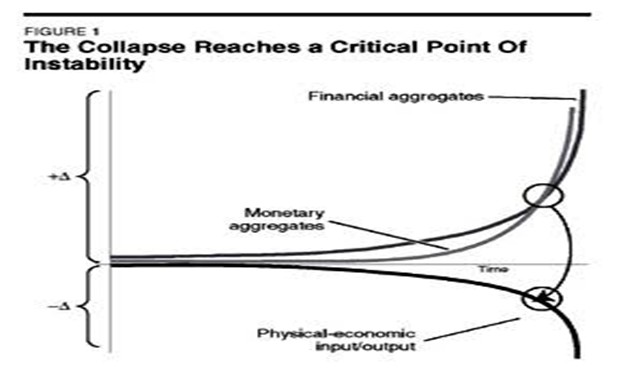
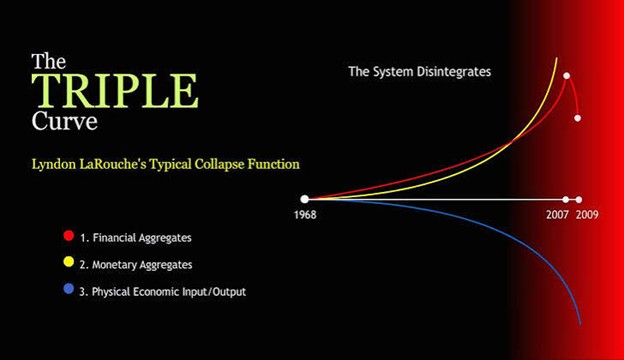
The General Electric example – “Greed is Good”
General Electric was eventually absorbed by the Rockefeller Empire over a period of lasting 2 decades. By the end of the 1970s, it was firmly within the Rockefeller orbit. For years, GE was honored as the most admired company in the world and was the most valuable by market cap. Jack Welch was the idol corporate chieftain case-studied in every business school and emulated by aspiring “corporate leaders”. He pioneered “the GE Way”. Welch, a.k.a. Neutron Jack, was a ruthless cost cutter and famously claimed for any business GE was in, it should be either No. 1 or No. 2 or get out. He was the original Wall Street darling, laser-focused on quarterly earnings and stock price. Welch aggressively offshored and outsourced manufacturing overseas to reduce labor costs and taxes. Most importantly, Welch prioritized GE Finance over the legacy industrial and consumer businesses, and turned GE essentially into a financial company by the time of his retirement. GE had an array of world leading businesses from aircraft engines, turbines, health care, NBC, Universal Studios, to refrigerators and light bulbs. GE Finance led in aircraft leasing and financing of capital goods produced by GE’s industrial units.GE’s fall symbolizes the fall of industrial America and the rise of financial capitalism. Welch famously quipped “GE is not in the business of making engines or light bulbs, it is in the business of making money”. General Electric’s 1953 annual report boasted that the firm’s “biggest payday ever” was the record sum it had paid for labor, because prosperity shared with workers was judged a source of national strength. That made GE one of the most progressive and responsible corporate employers.
However, in the twenty years since Jack Welch was the CEO, he eliminated more than 100,000 GE jobs, shuttered dozens of US factories, moved production abroad, and transformed the company from an industrial titan into a quasi-bank whose largest profit engine was the unregulated lending arm GE Capital. For his trouble, Jack Welch received a severance pay of $417 million when he retired in 2001, reportedly the largest such payment in business history at the time. Welsh supplied a playbook that hundreds of other corporations copied, helping to hollow out America’s industrial base and shift the economy’s center of gravity from the factory floor to the trading floor. Welch turned GE into both the emblem and the engine of America’s transition from a society that built things to one that trades paper claims on the value others create. The Welch era marked a hinge moment in US economic history: the moment when deindustrialization and financialization became conscious corporate strategy rather than unavoidable fate. The ruins of that model—industrial ghost towns, a shrinking middle class, and an economy prone to financial crisis—are the enduring legacy of the man once hailed as “Manager of the Century.” Another gift from Jack Welch to corporate America is short-termism, a.k.a. quarterly capitalism. Since R&D and CAPEX take a long time to yield results, they are abandoned in favor of projects that generate returns in the next quarter. If financial engineering boosts the P&L immediately, why bother with real engineering? The philosophy is adopted in the political world as well. Why would any politician build a highspeed rail network if such an undertaking will take 2 decades? The cost will be upfront and the benefits only come much later. Will any rational term-based politician make such long-term planning today? The US inter-state highway system was built between 1956 and 1992, over nearly 4 decades. Would such long-term whole-of-nation endeavor be possible today? This has become the ethos of Wall Street and high street. Money making alone has become the yardstick to measure success, permeating into popular culture through movies like Oliver Stone’s Wall Street and Norman Jewison’s Other People’s Money. The story of GE and the rise of Wall Street symbolizes the financialization of the US economy. Financialization is the increasing dominance of financial markets, incentives, and institutions over the “real” economy of production and services. Financialization orients economic activity toward generating profits through financial channels, such as trading and speculation, rather than through traditional manufacturing and production – activities that used to be called “an honest day’s work”. The rise of modern financialization started in the 1970s, following the end of the Bretton Woods monetary system under Richard Nixon, the single most important event in US economic history after WW2.
Subsequent governments, especially under President Reagon, opened the financial deregulation floodgate with predictable results:
- growing financial sector: the size and influence of the financial sector have increased relative to the total economy. Financial assets have grown to vastly outstrip the output of the real economy. Shift in corporate behavior: Even non-financial companies now earn a larger share of their profits from financial activities rather than from their core business. GM regularly makes more money from its financing arm than from selling cars.
- Shareholder value doctrine: The focus on maximizing shareholder value has led to practices like stock buybacks, often at the expense of long-term investments in production or R&D.
- financialization of daily life: Households have become more intertwined with financial markets through home mortgages, consumer debt, student loans, payday loans, and defined-contribution retirement plans like 401(k)s. This transfers financial risks from corporations and the state to individuals.
- Deregulation and “innovation”: Beginning in the 1980s, financial deregulation and the rise of technology enabled new financial products and markets, including complex derivatives, securitized assets, and high frequency trading. These “innovations” facilitate greater speculation and systemic risk.
I don’t know about you, but I still can barely understand the CDOs (collateralized debt obligations), CDSs (credit default swaps), or synthetic CDOs after reading many books on finance for decades. And I thought I had a decent education in finance. Financialization has been linked to a rise in income and wealth inequality. Executive compensation, often tied to stock performance, has grown dramatically, while financial speculation has disproportionately benefited high-income earners who own financial assets. US CEOs regularly earn 300 to 400 times the total comp of average employees today, compared with 20 – 30 times in the 1960s. The University of Chicago (a Rockefeller university) neoliberal economics thinkers have provided the intellectual support and rationale for such corporate greed by telling the world the financial market is the most efficient in “allocating capital”. Greed alone drives the behavior of these businesses in the capitalist system. After all, making money is the sole purpose of a business, as Welch proclaimed. When Gordon Gekko pronounced “Greed is Good”, he illuminated for us: “greed, for lack of a better word, is fundamentally good, right, and essential for progress.” Greed is to be celebrated, not denounced. Elon Musk, Jeff Bezos, and Larry Ellison are crowned as the Colossus and Oracle.
Derivatives & Wall Street
Derivates started in the mid-1980s. it has since become a monster that threatens to bankrupt and shut down the Western global financial system. Number one, we are in the middle of a full-blown collapse of the trans-Atlantic financial system; unstoppable, irreversible, thunderous, and dangerous. Two, there is already an avalanche of calls and action for de-dollarization; that is to say, of entire nations splitting out from the speculative global system run by the City of London and Wall Street, using the dollar for their purposes. That drive for de-dollarization is well underway, and I would say at this point, it’s a done deal. This is not going to stop. Now, first on the question of the collapse: We are dealing not with a debt problem internationally, we are dealing with a derivatives problem. We are dealing with a global financial bubble of approximately $2 quadrillion—and again for those of you who don’t really know how big a quadrillion is, it’s 2 followed by 15 zeroes. And that’s built on top of the debt bubble of the stocks, the bonds, the indebtedness of nations, of individuals, and so on. It is that derivatives bubble which blew out back in 2008, and the so-called “solution,” which was provided by the geniuses in Wall Street and in the City of London, was, “Let’s just feed the bubble and make it bigger. That should work out just fine.” And here we are, $30 trillion later of quantitative easing and other funny-money generation, and the world bubble is blowing out. Now, what they did first, was to really apply the gas pedal to try to provide more acceleration to this financial bubble. Then, a year ago when they saw that this was going to really get completely out of control, they decided, “Well, let’s try to apply the brakes.” They raised interest rates up to 4.5% to 5% today, and that in turn has led to what we have seen most immediately in this period, which is the bankruptcy of some medium-sized and major banks internationally. We had the crisis of Silicon Valley Bank, which went belly-up. That was bailed out, basically by the FDIC stepping in, way above the legal limit to which they’re allowed to defend deposits—which is $250,000—and they said, “No, we’ll bail everybody out. It’s OK, don’t worry.” This was a bank that had engaged in extensive speculation, especially in the tech bubble. Then, we had the case of Credit Suisse, one of the largest Swiss banks, with a huge amount of derivatives on their books. They went completely bankrupt. That was bailed out by the Swiss National Bank providing something like $270 billion in bail-out funds. That, in turn, back-stopped by the Federal Reserve, which provided swap lines to all of the European central banks just as it had done back in 2008 to help bail out the cancer. Then, it was taken over on the orders and instructions from the Swiss and other central banks, by UBS of Switzerland—creating a giant, huge, completely bankrupt bank. Now this issue of Credit Suisse actually brings into focus what the real problem is. And as I said, we’re talking about derivatives. If you consider the four largest banks in the United States in terms of derivatives holdings, what you will find is that they have $173 trillion in derivatives, as against $8 trillion in assets. See below.
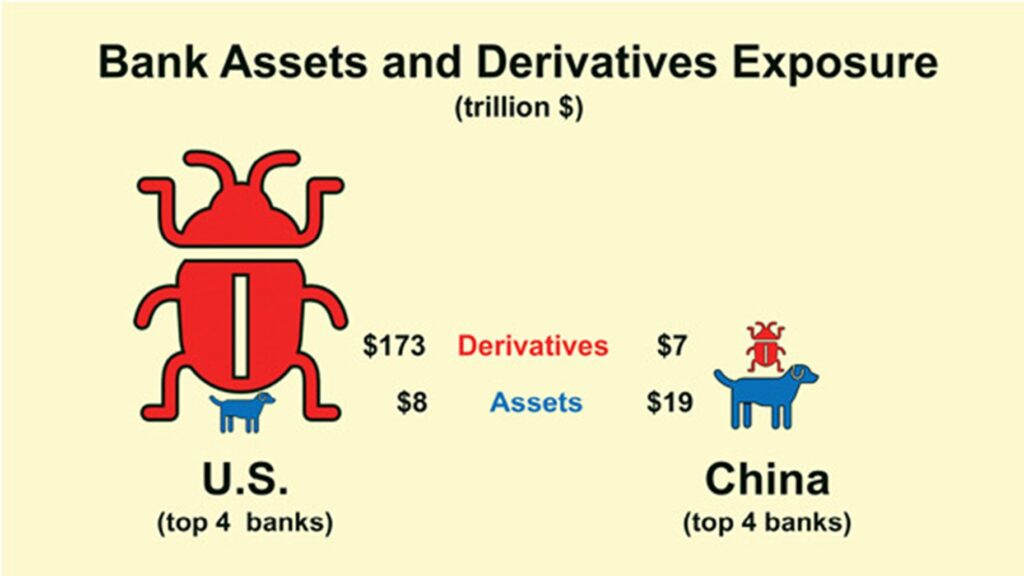
This is not the capital/equity of the banks. Generally, equity is about 5 % of the bank’s assets. So, in the US, the top 4 banks have around $400 billion in equity. Just a 0.2 % loss (amounting to some $350 billion) on their derivative positions will wipe out the capital of these 4 banks. Now, just for comparison purposes, take a look at the situation with China. China’s situation is very different. Their top four banks have $19 trillion in assets, but only $7 trillion in derivatives.Still too much, but not a situation that’s out of control by any means. It is this key problem that is, or has, bankrupted the Trans-Atlantic financial system. It is this collapse that is driving the need for more wars, for more resource grabs, for more control over human populations, and so on. And, since these two families-the Rothschilds in London and the Rockefellers in New York, that head up their respective networks of power, are the driving force behind these wars, we focus our spotlight on them to make understandable the current global geopolitical mess we find ourselves in. This reorganization of the world monetary and financial systems must be based upon the use of large-scale, long-term cooperation in infrastructural development within, and among nations, and heavy emphasis upon adopted targets of scientific and technological progress. The pivot for world economic growth, should be a new system of transcontinental cooperation among the sovereign nation-states of continental Eurasia … but all the world will benefit through participation as partners in that effort. To better understand these points, we have chosen China as a prime example. In 2000, after the dot.com bubble devastated China’s exports to the US, China went on a massive road-building spree. Then, in the aftermath of the 2008 financial crash, China began building railways on a massive scale. Then, in 2012, China began infrastructure globally, focusing on transportation corridors, ports, and industrial plants. This became known as the Belt and Road Initiative, or BRI. Before we resume our story on China, here is a quick detour on another key point:-
The British American Cartel or BAC
At the heart of the British-American-Commonwealth clique, run by the two families, along with other super-wealthy families of the oligarchy, is a combined economic and financial power greater than any single nation-state on Earth. The BAC has been busy, in preparation for the biggest financial implosion in history, which some insiders are acutely aware of—unlike the babblers at the Wall Street Journal and other financial press, who fantasize about the “eternal stability” of the system. There has been an intense consolidation, tightening the BAC’s death-grip over the production of goods necessary for human life. Under BAC control are 3-4,000 corporate entities. Although they maintain the fiction of corporate independence, their boards of directors are so multiply interlocked that it is difficult to tell one corporation from another. They are really one entity. In groups of 10 to 50 firms, they are formed into cartels, which dominate 50-90% of the economic activity in critical sectors: precious metals, base metals, strategic minerals, oil and energy, food supplies, and finance. As the rate of financial disintegration has accelerated, the BAC clique has hoarded commodities, often buying the source of production, from the mines to the oil fields, from which commodities are extracted or produced. The financiers behind the BAC reason thus: “The Mountain of financial instruments in the world will soon collapse and be worth very little. If, when the dust clears, we can own 70% of food, energy, metals, and strategic minerals, we will still dominate the world.” The BAC’s hoarding poses a potentially devastating danger to mankind: Its policy is the neo-Malthusian policy which Henry Kissinger promulgated in 1974 as U.S. Secretary of State, under his National Security Study Memorandum 200. NSSM-200 outlined a policy of genocide and depopulation against the Third World, and ultimately, against the industrialized sector.Through consolidation of 70% or more ownership of raw mat erials, the BAC has put within its grasp the power to cut back the production-flow of every kind of agricultural produce and raw material that is needed for people to eat, or, worked up from raw materials to capital and other finished goods, that is required for modern society. By squeezing off these flows, production would be crippled, to the point that mankind would be reduced to 500 million semi-literate souls roaming the Earth—achieving the paradigm desired by the 2 families. The immense physical goods and financial power of the BAC cartel is not reported in university textbooks or in the media. The latter focus on how much the stock of Facebook is worth, or what is going on with Tesla or with other Internet stocks, but it has given little coverage of how the BAC has been building up immensely its power. The claims that the United States is experiencing an economic boom are akin to claims that an emaciated patient is prospering, because his tumor gained 10 kgs. The U.S. economy is not growing; it is collapsing, and at an increasing rate. The industrial base is contracting; infrastructure is crumbling, and productivity declining. The United States is indeed on the edge of a new era: a plunge into a new Dark Age. Europe is already there, and other industrial nations, such as Japan and South Korea poised to join them, as soon as the bubble pops. And pop it will. Take a look at the perilous condition of the U.S. banking system, where what the Federal Deposit Insurance Corp. terms “off-balance-sheet derivatives” have taken over.
A snapshot picture of world agriculture shows a fast-worsening loss of farm capacity, and increase in food scarcity. This is the result not of failed policies or “adverse nature”, but is, in fact, a policy success for the 2 families. There are over a billion people going hungry. Farm capacity and production are declining. The 2026 prospective crop plantings and anticipated harvest are way below requirements, yet projects are underway that are known in advance to make the situation worse, e.g., 40% of the US corn crop is going to biofuels; international neo-plantations, for export only, are spreading. Meanwhile, desperately needed water-supply projects and related infrastructure are blocked. Why? Because scarcity and national breakdown are the goals behind the last 50 years of globalization of agriculture. Today’s crisis marks the successful imposition of deliberate policies against nation-states, policies which have wiped out the most basic conditions for national survival: food self-sufficiency. The mechanisms in this subversion are familiar: WTO, “free trade” and “global sourcing” of food mega-commodity cartels; hoaxes about climate change, the environment, and consequent demand for biofuels; and the extension of so-called intellectual property rights to private patent-control over food seeds and improvement-technologies themselves. Dominating and enforcing these patterns is an interlock of commodity cartels of mega-companies in fertilizers, agro-chemicals, seeds, processing and distribution, integrated in policy with the WTO, World Bank, the IMF, and the Wall Street and London-centered financial networks. Behind all this stand the financial interests of the 2 families, backing destruction of national economies and depopulation. Break with these policies, destroy their control, and all can be fed. Continue these policies, and a biological holocaust is ensured. There is no leeway at this point for ‘nice-nicey’ appeals to “defeat hunger by 2030, or for scheming to produce food on the sidelines of the WTO world.
The story continues in part 2.