

8 Lebanon
A Battlefield Strategy Shaped by Attrition
Militarily, the resistance movement is operating with notable tactical flexibility. Its strategy relies on carrying out attacks aimed at inflicting maximum losses through calculated offensive maneuvers that prevent Israeli forces from consolidating their positions, without forcing them into a full retreat. This approach aims to keep Israeli forces inside Lebanese territory rather than pushing them deeper, thereby giving Hezbollah greater room to maneuver and expand its target bank, leveraging its detailed knowledge of the terrain in what it considers a relatively “open” battlefield environment. At the same time, Israeli ground operations, particularly along eastern axes aim to achieve tactical breakthroughs by exploiting field gaps to reach elevated and strategic positions, granting Israeli forces firepower and intelligence advantages. However, this progress appears hindered by terrain and Hezbollah’s defensive infrastructure, which restricts heavy vehicle movement.
Hezbollah maintains a calculated pace of rocket fire to sustain pressure without provoking large-scale responses, using two patterns: tactical strikes targeting attacking troop concentrations, and strategic strikes against logistical nodes inside settlements, particularly along the coastal axis. Regarding Israeli movements, attempts by Tel Aviv to exert pressure along three axes – western, central, and eastern – to impose a new reality in southern Lebanon that distances Hezbollah from the border or reduces its ability to threaten northern settlements. Achieving this, however, would require either a costly large-scale ground operation or a political settlement under international pressure, particularly from the US. Hezbollah, on the other hand, is betting on prolonging the confrontation within controlled limits, leveraging time and its attrition strategy, while its decisions remain tied to the broader regional context, particularly the US–Iran rivalry. For the past 6 weeks, Hezbollah has fired some 6,500 drones, rockets and missiles at Israel. It has also destroyed more than 170 Merkava tanks, along with other military equipment. Israel has suffered 1000s of casualties – both wounded and killed. This excludes the civilian population within Israel, to which more 1000s can be added. We will not know the truth, as both Israel and the US are hiding their casualties. The United Kingdom’s Ministry of Defense announced on April 7 that HMS Dragon, a Royal Navy type-45 guided missile destroyer, will be docked after experiencing a “minor technical issue. “The warships will be going into port for a “routine logistics stop” and a “short maintenance period,” the ministry said in a statement. The MoD announcement came just two days after Israel’s Channel 14 News reported that Hezbollah launched a “shore-to-sea missile” at a British warship after mistaking it for an Israeli one. According to the news channel, the Israeli assessment indicated that “damage was caused” by the missile attack from Lebanon. Hezbollah announced the attack at the time, saying that it had targeted a warship of the Israeli Navy sailing 68 nautical miles off the coast of Lebanon with a cruise missile. Following the Channel 14 News report, it was speculated by many analysts that Hezbollah’s missile hit HMS Dragon. Additionally, in the south, Israel is increasingly getting bogged down, and taking heavy losses in both men and equipment.Bottom of Form
Israel Sabotages the Ceasefire
The Israeli occupation has intensified its large-scale aggression against Lebanon, carrying out a series of coordinated airstrikes that have left more than 250 people martyred and over 1,150 others wounded on Wednesday, according to the Lebanese Ministry of Health. Approximately 150 airstrikes were carried out across Lebanon within just two hours, highlighting the scale and intensity of the attacks that targeted several regions across the country, including the capital Beirut, its southern suburbs, southern Lebanon, the Bekaa Valley, and Mount Lebanon, with residential neighborhoods and civilian infrastructure bearing the brunt of the bombardment. Hezbollah condemned the Israeli massacres, “With its blind hatred, habitual criminality, and boundless brutality, now an entrenched characteristic of its nature, the Israeli enemy today carried out a series of roaming massacres against safe civilian populations.” Iran’s Parliament Speaker Ghalibaf said Israel broke the violations of the Iran’s 10-point proposal, also known as the Agreed Framework, even before negotiations had formally begun. He emphasized the historical mistrust Tehran holds toward the United States, noting that it “stems from its a pattern that has regrettably been repeated once again. “He highlighted that the proposal, which the US president has called a “has already been breached in three significant areas:
- Ceasefire in Lebanon – this commitment has not been honored.
- Violation of Iranian Airspace – An intruding drone entered Iranian airspace and was subsequently destroyed in Lar, Fars Province, in direct contravention of the clause prohibiting such violations.
- Right to Nuclear Enrichment – Iran’s entitlement to enrichment, included in the sixth clause of the framework, has been denied.
‘Any attack on Hezbollah is an attack on Iran’: IRGC chief stated, “if the attacks on dear Lebanon do not stop immediately, we will fulfill our duty and deliver a response that will make the evil aggressors in the region regret their actions.” In the same context, Brigadier General Majid Mousavi, commander of the IRGC’s Aerospace Force, said, “Any attack on the proud Hezbollah is an attack on Iran. “He also said that the battlefield is currently preparing for “a appropriate response on the Israeli entity.”
Targeting China’s Belt and Road Infrastructure
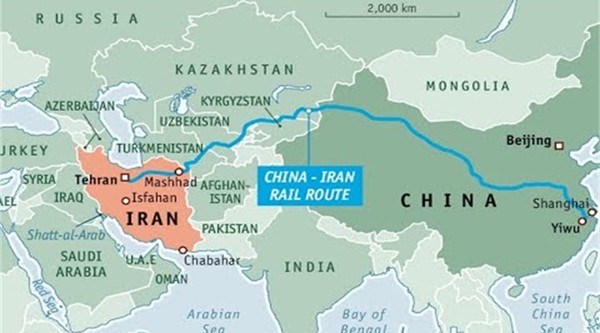
Col. Wilkerson, who previously served as the Chief of Staff to the U.S. State Secretary Colin Powell, agreed and stated the following about one of the priority targets of the U.S. – Israeli bombing campaign (abridged): “We’re bombing the hell out of that railroad that China had finished, all the way to the Persian Gulf, and was going to come up to the belly of the Caucasus. Every day they’re bombing that railroad. That’s because they know where that railroad is going. And that railroad will take 60% of the commerce that China now generates, which is probably about 40% of the world’s commerce, off the seas, where America has domain and put it on land. We don’t want that. We don’t want that at all…”. The railroad Wilkerson was referring to is the China-Iran Railway, also known as the China-Iran rail corridor or the Xi’an–Tehran rail link, part of China’s Belt and Road Initiative). The railroad was built by China as the key overland freight corridor (roughly 10,400 km total from Xi’an in China to the Aprin dry port near Tehran) funded and heavily supported by China. The rail line opened in June 2025 and was designed to transport Iranian oil, goods, and freight to China and beyond much faster than sea routes, cutting some 15 to 20 days off shipping times, while bypassing chokepoints like the Strait of Hormuz and Malacca Strait. Earlier this month [April 2026], the U.S. and Israel conducted airstrikes on multiple segments and bridges along this railroad as part of a wider campaign, hitting 8 to 10 railway bridges and line.
All about Eurasian Hegemony
To understand the importance of why the empire should be so anxious about the China-Iran railway, we have to examine the Rockefeller Empire’s long-term geopolitical imperatives. The war against Iran is only the last episode in more than two decades of permanent imperial wars in the region. We can safely disregard the tall tales demonizing the Iranian regime, along with any illusions that the conflict has anything to do with democracy and freedom, Iran’s nuclear program, ballistic missiles, women’s rights, or any other acceptable pretext. The real strategic objective of the Empire’s war against Iran are the same as the war against Russia in Ukraine, the looming conflict over Taiwan and multiple other conflicts smoldering across Asia and Africa: it is the imperative of preserving the empire’s hegemony over the Eurasian continent. This geopolitical strategy was the brainchild of the British Empire, which has been adopted by its American reincarnation.
Mackinder Geopolitics
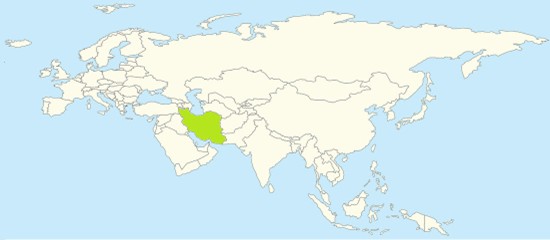
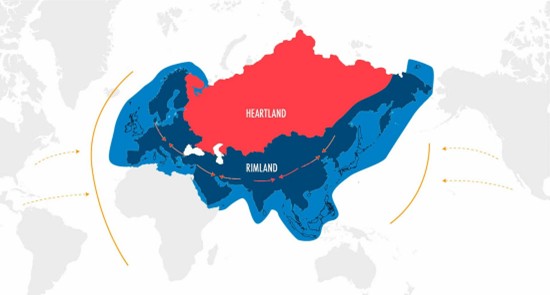
In 1904, following an extensive study of world history and geography, British scholar and statesman Sir Halford Mackinder published a seminal paper titled, “The Geographical Pivot of History,” in which he argued that the British Empire’s exclusive focus on sea power was misguided and that the destiny of the world would be shaped by a land power. He hypothesized that the long-term viability of states critically depended on their geographical space and location and concluded that in those terms, optimum conditions were only to be found in the inner regions of Eurasia which he named the Pivot Area: a large expanse roughly encompassing Russia, the Caucasus region, Kazakhstan, Iran, and Afghanistan. In Mackinder’s framework, the Pivot Area is surrounded by the Inner or Marginal Crescent which includes Europe, Northern Africa, Asia Minor, the Arabian Peninsula, India, China and Japan, while the lands of the Outer, or Insular Crescent include the rest of the world. What made the Pivot Area strategic was that it could emerge as an independently viable economic power, capable of spawning a rival empire, especially with improvements in its internal communications and transport that were then being introduced with the Trans-Siberian railway. The nation that was seen as best positioned to emerge as that pivot land power was Russia: “The spaces within the Russian empire are so vast, and their potentialities in population, wheat, cotton, fuel, and metals so incalculably great, that it is inevitable that a vast economic world, more or less apart, will develop inaccessible to oceanic commerce … She can strike on all sides, save the north. The full development of her modern railway mobility is merely a matter of time, resulting in its expansion over the marginal lands of Euro-Asia, would permit of the use of vast continental resources for fleet-building, and the empire of the world would then be in sight.”
In plain English, Mackinder suggested surrounding the Pivot Area with crisis flashpoints and inducing nations to bait the pivot power into an unending series of exhausting, crippling quagmires. Over the ensuing decades, the geography of the designated flashpoints evolved with changing geopolitical opportunities and Mackinder’s language evolved accordingly. In 1919 he published “Democratic Ideals and Reality,” in which he renamed the Pivot Area as “the Heartland,” and spelled out its significance in more blunt and less oracular terms: “Who rules East Europe commands the Heartland; who rules the Heartland commands the World-island; who rules the World-island controls the world. “By World-island, Mackinder was referring to the Eurasian landmass. Dominating this landmass remained the Empire’s undying obsession.
Imperial Parasite Switches Hosts
By the end of World War I, when the empire had exhausted its British host, the parasitic cabal moved to infiltrate a new host: the United States. As they did so, they brought their designs for world domination along and made their own policy objectives America’s objectives. One of Mackinder’s discipleswasHenry Kissinger. Together with his protégé Zbigniew Brzezinski, Kissinger founded the Trilateral Commission, one of the most powerful foreign policy think-tanks in the world. Brzezinski himself would become an influential policy advisor to many presidential administrations. These two worked exclusively for Nelson and David Rockefeller. The Trilateral Commission and the Bilderberg Group were founded by David Rockefeller in 1972 and 1954 respectively.

Kissinger and Brzezinski were instrumental in grafting British geopolitics onto the American foreign policy. In his 1997 book, “The Grand Chessboard” Brzezinski wrote that, “For America, the chief geopolitical prize is Eurasia…” In the same text, he demystifies the reasons behind the empire’s Eurasian obsession: “Eurasia is the globe’s largest continent and is geopolitically axial. A power that dominates Eurasia would control two of the world’s three most advanced and economically productive regions. … About 75% of the world’s people live in Eurasia and most of the world’s physical wealth is there as well, both in its enterprises and underneath its soil. Eurasia accounts for 60% of the world’s GDP and about 3/4ths of the world’s known energy resources. “The ultimate incentive behind imperial wars is, and always has been, the quest for collateral (resource wealth and slave labor). All the talk about Russia bad, China bad, Iranian mullahs, war on terror, women and girls or WMDs, are just a set of tall tales contrived to secure the acquiescence of domestic audiences for war. One of them has also been the tale about “the only democracy in the Middle East.”
The Hill-Citadel of Jerusalem
The comforting tale about the homeland for the long-suffering Jewish people has served the same cynical purpose as all other comforting tales, enabling the Empire to get away with countless atrocities because of democracy, holocaust, victimhood, etc. The cold reality of the whole Zionist project is far more sinister: the creation of Israel in 1948 has been little more than British Empire’s geopolitical gambit. Long before the holocaust took place in Nazi Germany, Sir Arthur Balfour issued his famous memo to Lord Walter Rothschild,which is for some reason accepted as a valid legal basis for the creation of a whole new country. The real agenda was spelled out by Mackinder: “If the world-island be inevitably the principal seat of humanity on this globe, and if Arabia, as the passage-land from Europe to the Indies and from the northern to the southern heartland, be central to the world-island, then the hill-citadel of Jerusalem has a strategical position with reference to world realities not different … from its ideal position in the perspective of the middle ages, or its strategical position between ancient Babylon and Egypt.”
The Round Table (a Rothschild entity) in a November 1915 explained that “the whole future of the British Empire as a Sea Empire” depended upon Palestine becoming a buffer state inhabited “by an intensely patriotic race.” Note, this was before World War II and even before the very important Balfour memo. With regards to that piece of paper, Mackinder stated the following: “The Jewish national seat in Palestine will be one of the most important outcomes of the war. That is a subject on which we can now afford to speak the truth [note, it is exceedingly rare that British imperial cabal ever felt they could afford to speak the truth] … A national home at the physical and historical center of the world, should make the Jew ‘range’ himself…” Well, the plan seems to have worked, and “the Jew,” did indeed “range himself.” Today, we can appreciate how well that worked out for “the Jew,” who has become the most prominent perpetrator and victim of the Empire’s forever wars, permanently expected to wage wars against any power “between ancient Babylon and Egypt” that could challenge the empire’s hegemony in the region. Sadly, very few among Israel’s settler population appreciate the depraved cynicism with which they have been lured into that role.
The Fight to the Death
The points laid out above all but guarantee that the war against Iran and Russia will continue and escalate until one man is left standing- either the West or the East. On one side is the global empires of the two families fighting for its own dominance. On the other side lie the powers that wish to remain independent and refuse to become the vassals of either London and New York: either they’ll unite in their resistance, or they’ll be picked off one by one by the imperial forces and their proxies. Iran therefore can’t afford to yield, and neither can Russia or China. For the empire, access to new collateral is existential and it will never cease to pursue it at any cost, until it brings about its own complete destruction.
Between War and Industrial Breakdown: The US-Israeli Attrition Crisis
The US war machine is burning through its own foundations, exposing a structural crisis that no amount of money alone can fix. The US–Israeli war on Iran has laid bare a structural crisis at the heart of Washington’s war machine – one that calls into question its ability to sustain prolonged conflict, let alone replenish what it expends. In the opening weeks alone, vast stockpiles of missiles, aircraft, and precision-guided munitions – from Tomahawk and ATACMS to Patriot, THAAD, and Arrow interceptors – were burned through at a staggering pace. Battlefield attrition is rapidly translating into an industrial reckoning, of US and Israeli capacity to reproduce high-end weaponry at the pace modern war demands.
Firepower without Endurance
According to a report by the Royal United Services Institute (RUSI) on 24 March, the first 16 days of the war saw the use of 11,294 munitions at a direct cost of $26 billion. The final cost could push that figure beyond $50 billion. But the financial toll only tells part of the story. In the first 96 hours alone, coalition forces launched 5,197 munitions across 35 categories – one of the most intense air campaigns in modern warfare. The scale of consumption quickly overwhelmed the logic of industrial replenishment. Air defense systems bore the brunt. US and Gulf batteries fired 943 Patriot interceptors in just four days – roughly equivalent to 18 months of production. THAAD systems followed a similar trajectory, with 145 missiles expended, consuming more than a third of the estimated stockpiles. On the Israeli side, the pressure was even sharper. dropped by more than half within the same period. Rebuilding that stockpile could take nearly 32 months. What initially appeared as heavy usage rapidly revealed itself as a structural imbalance. The cost of those first four days alone ranged between $10bn and $16bn, rising to $20bn when factoring in aircraft and system losses. Worse still, degradation of radar and satellite infrastructure reduced interception efficiency, forcing operators to fire multiple missiles at single targets – in some cases up to 11 interceptors for one incoming threat.
Strategic Weapons, Empty Warehouses
Offensive systems followed the same pattern. In the opening phase, 225 ATACMS and PrSM missiles were fired – core assets designed for deep precision strikes. Alongside them, more than 500 Tomahawk cruise missiles were launched over 16 days. Those Tomahawks alone could take up to 53 months – more than four years of uninterrupted production. In practical terms, this means the US cannot replicate the same level of sustained bombardment in any near-term confrontation. JASSM-ER missiles (precision-guided air-to-ground missiles), each costing over $1 million, were used in large numbers against Iranian radar and communications nodes. Their production cycles depend on advanced electronic components already under strain from global supply bottlenecks. HARM anti-radiation missiles were also heavily deployed, eating into stockpiles originally intended for the European theater. Precision came at a strategic cost. Every successful strike depleted asset that cannot be quickly replaced. The use of eight GBU-57 Massive Ordnance Penetrators in the first 96 hours – nearly a quarter of available inventory – underscored the intensity of the opening assault on hardened Iranian facilities. Thousands of JDAM kits followed, draining stocks of the guidance systems that convert conventional bombs into precision weapons. Small-diameter bombs were used in what the report described as near “suicidal” quantities, particularly against mobile launchers. Meanwhile, BLU-109 bombs were expended continuously, pushing global inventories toward depletion within two weeks.
When Air Superiority Breaks
The downing of an F-15E Strike Eagle inside Iranian territory on marked a turning point. It shattered the assumption of uncontested air dominance and revealed the cascading costs of even a single tactical loss. The incident triggered a complex that quickly spiraled. Alongside the destroyed fighter jet, an A-10 Thunderbolt II was lost, helicopters were hit, and additional assets were damaged or abandoned. At the peak of the operation, US forces destroyed two MC-130 transport aircraft and four special operations helicopters to prevent their capture. MQ-9 drones were also shot down, adding to the tally. Direct losses from this single incident exceeded $500 million. But the real cost lies elsewhere. The rescue mission involved 155 aircraft, hundreds of personnel, and stretched over two days inside hostile territory. To recover a single crew, Washington expended vast operational resources, exposing a deeper vulnerability: high-value platforms can trigger disproportionate losses when confronted with layered defenses. Iranian air defenses also reportedly struck an F-35 and downed multiple drones, while friendly fire incidents added further strain. Superiority, once assumed, is now conditional.
Supply Chains as the New Battlefield
US war spending within just over a month, according to tracking data based on Pentagon reporting to Congress. Daily costs eventually reached $1 – 2 billion. Yet the more consequential crisis lies not in expenditure, but in production. Building munitions used in the first four days alone requires 92 tons of copper, 137 kilograms of neodymium, 18 kilograms of gallium, 37 kilograms of tantalum, seven kilograms of dysprosium, and 600 tons of ammonium perchlorate – a critical component for solid-fuel rockets. The US depends on a single domestic source for ammonium perchlorate. At the same time, China controlling 98 percent of gallium production, 90 percent of neodymium processing, and 99 percent of dysprosium. Rebuilding just the first four days of munitions expenditure alone would require tens of tons of critical minerals and hundreds of tons of rocket propellant inputs, tying any recovery effort directly to these constrained supply chains. Military power is now tethered to geo-economic realities beyond Washington’s control, turning industrial recovery into a strategic vulnerability. Replenishment runs up against supply chains shaped by global resource flows that sit firmly outside the Atlanticism sphere. In practical terms, this means that even unlimited funding cannot accelerate production without access to these materials, placing a hard ceiling on how quickly stockpiles can be rebuilt. Beyond sheer consumption, the war exposes a deeper flaw in how interception works.Air defense systems rely on expensive interceptors to neutralize low-cost threats. Iranian drones and missiles, often built at a fraction of the cost, have pushed the US and its allies into an unsustainable exchange ratio. Eve as Iranian attack rates dropped by 80 to 90 percent after the opening phase, pressure did not ease. Daily barrages of roughly 33 missiles and 94 drones continued to drain defensive stockpiles. Close-in systems like C-RAM fired over 509,500 rounds at a cost of just $25 million, while interceptor missiles consumed at least $19 billion. This imbalance forces advanced militaries to burn through their most sophisticated systems far faster than their adversaries can replace losses, unless viable “cheap defeat” options are developed.
An Industrial Base that cannot Surge
The structure of the US defense industry compounds the problem. Despite rising demand, production has not meaningfully increased. Defense contractors remain hesitant to expand capacity without guaranteed long-term contracts. Repeated cycles of political promises followed by funding reversals have left industry wary of overcommitting. Key facilities, such as the Holston Army Ammunition Plant – the backbone of US ammonium perchlorate production – operate under fixed capacity, exposing a critical bottleneck at the heart of the US missile supply chain. The consequences extend far beyond the Iran theater. Every missile fired here reduces Washington’s ability to project power elsewhere. The depletion of more than 500 Tomahawks, alongside dwindling interceptor reserves, weakens US deterrence across multiple fronts – from East Asia to Eastern Europe. The war imposes a “second front tax,” forcing the US to choose between sustaining current operations and preserving its broader deterrence posture.
A Myth Unraveling
The war on Iran strips away the illusion of limitless western military superiority. Technological advantage remains, but it no longer guarantees endurance. Missiles can hit their targets. Aircraft can penetrate defenses. But without the industrial capacity to sustain operations, every strike draws down future capability. This war exposes the limits of US-Israeli power and points to a new strategic equation, where industrial resilience outweighs firepower. The ability to sustain production, rather than deliver precision strikes, increasingly defines military power in a prolonged conflict. In that equation, Washington is no longer dominant.
India – Pick the Wrong Side & Lose
For weeks, we mapped out for readers how the Gulf energy shock dominoes would fall, spreading outward from the Middle East and striking Asia first through tightened energy-product flows that risk destabilizing the global economy. That transmission of tightening energy flows is now becoming alarmingly visible on factory floors across Asia. Goldman analysts, led by Georgina Fraser, warned clients that the petrochemical shock is worsening across Asia, with textile and packaging plants emerging as the first major downstream casualties. “The supply shock is transmitting faster and at a greater magnitude than we had anticipated – the supply shock is moving beyond higher energy prices into production cuts, margin compression, and early demand destruction.” The price of silence: How India’s grand ambitions got lost in the Gulf. India’s push to anchor itself in the Middle East through the IMEC corridor is collapsing under regional war and US pressure, exposing the fragility of its strategic autonomy. As it retreats from Iran and stays silent in key forums, India’s credibility as an independent Global South power is in question. In New Delhi September 2023. Under a canopy of chandeliers, leaders from India, the United States, Saudi Arabia, the UAE, France, Germany, Italy, and the European Union signed a memorandum of intent. The was unveiled as a “modern spice route” – a network of railways, shipping lanes, and digital cables meant to pass through Abu Dhabi and onwards to Europe. This was the logic. The air smelled of ink and ambition. Bandar Abbas, March 2026. The IMEC rail link is now a geopolitical fault line. Shipping giants have suspended calls at Israeli ports. The corridor has become a ghost. How did India – a founding member of the Non‑Aligned Movement, a pillar of BRICS and the SCO end up here, watching its most ambitious geopolitical play crumble while it sits silent in multilateral forums as a fellow member of those same institutions is bombed?
When IMEC was announced, the choice appeared clear. India threw its weight behind the corridor that aligned with Washington’s vision of a normalized Middle East. But the gamble rested on a fragile premise: that the Abraham Accords would survive any regional storm. Within weeks of IMEC’s launch, the Gaza war erupted, and the foundation cracked. By the time Iran and Israel were trading blows in 2026, the corridor was not just dormant – it was obsolete. And Chabahar? In late 2025. the Indian directors resigned, the website went dark, funds were liquidated. The exit was surgical, but the signal was unmistakable: when forced to choose between a strategic asset in Iran and access to the American market, India would choose the latter. Follow a barrel of oil. In 2023, India became the world’s largest buyer of Russian crude, taking advantage of deep discounts – sometimes $40 below the Brent benchmark – while European buyers stayed away. Moscow was happy to oblige; Delhi was hailed for its “strategic autonomy.” By 2026, that autonomy had vanished. Then came the Iranian oil. In March 2026, – but only after securing a temporary 30‑day US sanctions waiver, and at a $7‑a‑barrel premium. No discount. No long‑term arrangement. The tankers arrived on America’s terms, not India’s. The arithmetic of non‑alignment had been inverted. The very purpose of playing multiple sides – to obtain strategic goods at favorable prices – had been lost. India now pays market rates for both Russian and Iranian oil, yet still finds itself tied to Washington’s sanctions regime.
Silence in the Hall
The most telling moment came in early 2026, when the US and Israel launched a sustained military campaign against Iran – a fellow member of both BRICS and the SCO. In the halls of the SCO summit in Astana, a resolution condemning the aggression was tabled. India abstained. At a BRICS Foreign Ministers meeting, the same silence. This was not the India of 1956, which at the Suez Crisis sided with Egypt against its own former colonial powers. Today’s India sits in forums it helped create – BRICS, the SCO – and yet refuses to extend solidarity to a fellow member under attack. The result is that India’s trust rating amongst Central Asian and Arab countries had fallen to 18%. The narrative of India as a champion of the developing world is being quietly rewritten. What explains this retreat? One answer lies in the composition of the elite that shapes India’s foreign policy – the bureaucrats, corporate chieftains, and their children who move seamlessly between Mumbai, New York, and London. India’s largest conglomerates raise capital on US exchanges; their executives sit on American corporate boards. When the US threatens tariffs, these interests speak with one voice, and the government listens. A generation of Indian policymakers trained in American and British universities, comfortable in Western think‑tanks and media, naturally gravitates toward the Atlantic orbit when pressure mounts. The path of least resistance – the one that preserves personal and professional networks – runs through Washington. Strategic autonomy, a concept born of anti‑colonial struggle, becomes a luxury when the elite’s own fortunes are tied to the very power that India is meant to balance. The ledger of what India has lost is now visible. Russia has pivoted its oil exports to China – India’s share of Russian seaborne crude fell from 40% to under 15% in early 2026. The IMEC corridor, once a monument to Indian ambition, is a cautionary tale of building grand strategy on alliances that can unravel overnight. But the deeper loss is one of credibility. In the Global South, India is no longer seen as a reliable partner willing to absorb short‑term pain for long‑term independence. It is viewed as a power that will retreat when the pressure is high, leaving its partners to face the consequences alone. In short, India duplicity and worshipping the white man, has been exposed. Gaza continues to expose the true friends from the fake ones.
Till the next article folks.
Sam, what about the Hanta virus? Any thoughts??!
It would be interesting to hear what the elites are doing with their money. I would imagine the elites have prepared their portfolios for large scale inflation, which these war cycles bring. I would also appreciate hearing why China, Russia and Iran went along with the Covid ruse.
Exactly! We are purposely indoctrinated “we” are good, yet “baddies” implement same unscientific rules, etc. What’s really going on is totally beyond nation states. The underground bunkers prepared for “elite” shoud open eyes, thoughts.
The Indians have proven to be very duplicitous and stupid. I was hearing great oratory from Jaishankar the Foreign Minister and then it seems like he was gone. Modi is a snake, a liar, a false prophet and a good slave for the white man. All the Indian elites are too stupid to appreciate the slave masters of their grandparents generations are the ones they coddle up to now just for money. Well India will be considered a traitor nation and will never be trusted again by Russia and China and Brazil, Iran, South Africa and many others who are sick to thw teeth with the Western Zionist white make fake Semites. This is all very sad and pathetic for India. Maybe some elite assassinations are in order in India to steer the ship of state away from being a giant slave race for the Zionists.